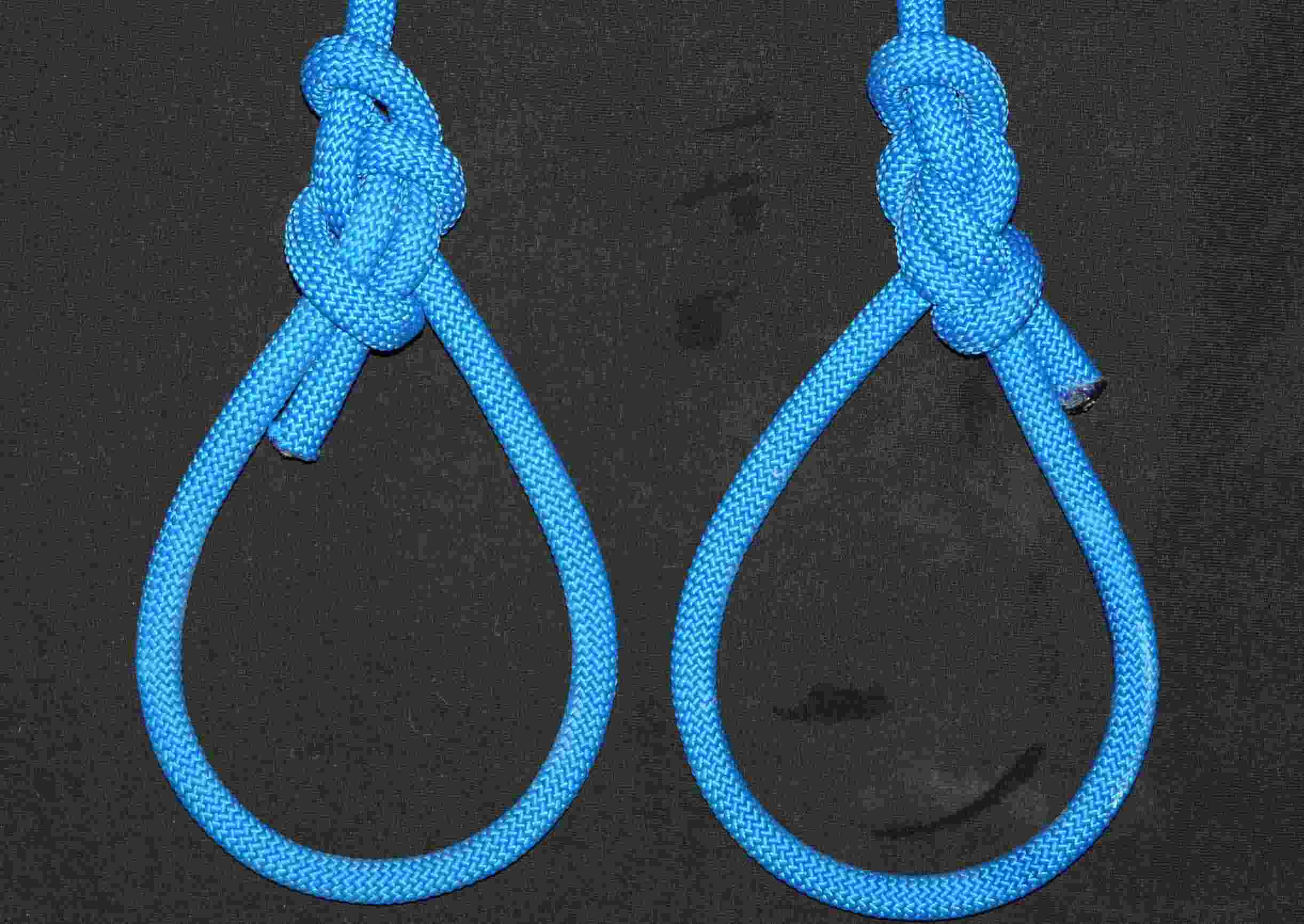
There is a “reversed” form of the Constrictor-as-double-nipping-structure bowline - “reversed” in just the same way there is a “reversed” form of the Clove-as-double-nipping-structure bowline ( = the Water bowline ).( To the time being, " Analysis of Bowlines" shows only the “reversed” form ). In the “reversed” forms the Clove or the Constrictor, which play the roles of the double nipping turns, are rotated 180 degrees vertically, in relation to the standard, non-reversed ones, and if there are, to chose the easier to untie.
As the Constrictor is what its name suggests, i.e. a very tight hitch, it is expected that we should not worry about the nipping power of it on the legs of the encircled bight component ( collar structure ). And it might also be expected that one or both of those bowlines would be difficult to untie. However, one of the great advantages of the secure bowlines in comparison to the fig.8 eyeknot is just the easiness with which they can be untied, even after hard strain. So, we wish to find if there are any differences regarding this characteristic between the two forms.
It turns out that there are, indeed. The reversed form, shown in “Analysis…”, can be untied much easier than the non reversed one. Therefore I believe that it is more suitable as a secure bowline, that could possibly replace the hard-to-untie fig.8 eyeknot.
I have tied and tried those bowlines on the two ends of the same 7mm rope, hanged from a pipe end on the ceiling of my laboratory ( kitchen)  . I had submitted them to a moderate, for their size, but alternating loading ; my own body weight, jumping on the one or the other eye !
The careful reader will distinguish, at the attached pictures, that the “lower” nipping turn / collar around the eye leg is much smaller=tighter in the case of the non-reversed form ( at the right side of the attached pictures ) than in the case of the reversed one ( at the left side). Although the “higher” collars of both forms can be released very easily, the “lower” collar of the non-reversed form tend to clinch very hard, around the eye leg, because it is fed directly by the tensile forces coming from the Standing Part. On the contrary, in the 'reversed" form, the Standing part makes a U turn, and then turns upwards, so much of the tensile forces transported through it are “uploaded” and dissipated at the point of this U turn.
Provisional verdict : The Constrictor bowlines have a very efficient double nipping turn ( we knew that… ), so they present no weakness whatsoever regarding security. However, only one of them, the “reversed” form ( the one shown in “Analysis…” ) is very easy to untie. The other can jam at the point the “lower” nipping turn collars the eye leg of the Tail side ( by just examining the structure per se, we might had expected that, but now we have more “evidence” ).