Hi can you tie a left handed bowline (with tail on the outside) with a Yosemite back up/tie off like you can on the regular bowline? Or is the Yosemite only meant to be used on the regular bowline with the tail in the inside?
Thanks!
Hi can you tie a left handed bowline (with tail on the outside) with a Yosemite back up/tie off like you can on the regular bowline? Or is the Yosemite only meant to be used on the regular bowline with the tail in the inside?
Thanks!
Can you ...
Well, yes, I can. But did I vioate some(one’s) rules,
or go too far on the Wild Side …, I suppose is your
point to asking!?
What looks better to me than the direct making of such
a bowline extension is to either do the similar tucking
going the opposite direction around the eye leg,
such that the tail forms an overhand not fig.8 structure;
or to go the direct way but take the tail across
the SPart to tuck out of the collar the other side
from what would be “normal” --which seems to draw
up & set better.

You can mechanically do this and get more security, not strength; and would be advised especially if you ‘need’ to use this inferior form.
Better would be a RoundTurn/Double Bowline w/Yosemite (DBY) could be applied to ‘cowboy’/‘left-handed’ as a regular Bowline.
.
BUT…why?
.
In my imagery; normal Bowline is most correct form similar to same in SheetBend because:
Starting with SheetBend:
The sParts would be yin-yang equal and opposites:
The cowboy/left hand SheetBend or Bowline w/tail ‘out’ is not 'sandwiched between the sParts to Nip properly;
it is off to the side not between the primary forces, just side forces to secure.
.
Compared to a 220v fuse box that can get 220v from primaries or 110v w/one leg to ground:
We are trying to secure 220v force with 110v Nip.
Note if ‘tail-in’ the tail is sandwiched between the primaries, so have 220v Nip to secure 220v force most properly.
(i think model easier to see in SheetBend, then graduate model to Bowline.
.
Similarily, in the most basic lessons of the Square / Reef knot* if improperly used as a Bend, forces the only Nip to be to the side;
more towards the 110v Nip trying to secure 220v primaries, Nip is not a direct, immediately imposed descendant of parent pulls is more like cousin, to the side.
BUT properly used around something, Nips against (proper convex) object with the primary 220v to secure 220v force/pull as an inline, direct descendant of parent pulls.
.
.
Morphing from Square/Reef to SheetBend (then Bowline) we start on the opposite side with one sPart to get Bitter/tail between ‘primaries’; if we don’t and make SheetBend Bitters/tails opposite sides makes towards the leftie/cowboy construction.
.
For me, these are the basic lessons and models to base other configurations on;
and my 220v/110v a standard point of analysis.
.
ALSO; a single Turn these are based on is a hook construction to 1 side;
upgrade to RT /Round Turn (RT think in imagery Real Turn) gives full choke not just hook construction.
So non-RT cowboy fault is covered more by RT and then yes Yosemite for me secure.
.
Why knot use proper non-Cowboy form?
*i as american was taught this is a Square Knot; but would gladly embrace the seaworthiness of knot lessons by the original /non-american ‘Reef’ even sounds cooler, gets the taste of the sea and all the work/rich heritage that spawned these devices etc.
EXCEPT for me: The Square Knot as one of the simplest of knot lessons lends the word ‘Square’ to it as in purpose-full alignmeant; and i feel ALL lacings should be measured as to if ‘square’ to purpose, and if in use would maintain the align-meant!
In higher loading can see Surgeon, Sheet, even Square/Reef pulled from square formation to out of alignment, when most needed!
So in dressing would input pull to lacing backward , so in higher loading pulls back to projected squareness
similar to both Bitters slipped in common shoelace, dressed at ends then pulls back square.
Hi can you tie a left handed bowline (with tail on the outside) with a Yosemite back up/tie off like you can on the regular bowline? Or is the Yosemite only meant to be used on the regular bowline with the tail in the inside?
If you do so, there is a risk that you might inadvertently up with only a single rope diameter inside the nipping loop (depending on how you dress the knot).
Ropes used in mission critical life support applications (eg climbing, vertical rescue, etc) - are tending to get thinner and thinner as the years roll on.
With thin dynamic climbing ropes, having only a single rope diameter inside the nipping loop might reduce the MBL to a point where it could be a concern.
If your application is not of a ‘life support’ nature, then it probably doesn’t matter but, some cheaper cords might also have a significantly lowered MBL which might be a cause for concern.
Note that there is a theory that the number of rope diameters inside the nipping loop plays an important role in the MBL (yield) of the knot.
I have found ‘Scott’s lock’ to be a very simple yet effective way to enhance the security of the common #1010 based Bowlines (I am of the view that the #1034 1/2 Bowline should not be called a ‘left-hand’ Bowline because it confuses with the left/right orientation of the nipping loop).
I’ve attached some images of Scott’s lock as applied to the #1034 1/2 Bowline.
Mark
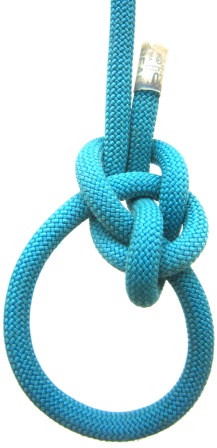
The cowboy/left hand SheetBend or Bowline w/tail 'out' is not 'sandwiched between the sParts to Nip properly; it is off to the side not between the primary forces, just side forces to secure.
An interesting hypothesis…but in practice there is no observable evidence of inferiority.
In fact, #1034 1/2 is resistant to ‘ring loading’, whereas the common #1010 Bowline is vulnerable to ring loading.
The nipping loop is the primary component that acts to compress all material within. As force increases, the compressive force of the nipping loop also increases. So the tail is firmly gripped by the nipping loop.
Note that some ultra slippery cords (HMPE/dyneema) can confound this…and we see slippage in otherwise secure knots using ordinary nylon rope materials. There is another post on the slippery nature of HMPE cords elsewhere in this IGKT forum…
Note also that both #1010 and #1034 1/2 in their native forms are both insecure. Additional tail maneuvering is required to achieve some measure of security.
i was taught this way; and this cartoon model was always my explanation to keep me in the lines;
and make motions ‘intuitive’ so naturally do the right thing.
can’t argue the numbers on right/left; but please electrical examination model of tension loading thru line is still consistent in other areas.
If by ring-loading, we mean splayed eye/ Standing Part loose/ becomes Bitter End
(would say normal usage sPart 100% loading, each leg of eye 50%)
would watch electrical path running backwards thru Nip in each and
see how ‘Cowboy’ is now pulls on it’s lock axis, with what was sPart as a Bitter End, using revers strategy on revers axis of major input (what was sPart is now Bitter End)
In Normal Bowline; see how reverse force flow to make sPart the Bitter End, ‘ring loaded’ we have the bight trying to escape (in all these)
And the Nip collar lock
The Nip to the reversed Cowboy is more immediate and intense on the final Bitter End
at werk, to be continued
Yep KC this is one of the reasons for using the “cowboy” over the “non-cowboy” form as Agent stated…
I wish there was some type of flow chart or “bible” to say this is the “correct way” to tie a knot or at least the “best”/“better” way as it applies to creating a more secure knot keeping as much of the rope strength as possible!!
I mean there are some insight/guidelines like the more bends you make the more you decrease the ropes strength etc… right but maybe not? I mean do more bends equal less strength if they are made later down the line on the working in… triple fishermans vs double, the triple has more bends less secure, or maybe more secure but less strength… sorry going off a bit just so many ways to look at these knots lol, and understand them…
But I am finding it depends on many factors and maybe the only true way of ever being certain what way is better… is testing the knot in a load test! And then again at different angles of pull (static and non-static)… as we know each knot is better suited for different tasks/situations…
This was the main reason I asked the question because when trying to tie this Yosemite tie off with the cowboy I found it looked nothing like the traditional and wondered if it actually became determintal/worse or did it indeed improve the safety/strength of the knot… I was also finding myself coming up with different ways of tying it off which some I think look better and dress up better, maybe I can name a tie off after myself lol…
So I guess this is the beauty of knots… but at the same rate I would like to have a system or a set of “rules” I could follow to make sure I don’t tie myself a “unsafe” knot…
Thanks for everyone’s input this far!!
Hi can you tie a left handed bowline (with tail on the outside) with a Yosemite back up/tie off like you can on the regular bowline? Or is the Yosemite only meant to be used on the regular bowline with the tail in the inside?
Our members and experts have try their best give you some answer.
I was also finding myself coming up with different ways of tying it off which some I think look better and dress up better, maybe I can name a tie off after myself lol....
Now you said have different ways of tying it, can you please bring in some knots picture and share it with us? I am eager to learn more.
謝謝 alan lee.
.
i think knot!
.
in my cartoon mental comix>>
normal pull angle is inline to long position (that forms sPart in normal usage vs. Bitter End in splayed/ring loaded)
but in ring loaded is opposite axis (not direction but rather goes from inline to not inline/tangential/lateral force pattern)
so adjust strategy to opposite also!
.
Most immediate , intense, unreduced Nip is direct to Bitter in Standard inline loading to ring middle lock by innie/normal/right hand tail
if do cowboy here, the most loaded sPart does NOT crimp/Nip on most reduced Bitter End of force flow.
On other hand, when ring loaded/splayed to load perpendicular with longest part of line / was sPart/ no Bitter End is opposite axis loading, use opposite strategy!
NOW cowboy/outie/leftie does get most immediate crimp, while normal/innie would not
in fact innie on splayed across can pull open, not closed because of this
Nip is not on main inline, to Nip this with main inline force would have to be on mount like Square/Reef…
.
Y’all saved by the bell;
posting at work;
as still living like caveman at home after kissed by Irma!
I stand by my prior answer, and suggest to those who question
the difference to be sure to examine the loaded knots of your
comparison and not merely the 2-dimensional looks-like image
which might be found in various sources. The knot can be
dressed in various ways; i.p., one might anticipate the SPart’s
draw on the “tail” (please, not “bitter end” --there are no bitts
involved here!) by dressing it to cross the other leg of the
collar bight so that AFTER loading it is moved a bit around
to where common diagrams show it starting.
The tail-outside version gets increased pressure on the tail
as the SPart’s draw moves it; the tail-inside one can lose
pressure if moved to be more inline with the other bight
leg (returning eye leg). I’ve witnessed many capsized
bowlines in commercial-fishing mooring lines (thick),
and surmise --just that, but …-- that the tail-outside
version will resist this better. (I got a nice photo of such
a knot but didn’t have a chance to ask its boat’s crew
whether they deliberately chose the verison (and why).)
And, in general, I’ll repeat an admonition I’ve made previously:
one will do well to think/speak of <this material so-knotted>
vs. <this knot>.
In this thinking, one is chary about attaching attributes
to the structure en vacuo!
i would say certainly via change in mechanics/ changing shituation;
stiffness, dressing, loading to distorting can all affect mechanical alignment of parts to leverage impacting change in system.
i would say to be real specific one would watch material/stiffness, dressing , load ranges/and when pull out of square as well as constant/intermittent/total shock force types or tension (long term) hardening and ‘weather hardening’(?) ; by accepting a norm or breaking to categories.
.
Just as a flip of the binary from inline force to tangent might then in paradigm have also the opposite strategy to control;
i use DBY in my ‘range’ of ropes/strings, but wouldn’t use in super stiff static lines; the reverse in properties sometimes call for an equal reverse in strategy!
.
please, not "bitter end" --there are no bitts involved hereAre you sure a Bitter End to the Bitter End nomenclature is ok? . In the electric schematic models i've built in head around common lessons and terms; i sometimes see the tension flow thru a rope device (similar to electric thru wire or hydraulic thru hose devices); as gradually degraded value Bitt by Bitt thru frictions(resistors), until there is no more tension force left in our tension 'hose' at the Bitter End (of force flow)! Commonly achieved by placing the most intense, hardest sPart tension pull across the leastest , softest tail (there i said it!) to crimp/Nip out all further force in the Nipped part. Highest tension on lowest AND hard convex surfaces (more tension, more hardness) as essential E/O Nip-er around Nip-ee. . To original quest-ion: use Yosemite in cowboy? YES! >>as a standard answer; many considerations to actual usage and line i'm actually a DBY fan, where argument of righty vs. lefty makes much less difference w/the RT (Real Turn/ RoundTurn)Dbl.Bowl. >>DBY partially for id'ing quickly and clean climbing profile If want instead of Yosemite can take tail exiting cowboy or regular and with sPart tracing down rear view of knot: steer tail around and under sPart after enters 'cuckold'/(?). as even more reduced force tail Nipped under the primary sPart. >>This is a better Nip point than Yosemite, but not the clean profile, longer tail can fall into eye (which i like keeping clean). DBY or any Yosemite type finish traces back up sPart, can even be temp/tape seized here for clean eye profile, not so much at this 'better Nip point' in the normal inline to 'long tail' perspective. 'Long Tail' functioning as sPart in normal inline (sPart) axis of pull >>BUT 'Long Tail' function in cross axis ring loaded Bowline as (the last word!) 'Bitter-End'.
To original quest-ion: use Yosemite in cowboy? YES! >>as a standard answer; many considerations to actual usage and line i'm actually a DBY fan, where argument of righty vs. lefty makes much less difference w/the RT (Real Turn/ RoundTurn)Dbl.Bowl. >>DBY partially for id'ing quickly and clean climbing profile If want instead of Yosemite can take tail exiting cowboy or regular and with sPart tracing down rear view of knot: steer tail around and under sPart after enters 'cuckold'/(?). as even more reduced force tail Nipped under the primary sPart. >>This is a better Nip point than Yosemite, but not the clean profile, longer tail can fall into eye (which i like keeping clean). DBY or any Yosemite type finish traces back up sPart, can even be temp/tape seized here for clean eye profile, not so much at this 'better Nip point' in the normal inline to 'long tail' perspective. 'Long Tail' functioning as sPart in normal inline (sPart) axis of pull >>BUT 'Long Tail' function in cross axis ring loaded Bowline as (the last word!) 'Bitter-End'.
This is all Greek to me… very hard to actually understand precisely what you are saying.
To cut to the chase of the original posters question…
Each knot has a particular name and usually an ‘ABoK’ number associated with it (per Ashley).
In the case of the ‘Yosemite Bowline’ - there is no specific ABoK number.
The Yosemite Bowline is based on the common #1010 Bowline… and not the #1034 1/2 Bowline.
If you begin from #1034 1/2 and try to maneuver the tail per ‘yosemite finish’, there is a risk that you might end up with only one rope diameter inside the nipping loop (as i had reported earlier).
It is important to note that both #1010 and #1034 1/2 are both insecure in their native form. If you want to use either of these knots in mission critical human life support applications, measures must be taken to render the knot secure.
Scott’s lock is one possible securing tactic - it is simple and effective. Furthermore, Scott’s lock places 3 rope diameters inside the nipping loop.
Scott is a member of the IGKT forum and may wish to chime in here…
I have not used Scott’s lock as a tie-in knot for rock climbing/lead climbing… but I think Scott has routinely used it for this purpose.
RING LOADING
You can easily check this for yourself…pick up a piece of cord and tie #1010 common Bowline. Now pull/yank on the eye to expand it. Cyclic pulling/yanking in particular causes the tail to progressively slip until the knot falls apart.
Try the same loading profile on #1034 1/2 and you will find that it resists tail slippage.
I am not sure of the OP’s intended application of his Bowline.
My 2 personal favourites for rock climbing (life support) application are the EBSB (based on Dan Lehman’s EBDB) and Alan Lee’s “Lees link Bowline” (refer photo images).
Mark
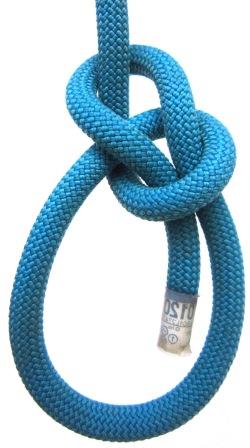
Apologies;
Greatly appreciate your .pdf works etc.!
.
DBY = Double Bowline with Yosemite tie off.
RT = Round Turn of course, but i also quip commonly RT = Real Turn, Full Turn
to keep in mind Turn is not full; more like hook, open, ‘half-tang’ (knife reference) even though eye sees/translates different
.
Normal/tail-in Bowline usually depicted as right
Cowboy/tail-out as left handed
This ‘handedness’ i think makes less difference in RT style DBY
for the tail(seeking freedom) can’t evade most loaded sPart(seeking to secure) quite as easily
.
As far as the ring-loading axis:
i try to point out that the same structure with reverse force flow, can take reverse strategy
(similarly knot architectures not favored in ‘round-wear’/rope can work best in ‘flat-ware’/webbing)
Have been waiting to get back to think take have pictures of Bowline ‘cuckholds’(?) going from 1 side of ring to other as most proper;
and most resembling proper angle of pull into this style Nip, and with the long ‘end’ that is normally the sPart now the tail/Bitter End
(of matching mechanic in same construction due to running tension/electric force backwards thru the ‘circuit’)
Also, how we would load this Bowline over horizontal branch to carry pulley(s) with line thru pulley(s).
The long end is played aside and only used for removal;
we load and remove the contraption remotely/from the ground to 30ft./whatever over head by an inversion ‘trick’
this is where these questions would come up every few years on garbo forums.
.
We now have electric at home (intermittent yesterday but on this morning) after 10 days(went off before Irma hit here actually); but supposedly internet today.
So can get back into think tank and draw some of this out
Some of Bitter-End especially at end was jest messing with dLeahman on calling me out on my knot-grammer;
but really have built imagery around the taught terms to ‘see’ tension force degraded in line bitt-by-bitt until crimped/Nipped as Bitter-End of force flow as mnemonic to terms and meanings and to form decisions on etc. as each move is purposefully laid!
.
Hi Mark, thanks for the great pictures.
I have used the simple lock for the #1010 bowline in many ways an eye knot can be used. From my climbing tie in (so much quicker), anchor, hauling, to load tiedown. I have not found myself using anything else since.
It was used recently to lift quite a few roof trusses, each over forty feet in length and the tie in points (truss webs with king post) were ten feet apart
which certainly put the “ring load” to it. Further, the trusses were dragged over the tops of interior walls, laying down, the knot bumping over the top
plates. No failures.
It really is a simple lock for the standard bowline and very easy to untie after severe loadings.
I did a quick, unscientific strength reduction test, sometime back, one locked sample against another, and then a locked against the #1010 unmodified. The #1010 failed before the simple locked one. The other test, well, one of them failed… Rope broke inside the entry of the collar as best I could determine by the permanent marker spots I had placed.
The only “misconduct” I’ve seen has been using old 3/4" Bull rope that is so stiff that it hardly wants to be coiled. I had to shake it and beat it against a
tree to cause it to loosen. Never did it come undone though.
*I even used it with thin aircraft cable to fix my lawn mower’s throttle cable. Broke on a Sunday. I was able to thread it inside the existing sleeve and tied two locked bowlines on each end. The original cable had swagged eyes and not salvageable. Still working well. *
SS
I have used the simple lock for the #1010 bowline in many ways an eye knot can be used. From my climbing tie in (so much quicker), anchor, hauling, to load tiedown.
Scott, good to hear that you routinely use 'Scott’s lock" to secure the common #1010 Bowline…including as a tie-in knot to your harness for rock climbing applications. Have you used it for ‘lead climbing’ or just ‘top rope climbing’?
I have used Scott’s lock routinely for anchoring ropes to trees and around boulders when setting up top rope climbing anchors - and have had no issues over the past several years.
…
KC… I admit to struggling somewhat with exactly what it is that you are actually trying to say…
And I think we are getting off topic.
Maybe you could start a new thread to discuss and explore your theories?
As far as the ring-loading axis: >>i try to point out that the same structure with reverse force flow, can take reverse strategy >>(similarly knot architectures not favored in 'round-wear'/rope can work best in 'flat-ware'/webbing) Have been waiting to get back to think take have pictures of Bowline '[b]cuckholds[/b]'(?) going from 1 side of ring to other as most proper; >>and most resembling proper angle of pull into this style Nip, and with the long 'end' that is normally the sPart now the tail/Bitter End >>(of matching mechanic in same construction due to running tension/electric force backwards thru the 'circuit') Also, how we would load this Bowline over horizontal branch to carry pulley(s) with line thru pulley(s).
The word ‘cuckholds’ conjured up some other image in my mind which has nothing to do with knots!
I am not sure that your analogy of electricity running down a wire is entirely relevant to the tension forces transmitted through a knot. There are too many variables at play - and the properties of the sheath fibres influence friction to a significant degree (search HMPE cords/rope and you will see lots of IGKT forum discussions).
Be that as it may, I have have attached a photo of a #1034 1/2 Bowline that is EEL (either end loaded). There has been a lot of discussion about EEL and Bowlines in this forum.
I think this might be something along the lines of what you are discussing??
Again, I think we are deviating from the OP’s topic…
Mark
Will start other thread on theoretical model(s).
.
Googled my own stuff and found this old pic of input force direction into Nipping lock to secure;
Also shows question about even in ‘Jacked’ position; some loss of Nip that eventually went to ‘Cowboy’ tail too, and always DBY(where makes less difference)
.
.
And this was how used, a magical inversion, but spreading force on the knot, w/unloaded long tail (used to retrieve, not hold jig)
Being deployed in remote position/away from inspection; and overhead rigging with 2:1 loading position favored seizing down with bright electric tape that contrasted rope color.
.
http://mytreelessons.com/images/staticretrieve%20false%20crotch.jpg
Mark, I use it in both scenarios, although my lead climbs have become fewer. This mainly due to climbing partners too busy with life and lack of experience.
So, why is it that you have not tried it or don’t use it for your tie in Mark? Just wondering…
SS
For a Bowline with spread apart force in loop this is my choice:
http://mytreelessons.com/images/bowline_splayed_a.png
.
i think Bowline is based on a Half_Hitch, that is designed to pull INLINE;
not spread on cross-axis, so would change orientation of tool to match force flow.
.
So i think, as we switch to cross-axis loading across the loop;
we’d turn the inline structure of the Bowline to match.
.
This might reference as a ‘Cowboy’ visually because ‘tail outside of eye’:
BUT; mechanically it is the same structure; both 'tails’exit the same side; both tails sandwich between primaries.
.
also note: how the longest tail; that is usually on outside of ring it forms,
is now on the inside; just as now it is the tail and not the sPart;
thus another reverse, in this reverse situation!
.
noting pull forces are different in this form; there is no sPart pull that is 2x tail/release(so more like Sheet Bend in that aspect)
not visualizing this as binding not rather a ‘splayed’/spreading force
.
strain spreading on loop would go to solid side primarily, from any stretch , shift, adjustment in Bowline as weaker leg i’d think.
.
And to original question:
i’d ‘DBY’ any or these commonly by habit.
Double/Round Turn Bowline with Yosemite finish
(favor the inversion method for easier threading thru dbl.rings)
KC, the image you have posted is what is known as an ‘anti Bowline’.
There are in fact 4 different versions of the anti-Bowline.
This phenomena you describe has long been known by members on this forum… particularly by Dan Lehman and Xarax.
Have a look at this web page: http://www.paci.com.au/knots.php
Download the Analysis of Bowlines paper (#2 in the table).
Mark G
Thanx,once again nice collection!
.
i originally learned this as a Jacked (to the side) Bowline ~25yrs ago;
to be used for mounting pulley in tree(as shown) or other spreading on bowline ring.
i changed it to tail out; to follow standard Sheet Bend advice to construction, not eye.
.
Yes, more a Sheet Bend type lock/only pulls on 1 side ; than the Half Hitch of Nipping Loop; but both are for inline pulls down their loaded length i think.
i think best if tail out of ring/same side as long tail left or right construction i see as same mechanix; but for same arguments.
.
But, by any other name, this would be my choice for this type loading;
i favor standard tail in for normal loading as opposed to ‘Cowboy’;
Wouldn’t use Cowboy in case had splay/ring cross loading;
would build normal or anti/jacked architecture towards how force would be carried by device; down the long/major axis of the knot construction.
.
The Half-Hitch is decidedly for inline context of pulls down the line in contrast to most other lacings.
Most ‘knots’ are made to embrace host mount at right angle across;
for pulls inline can take same knot generally as ‘anchor’ and precede with Half (HH)Hitch ‘angle converter’ to make fare.
The equal and opposite resistance to pull in HH allows this;
and so probably ‘parent’ Sheet Bend’ construction(?).