[b]Dragon knots[/b]
[i]
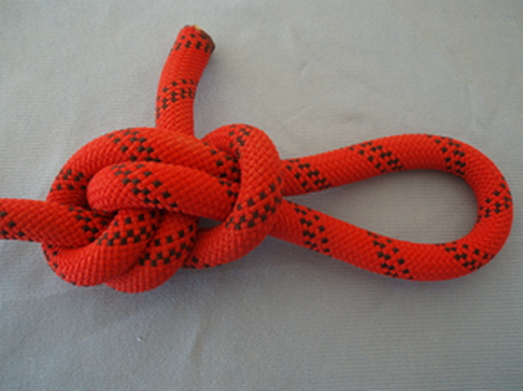
A short preface about the double dragon knot of first image, probably one of the most favoured knots, overwhelmingly (and justifiably, in my view, dare i say), promoted by knot enthusiasts.
What exactly is the double dragon, and which knot it can be related to?
It is clearly, a different loading profile of the TIB version of ABOK#1013 (tail tucked back through the collar), double or round turn bowline, or in other words, 1013 loaded from the returning eye leg side, as a crossing knot based profile.
In comparison of those two, from a jam resistance point of view, i would claim that double dragon’s, crossing knot nipping structure appears to form a more pliable core than the two nipping wraps of the double bowline.
But, is double dragon’s second wrap through the nub a must component?
I’m afraid it is, provided that the knot is going to be heavily loaded, because it enhances the crossing knot stability, leading to a distortion proof knot, compared to a single wrap configuration.[/i]
Moving to an alternative design of my own invention, I have transfered double dragon’s complexity (two wraps) from the returning structure, to the nipping structure, adding a helical SP formation.
It’s one of those cases i refer to as systems with qualitative complexity at the nipping stage with an excellent response at heavy stress.
In short, a few words about a very easy tying method......
-
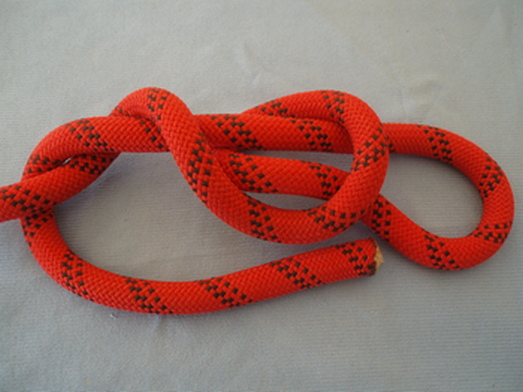
Form a bight on the SP continuation and place the returning line over the bight and under the SP (second image).
-
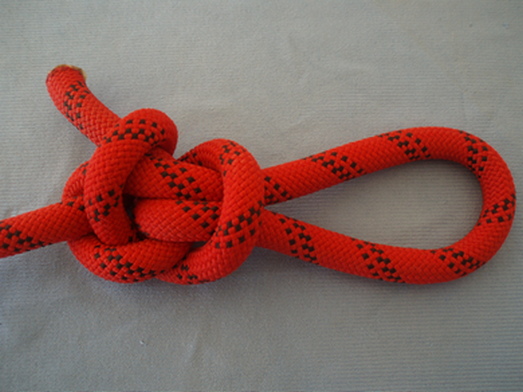
Fold the bight over the returning/out-going line, and pull the two lines up through the bight in marlin spike fashion (third image).
-
Lock the tail under those lines and the helical SP formation.
The tail toggle component of fourth image (Xarax would define it as a rope made hinge), is a major influence in the system’s stability and pliability because:
-
It stabilises the helical SP formation.
-
It prevents most of the tension to diffuse through the second nipping stage (crossing knot).
-
It counteracts crossing knot’s tedency to distortion.
-
The out- going loading force restrains the toggle from an irreversible locking deep through the helical SP formation.
-
Moreover, under loading conditions, the helical SP formation, creates a small slack in the returning structure loop, which makes the knot accessible from both nipping stages.
On this basis, along with some stress tests, i’m confident to claim that the knot goes unblocked right up to the MBS yield point.
To be clear, i’m not claiming that the double dragon jams, but i’m not absolutely sure for loadings near the rupture zone.