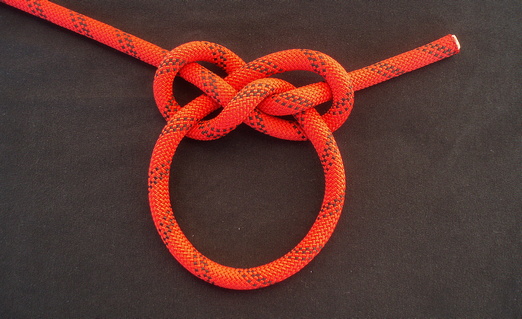
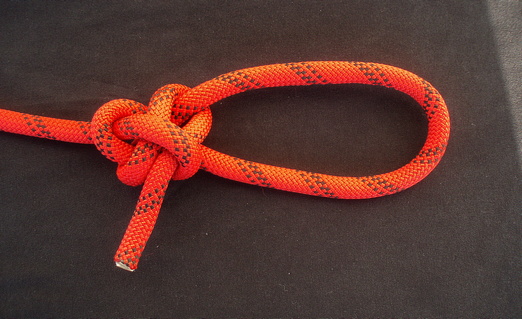
Picture from "Carrick Bend #1439 Loop Transformmation"
       https://www.youtube.com/watch?v=SW3dDaz-vHk&t=58s     謝謝 alanleeknots.
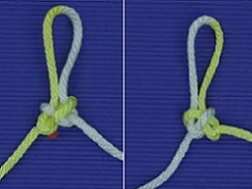
Picture from "Carrick Bend #1439 Loop Transformmation"
https://www.youtube.com/watch?v=SW3dDaz-vHk&t=58s 謝謝 alanleeknots.
Hi all,
@alanleeknots
Thanks for your tests and comment.
@tsik_lestat
Carrick, Corrick, Ume and Umi Bends are composed with 2 Crosssing Knots interwoven. The added green and red lines indicated the type/state of Crossing Knot.
Carrick has two greens, Corrick has two red, Ume has red and green, and Umi has green and red. These show that Ume and Umi are hybrid bu elements from Carrick and Corrick. Umi Bend is the inverse of Ume Bend, both are found in my tying methods. They may not be pratical, but worth explore in bends compose Crossing Knots.
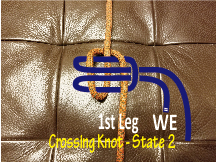
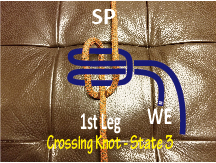
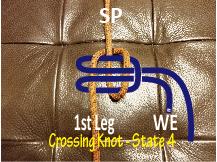
Here are 4 states of Crossing Knot. As we insert the WE into the Crossing Knot base, we form a loop knot. In respect to the exit of the WE and the interwoven structure, the axial loading and ring loading my be checked by hand.
I tested on loop knots with Crossing Knot + Cow Hitch (see attached pictures) and Crossing Knot + Clove Hitch. Both are find as follows:-
State 1 - good at axial loading, good at ring loading.
State 2 - not good at axial loading, good at ring loading.
State 3 - good at axial loading, good at ring loading.
State 4 - not good at axial loading, good at ring loading.
For CSLK (in state 1), that is LK with Crossing Knot + Crossing Knot, and other LKs in state 2, 3 and 4, the findings are :-
State 1 - not good at axial loading, good at ring loading.
State 2 - good at axial loading, good at ring loading.
State 3 - good at axial loading, good at ring loading.
State 4 - not good at axial loading, Not good at ring loading.
These lead me to the impression that the 1st leg at either side of the Crossing Knot (state 2 and 4, with upper collar) will liable to deform the nub. State 1 and 3 (with lower collar) would be more secure, of course depends on the whole structure.
Please advise if I am not right.
@ Mark
I do not know anybody has named different states of Crossing Knot in tying LK. Would you suggest or expose your idea?
Happy Knotting
yChan
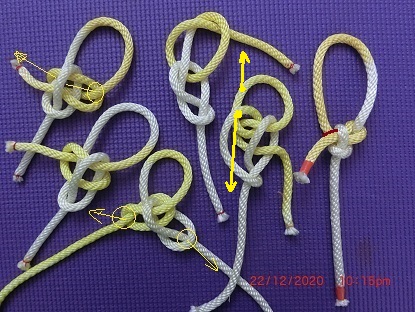
Nice approach Alan, your version of an S loop #1428 based, assymetrical Carrick at reply#18, shown in my first attached image. I regard this variant as a solid, energy stable state skeptically, but one can acknowledge an alternative way of stabilizing a nipping loop, with a crossing knot component.
I also wonder if we may transfuse bowline characteristics to this structure, provided that one of its energy stable variants (or more), is alleged to be jam proof (second image).
Xarax’s improved version is very interestig too, plus one may finish it by threading WE down through the collar, to form a figure eight collar component and a TIB knot, after all.
Additionally, i have recalled an old structure of mine with a different finish, where the WE, after passing through the nipping loop for the first time, as in your structure, captures both eye legs, and then it is secured using a Fontus toggled locking mechanism.
   Hi All,
            Nothing mean, Just to share my thought .
            <blockquote>? Reply #14 on: December 11, 2020, 06:18:54 PM ?
tsik_lestat
I use the state 1 of Crossing Knot in my LKs.
yChan
"I mean when you tie a eye knot with these nipping structure "
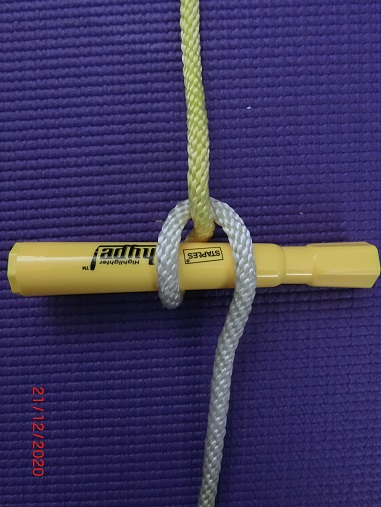
@ Mark, Your Carrick-Bend_1439 Transformation, unexpectedly show up here,
so I give it a try and transform carrick-Bend 1439 to you knot,
but the tail not in the right place, need one more step to finish to the knot.
Just wonder if it ok to call “Carrick-Bend_1439 Transformation”.
Since it can’t finish the job, with curious so I look into it.
Here are few knots I found relate to your knot. and also relate to my knot.
謝謝 alanleeknots.
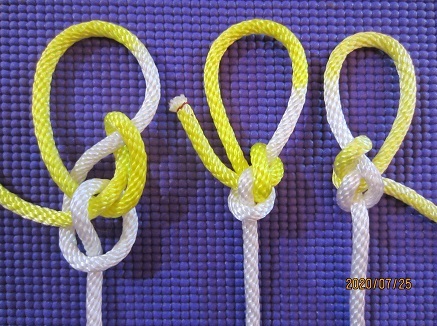
More knots
Hi All, Crossing knot #3 and #7 have a place here, Crossing knot #6 have the similar look,
must have something similar. so it does.
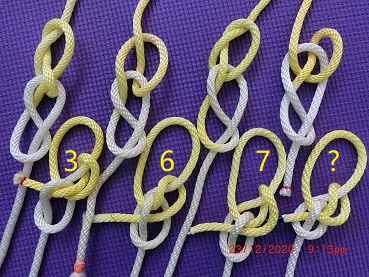
More knots transformation.
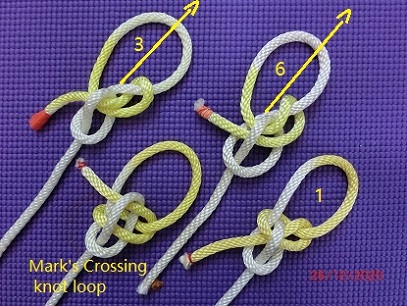
        <blockquote>? Reply #22 on: December 20, 2020, 06:11:04 PM ?</blockquote>
        tsik_lestat,Thanks for great work, Just so busy with my own knots work, delay my reply the result here.
        quick test with your nice looking Two collar fontus  with 1/4 " solid braid rope, easy to untie after loading with extremes load,
        your knot may need to dress very good and tight, in order to  maintain the compact form, For small rope can do it easily,
        for climbing may react differently, need more test for sure. 謝謝 alanleeknots
per Siriuso:
@ Mark I do not know anybody has named different states of Crossing Knot in tying LK. Would you suggest or [b]expose [/b]your idea?? I dont really understand your question? Also, I do not wish to derail and move away from the subject matter of this topic thread.
However (and very briefly) - if I take a guess at what the intent of your question is…
And this risks drifting too far off topic (apologies to Alan).
A crossing hitch isn’t a ‘knot’ (by a strict definition).
A crossing hitch can be tied in different chiralities - being either 'right-handed (Z) or left-handed (S). the same goes for a ‘loop’ (which can also exist in S or Z form).
If you tie a crossing hitch in Z chirality and hold it up to a plain mirror, you will see the same hitch but in its ‘S’ form.
With regard to ‘expose’ - not really clear on what your intended meaning is?
If you are referring to ‘chirality’ - this has been discussed before in this forum and is a well understood concept.
Tie any knot and then hold it up to a plane mirror - and you will see its mirror reflection - being equally valid, and simply its ‘inverse’.
Most knot tyers will tie a knot in a particular way - and this is usually influenced by their dominant hand.
When presenting knots in this IGKT forum - a poster will typically tie their creation according to their dominant hand movements. It is rare for a poster to also show the mirror ‘inverse’ form.
We can see this in Ashleys book - virtually all of the ‘Bowlines’ that are illustrated have Z chirality.
Exception: #1087 Spanish Bowline is illustrated with both S and Z chiralites (they co-exist) and interestingly, at #1716 the initial loop is formed as ‘Z’ and then capsized to ‘Z’ (always being Z).
Note: There might be an instance where he illustrates a Bowline with ‘S’ chirality, am still looking, I haven’t exhaustively scrutinized each and every page!
Hi Alan, it’s surprisingly good to know that a non-bowline structure, (two collar fontus), responds quite well at high loading stress tests. I guess, simplicity is the key.
Additionally, the capturing of both eye legs, does not appear to considerably deform the nub at cross loading strain. Thanks!