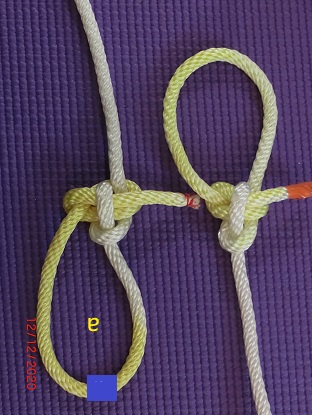
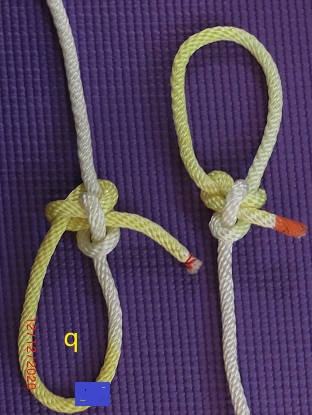
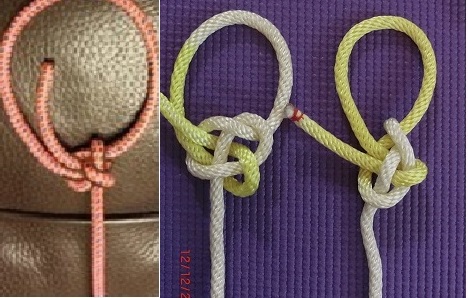
Hi All,  Jam resistant loops, hope you like it.
                                          謝謝,  alanleeknots.
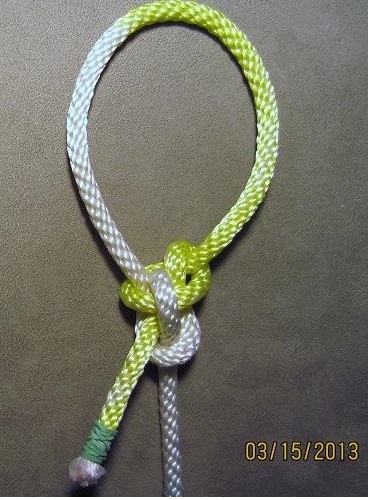
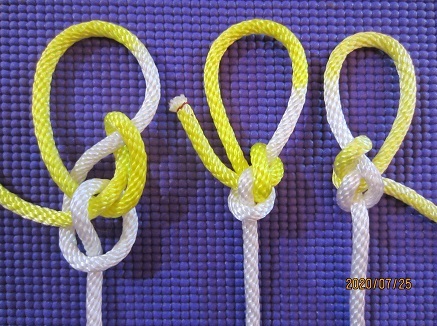
                               Hi All,  Jam resistant loops, hope you like it.
                                          謝謝,  alanleeknots.
謝謝, alanleeknots.
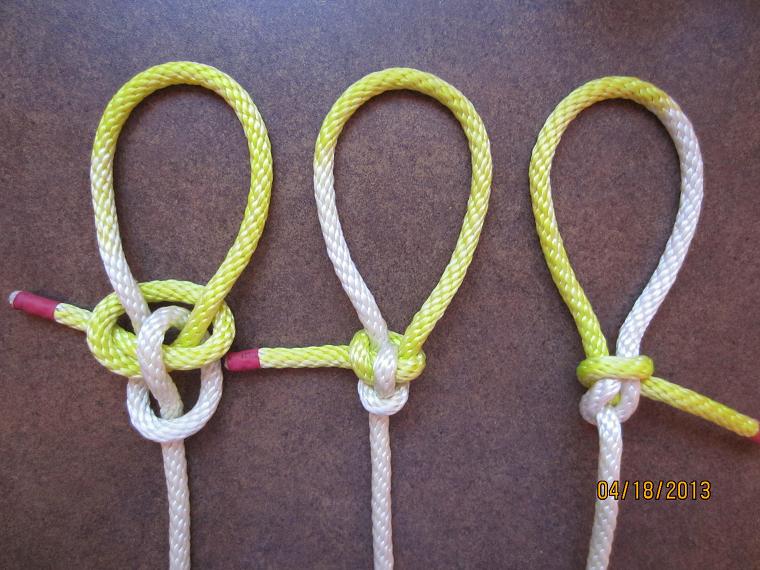
謝謝, alanleeknots.
July-27-2020 ; Add Crossing knot loop # 10 here, this loop fit in nice and smooth , even though is no well balance, under heavy weight it retain form very well. and easy to untie.
tsik_lestat Thanks for your reply.
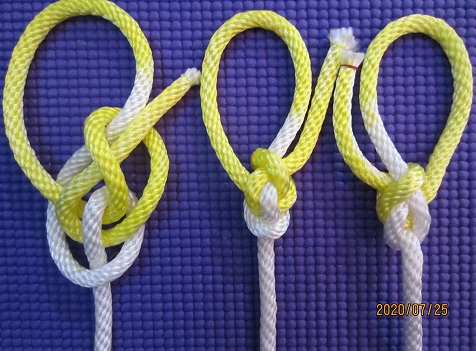
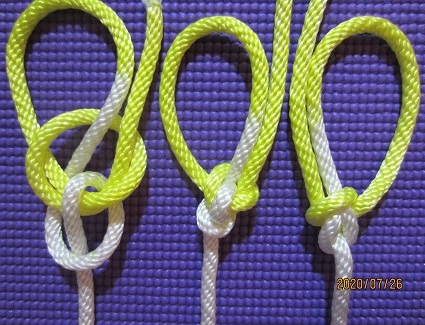
I like them, and i appreciate the fact that you are dragging up some of your old creations, for those of us that they were not members, at the time they were posted for the first time, or refreshing the memory of others. I am refering of course to eyeknots #1, #5, with the number #5 being more familiar (have seen it before as a Luca creation, but i don’t have the link right now). Although, i wouldn’t use an overhand locking to enhance a Carrick-like loop, i admit that both have a compact form (same stands for eyeknot #4).
Eyeknot #2, uses Siriuso’s two crossing knot locking mechanism (north south), which has been discussed here : Link 1 : https://igkt.net/sm/index.php?topic=6636.0. i wouldn’t characterize it as mirror, but using the same mechanism in a slightly different nipping structure, where an aditional WE tucking through the collar, leads to a girth hitched crossing knot. The corresponding bend, is interesting too.
Now for eyeknots #3, #6, #7, if i was to borrow a DL’s expression, i’d say that they are Eskimos/anti-bowlines of another variety. I remember, i sent one of them to Xarax some time ago, and his comment was as follows:
" I have the sense that every single strand/component of such a knot, is being drawn tightly towards a center (at the heart of the nub), where much pressure is acummulated, rendering the untying process more challenging at maximal loadings". Α common feature of the Eskimos I’d say.
I’d like to add that you have a double version of such a loopknot in your other double loop related thread,
Link 2 : https://igkt.net/sm/index.php?topic=6451.msg43701#msg43701.
Too bad, number#8 is not TIB  besides the two end parallel configuration, plus nice final tucking at eyeknot #9.
   Hi All,  here is a TIB Quick Release loop, well secure and easy to release after heavy loading.
             I like it, hope you like it too.    謝謝,  alanleeknots.
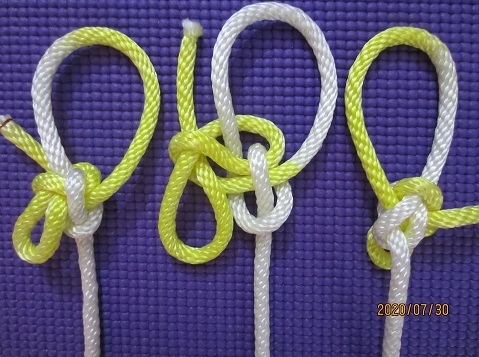
    Hi All,
             I have two loops here, both of them  are well  secure and easy to untie after heavy loading.
                謝謝 alanleeknots.
Hi All,
I like this simple solid knot , well secure and easy to untie after heavy loading.
謝謝 alanleeknots.
Hi ALL,
Crossing knot loop # 12, have few a quick test with 1/4" solid braid nylon rope,
it handed heavy weight very well and easy to untie.
  Second picture Jam knot 01, not happy with it.
  Third picture, move the standing part, problem solved.

  Crossing knot loop # 13, work fine handed heavy well and easy to untie.
  謝謝 alanleeknots.
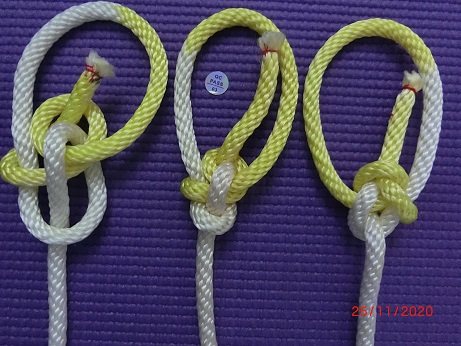
I think Crossing knot loop #11, at reply#6 is the flipped collar or ring loaded version of the tugboat beta (flying bowline) TIB structure.
Additionally, the crossings knots #12, #13, are also TIB, if their tug ends are tucked back through the collar, which would give extra credit to both good knots anyhow.
Hi tsik_lestat, Thanks you, good to know Crossing knot loop #11 is the flipped collar or ring loaded version of the tugboat beta.
Tugboat beta is a famous knot, but it jam and distorted so bad under heavy loading, and it have a excellence flipped collar version , I don’t know why nobody use or mention it. may be I have not aware it, someone already mention or use before.
My conclusion, amount all the simple crossing knots loop, beside Reroute Eskimo bowline, Crossing knot loop #11 is the second best out there.
If Crossing knot loop #12 become TIB version, the 2 ropes diameter inside the collar, mean capsize under heavy load.
crossings knots #13 become TIB version, the standing part nipping loop is riding single rope diameter on the incoming eye leg.
Thanks for your frequent reply my post, Writing is my bad, I want to reply
you, but too much time for put together something like these.
Anyway I have a loop here, no a great knot but have very unique look. have to dress very tie in 90 degree fashion with soft rope only, then it can handed heavy weight, dress the loop inline, will be disaster.
謝謝 alanleeknots.
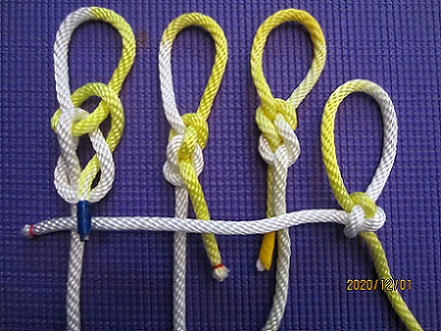
Tugboat beta is a famous knot, but it jam and distorted so bad under heavy loading
It certainly is, it has even made an appearence in an animation movie for kids, well imagine that! I guess, the fame relies on its fancy flash TIB tying method.
Now something interesting about your more stable crossing loop #11 variation…
If you load it from the tail part, this will reshape the initial crossing knot nipping structure into a two wrap nipping channel.
Besides the fact that this may be considered as a decent TIB noose, if you push the tail out and replace it with a tube, you have a fine, tight, two wrap hitch.
I definitely have seen it before, but i kind of miss the info right now as to who has developed it in the first place. Master Xarax is a usual suspect for sure :).
tsik_lestat, Alan
I have 3 loop knots using Crossing Knot as a start
Happy Knotting
yChan
@ Siriuso
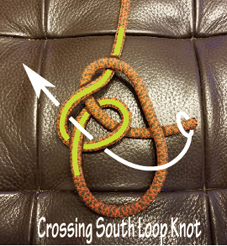
It has been said that your CSLK is a Carrick product. I’ve tried to match your eyeknot, with all Carrick initial dressing states, #1439,#1428 included, but paradoxically, it didn’t work.
So, what’s going on here? There must be some other initial dressing states, as numbers don’t fit ::).
Verily, try to load the first image configuration, from the on going eye leg and tail sides as white arrows indicate, and you will get your knot (first image).
If you load it from the other two lines, it will transform to a more appropriate final energy state to process the load, while yours, is better for cross loading (ring loading).
A question that raises here, is which is this asymmetrical Carrick variation, (neither symmetrical nor Carrick perhaps) that mimics original Carrick’s self dressing ability?
I illustrate a slightly different #1428 variation to coordinate with your eyeknot (second image), while that trick, extends to the other classic Carricks as well.
Is there a reference in Asley’s, or anywhere else, or in your bend archives? Well, if not, there will be, because having tied a loopknot, by definition you have tied the corresponding bends too ;).
I assume that it is weaker than the symmetrical carrick variations, but one must struggle to discriminate between final energy states, if you ask me.
To avoid drifting off- topic, maybe you should start a new thread to explore Carrick variations? 
tsik-lestat
I do not class the Crossing South Loop Knot as it is in the Carrick family. It is just a LK starts with a Crossing Knot. I have not get deep to the Carricks.
I like to use one of the state of the Crossing Knot to create Loop Knots. To form a Crossing Knot in the SPart and let the WE also in the form of Crossing Knot to enter into the former Crossing Knot. One may use/play with WE with other knots or tuckings. They are worth to try and explore.
Once it happened that I made a Crossing North Loop Knot and a Crossing South Loop Knot. Thanks to Agent Smith?s comment, I admitted that my Crossing North Loop Knot is Carrick Loop Knot. But a different direction of the Crossing Knot leads to Crossing South Loop Knot and it is not of the Carrick family I think.
There are a lot of Carrick-like bends (composed with Crossing Knots) and Ashley-like bends (composed with Overhand Knots). We may discover more as well as their corresponding loop knots.
Here are some examples.
Happy Knotting
yChan
tsik_lestat
I use the state 1 of Crossing Knot in my LKs.
yChan
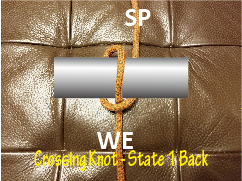
With these knot bases, in that my own thinking
on this I’m calling “crossing knot” that orientation
where the SPart is collared by itself,
and so I distinguish as “Tugboat Bowlines” the state
where the (outgoing & usually also returning) eye leg
is collared by the SPart. --as there can be quite some
difference, and plenty of options to stock each case. 
@ Siriuso
Thanks for your photos, they will assist me in clarifying my point. It’s nice to examine the knots in isolation, as i’m kind of loosing the ball in your big data files. Perhaps this attempt, will leave you with ideas of organizing them in more meaningful categories, (like Carrick variations e.t.c).
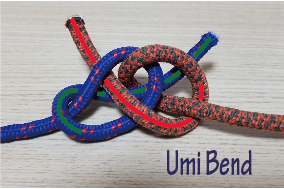
Now, suppose that you show me your Ume, Umi bends, and you ask me which one is a genuine Carrick product. I don’t know about others, but i’d be unable to answer to this question, in just a quick peek at the final energy states you present. Doing some further analysis, thus finding the initial dressing states, i’d be confident to claim that your Ume bend, is a pure #1428 derived symmetrical Carrick product, while your Umi bend, is an asymmetrical #1439 product. I’m not sure why you have alternated the crossing knot state of the blue rope at Umi bend, deviating from your standards, but it doesn’t really matter.
With respect to your CNLK and CSLK eyeknots.
Your CNSK derives from #1428, while CSLK derives from asymmetrical #1428, as i showed previously. In particular, you have to load the initial dressing states, tied as eyeknots of course, from the on going eye leg and the tail. Your final dressing states that you have demonstated in both loopknots, which form the state 1 crossing knot nipping structure, hardly feature a practical aspect in that geometry, and i’m explaining.
Since you load them from the SPs, the knot will deform, trying to take the final energy state that is meant to take, (Ume state in case of CNLK). Verily if you leave the nub a bit loose and load it, it will capsize to form the #1428 final energy state of Ume. The same applies to the other CSLK eyeknot.(if you care to investigate the final energy state of CSLK eyeknot, just load my previous attached configurations from the SPs). I mean that these are temporary geometry states before loading the knots.
Hello siriuso,
Just some comments I thought I’d make…they are not an attack nor are they intended to denigrate or devalue your work.
My comments are simply given from a technical standpoint and provided in good faith.
With respect your post at reply #14, I see your various depicted states as follows:
From a technical standpoint, these structures are hitches - in that they require a host to maintain form/geometry.
The use of the terms ‘State 1’ and ‘State 2’ could be re-characterized in terms of chirality.
Chirality is found everywhere in nature - and we also see it in knots/hitches.
‘State 1’ and ‘State 2’ are identical geometry. All that has occurred is a reversal of load on SPart and tail.
The crossing hitch (ie Munter hitch) depicted in ‘State 1’ is unstable and will capsize when load is applied to the SPart.
The crossing hitch depicted in ‘State 2’ is energy stable.
‘State 1’ will capsize and transform into your depicted ‘State 2’ (lowest image titled CKState2Back.jpg)
In my view:
‘State 1’ is best identified as a right-handed crossing hitch (it has right-hand chirality) - and it is in its energy unstable state (it will capsize)
‘State 2’ is best identified as a right-handed crossing hitch (it has right-hand chirality) - and it is in its energy stable state.
Fundamentally, the loading profile has been reversed.
Using the concept of chirality is an effective way of describing your depicted crossing hitches.
Flipping or rotating the hitch does not alter its underlying chirality - it remains unaltered.
The only way to ‘see’ a reversal of chirality is to view the object in a plane mirror… the reflected image having opposite chirality.
You could also tie and photograph the crossing hitches with left-hand chirality (if you wish).
Hi All,
First picture, It was many years ago, I send it to Xarax for his advice. Picture 2,
Xarax Thanks you, come up this improvement version.
And then is the transformation picture.
 Coffree loop knot, nice looking, complicated knot, but is a jam proof knot,
 In order to maintenance compact form of the knot, have to dress the nub good and tie,
 bad thing is nipping loop riding hard on the out going eye leg.

 Crossing South loop knot is good complicated knots also a jam proof loop. may prefer "loop b"

Mocha loop knot jam bad, prefer the transformation version"open the book and straighten the
out going eye leg" to do some light duty work.
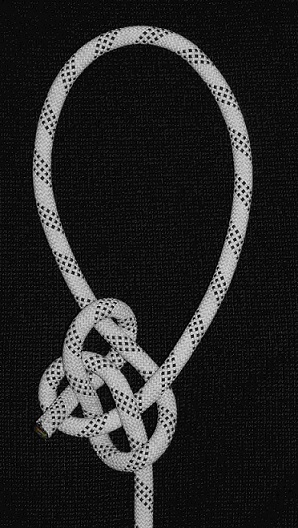
Picture from "Carrick Bend #1439 Loop Transformmation"  謝謝 alanleeknots.
More pictures.