If you haven’t already taken a look at Mark Gommer’s excellent Knots Study Guide, you ought to. Its a wealth of information about knots commonly used in climbing.
http://www.paci.com.au/downloads_public/knots/01_Knots.pdf
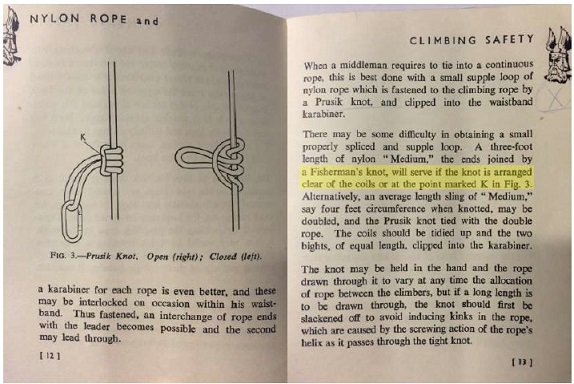
Gommer’s study guide first introduced me to the useful technique of positioning the Double Fisherman’s knot in a prusik sling in the bridge of the Prusik. I recently came across the concept in a much earlier publication, and thought it worth noting for all.
Attached are pages 12 & 13 of Ken Tarbuck’s Nylon Rope and Climbing Saftey, an undated pamphlet published by British Ropes Limited, promoting the use of their laid nylon Viking rope for use with mountaineering and rock climbing. While undated, contextual clues in the text indicate publication after 1947, and sometime before kernmantle ropes became popular for climbing, so perhaps sometime in the 1950s.
I would be keen to know any information about the technique of placing the knot of a prusik loop in the bridge of the prusik; such as when or where it became popular, or any other pubications that mention it.
cheers
andy
I can not answer your question, but here is a Prusik Bottle Sling: https://youtu.be/iNfOc5jmcoA using the Prusik and the Double Fishermans Knot. ABoK 1763 mentions the knot, but does not name it.
JD
Thanks for the link, I’d never thought of adding a round turn in the Prusik bridge around the loaded loop to secure the knot from coming loose without load. A useful addition to my bag of tricks 
I found some interesting links:
Some testing to failure to compare prusik strength depending on DF knot (double fisherman’s knot) placement:
http://itrsonline.org/wordpress/wp-content/uploads/2016/11/Evans.Truebe.Poster_1a-Is-There-A-Right-Way-To-Tie-A-Prusik-Paper.1a.pdf
Two links cited from above which test a Prusik with the DF knot in the bridge:
http://www.kajakksenteret.no/files/Rope%20system%20testing%202010.pdf
http://www.swiftwaterrescue.at/content/info/prussik.html
Their testing shows the Prusik with the DF knot in the bridge slipped (and eventual failed) at lower force then a traditional Prusik, although as the first author points out “Given that these results are based on sample sizes of 1 in each configuration, the results should be considered with skepticism. Clearly more testing is needed.”
The second and third authors call the prusik with the DF in the bridge an “Innsbruck Prusik”
cheers
andy
Thanks for the information.
I have seen the recommendation --or, at least the
presentation of the possibility-- of positioning the end-2-end
knot at the Prusik hitch bridge.
The testing that is referenced above seems to focus on the
use of these hitches in cases of high load, and not for the
common purpose of ascending ropes --for which ALL the
reported forces are WAY high. Possibly, the knot-at-bridge
version grips & releases better, in ascending use?
–dl*
I would be keen to know any information about the technique of placing the knot of a prusik loop in the bridge of the prusik; such as when or where it became popular, or any other publications that mention it.
Question per knot rigger
Possibly, the knot-at-bridge
version grips & [b]releases better[/b], in ascending use?
Answer per Dan Lehman
Its not that it “grips better”.
The point of positioning #1415 Double Fishermans knot (bend) directly in the bridge sitting on top of the coils of the hitch is that it makes releasing the hitch easier during rope ascension (ie climbing up a fixed rope using 2 slide and grip hitches).
Ascending a fixed rope using slide and grip hitches is hard work - and most people would be fatigued if they had to climb up any significant distance.
Anything that makes the process easier is an attractive option.
One should also spare a thought for mountaineers who wear gloves. Gloved hands make simple tasks more difficult. The technique of positioning the Double Fishermans knot directly in the bridge makes it easier to ‘break’ the tension of the hitch - even with gloved hands.
Mark G
Two links cited from above which test a Prusik with the DF knot in the bridge:
http://www.kajakksenteret.no/files/Rope%20system%20testing%202010.pdf
http://www.swiftwaterrescue.at/content/info/prussik.html
The swiftwater rescue link (Prusik hitch testing) is yet another example in a seemingly endless number of tests that actually fail to prove the alleged hypothesis/premise.
For a start - they can’t even get the spelling correct…its ‘Prusik’ (not Prussik). Dr Kark Prusik might be rolling over in his grave..
Secondly, its a hitch, not a knot! That is; ‘Prusik hitch’ (not Prusik knot).
Thirdly, only 7.0mm cord was ‘tested’ on a 10.5mm parent rope.
7/10.5 = 0.66 = 66%
No other comparative testing was carried out - and a conclusion was drawn based solely on this cord-to-parent-rope ratio.
For example, a ‘Klemheist hitch’ could also have been tested.
And a test should have been carried out at an exact 50% ratio (eg 5.5mm cord on 11.0mm diameter parent rope) - to establish a baseline. Note that 11.0mm (7/16 inch) rope is more common across the rope access and vertical rescue industry (although fire rescue agencies usually prefer 13.0mm diameter rope).
Basically, there was no ‘control’ established for the tests. This is a major oversight in my opinion.
Fourthly, the test appeared to be focusing on pure MBS yield only (ie pull to failure) - which is so typical of the entire roping industry.
The conclusions of the test are stated as follows:
The traditional 3 - wrap wins on both overall strength and first slippage. Don’t forget that strength of prussik knots is dependent on the type and diameter of cordage used as well as the knots used to tie them.
With the blinkered focus only on pure MBL yield… the concept of slippage of the hitch was overlooked as a mechanism to warn of over-strain to vertical rescue teams pulling too hard or using too much M.A. (mechanical advantage). That is, once the hitch starts to slip - this is a useful indicator to back-off on the throttle.
If toothed mechanical rope grabs are used - they can strip the outer ‘sheath’ of a parent rope - which is not good. The idea behind using slide and grip hitches is to avoid toothed mechanical rope grabs - and to have a built-in warning mechanism that the system is being over-loaded.
If that was one of the goals of testing - the conclusions may have different.
Mark G
Agent_Smith:
As I know that MBS testing of knots is a pet peeve of yours, I am not surprised by your latest post. Even as I cited the testing, I knew that it would be chum in the water. My apologies, perhaps I should have offered you a “trigger warning”.
I don’t disagree with your irritation with MBS of knots being overvalued relative to other factors (that you’ve stated elsewhere may times) but I do think that knot efficiency has a valid role in evaluating rope rigging choices and design.
This swiftwater test is nothing other than what it presents itself as: a simple “back yard” break test. They compared a standard Prusik to an Innsbruck Prusik; only one sample of each knot. They state their findings that the standard version slipped and broke at a higher strength. It’s certainly not scientific, but I don’t see that they are claiming it to be either.
Have you read any of Tom Evens (with SAR3) reports where he aggregates multiple “back yard” breaking test of various knots and reports his findings? An interesting concept. (http://sarrr.weebly.com/knots.html)
Last thing Mark, I’d appreciate it if you share how you learned this “Innsbruck Prusik” or any other knowledge you may have of it’s “Pedigree”. Thanks for sharing your thoughts on its’s uses and merits vs. a standard prusik.
cheers
andy
As I know that MBS testing of knots is a pet peeve of yours, I am not surprised by your latest post. Even as I cited the testing, I knew that it would be chum in the water. My apologies, perhaps I should have offered you a "trigger warning".
Per knot rigger
Its not that its a “pet peeve”…rather, I think like this:
“We are now in the year 2017. Why do the vast majority of ‘knot testers’ place such great emphasis on pure MBL yield (ie pull-to-failure) testing? I merely ask the question why? What is it about pulling things to failure - to break a knot structure - that overwhelms the minds of many in the entire roping industry? Are there other qualities of knot structures worthy of investigtion or is pure MBL break testing the only way forward?”
The above is what I truly think every time I read another knot test report with conclusions drawn on the sole basis of MBL yields!
And I also think to myself…“Will this one track mind way of approaching knot testing ever change in my lifetime?”
Honestly - probably not! (a sad truth).
Then again - I dont have a great many years left on Earth - the age clock is ticking.
So I also think…“Should I stick my neck on the chopping block and make some noise about this matter?”
In doing so - I pop up on a few radars - to some people’s annoyance.
Take #1410 (offset overhand bend…Or…offset water knot…Or…EDK) as an example. Focusing on pure MBL yields (break testing) proves exactly what? And yet, many ‘knot testers’ perform their MBL break tests on #1410 and then publish their conclusions based on a flawed assumption.
I think its a part of my DNA to question things and to be willing to buck the trend a little.
…
In any case, Dan Lehman has also given many examples where knot book authors simply parrot concepts or regurgitate information that has not been proven as factual. He has done this several times over the years…and this might be seen as a pet peeve of his! Maybe MBL yield/break testing is also regurgitated from person to person and tester to tester?
My comments were not directed at you knot rigger…they were generalized remarks aimed at no one in particular!
I also stand by my remarks - backyard testing seems to be the norm around the world…and is often cited by others to lend proof to some notional view. If you are going to publish to the world - backyard quality or not - you still need to take care (due diligence).
Mark G