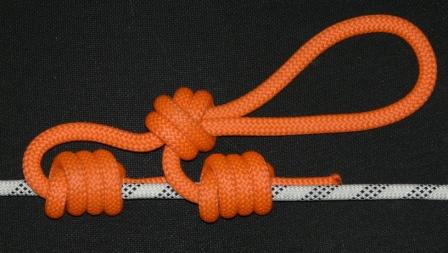
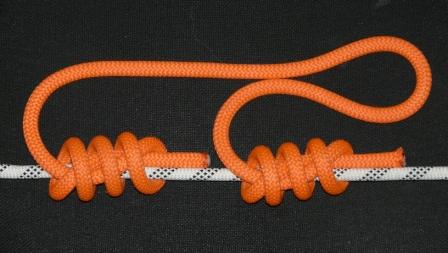
If we use two climbing hitches, the one above the other…
I used this idea with a pair of triple strangle knots, loaded in the reverse orientation, as shown in the attached pictures. The fixed loop and the distance between the two hitches is such that the upper hitch can not kick/push the lower downwards. The bulky knot on the loop forces the loaded end(s) to stay a little futher away from the axis of the main line, which is beneficial to the leverage and gripping power of the hitch.
By “climbing hitch” do you mean a hitch that can be used to climb a rope. like Prusik knots and many other hitches? I don’t have a good place to load a practice rope under full body weight. I tried a triple strangle knot. It will grip when reverse loaded, just as claimed. It will not grip when forward loaded. A climber must unload the hitches as he ascends the rope. I find one strangle knot hard to loosen. Two would be very inconvenient. Ease of loosening is the reason many prefer helical knots instead of Prusik knots.
Oh, my question was not about this particular hitch, which, besides being an almost jamming knot, as you have noticed, is also not holding as well as I would have expected from a true climbing hitch. My question was more general : Is there a point in using two climbing hitches on the same main line, instead of just one, for safety reasons ? Or the additional complexity outweighs the presumed advantages ?
A climber moves the hitches in quick succession - as quickly as he can. Doubling up on the hitches would be more than twice the trouble. If conditions are such that one hitch will slip, two hitches will also slip. Depending on the climbing setup, multiple hitches might limit the length of step a climber can take
I do not understand why. Each hitch would be attached to a different point on the main line, and loaded by half the weight of the climber. I thought that those facts would probably help decrease the number of such conditions, in the first place.
That’s not what I imagine happening. I imagine one of the knots taking all of the load at one particular time. If that knot fails, then the other knot takes all of the load at that point. In such a case, I understand what Bob is saying. If both knots are tied the same and if one knot fails on the load, then the other knot is also likely to fail once it takes the brunt of the load…substantially same conditions.
In contrast, if you want to have both knots under equal load at once, then the answer to your original question is definitely “double trouble” I think. To have equal load across the knots, the climber would have to provide high concentration on that singular task. The load across the knots would have to be perfectly balanced between the two knots for the load to be shared equally. Otherwise, the knot attached to the tighter line would take practically all of the load.
Yes, your reasoning sounds very convincing, indeed. Perhaps the link between the two hitches should be such that this balance would be always maintained in another, more clever/automatic way…so it will not require the climber pay any attention whatsoever.
I have tried the same idea with the tautline, the Prusik and the Blake s hitches, but I have not been able to figure out a simple, satisfactory self adjusting link till now. What is needed is, in fact, a rope-made trianglular friction mechansm, with its two vertices/hitches on two points of the main line, and the third one carrying the climber s weight - but in a way that will always distribute/balance the loadings between the two edges/legs as much as possible.
I do not expect a situation where a friction hitch will slip under full body load but not slip under half body load to occur frequently. If a hitch is slipping, the remedy is to tie a hitch that grips better, not tie a second hitch like the one that is slipping. Of course this should be done before starting a climb.
If two hitches are connected by a short length of rope, as pictured, the distance each could travel in a single move would be limited. This would shorten the climber’s step size. Furthermore, the extra hitches would take up a lot of real estate on the standing rope. I can envision a climber taking twice as many steps and moving twice as many hitches on each step.
One of the hitches could slip on the particular point where it is attached on the main line, because of local rope deformations there, and/or because it is not tied properly, but the other one, that is attached on another point, would come as a back up. Ships have two anchors tied on two anchor chains, instead one heavier anchor tied on a heavier chain…
Being connected by such a short length of rope means that they can be transported upwards as a single hitch knot, by the same hand. There are hitches that do not grip when loaded in the reverse than they are designed to be, like this one. You have only to push/slide the lower hitch upwards, and the upper one will be pushed upwards, too.