Hi All,  Just follow up, make it more clear and understand about how Butterfly knot function.
                   Thanks.  alanleeknots.

         Edit; The loop below is called  Lineman's Loop "ABOK # 1053" or Butterfly Loop.
                 Just getting old, old age issues start to come,. Sometimes I just don't know where I am.
                 Aug-21-2022. Thanks
Here is another variation on Dual Loops from a Single Butterfly. You would not want to do this with climbing rope, but with paracord and other cheap, slick synthetic rope you might want to double wrap the single Butterfly. Then you can turn it into dual loops using the method in an earlier reply.
If you are going (say with a hand wrap method) directly to a Double Butterfly, you do not want to double wrap both loops. The method described below only double wraps the first loop.
This thread would not be complete without showing how to get three loops from a single Butterfly Knot. Dave Root shows how to get a Triple Butterfly via a hand wrap method at his site.
https://daveroot.neocities.org/knots/Knots_MultiLoops.html
Below is how to convert a single into a triple. Admittedly, the easiest way to get the “coil” needed early in this is to do a little “hand-wrapping” but this could be done other ways. The trick when tightening the knot is to keep the three loops of equal size (if that is important).

Resurrecting this post because it deals with various ‘multiple eye’ Butterfly knots.
With the ‘Double eye’ Butterfly knots, there are 3 distinct geometric forms:
-
The ‘Double Butterfly’; and
-
The ‘Pseudo Double Butterfly bend’
-
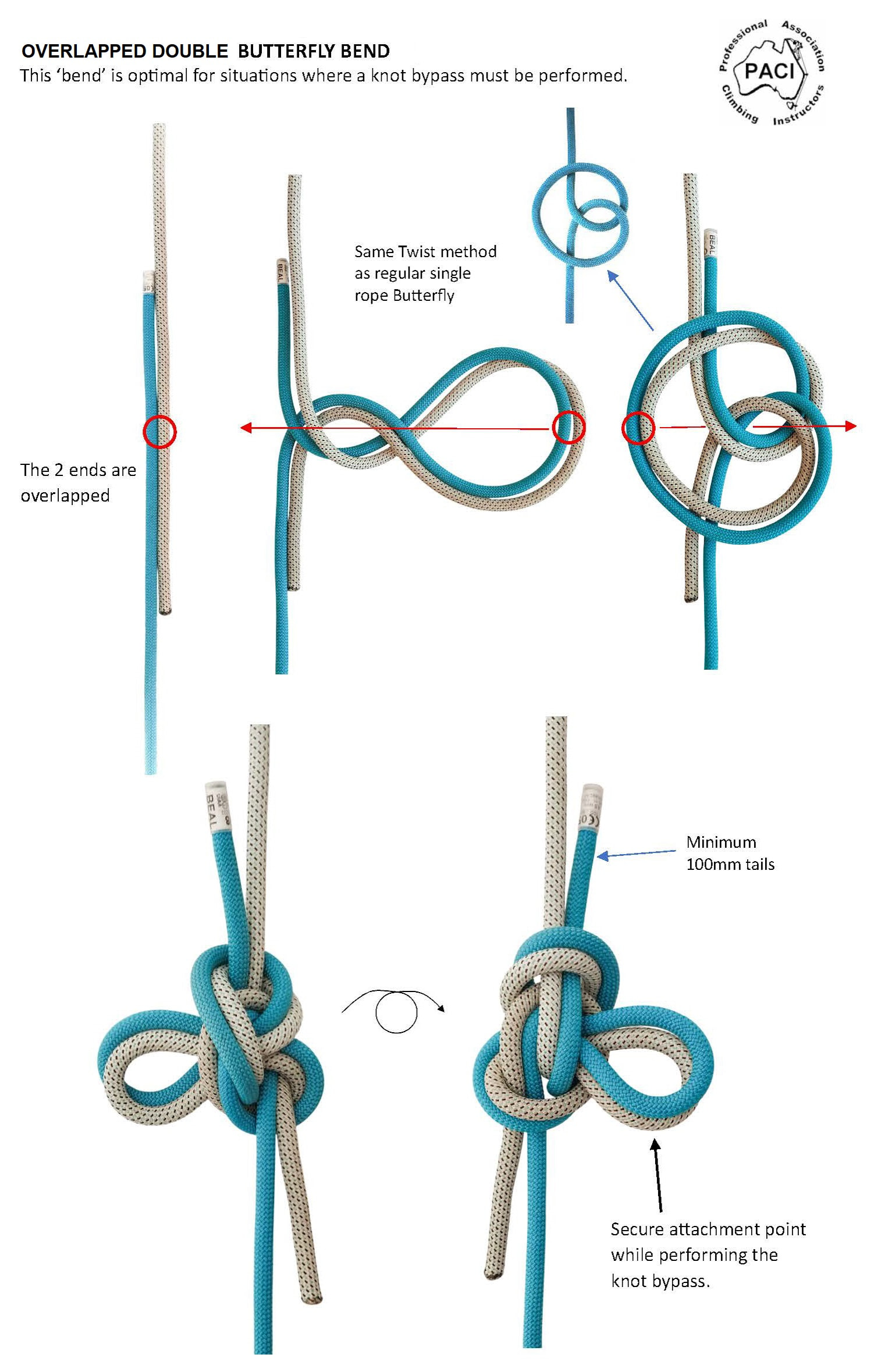
The ‘Overlapped Double Butterfly Bend’
All are ‘TWATE’ (Tiable Without Access to either End) - also referred to as ‘TIB’ (Tiable In the Bight).
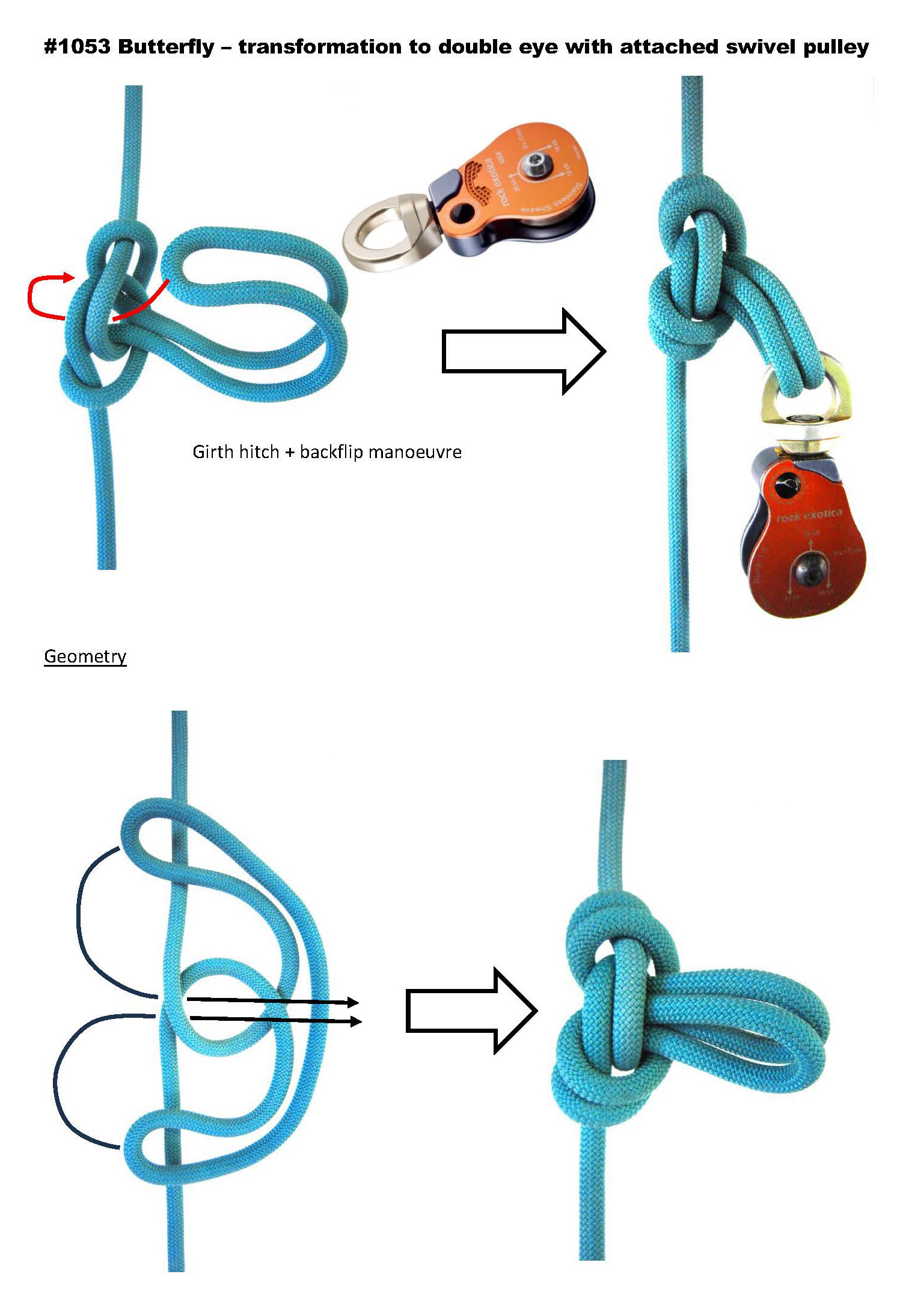
The ‘Pseudo Double Butterfly Bend’ is also known as a ‘Girth Hitched Butterfly’ - per Richard Delaney (2017) - where he shows it as a method of attaching a pulley to an existing Butterfly.
The ‘Double Butterfly’ has a different geometry.
Dennis also pointed to Dave Root website:
Link: Multi-Loop Knots
…
I would point out that using Richard Delaney’s ‘Pseudo Double Butterfly bend’ as a starting base, it is easy to derive the Pseudo Double Riggers Bend. This is done by reversing the direction of one of the ‘eyes’ - to arrive at the Riggers bend.
…
In terms of use cases:
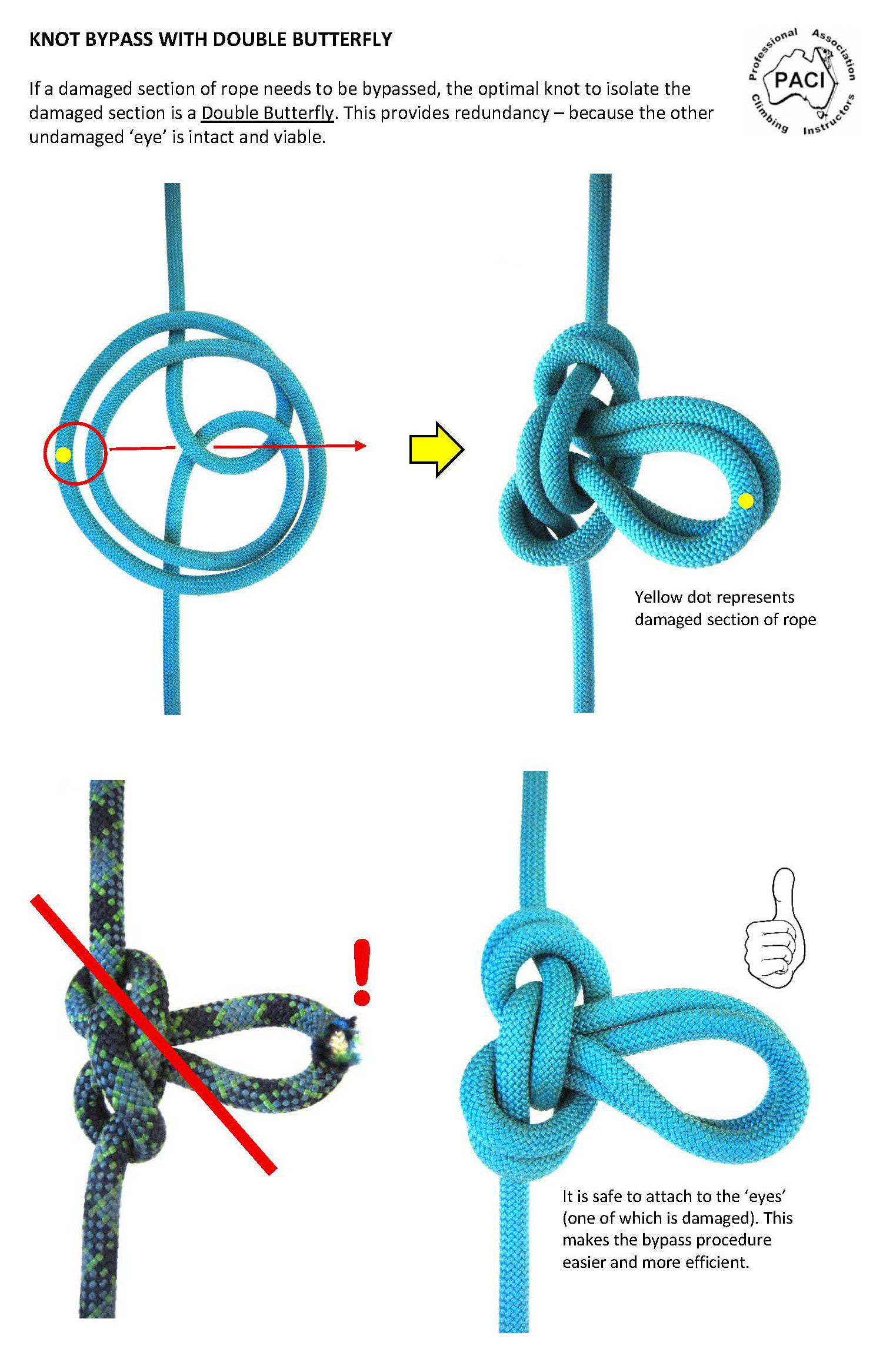
I would reply that the ‘Double Butterfly’ is the optimal knot for isolating a damaged section of single rope. Refer to image below. The ‘eyes’ provide a secure attachment point (one eye is fully intact) for the bypass procedure.
In the case where 2 ropes must be joined to create an overall longer length - the optimal knot is an ‘Overlapped Double Butterfly Bend’ (refer image). By default, a convenient attachment point is created for the bypass procedure.