There is a wrap-over-hand method of tying the dual-loop Butterfly (and the single one as well). Is there a way of converting the regular (single loop) Butterfly to a double-loop one?
Is there a way of converting the regular (single loop) Butterfly to a double-loop one?It depends on which variant you are referring to? One might also assume that you are referring to a 'TIB' transformation?
There are 2 known double eye variants…
The ‘Girth hitched Double Butterfly’ can easily be transformed into its dual eye geometry from the base #1053 Butterfly (via TIB - without access to either end).
As far as I am aware, the other double Butterfly cannot be transformed from the base #1053 Butterfly structure via ‘TIB’ methods.
Although, knot masters such as Alan Lee or Xarax might direct their minds to this challenge and figure out a way to achieve such a transformation (via ‘TIB’ method from base structure).
Note that both variants have very different geometries (refer to my image for details).
Thank you Mark - I had no idea that there are two ‘versions’ of double eye Butterfly. Do they both have similar properties?
There are more than two “dual loop” variations on a Butterfly. Ashley himself gave one way to transform a Butterfly (which he called a Lineman’s Loop) into two splayed loops. See ABoK #1100, where he gives the wrong name for the knot you start with (a Single Bight Loop Knot) but he gives the correct reference number (ABoK #1053). You can also find this in Phil D. Smith, Knots for Mountaineering, 1953. Available at
http://www.paci.com.au/knots.php
Smith labels it no. 19 Twin Loops (a method for reworking a Butterfly Loop to get two loops). Brian Toss in Knots for Boaters, 1990, calls it a Double Lineman’s Loop.
However, this double loop knot works best if the two standing parts come out of the knot parallel to one another. You can pull them in separate directions, but the spread knot doesn’t seem that great. The versions that Mark gave above work better for spreading.
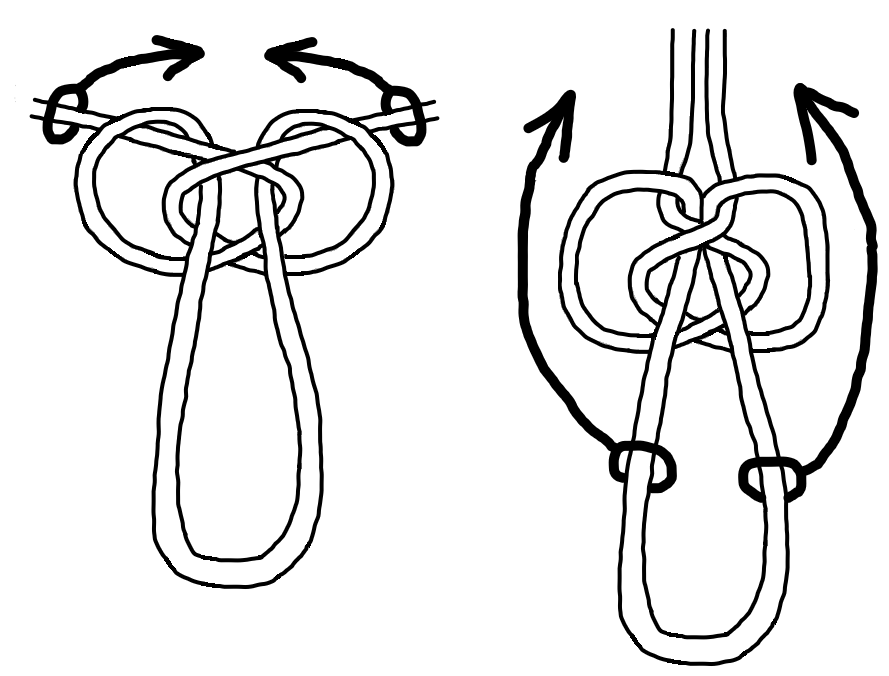
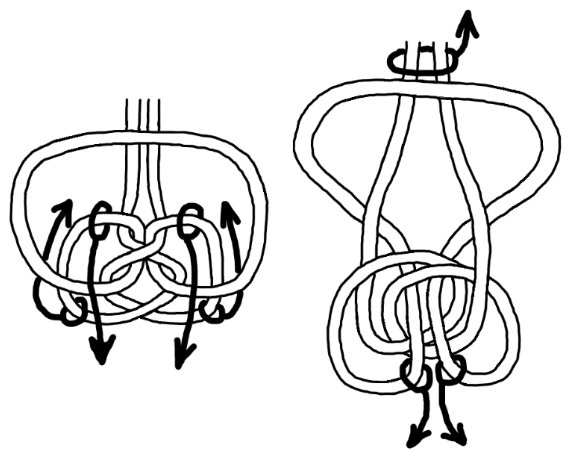
If your complaint is simply that you do not like to tie a Butterfly with a hand wrap method, here is a generalization of the “twist-and-flop” method that is given by Bushby and Ashley [ABoK #1053] that will give a Double Butterfly. I tried to label things much as Bushby did in his beautiful diagrams.
See also the excellent article by Richard Delaney
https://www.ropelab.com.au/the-awesome-alpine-butterfly/
where he has a delightful video showing how to tie what he calls an “Alpine Bunny” starting with a regular Butterfly. This effectively shows how to transform a Butterfly into the Girth Hitch Double Butterfly with the loops going through the ring in a pulley.
Cheers for that, Dennis!
There are more than two "dual loop" variations on a Butterfly.
This comment is entirely dependent on how you wish to precisely define what a 'Butterfly eye knot is!
In my personal view, #1100 ‘Double Splayed Loop’ from Ashley is not a ‘Butterfly’.
Also the knot at illustration #19 ‘Twin loops’ in Phil D Smith’s book isn’t a ‘Butterfly’.
In both cases, the knot is derived from a #1053 Butterfly - but this is not the same as saying that it is a Butterfly.
I also note that both authors were careful not to assign the name ‘Butterfly’ to their illustrations.
From a geometric standpoint (which is sort of like looking at its DNA fingerprint) - A ‘Butterfly’ consists of 2 inter-linked overhand knots of opposite chirality.
And, a ‘Butterfly’ can be through-loaded (biaxially, from SPart-to-SPart) while remaining secure and stable.
As far as I am aware, a ‘Butterfly’ is jam resistant in biaxial through loading profile.
The derived dual eye knots from Ashley and Smith are not stable in a biaxial through loading profile.
Furthermore, the geometries depicted by Ashley and Smith are actually a type of ‘Bowline’.
Look closely and you will see the nipping loops.
…
Interesting note: The ‘Karash’ eye knot can be derived from #1047 F8.
But this does not mean the Karash knot is a Figure 8 knot.
In fact, the Karash eye knot is a pseudo/virtual Bowline (nipping structure is based on a #206 crossing hitch).
So this is another example where a derivation can differ markedly from its starting base.
Inspired by Richard Delaney’s way to transform a regular Butterfly into what he calls an Alpine Bunny (Girth Hitch Double Butterfly), I came up with the following way to transform a regular Butterfly into a Double Butterfly. At first, I thought it was different from the Double Butterfly above, so I started to call it version B. But then I saw how it could easily be transformed into version A. When I tie a Double Butterfly with the hand-wrap method, I am not sure which version I get, and I do not think it really matters.
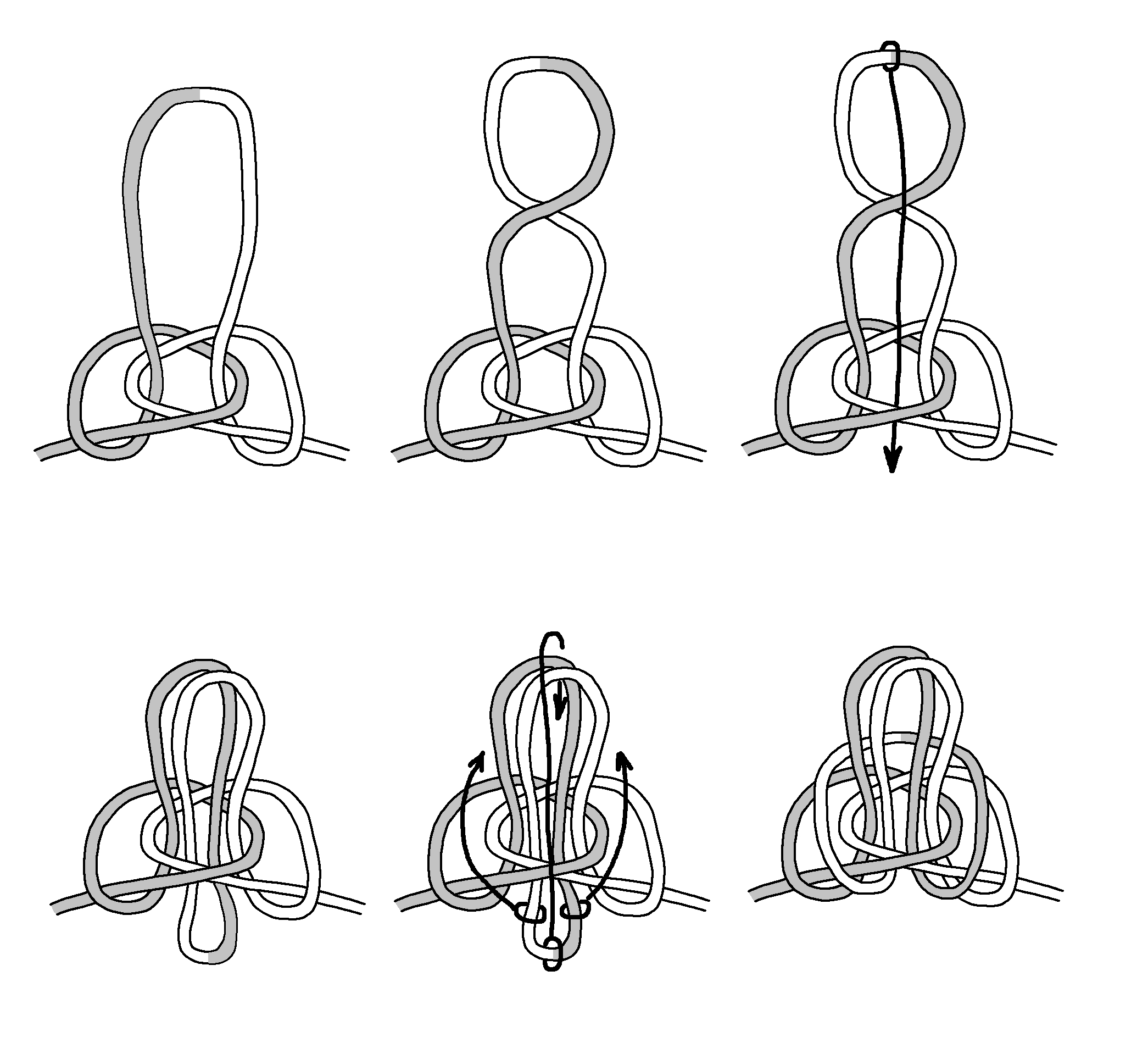
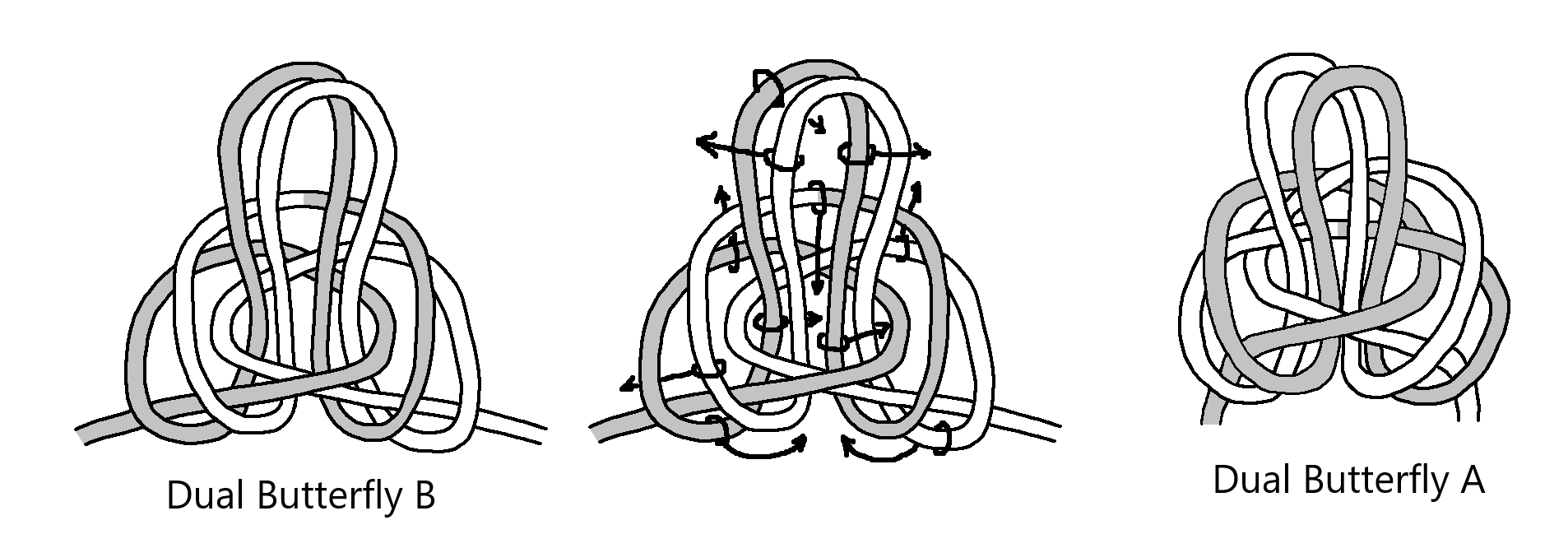
Hello Dennis,
I’ve been distracted by too many other things in life… and have only just had time to come back and revisit your work.
I must say that I am very impressed with your technical creativity!
You have proven that it is indeed possible to derive both double eye versions of a ‘Butterfly’ (beginning from base #1053 Butterfly).
This is just brilliant in my view 
I would like to ask you a question if I may…
Did you derive this TIB tying method independently?
Or, was the tying method already existing in some obscure literature?
Please note that I am not attempting to insult you or to denigrate you!
I just need to be 100% sure - because I am writing a technical paper on #1053 Butterfly - and I would like to acknowledge you as the discoverer of this ingenious TIB tying method.
What you have achieved is remarkable in my view…
Thank you for your consideration…
EDIT:
I’ve attached an image showing how a pulley can be attached to the so-called "Girth hitched double Butterfly’ (via TIB transformation from base #1053 Butterfly).
This is a very useful technique for vertical rescue technicians and rope access technicians.
Its simple and quick.
With the other double eye Butterfly variant, it would be nice if a similar method would work to add a pulley (via TIB transformation from base #1053 Butterfly).
I haven’t attempted the procedure as yet… just putting it out there for you or others to find a way
I’ll have a crack at it later…
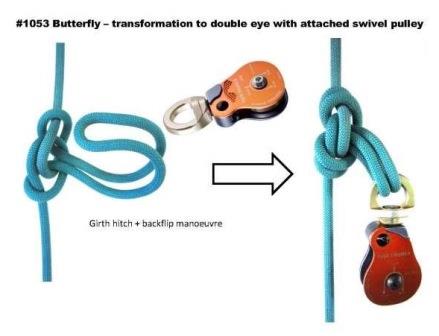
That pulley-swivel attachment knot is neat.
But for what other reasons is a double-eye, NSUE/midline
Eye Knot wanted? --for one can dispense with the asymmetric
butterfly and go with a symmetric version i[/i] or with
#1452, among others. These work well for using the two eyes
as one --with only one loaded, the other can draw too snug to
the knot body; used as twins, that doesn’t happen.
–dl*
But for what other reasons is a double-eye, NSUE/midline Eye Knot wantedRope access technicians and vertical rope rescue technicians work in a diverse range of environments and contexts. The ability to quickly and easily create a mid-rope anchor point (via a TIB through loadable knot), and also the ability to add a pulley increases the options that are available to the operator. Furthermore, the 'Butterfly' and its double eye variants are [i]biaxially through loadable[/i], which does not disturb an already deployed vertical rope's alignment. The deployed rope can also be tensioned (ie loaded), without adverse effects (the reduction in MBS due to the tied Butterfly is not critical).
As for your ‘NSUE’ acronym - not sure of your precise intended meaning? 'Non Symmetric …?
As for #1408 - have you found a way to make this knot TIB (Tiable In the Bight) - that is, TIB as an mid-line TIB eye knot?
I am of the view that the eye knot form of #1408 is not TIB?
Same issue with #1452, if this is tied as an eye knot, I was of the view that it isn’t TIB?
Are you suggesting that #1408 and #1452 can both be tied (with an eye) via TIB method (and have double eyes) - and be through loadable?
This would be quite remarkable…
EDIT NOTE:
I’ve attached an image showing TIB midline variants of #1425A Riggers bend and the Zeppelin bend.
However, neither of these structures are ‘Butterfly’ knots. The ‘TIB Zeppelin’ isn’t ‘easy’ to tie… (in my opinion).
The ‘TIB Riggers bend’ is easy to tie, but I don’t think it will find utility with rope access or VR technicians.
I think the double eye variants of the ‘Butterfly’ will find utility with these user groups…
NOTE: The ‘Girth hitched double eye Butterfly’ has a different loading effect on the knot core. Each ‘eye’ is
actually independent. Compare this to the other double eye variant of the ‘Butterfly’ where the the ‘legs’ of
each ‘eye’ distribute load across the knot core more evenly.
Again, it’s a SINGLE “axis” of tension running through the knot
(on it’s S.Parts, eye legs unloaded here).
As for your 'NSUE' acronym - not sure of your precise intended meaning? 'Non Symmetric ...?"NSUE" (French) = "TIB" (English) :: made to both get other than English into the nomenclature ("nouer' sans utiliser les extre'mite's") AND to avoid the problematic "bight" --which just doesn't have a happy (=consistent) existence.
> As for #1408 - have you found a way to make this knot NSUE > - that is, TIB as an mid-line TIB eye knot? > I am of the view that the eye knot form of #1408 is not TIB? > Same issue with #1452, if this is tied as an eye knot, I was of the view that it isn't TIB? [u]EDIT NOTE:[/u] I've attached an image showing TIB midline variants of #1425A Riggers bend and the Zeppelin bend.And these have dual eyes, opposed sides of the knot (and thus more like the insect than others --nb!). ::)
Probably tying in similar method, lay out a big “Z” / “S”
in the what-some-might-call-“bight”-but-not-others
… rope where the knot’s wanted,
and then work with the U-parts (some…“bights”…)
qua single end-parts to tie the desired knot,
having this share-bight-leg/part in middle
to mind and work around.
Yes, I was amazed/surprised/delighted to see these
knots take form; big surrounding of parts by the S.Parts
so must be in this gentle curving pretty kind to the rope.
But the eyes really are best used as one,
just to prevent the collapsing of a collar if around an
UNtensioned S.Part.
–dl*
@mcjtom
Please excuse me I have to go off topic to salute Mr.Lehman
@Dan_Lehman
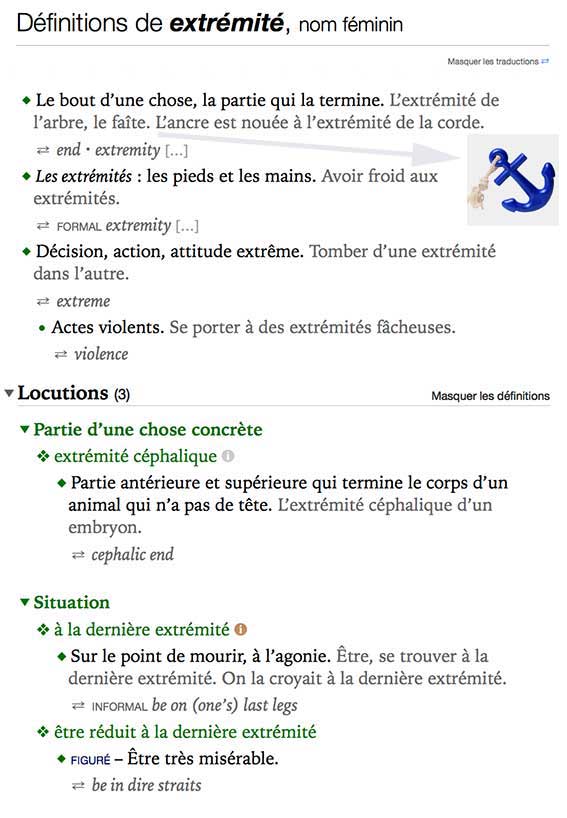
It is interesting to note that I (a native French speaker) didn’t come to know about the term “NSUE” until I read your post.
I take the liberty to insert the definition to provide some other meanings.
The English translation is italicized.
Whether you like it or not, English is the defacto language for science and research papers.
Link: https://www.researchgate.net/publication/329655421_The_Use_of_English_Language_in_Research
I am a native English speaker - meaning English is my first language.
I will therefore stick with communicating concepts/ideas/discoveries in English.
I suppose with the prevalence of cancel culture and woke ideology, (ie the tendency to call out others for anything you disagree with),
its probably just a question of time until I get cancelled
Anyhow, on topic (sort of)…
The term ‘TIB’ (Tiable In the Bight) works for me - there aren’t too many ‘edge cases’ where the concept is muddled.
I usually define ‘TIB’ as follows:
A knot is TIB if it can be formed without access to either end. The reverse also applies; it can be untied without access to either end.
The key underpinning concept is … without access to either end.
Another acronym… WATEE (without access to either end)!
I’m content to stick with English and use ‘TIB’.
…
The main concept behind the original post and I think most of the follow up posts is in relation to an eye knot that fulfills the following criteria:
- Is TIB.
- Can be ‘through loaded’.
- Have dual eyes that are superposed (adjacent/side-by-side) - and can be loaded together.
When I use the phrase ‘through loaded’… I mean:
Loading is in axial alignment with both SParts, which are 180 degrees opposed,
so that load transmits through the knot core in a straight line pathway.
This definition requires the presence of two (2) SParts (standing parts).
And the SParts must be in axial alignment.
Load propagates from one SPart, passes through the knot core, and continues through to the opposite SPart.
Load can be bi-directional (coming from, or going in both directions).
Not all knots can sustain this type of ‘through loading’ profile (or biaxial through loading).
#1053 Butterfly can… which makes it very useful to rope access technicians, and other users groups who engaged in roped sports.
I have used the term ‘biaxial through loading’… to make it clear that both SParts are involved.
Its not just a case of having the knot axially aligned… it also the fact that both SParts play a role.
It is also implied by these definitions that a ‘TIB’, through loadable eye knot can also exist mid-line.
Anyhow… I’m acutely aware that language and definitions are on trial here… and this is a technical knot forum;
and so when we start to drill down to granular details, there will be differing opinions.
Firmly on topic:
#1053 Butterfly is capable of sustaining a ‘through loading’ profile - without jamming or distorting.
Key points:
- The Butterfly can be transformed into a double eye variant - beginning from the base structure, without untying it.
- There appears to be only two (2) double eye variants of the Butterfly (this is not conclusively proven).
- It is possible to attach a pulley to one of the double eye Butterfly variants (the ‘Girth hitched’ variant).
- It is not clear to me if a pulley can be attached to the other double eye variant of the Butterfly (needs to be proven if possible).
Dan Lehman has raised the issue of #1408 and #1452… suggesting that these knots can exist in ‘TIB’ form with double eyes, and be through loadable.
That is, #1408 and #1452 can exist mid-line, without access to either end, and be capable of sustaining a through loading profile.
If this is true, then it also needs to be confirmed if a pulley can be easily attached (in the same manner as with the ‘Girth hitched’ double eye Butterfly).
Happy to discuss - since this is a technical knot geek forum
Another definable consideration:
Angle of pull on the eye/pulley, inline to the length of the rope distorting graceful flow of BFly the most
vs. lateral/cross-axis pull across the length of the line, distorting BFly the least, easiest untie too.
(but at worst angle structurally for column of length of line in trade)
.
Will go with a single axis of tension on (opposing)length of the line pulls.
A pull direction from center to each end, in opposing directions as then collectively an axis proper.
the gun shot, and it’s kickback, each starting at the initial point in opposing directions as collectively a loaded axis.
just as a tug of war across great rope is a 1D single axis of antagonistic/opposing pulls, Equal (forces) & Opposites(directionally).
can not have 1 direction of force without the other, to make 1D line the minimal force form
no 0Dimensional force that is a point w/o wife/pair; as must have E&O and potential oppression in direction for change to then have force of linear 1D(loaded rope line, gun shot) or radial of 2D(capstan or winch)or3D(explosion) forces, but no 0D force.
Indeed, which means we see already plenty of it.
Now, for an acronym which could be much of anything
–if it is used & well understood-- we can do what
English itself has done over time, and include some
non-English phrases.
The term 'TIB' (Tiable In the Bight) works for me --there aren't too many 'edge cases' where the concept is muddled.The problem is with the word "bight" --and it's smack in "TIB"--; that is what needs to be excised, for clarity (that doesn't depend upon gobs of context & likeliness for a meaning).
I usually define 'TIB' as follows: A knot is TIB if it can be formed [b]without access to either end[/b].Ha, I've been reviewing knots books on these knotty definitions, and you've scored a gain over most if not all :: i.e., that it is [i][b]access to the ends[/b][/i] and not specifically [i]using[/i] an end --one might do a BoaBight-like "back-flip" maneuvre that must go around an (accessible, thus!) end but cannot be said to be [i]using[/i] it!
Also, though I do NOT support “bend” as Ashley wanted (and many
copy) but use “(ends) joint” for that, it is so far I think alone Brion
Toss in his Chapman’s Guide to Knots (not Rigger’s Apprentice)
that he wises up to “join two ends” and nevermind how many ropes
–just one, if making a sling, e.g.-- are engaged! (–in which sling case
the definitions will have trouble with there being no “standing end”
in this case : both are “working”!).
The key underpinning concept is .... [i]without access to either end[/i].Which can put "NSUE" to question, as just noted.
[i]Loading is in axial alignment with both SParts, which are 180 degrees opposed, so that load transmits through the knot core in a straight line pathway.[/i]This definition requires the presence of two (2) SParts (standing parts).
And the SParts must be in axial alignment.
Load propagates from one SPart, passes through the knot core, and continues through to the opposite SPart.Load can be bi-directional (coming from, or going in both directions).
An assertion sure to win the applause of “one hand clapping”!
Now, for those not so clever, what would it mean to have an
(implied…) UNI-directional load?
.:. No, there is one axis of tension with those S.Parts in
“through loading” (also called “cross loading” in reference
to eye knots just randomly (w/o special consideration/design)
and loading the tail-vs-S.Part).
Though, loading the eye ALSO … and at some range of angles
to the S.Parts … and all can assume various angles per forces,
but still will be a condition separating wheat from chaff vis-a-vis
“mid-line” eye knots
–as you note (“Not all knots can sustain this type of ‘through loading’ profile”)
I have used the term 'biaxial through loading'... to make it clear that [i]both [/i]SParts are involved. Its not just a case of having the knot axially aligned... it also the fact that both SParts play a role. It is also implied by these definitions that a 'TIB', through loadable eye knot can also exist mid-line.Again, there is no sense to your implied 1-fewer-than-2 (uni- vs bi-axial); there is a single axis of tension (and it has been argued that loading the eye, e.g., brings in a SECOND axis ... though showing a trio of directions; Hmmm, I'm more of a 3D person on this : blow apart the union point and formerly attached pieces are going in THREE directions, methinks).
Dan Lehman has raised the issue of #1408 and #1452... [CONFIRMING] that these knots can exist in 'TIB' form with double eyes, and be through loadable. That is, #1408 and #1452 can exist mid-line, without access to either end, and be capable of sustaining a through loading profile. If this is true, then it also needs to be confirmed if a pulley can be easily attached (in the same manner as with the 'Girth hitched' double eye Butterfly).At least in this way :: make the twin eyes with one long, the other not-so ; reeve the long eye through pulley eye and other eye; then "backflip" it around to sort of make a *squared larkshead* to complete the both-eyes-contain-pulley state (this "square" structure would encompass all four eye legs, yes). (A scarier attachment would be having the shorter eye go through the swivel eye and the longer eye go through the shorter qua toggle (though some fright could be shed by taking this toggling eye around (backflip'd) the pulley, I suppose --but for which then one wants pretty close sizing of the longer one : enough to surround pulley without being much loose. (The load on the shorter eye would be sort of *stopper*-like, as it pulls through the swivel eye but then surrounds the other-eye-qua-toggle and not (as for a girth h.) U-turning back up & around itself.) ) ((And here is where knot-book pub.s rush out the big-font red signage stating no responsibility for accuracy and please --no, you MUST-- consult with exp'd knot tyer before using anything in the book you've just paid $$ for!! :o ;) ;D ))
–dl*
Hello Mark,
I have been away for a while as well (quality time with a grandson!). I did come up with the tying method in Reply #7 by myself, although I am sure others could come up with it if they had noticed the request. Of course, I was greatly inspired by the tying method of Richard Delaney for the “Girth Hitch Double Butterfly”.
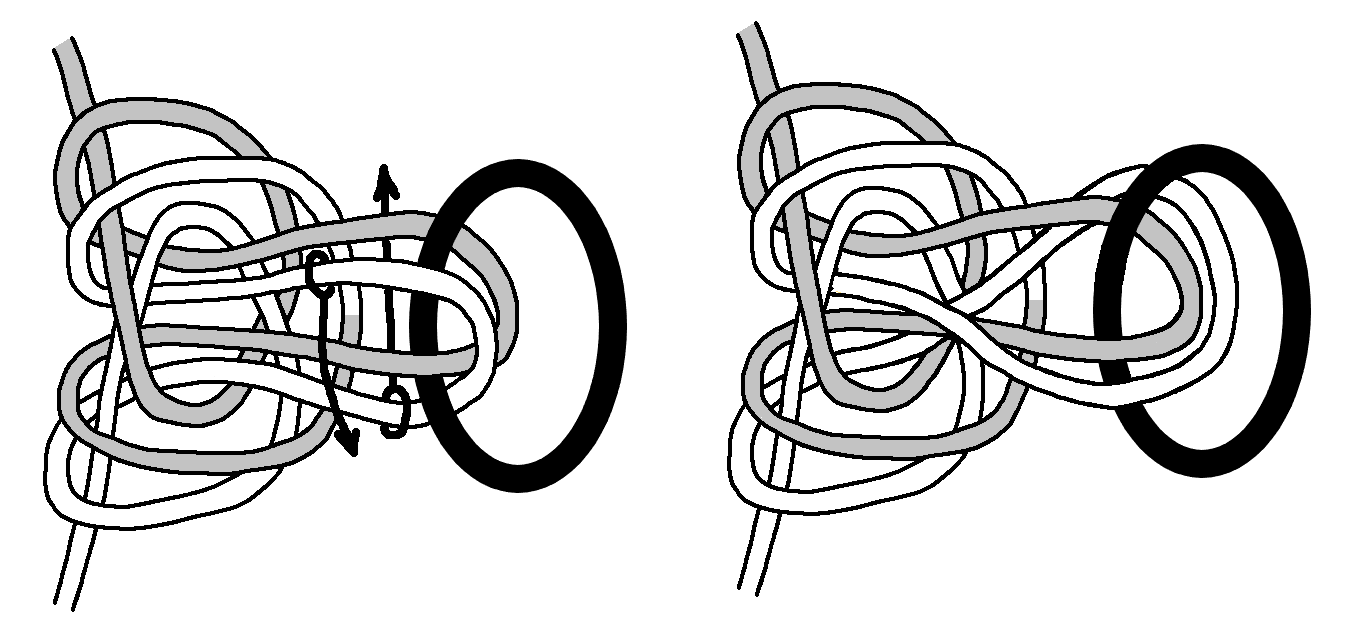
I have also been trying to come up with a way to insert a pulley or ring for this variant as well. It would be nice if it would turn the pulley or ring 90 degrees compared to the Girth Hitch variant. Below is the best I could do. You simply insert the device and carry out the steps shown in Reply #7. But this leaves the ring in an awkward position between the two loops. The trick is to do a half twist of one of the loops, much like the half twist that Wright and Magowan insist should be done in a single Butterfly Loop. (It does not seem to matter which one you twist, but you only twist one.)
I also thought about applications for this. When you tie a Trucker’s Hitch, you usually tie the Midline Loop each time in a different position to adjust for the size of the load. But if you are tying the same load every time (say a canoe or kayak on the top of your car), you might want to leave the Midline Loop. Tying this Double Butterfly with a Ring would cause much less wear on the rope, and it would give you much less friction to get closer to the 3-to-1 mechanical advantage when you pull through the ring instead of a rope loop.
Thanks Dennis,
We’ve now got 2 different ‘thread topics’ dealing with double eye Butterfly’s… its not easy to keep track of developments.
I feel you are very close to a way of figuring out how to avoid overlapping/crossed eye legs (in one of the double eye Butterfly’s).
I remain optimistic that there might be a tying method (starting from base #1053 Butterfly and without untying it).
Then again, I am always the eternal optimist…because the human mind seems to have no limits on what it can imagine!
i use Bend as you de-scribe as ‘pirated parroting’; but please forgive w/o plank walking as is for clarity and consistency across the (p)ages and newbs.
But internally i see and describe to self either a termination or continuation of the rope force line in more precise speak.
and really go with rope was loaded on great ships, but were called a line in typical usage.
That is a line of force at the end of the day to me, that the unused rope loading onto great ship does not have, but only promises the capacity of. The geometry reigns all thru rope works (to include knotting) from there !
.
A base example to me is primary rope lessons w/Half Hitch(HH) as a termination of rope(Hitch type) force line or continuation of same as if a Bend type logic of the node(node: deformity swell in straight line run; as in plants)formed as pass-thru/continuation.
If take the nip point of continuation HH is like a dual shared termination to that single nip point from either input/output side. Each leg could be HH termination type w/o Bitter End.
From this view the continuation is a dual in/out terminating HHs, that forms single axis thru the force line.
The continuation line parts will be of greater tension than the ‘sideline’ ring formed, as it is not in this ‘electric’ linear path that the ends line up to. Until with too long a collar in Bowline as to allow the fault of Sheepshank and get the roll out of the continuous HH (90, 180, 90 degree geometry parts) to just a combined sum 360 that is now folded down into inline with the line of force, and so now tension increases thru the loop, where was lesser before. There is no ‘shorter electrical path’ to skip the loop with; now that loop is folded down into the linear of force. i find it much better to look at force as in more a liquidly flowing electrical sense thru rope pipeline as wire, and as such takes opportunities to pass from one rope part to another, even if partially, to leave then less behind of the finite source force.
.
A sling crosses a line to me here tho bro, to go from a linear to radial device…
Choked tho, i do see 2 SParts, as do in Girth Hitch. Difference is the SParts in sling are self adjusting set on a hook, girth does not have self adjusting SParts, so must manually set/guess this key point, then should only use at that angle for maximum sharing between the 2 SParts as legs of support. The sling by contrast is microscopically self balancing adjustment on the fly at many angles of pull but still 2 legs of support, sharing load evenly, as ports force as SPart(s) into the controlling arcs, as like gas hose into car to power/energize i always think. So to me, a SPart in ‘Tensionless’ Hitch and HH both start at load and end halfway around round host where the primary arc180 starts in both. To model have formed in head SPart is a linear, even if deformed in HH, as the pull of the load at one end of SPart and that entrance to arc180 as primary arc are in OPPOSING directions for that specific rope element. Does not need to be rigidly aligned , as no rigidity to the cross axis, so can be just DIRECTIONALLY opposing to qualify, is less efficient tho than ‘Tensionless’.
.
An assertion sure to win the applause of "one hand clapping"!Kinda an alma mater please(might explain a lot.. :P ) Of c(o)urse Dad artfully schooled in the sound of 1 hand slapping as well(he was 5th Chicago cop in the family, nicknamed by piers as the disciplinarian; witch too might explain a lot :-X ) .. .
Now, for those not so clever, what would it mean to have an (implied...) UNI-directional load? .:. No, there is one axis of tension with those S.Parts in "through loading" (also called "cross loading" in reference to eye knots just *randomly* (w/o special consideration/design) and loading the tail-vs-S.Part). Though, loading the eye ALSO ... and at some range of angles to the S.Parts ... and all can assume various angles per forces, but still will be a condition separating wheat from chaff vis-a-vis "mid-line" eye knots --as you note ("Not all knots can sustain this type of 'through loading' profile")Can have uni-direction if want i guess of travel if no force against i guess... but NOT force, that needs antagonistic twin, 'dueling' points. To me can cross-load Bowline eye, to use as if Binder from internal force w/o SPart loaded. >>but spread eye and as also hang from SPart is a bit outside as 2 separate handled forces, sharing a system. Best clean simple view would be as separate function models.
Again, there is no sense to your implied 1-fewer-than-2 (uni- vs bi-axial); there is a single axis of tension (and it has been argued that loading the eye, e.g., brings in a SECOND axis ... though showing a trio of directions; Hmmm, I'm more of a 3D person on this : blow apart the union point and formerly attached pieces are going in THREE directions, methinks).Totally agree, 2 OPPOSING directions (compression or tension) constitute a loaded axis, can leverage a 3rd direction on separate axis, rooted from the resistance of the primary axis. Working in dimensions, there is no Zer0 dimension point of force in my terms; Must have at least 2 points of Equal (force) & Opposite (direction) here for force, so at least 1dimensional, no uni! The line of the loaded axis in rope gives these competing, antagonistic, dueling twins. This gets more complicated when not a flexible class like rope, but rather a rigid that has resistance on the cross axis AND can load in tension (as rope only does) or compression. So, from that view, rope gives clearer lessons in these things; with less complications, but we tend to start with rigids in understanding, and then this simpler now seems a twist i think (psyche self is simpler and go on)!! It is rather counter intuitive to our initial L-earnings that rope works by rigidity against force, as it lays slack in your palm. But in use is a rigidity against (or for) physical and/or force displacement as any other structure ever. Rope is just easier to form for our repeated usages than other substances; but must follow the same rules of rigid architecture geometry along it's tensioned linear length. . Bi-axial in plants etc. is NOT a continuous line or plane , but rather separate parts, in separate, not continuous linear single dimension(s). Thus stem it self is not biaxial, but rather alternating parts to either side of stem dichotomy are biaxial. Even if somehow could find a straight line to the separate sides of stem, they would be fed separately, structured and therefore shear separately they are not a continuation of each other as in rope line. . i believe that rope can physically lace in 3Dimensions, but only handles force in 2dimesnions force wise, or forms another system. i think this is as Ashley shows/represents in choice of right angle to host Hitch (1D hold host and load in 1 line))or lengthwise, 2 dimensions(hold host and hold load). Simplest right angle Hitching example:primary dimension linear is the load force as standard, the 2nd deflected force overrun of byproduct side force not aligned properly to primary linear dimension(for accounting purposes). Would have to have cross-axis rigidity on the 2nd Dimension to need the 3rd Dimension deflections of force as in rigids. But rope as part of flexibles class definition does not have cross-axis(to the linear length) rigidity. Rope length in linears can be shown as cosine work, cross axis sine by product. Rigids could then have a byproduct(sine) of the byproduct(sine) as 1st sine is rigid; but not in rope/flexibles. In flat rope/webbing do have a scrunch across width consideration of deformation, but is not a Native rigidity to then fight and have force byproduct to show. Round rope does not have this problem as the cross section profile across length is the ultimate equilateral(in 2D) of circle , where webbing has flat and wide. Radial or Linear again here is key. .
Overhand Knot is Natively a 90degree architecture to me, thus wrenched full 90 degrees to linear flat is thus worst position of pull and then around 1 diameter, and so jams hardest and weakens that rope part in the chain the most; in a parent system that is as strong as that weakest link…
The interlaced Overhands to extrude BFly works in 90degree Overhand to each side of eye together as a 180 flat continuous line and does not shrink to own diameter. Similar view as HH termination or continuing model of shared terminating nip point; only here have input/output Overhands instead (seen best eye onloaded). But, inherits that it is still best if the eye part of each Overhand was pulled @90degrees if any, or jams more easily from the still errant angle of lengthwise pull on Overhand(s), but BFly so sturdy shines thru such usage in Trucker’s making only harder untie, and probably weaker structurally for the violation from premium position. It kinda so good, can fool, but must follow same rules as then also stands as an example of.
.
Intertwined Overhands of BFly and Rigger’s kinda overconcentrate force, unceasingly at high loading.(Zepp and faux form side by side SParts not intertwined, not over focused)
The BFly has a less rigid side of some relief to the overconcentration with both SParts to either front or back;
Rigger’s has most rigid SPart(s) to either side as like front and back guards to the overconcentration w/o any softness/relief and jams by contrast i think.
Zepp gives the both side guards of rigid SParts as Rigger’s, but is not over focused as a softener, so works super, but faux form has the same side by side but then the same open /soft side of no rigid SPart guard (both on other side), as like a double fault that fails as xTension is increased.
.
part segregation questions
produced eyes >>Will a doubled eye form hold 2x as much??
Linear length >>If unloaded dual eyes, is the linear itself stronger from the softer bends?
     Hi All,  Here is how I descript Overhand knot.  Thanks.

     https://www.dropbox.com/s/wvqkedw3s9zah7x/Tie%20Overhand%20knot.MOV?dl=0