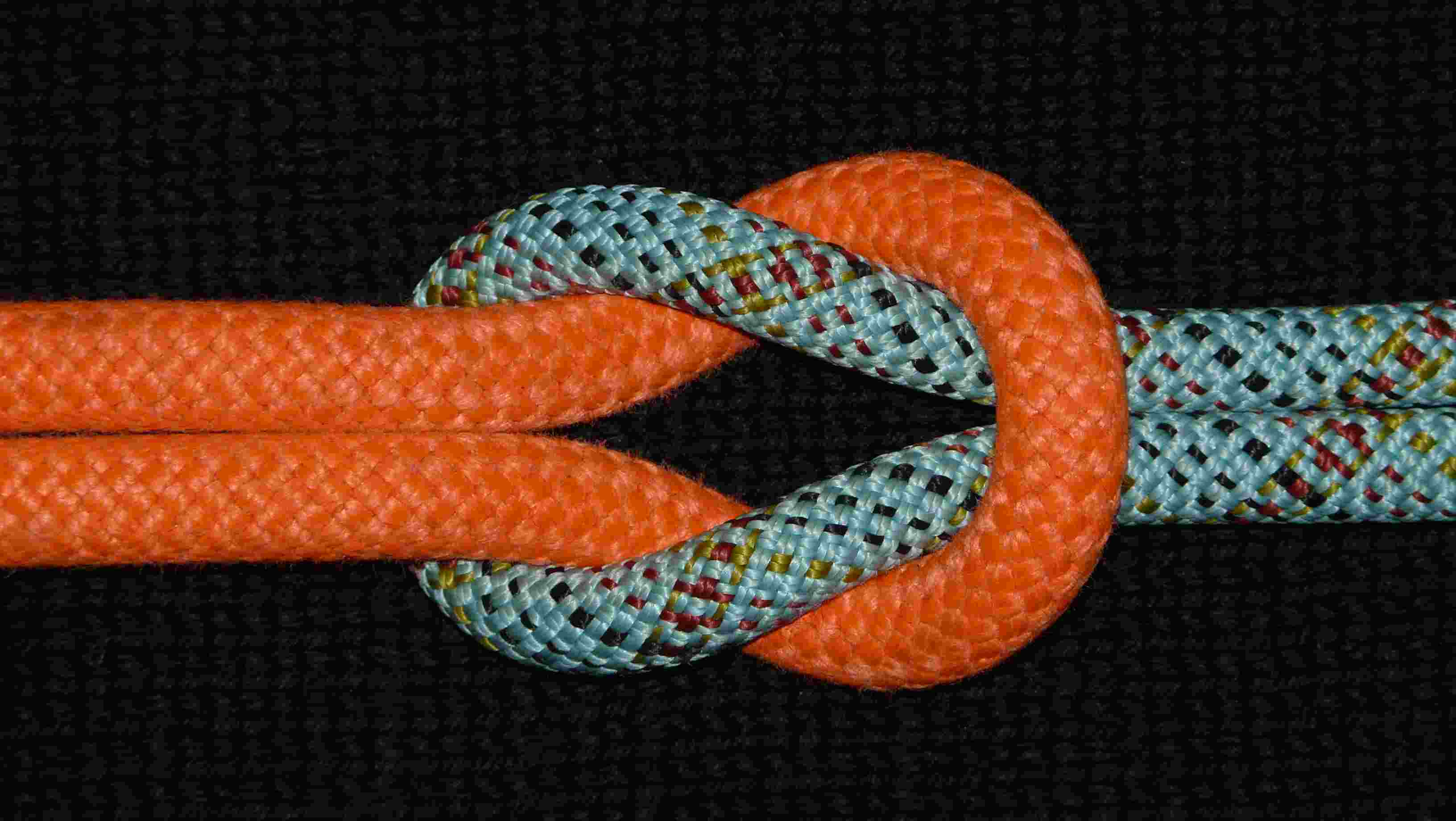
[ In my mind ] ropes are, by definition, extended objects - but knots are local formations of those objects. Ropes can be very long - but knots are more or less compact “nubs”, tied on a relatively small area / short segment of them. A knotted rope is a however long object, with one or more knots tied on one or more points/areas of it. I usually think of “a knot” as having “ends” that are not very distant the one from each other. So, one knot tied on a long rope is not as extended as the rope ! That is why I do not like the term “eye-knots”, for the “loop knots” and/or the “loops”. A “loop” can be an extended formation of a rope, with a knot ( the “loop knot” ) at one point/area of it, and a bight with two short or long legs. Now, the word “eye-knot” can mean either this “loop”, the “loop knot” and the two legs of the bight taken together, or only the “loop knot”. In the former case, we can have extended “eye-knots” with long legs, that is, extended knots…(? ? ? ) In the later, we can not speak of eyeknot-to-eyeknot compound knots, because, in such a joining of two ropes, it is the bight of the one loop that is linked to the bight of the other loop - the “loop knots” themselves are not in any contact to each other.
Having said that, I do not mean that the words “loop” and “loop knots” are perfect either… Perhaps we should establish another term, to describe what a “loop knot” is : an entanglement of two segments of a line with the help of one mid-line knot, tied on one or both of them ( the “loop knot” or whatever other word one would use), when those two segments of the line share one end ( i.e., one end of the one segment is also the one end of the other segment ).
The term “eye-knot” is not so bad - but the term “eye-to-eye” knot is - and this “eye-2-eye” neologism is even worse !  ( I do not know if people that speak English as their mother language distinguish the “to” from the “two” ? I suspect that the initial difference is always there, but it is diminishing from one generation to the next … Has "night "became “nite” already ? )
What is an “eye-to-eye” knot ? A “bend” ? But then, where are the “eyes” that are linked together ? A “bend” can be two very convoluted segments of two lines joined together, where we can not see two “eyes” - or we can see more than two “eyes”. There are some simple bends where the “eye-to-eye knot” term is descriptive, indeed, but, for most “bends”, it is a supposedly descriptive term that offers no comprehensible image.
On the other hand, the term “bend” has a merit : It underlines the fact that, for two lines to be joined together ( without the use of fasteners, glue, etc.), each one of them should be bent, to a more or less degree - because friction is enhanced on the curved, bent segments of the rope, and ropes (that are not already topologically linked) can only joined with the help of friction. This is a comprehensible image of two convoluted segments of lines joined together the word “bend” is able to convey.
I suppose that, in the course of history, there were many words in the English language to denote the knots that join two lines. Perhaps one of them would be much more descriptive for what nowadays is called “bend” - than this “eye-to-eye knot” term.
 ).
).