Favorite Way to Tie Trucker's Hitch

Keystoner, there is no need for Andy to take another look. I already went back-and-forth with him about one hundred times on this issue. He sees what he sees.

Very true, and also agreeing with you that it does not really matter, the real question being which is preferable (which question you have already given your detailed answer to).
Nevertheless, I have two treats for you guys, which may highlight where we see differently.

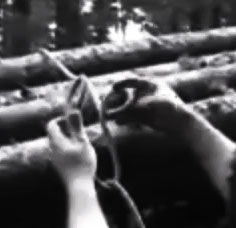
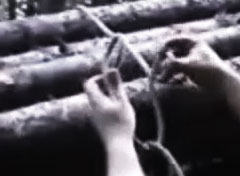
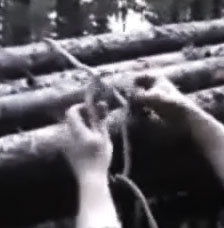
First, please look at the three attached pictures, excerpted from the video, with the contrast increased. To see something, you will probably have to click on each picture.
These are three consecutive shots.
==> The first one shows Lee having completed what I call the single twist (same as my picture # 1 from today I believe).
==> The second one shows Lee… starting to twist that first nip again, clockwise, i.e, starting the double twist.
==> On the third picture (blurry, sorry), he has completed the double twist, and is about to push the bight through it.

Second, if you guys have a media player, please take a look at this excerpt from the video, showing exactly where I see the double twist happening.
[Apologies in advance to readers from the future, as I will delete this at some stage for copyright reasons, although I believe such an excerpt constitutes “fair use”.]
If your computer doesn’t play this file, you can download PotPlayer (fabulous for PC) or VLC (for Mac or PC).

Looking forward to your thoughts about what we’re seeing differently here and why. I might yet rally to your camp.

@Keystoner, the most confusing thing about the southern hemisphere is that mirrors invert top and bottom instead of left and right. :wink:

Peace,

Andy


Lee01.jpg

Lee02.jpg

Lee03.jpg

Perhaps even better, my friends: please download this video—the segment where I see the double twist, in slow motion.

Agreed. Lee has just completed his first 180 degree clockwise twist. At this point I will define the opening in the nip facing the camera as Side 1 and the opening facing away from the camera as Side 2. Side 1 is the top facing up and to the left; Side 2 is the bottom facing down and to the right. Lee is about to twist again. His right index finger is on top of Side 1; his right thumb is on the bottom of Side 2.

For the sake of agreement, I’ll agree to call this the start of a “double twist.” In this picture Side 1 is now facing to the left and Side 2 is facing to the right.

This picture is horrible, but he has definitely not completed another 180 degree twist. If you follow the video closely, you will see that Lee pushes the bight through Side 2 and out through Side 1. His “second” twist was just enough (I said 90 degrees previously) to expose Side 2 to the bight. He does not twist so far to expose Side 1 again in order for the bight to enter through Side 1. Please try to see this.

It couldn’t have been more clear. What side does Lee insert the bight? (Hint: Side 2)

Hi Keystoner,

Thank you for looking at these pictures and the video in detail.

Yes, I do agree with you that the man pushes the bight in through side 2.

On the slo-mo, I see him as having nearly completed another 180 degree twist (maybe 160), but even if it’s just another 130, that’s immaterial: if he goes in through side 2, that is the exact same as my picture #2 of earlier today, in other words, what I have been calling a “double twist”. Going through side 1 would be a single twist (picture #1). I say this after double checking rope in hand, looking at picture #2 and side 2 on the screen.
Does this make sense to you, or do you think I am missing something?

Anyhow, between your “side 1 / side 2” and my “picture 1 / picture 2”, it seems like we may have found a “language” to understand what each other means—and we might be near a resolution.

Wishing you a beautiful day,

Andy

Yes, but I’m determined to show you the light.

Excellent. Now let’s compare your two pictures from Reply #208. Please refer to the first picture for which you say, “The first one is what I call ‘single twist.’” I’ll refer to that as “Andy #1.” Let’s compare Andy #1 to the first Lee picture, “Lee #1,” from Reply #219. In Andy #1, a single, 180 degree, clockwise twist has already been performed. The nip is identical to that in Lee #1. Side 1 and Side 2 are as I defined in Reply #221. In Andy #1, Side 1 is facing to the right and Side 2 is facing to the left. Your right hand has entered the nip through Side 1 and is about to grab the bight. You are about to pull the bight through Side 2.

Your bight enters the nip through the same side as it did for Lee. The result is a single nip, identical to that in a Bowline, with the “rabbit”/bight entering the nip in the same way.

I do NOT agree.

As I understood you, all along you have been using the term “topologically equivalent” to refer to Lee’s combo as being equivalent to ABOK #173. As I now understand, ABOK #173 involves two nips, a la a Clove Hitch, like the Asian fellow, the Australian fellow on the porch, and TMCD’s description in Reply #181. As Andy has asserted to you several times, Lee does not explicitly tie a two nip, ABOK #173, formation.

“Mathematically,” what does Lee tie? I submit that he ties ABOK #172 + half hitch lock with the bight. With the direction Lee ties the bight, all along I agreed with you that it is “topologically equivalent” to a Clove Hitch. But if you are now saying he goes around the WRONG way, I do not see it as “topologically equivalent” or I do not understand your use of that term.

[This will be hard for me to explain.]

Lee’s nip: Equivalent to a Bowline nip, the nip is formed with the running part passing OVER and to the LEFT of the standing part.

Lee’s half hitch lock: The bight passes behind the standing part from right to left, comes around passing OVER and to the RIGHT of the standing part.

In other words, there is one pass (with a single leg) over and to the LEFT of the standing part, and one pass (with the two legs of the bight) over and to the RIGHT of the standing part, just like a Clove Hitch. Going around in the opposite direction results in a topologically equivalent Cow Hitch. As I said, I’ve tried both directions (in small climbing rope around the handles of my desk drawers). Neither seemed advantageous but I’ll stick with Lee’s directions, since I can visually see the Clove Hitch formation. (Note: when I refer to Clove Hitch here, I am not referring to the explicit two nip Clove Hitch formation of ABOK #173.)

Hello Keystoner,

Thank you for trying to illuminate me.
Please allow me to respond, and perhaps reciprocate?

You are about to pull the bight through Side 2.

Yes, that’s right, that’s what happens on picture #1: I push the bight through Side 1 and pull out of Side 2.

But that is not what happens in the video.

For what happens in the video, let us quote you from reply 221:

If you follow the video closely, you will see that Lee pushes the bight through Side 2 and out through Side 1.

In other words, per this quote, you see Lee doing the opposite of what you see me doing in picture 1 (per the first quote).

Now may I please ask you to consider the statement “Lee pushes the bight through Side 2 and out through Side 1”: I propose that this is exactly what happens in Picture #2: I push the bight through Side 2 and pull it out of Side 1.

As you said yourself, on Picture #1, the part facing me is Side 1. Therefore on Picture #2, Side 1 is at the back. The bight enters Side 2 and comes out of Side 1. Same as what you see Lee doing.

Hope all is well in Chicago.

Wishing you a relaxing evening,

Andy

Hello Mate,

I don’t know if you know much about Chicago politics, but you’d fit right in. That was pretty slick the way you turned that on me.

No, you are about to pull with your right hand/push with your left hand the bight through Side 2 and pull with your right hand out Side 1.

Since I know you disagree, you must have disagreed with me when I wrote this:

In Andy #1, Side 1 is facing to the right and Side 2 is facing to the left. Your right hand has entered the nip through Side 1 and is about to grab the bight

We really can’t proceed unless we agree on the nomenclature/sign convention. Take a vertically standing line and hold it in front of you with your left hand. With your right hand, grab the line and twist forward 180 degrees, forming the classic Bowline nip (“hole” if you will, but I now find that term particulary amateurish) which now sits to the right of the vertically standing line. You are facing Side 1 of the nip. Side 2 faces away from you.

Do you agree that I have not changed my sign convention? Do you agree that what you see is identical to Lee #1? Do you agree that in Andy #1, which is viewed from the right side, your right hand has entered the nip through Side 1 and has exited through Side 2?

If you don’t agree with all those questions, I may just have to go on Walkabout to figure out another tact with you. ;D

When I watched the original video several times I also concluded that there was a double twist BUT it’s a bit like reading something and seeing what you expect rather than what’s actually written. In the video the nipping loop is the opposite way round to the way I naturally tie it (in fact I found it quite awkward to replicate) so that the nipped bight has to be inserted from the back - achieved by twisting the nipping loop - or else there would be no nip at all as Knot4U has said repeatedly - and I owe him an apology for looking but not seeing.

I’ll stick to the span loop though and bow out of this discussion now!

Barry

Trust me, out of respect for you, the whole double/twist discussion, and for my own knowledge, I have EXHAUSTIVELY watched Lee’s video and yours. Remember I noticed that you and Lee tied your bight in opposite directions? I watched that thing so many times that I cannot let it go with Andy either. I’d rather not get into a drawn out discussion with you about what you and I now disagree regarding Lee’s video, but I maintain that your video demonstrates a topologically equivalent Cow Hitch.

With which part of this do you disagree:

[b]Lee's nip:[/b] Equivalent to a Bowline nip, the nip is formed with the running part passing OVER and to the LEFT of the standing part.

Lee’s half hitch lock: The bight passes behind the standing part from right to left, comes around passing OVER and to the RIGHT of the standing part.

I’m a knot hack but I understand everything you said here. I understand what you mean by “topologically equivalent.” However, I think it is very misleading, and confusing to novices, to equate [ABOK #173] ‘=’ [(ABOK #172) + (Half-Hitch lock)], even though I agree that ‘=’ (equals sign with quotation marks) means “topologically equivalent” (provided the Half Hitch lock is taken around correctly). To me, properly, [ABOK #173] = [Two Half Hitches] = [Clove Hitch] = [Two Nips], with no quotation marks around the equals sign.

Thank God!

No, I was not aware. I’m trying to see this. Are you pulling the bight up straight after you tied the locking half hitch with it? I don’t know how to visualize the standing part going around the bight at this point. The bight is going around the standing part. The only time I see the standing part going around the bight is with the single nip.

Yes!

“back” = Side 2

This is where you are very misleading. Although your TH may be “topologically equivalent” to this enlightening-to-me ABOK #173 figure, it does not look like that at all since you actually pictorially tie [(ABOK #172) + (a Locking Half Hitch)].

The nipping loop in the above figure would be formed with a counterclockwise right hand twist. Lee’s ABOK #172 nip is formed with a clockwise right hand twist. [You don’t need to repeat your consistency argument with respect to counter/clockwise. I understand that.]

In your video, you tie your nip in the same direction as Lee. You tie your locking half hitch in the opposite direction as Lee.

Now we’re back to…

The discussion on this issue can't go any further if we are at polar opposites on this fundamental concept.
and I don't see any point to continue. Do you?

Andy, where are you?

Check, check, check, check.

Yet your video demonstrates a Cow Hitch. We can agree to disagree, you know?

Hi Keystoner, hi Knot4U,

Sorry about the delay, out all day.
Gentlemen, I have good news: a resolution (I hope) of the single vs double twist question.

By looking at the two pictures below, I had an epiphany.
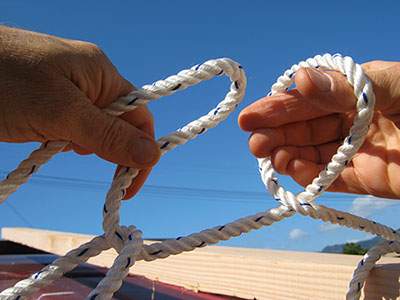
They are the picture of my single twist (the shape I produce with one single clockwise twist of my right hand), and the picture of what the man produces with one single twist of his right hand. I had always assumed that these are the same (we both seem to be doing the same motion in a clockwise direction). Looking closely at the two pictures, I see that they do not show the same loop. [Edit to clarify:] On mine, the “down rope” crosses behind. On his, it crosses in front.

1. I now see that I was wrong about the morphology of what the man is tying, and that you both were right about that. He produces what I have been calling the “single twist”.

The reason is quite subtle, and, not to diminish your “rightness” about the overall question in any way, there is one fundamental aspect where I believe I was at least as right as you guys, and I believe this was the source of the problem:

2. To produce the “single twist”, the man twists twice—nearly exactly the motion I use for the double twist.

I believe this is the source of the confusion.
Believe it or not, this whole confusing discussion may therefore be a story of wasted motion (or, since “wasted” can antagonize, “different motion”): all along, with a single twist, we have been producing different loops, and therefore talking about different things.

Lee twists twice to produce my single twist. Do you guys also twist twice? You must do, as you have said that you do what he does? Please come forward, I have given you the cake and changed my mind about the morphology produced, as I always said I would do the second I was convinced.

For the record, here is the “single twist” motion that produces my “single twist” on my picture below, which differs from where the man is after one twist, and is in fact his double twist.

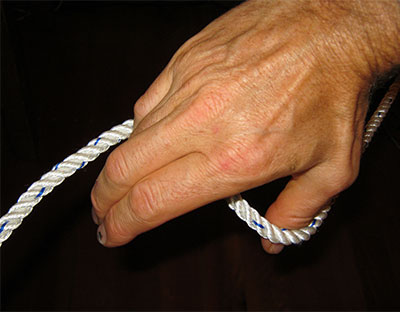
When I grab the rope to make my first twist, I sweep my right forearm counterclockwise. The elbow points away, and the right hand points towards me. The right hand’s fingers crosses the rope from the left, except for the thumb, which stays on the left side, creating a fulcrum opposite the four fingers which grab the rope from the other side. The hand twists clockwise, and we have what I have been calling a “single twist”. I am so used to this gesture that I never considered that a single clockwise twist might be producing a different structure. Will post pictures in the next post.

You guys weren’t mad that the man on the video produces a “single twist” (I thought you were).
And I wasn’t mad that he twists twice (in what looks like my “double twist”).

I am amazed that we didn’t get here sooner. How very odd that it took all this time.
Glad indeed to have that resolved! I was on the verge of pulling my hair a few times and I’m sure some of you were too. :cry:
Thank you all for your patience. I’m sure we all learned something on this ride, whether about knots or about the challenge using words to make each other see the same thing.

Wishing you all a beautiful day,

Andy


truckie_loops_11.jpg

Lee01.jpg

My single twist (what the man does in two twists). This gesture is so natural and ingrained I don’t even think about it.

Sorry about the “late night” quality of these pictures.


truckie_loops_13.jpg