I would like to repeat something that I believe may be interesting : What about modifying the fig. 8 loop or bend, to make it easier to untie ?
I cannot find the quote quickly, but somewhere Knot_Rigger
remarked --and posted URL to image of…-- that the S.Part
of the fig.8 eyeknot in the “strong form” would pull under
its twin and so achieve a tight turn … . Well, this might be
behavior dependent upon both dressing & setting and material.
I, too, can see this. But is it inevitable, and is it --although
apparent in a highly loaded knot-- achieved without some
benefit --i.e., might there be some offloading of force in
the process of the S.Part pushing (against a well-set twin
part)?! --that the S.Part had to press hard against its twin
in order to run fairly straight, and so ends up stronger in
this than where it runs straight more “unopposed” ?!
It does suggest that in material that is resistant to being
set as I muse could be beneficial for the “strong form”
the benefit of this form cannot be achieved readily (i.e.,
it might take devices to set the knot well enough, as
manual strength vis-a-vis expected forces is just too low).
(There is another factor : elastic, compressible material
should do things that static or firm material won’t!)
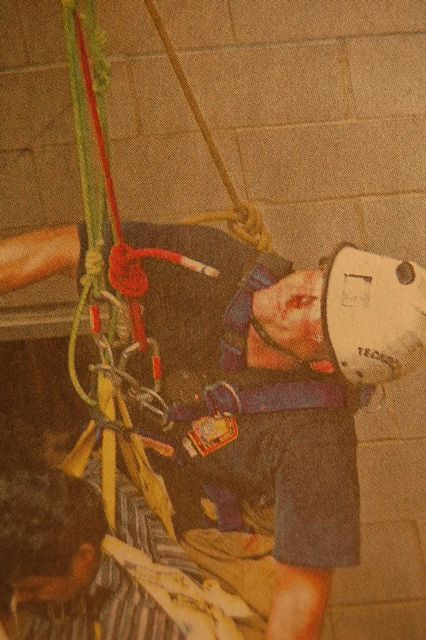
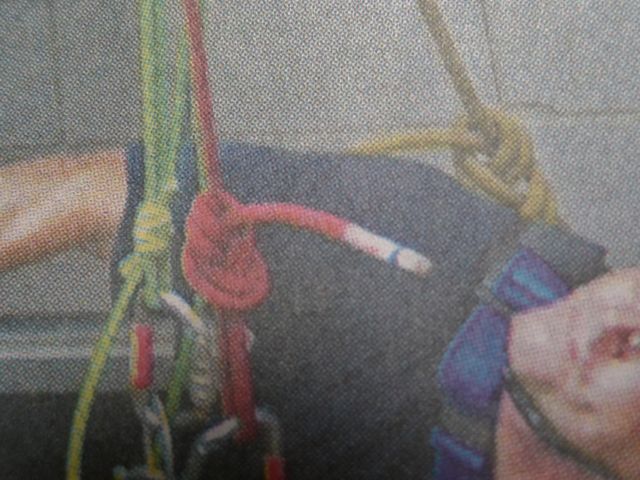
I attach two views of a newspaper photo of a fellow doing
training rescue work in which one can see two fig.8 eyeknots
–in red & gold ropes. Note how UNloaded one of the twin
strands is in the red rope; I believe that this is the twin
of the “strong form”, and so we see how the S.Part gets
“into” making a tight turn, missing bearing against this
twin for offloading, the twin too loose in the setting.
And note the gold/yellow knot : it, too, is amply loose
–one can see through gaps in its parts–, maybe because
it’s a stout, stiff rope, and not given special effort in its
setting (but even so, it might be one that, with higher
loads --those that only can show a strength difference–,
see the S.Part bypassing the “bear-against” aspect of my
conjecture.
I, too, like Knot_Rigger remarks, had viewed the knot as
showing a milder (if any difference) curvature with the
“weak” (inner twin) strand (which bears into parts that
turn around it, and pulls away from its twin (which will
show its lack of tension by sort of standing aloof in a loaded
knot)), and so wondered at Chisnall’s assertion. Looking
with Chisnall’s result as an assumption, I arrived at my
conjuecture of this “bearing against” curvature leading
to the tight, around-eye-legs U-turn. (But, also, one can
see a brief harder curve in the “weak form” S.Part
where it first is deflected around parts; but this might
quickly straighten w/o much consequence.)
AND . . . this conjecture led directly to my “building”
the “Lehman8” (vanity made me choose this moniker
over “bowlinEight” of my word-fusion formation). I used
the 8 as a base, and then deliberately looked at how the
returning eyeleg could go into this and give the “padding”
(“bearing against”) benefit conjectured to benefit the
fig.8, and worked that around with a finish that has
some of the easy-to-loosen collar of the bowlilne.
A side benefit is that it seems to be a pretty slack-secure
knot, to boot.
X., I have anticipated your --sent whilst I’m keystroking–
thought:
I would like to repeat something that I believe may be interesting : What about modifying the fig. 8 loop or bend, to make it easier to untie ?Exactly my design goal (I was "designing" actually, rather than just "fiddling" "what if..." variations (often productive on its own)!) for the [i]Lehman8[/i] (not an end-2-ender).
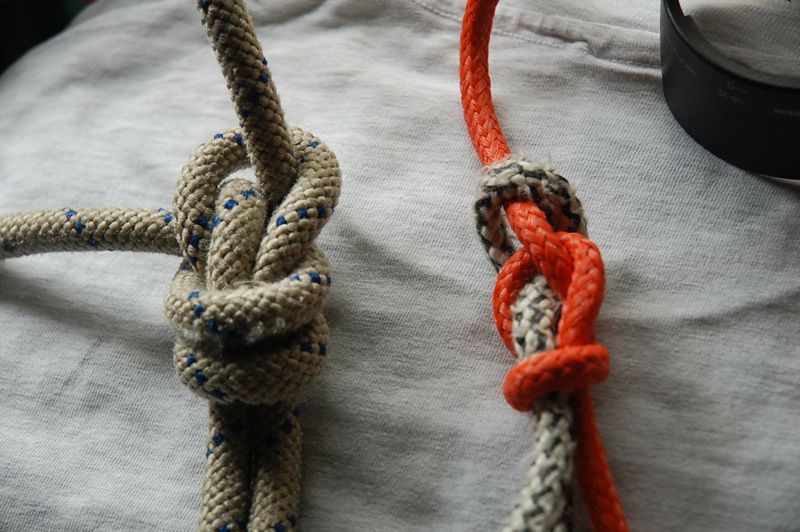
Per X.'s & my discussion of the Lehman8, I attach two
(previously posted somewhere) images of this, with the smaller
2nd one showing the “easy untying” collar aspect’s reverse
side, i.p.; YMMV on how very tight this might become, though
(needing a marlinespike for the “easy untying” aspect?
–but, nb, that IS easier than knots in which the spike is only
a hope, with no obvious point of insertion and use : here,
it would be at the colloar, to pry it around/off binding S.Part
to “padding” part, which I think would not require so much
stretching of material but just getting tightly pressed parts
to move against each other. I recall one knot-forum person
admitting to having used this as a climbing tie-in, generally
liking it.
The knot in orange & B&W (an interesting seen-in-marine
setting hollow braid of PP (B) & polyester (W)) is merely a
“quick8” were it stopped before collaring the S.Part
–yes, just the pinch of the 8 on the tail’s leg will hold(!)–;
that I doubted such brevity led me to put in a bowlinesque
collar (and stuff a 3rd diameter out through the S.Part’s
U-turn. Looking at it now, I muse about turning it around
the collar clockwise, and then taking it not as shown
but to run “twin” qua “padding” against the orange S.Part’s
turn, and so back out twinning the S.Part.
Well, with setting just so, and … , maybe ….
All of which suggests the practical silliness of such contrivances,
if they require Advanced Knot Setting courses and guesstimations
of ultimate forces effects on particular_material_M !!
BUT, it is not w/o merit, I submit, that in pursuit of learning
what affects knot “efficiency” and so on, that we are able
to build such nearly-alike (small differences to isolate things
that might affect …) knots for testing, and see what matters
(and in what material_M it matters or not).
–dl*
I believe that the only answer to our problems, is this :
http://www.alibaba.com/product-detail/20T-Pull-Back-Ram_984242477.html
( Nice, clear pictures ! )
Perhaps if one "plants"/"nails" the Tail End another time into some opening of the knot... and the sheer compressible bulk / volume of this segment prevents the nub from being too tightly clinched around itself ?
I believe that climbers and rescue workers would be more easily persuaded to use a more easily untied knot which has something more than their beloved fig.8 bend or loop, than something less !
Upside-down, from DownUnder! 
The notional concept a right Vs wrong (or strong Vs weak) method of tying a Figure 8 connective eye knot (#1047) is [i]more likely than not[/i], only for the realm of discussion and debate among knotting theoreticians.There is no real-world practical application of the ‘strong form’ over the ‘weak form’
of #1047 within climbing or rescue contexts.As I have pointed out many times before, strength is irrelevant in climbing/rescue applications.
It might be relevant for the purpose of setting “high lines”
which will require high tension for staying closer to straight,
and if not needing strength of the knot for this, might need
preferable/easier untying of one vs. other versions.
Perhaps the “ease of untying” difference (is there…?) will
have (some) significance in other uses, too.
The 'ideal' knot is one that is secure and stable and doesn't jam. Also (preferably) it can withstand loading from multiple directions (eg refer to 'wrap 3 pull 2' anchoring knot).There might be some seen difference in [i]offset loading[/i] (aka "EDK") between the forms, although there is now some advice to avoid the [i]offset fig.8[/i] in favor of the simpler and more widely used [i]offset [u]waterknot[/u] (overhand)[/i] already.
((
BTW/FYI : Clyde Soles introduced the name “offset overhand”
which I liked --esp. the “offset” adjective, which is spot on
(such knots are NOT “flat”!)–, but I opted to go for “water knot”
as the least confusing name (not liking “ring bend” as this
knot doesn’t bend to a ring; I no longer support Ashley’s
desire to hijack “bend” for “end-2-end”, as history used it
otherwise --a point that C.L. Day made).
Similarly, as an essential aspect of webbing/tape IS its
"flat"ness, I do not like “flat” vs. “tubular” for tape types
but “solid” vice “flat” --again, to the point!)
))
A person can tie #1047 deliberately 'messy' - and it will still hold a falling climber.NB : "messy" is a non-particular description! One messy orientation and another one might be quite different in effect?! NB-2 : "properly dressed" is sometimes advised, but is there EVER any given specification to what this is, actually?! (All I've seen is the further verbal guidance to avoid parts "crossing over" each other, which is subject to interpretation.) This goes to X.'s point about authors not having real knowledge (in the No Author is Wrong challenge), but just parroting what they've heard elsewhere!
TO THE POINTS WE DEBATE (“strong”/inner vs. “weak”/outer versions):
NB-3 : TWO sources --viz., CMC (3rd; & 4th?) & Dave Richards-- have
thought to test “tied in the bight & "follow through” versions of the
fig.8 eyeknot !!! I believe that Agent_Smith has remarked at this,
as have I --that the knots (presumed to have been “dressed & set”
to whatever believed ideal the particular knot tester had, AND that
it was specific enough…-- that the knots cannot care about their
tying method : they are the same entanglement receiving force.
THIS IS A FAR LESS DIFFERENT CIRCUMSTANCE THAN “STRONG/WEAK”!!
And yet it was tested !!
It just would NOT occur to me to do this,
UNLESS
I had done some in-the-field, practical, actual-factual empirical
research that revealed that there was a difference in
orientation (or a statistically significant bias) of result obtained
from the different tying methods. THEN, well, yes, test these
different knots !! But neither CMC nor D.R. give such thinking;
they just indicate tying method, for which there is no evidence
of differing results (and general guidance that results should be =) !!
(I find this amazing, appalling. Mostly, also, w/o remark or critique.)
... a 'dressed' form of #1047 ... behaves more predictably under load and holds its form... is in a vague way at least better specified than the open-ended, who-knows-what, "messy" result.
Knotting theorists have long tried to pinpoint with [i]precision [/i]the locality of knot rupture but to date it has eluded them. This in my view might be a prime driver for the subject matter of this thread.Whoa, this K.T. has made some small effort to learn this, and --speaking of "thread"-- has introduced the technique of sewing into test specimens colored threads to mark the locations at pertinent points of interest. (See attached!) I think that I've seen clearly enough that it is the INNER yarns/strand(s) of a part in a bend that by compression break, and not the outer, presumed-more-stretched parts, which was a commonly voiced theory (i.e., outer breakage). One might see this in following the twist of laid rope where one of three strands breaks, others stretch out intact, and see that it leads to concave side of curve at rupture, not the convex/outer side.
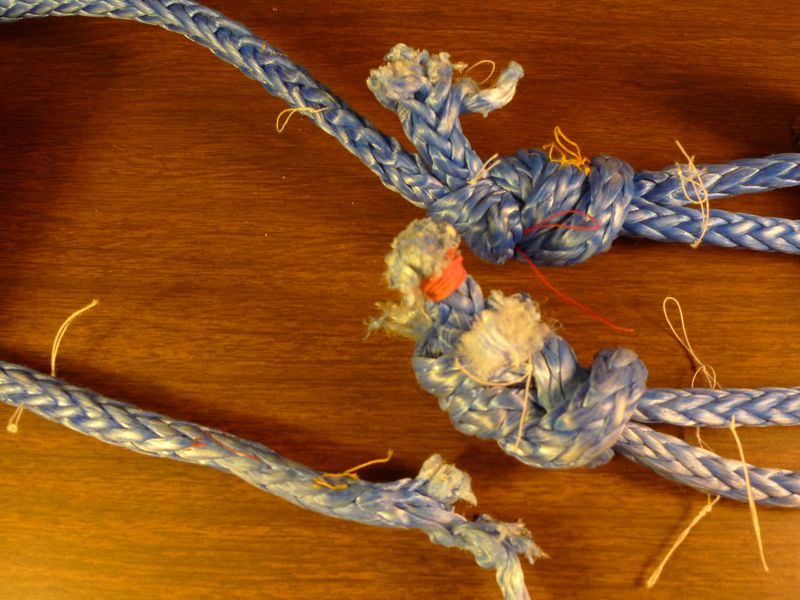
I’ll attach two (elsewhere here previously posted?) pics
of such thread-marked tested knots --the ruptured one,
and the survivor eyeknot showing where the marked
spots were (likely) at point of rupture. (I’m thinking
that these qualify me for a Nobel Prize in Knotting.) 8)
From a purely theoretical standpoint, narrowing down the precise nature of rope rupture in tensile pull-to-failure tests is interesting and helps us to learn more about the science of knotting. Altering the path of a curve/turn of rope within a knot might yield a few % points difference in strength - and this is exciting for theoreticians as it moves the science a notch forward.But only if the testing comes with specifics of geometry and so on, not merely --and as is common-- [u]knot names[/u] and test data, a not showing the pre-loaded geometry, and the near-rupture geometry, and so on. (I feel a lock on the Nobel!)
If someone posted news of a discovery of a new knot climbing tie-in knot that is: [ ] easy to tie - ('easy' is based on an inexperienced climber attempting to tie the knot) [ ] is secure [ ] is stable [ ] is easy to [i]untie [/i]after high loading event (eg a 100 kg+ falling climber - who generates significant impact force) ... would be more interesting than pure theory about 'strong' Vs 'weak' form of #1047 (more interesting to me personally)That is spelled 'L e h m a n 8' (and spells "Nobel") ! ::)
In the attached photos of tested knots (in Dyneema, 5/16" 12-strand),
a pink thread marked a point I thought likely for rupture, and a gold
thread led or trailed this, anticipating movement in tightening
–i.e., that the gold might move for rupture where the pink had been.
Some white threads are at entry points, to show how much
material is drawn out during tightening/compression (this is
quite INelastic cordage).
The reverse fig.9 eyeknot was chosen over the common
one with this thinking : common one might benefit, in usual
material/fibre, from some gripping effect, but in HMPE
the material is too slick for this,
so go instead for a form that seems to give a broader curve.
Note that the break point looks to be rather well around
this curve, maybe beyond the U-turn point, where the S.Part
bears against entering eye legs!?
In these cases, it will take more scrutiny to conjecture about
concave/convex side of curve vis-a-vis break point.
–dl*
I agree with agent_smith for practical purposes and that is how I would use the figure 8 loop - without unnecessary worry. I personally tie in with a simple-locked bowline, but that’s diverting.
I think that there are tests out there that have been done, measured and video captured that show the parts orientations well enough and the motion of the knot during destructive testing. Thermal imagery included that indicates where the destructive heat is generated and most likely the cause of the rupture. I think so at least.
Watch the video. https://www.youtube.com/watch?v=s3fHYGY3YTo
SS
I think some strain energy gets converted to heat and since strain is proportional to stress, this can be used to give an approximate indication of where high stress areas are, and thus where rupture is most likely.
But other effects can mask this. There may be friction-generated heat, and some parts of the knot may lose heat faster just due to geometry.
edit to add related link: http://www.researchgate.net/publication/252707600_Correlation_of_infrared_thermographic_patterns_and_acoustic_emission_signals_with_tensile_deformation_and_fracture_processes
It’s interesting to see the high stress areas from the rope surface become more uniformly distributed as the rope travels away from the knot.
From DownUnder :
Right and wrong Figure-of-8 knot
http://www.ropelab.com.au/right-and-wrong-figure-of-8-knot/
Yeah, I know friction can be included along with pressure, both contributing to the demise of this and other knots. But, I think in this case, this Fig. 8 loop test video, it shows clearly enough with enough data, with this particular dressing, what and where the demise is going to take place. If you were to zoom in close enough…
Of course the rest of the surrounding knot parts (geometry) will carry away/absorb the heat, though I don’t really see what that statement proves here. Maybe it slows the flow too much?
This was a slow pull test, but I am of the opinion that a fast pull test or drop test would have very similar results, just faster.
I am of the opinion that if you were to stop the pull test just short of the projected rupture point, it would take a Herculean effort to untie this. As well, the rope would be ruined there.
Regardless, the video shows a well enough completed test.
SS
Slightly off topic, but this is an interesting related experiment:
http://demo.physics.uiuc.edu/LectDemo/scripts/demo_descript.idc?DemoID=1193
However, they left off the really fun part. Once the rubber band is stretched and the heat dissipates, let it shrink back again and it really feels cold against your skin.
Nice experiment ! Very interesting ! Thanks for the reference.
From DownUnder : Right and wrong Figure-of-8 knot http://www.ropelab.com.au/right-and-wrong-figure-of-8-knot/
A shame I have to pay to read this, Xarax, anychance you have the text of this article without me having to become a member of this site?
Watch the video. https://www.youtube.com/watch?v=s3fHYGY3YTo
SS, fantastic video, thanks for posting it. It’s very interesting. I especially take note of which “weak” or “strong” form they happened to have tied!
Quote A person can tie #1047 deliberately 'messy' - and it will still hold a falling climber. NB : "messy" is a non-particular description! One messy orientation and another one might be quite different in effect?!
Dan, I knew exactly what A_S meant by “messy” dressing of the knot. And I completely agree with his point: that while a messy dressed fi 8 may be weaker, and may be more prone to jamming after a fall… It’s still adequate to the task at hand, and there is no reason to fear a “messy” knot would not hold a climber’s fall. All things considered, I personally dress all my fig 8 loops as well as I know how before they are loaded, but if I inspected one that was “messy” I may not fix it right away, depending on the circumstances.
Knot_Rigger, per you questions, the HSE report (one of a few?) is: www.hse.gov.uk/research/crr_pdf/2001/crr01364.pdf
I got a 404 error when I tried that link
Quote from: knot rigger on May 15, 2015, 05:48:38 AM Agent_Smith: I wholeheartedly agree with everything you say in your post. You are are ready to parrot him, then!
What he says makes sense, and to agree with what makes sense isn’t “parroting” IMO. (btw It’s off topic but I don’t care for the EDK myself, but I come from things more from a rope’s access viewpoint than a sport climbing point of view)
I often need to calculate the safe working load of a system, and the difference would matter to me in this situation,We should all find this sort of statement entirely DUBIOUS : what sort of basis do you have to play around with such *numbers* as though they mean something?!
Dubious? really? I was just pointing out how in my line of work, am indeed concerned with efficiencies of knots. What about that do you think is “entirely dubious” or what about this statement of fact (it is a fact that I do load calculations involving efficiencies of knots) should “we all” find dubious.
The point I was driving at was accuracy. If you hadn’t have truncated my quote, the point would (perhaps) been more clear.
here is the full quote:
I often need to calculate the safe working load of a system, and the difference would matter to me in this situation, but only so far as getting the calculation as close to [i]accurate[/i] as possible. All (well done) rigging load calculations carry a comfortable margin of error in the design factor.
you go on to ask:
Tell us, how do you do this clever calculation of yours?...
I will be brief, as this is off topic of the thread: Suppose in the course of inspecting some show rigging, we find a problem with a 400 lbs speaker system. (perhaps there is a side loaded shackle that we need to fix) Due to the details of the situation, we determine the best way to proceed is to temporarily lift the speaker with rope. What we have on hand is 11mm Kernmantle with a breaking strength of 6000 lbs. Given the nature of the load, the industry ‘best practice’ for lifting with fibrous rope would be to use a 10 to 1 design factor. A 10:1 DF with a 75% efficient termination would give us a safe working load of 450 lbs. A 10:1 DF with a 65% efficient termination would give us a SWL of only 390 lbs. Less than the given load we need to lift.
This example may seem contrived to you, but I assure you that I have made these sorts of “on the fly” safe working load determinations many times. You may think that a mere 60 lb difference between knot efficiencies isn’t that much and doesn’t matter that much in real life, and in a way it doesn’t. The healthy safety margin is a buffer against human error, the necessity of estimation, errors of information, and unforeseen loading events. And that same safety margin would let me sleep at night, even if the rigger who tied the figure 8 knot we used happend to tie the weaker form. However, I would like to do my calculations as accurately as I can, and there lies my interest in the question at hand.
One last point about my example. The actual difference of 10% efficiencies in the knots would yield a 600lb difference in ultimate breaking strength. The 600 lbs difference is larger than the 400 lbs load we’re lifting!
I do not have it either !  It was just an effort to make out friend from DownUnder, agent smith, reply - I guess he knows the writer in person, and he can tell us more about the whole thing.
I live ‘DownUnder’ too, in Sydney
I have to say that the site looks really interesting and from reading their blurb it seems they do testing.
I was thinking more along the lines of heat being lost to the surrounding airflow via convection and to space via radiant heat transfer. In other words, the more exposed regions would lose heat faster, skewing the relative stress results to some degree.
And so did I, clicking on your copy of my URL!?! ???
Well, I retrace my fetching steps (Google produced)
and again am using URL into the PDF.
Here is the combination of “404” <> “working” URLs,
between which I’ve not been able to see any difference:
http://www.hse.gov.uk/research/crr_pdf/2001/crr01364.pdf<>
http://www.hse.gov.uk/research/crr_pdf/2001/crr01364.pdf
I copied above from my window’s URLocator window,
in which I first got 404 from the left half (w/o extension of R),
then pasted in the R half which had just seen me INTO the PDF!?
HUH??? The ‘0’ are indeed zeroes & all identical.
NOW --while typing this Reply–,
I copy-past tope URL from ‘www’ on, and … “404”.
I do the same with 2nd line, similarly, and … AM IN???
Holy double-vision, Batman,
what’s going on here?
UPDATE :: By tediously using window Find and parts of
these URLs, I reach a non-matching point at ‘p’ of ‘pdf’ !?
I.e., URLs match up through final period but fail at an
apparently identical ‘p’!?!?
MORE bizarre :: I just cut’n’pasted the offending ‘pdf’
into Find window; all the OTHER "pdf"s --i.e., lower AND
uppercase-- were highlighted in yellow of multiple occurrences;
but, Next used in Find DID TOUCH THE UN-HIGHLIGHTED ‘pdf’
of the offending/404 URL. !?!?
(Google “hse Lyon Equipment knots test” and you should get
your own, if one of the (two identical (l00king!)) URLs above,
here, fails again.
… baffled … :o :-[ :-\ : :o
:o
[edit : I just clicked on embedded --by system-- URLs above,
and again the 1st/upper one got “404”, the 2nd apparently
identical one got me to the PDF.]
now, putting both ‘pdf’, ‘.pdf’, and fuller ending
of these URLs, I see ALL of them highlighted (by Find)
on this forum page, and Next to all, also (whereas before,
doing Next/Find in my post-compose window, I got the
odd yellow-highlighting EXCLUDING the offending URL’s ‘pdf’,
but Next went to it, anyway. :o
I often need to calculate the safe working load of a system, and the difference would matter to me in this situation,We should all find this sort of statement entirely DUBIOUS : what sort of basis do you have to play around with such *numbers* as though they mean something?!Dubious? really? I was just pointing out how in my line of work, am indeed concerned with efficiencies of knots. What about that do you think is “entirely dubious” or what about this statement of fact (it is a fact that I do load calculations involving efficiencies of knots) should “we all” find dubious.
… A 10:1 DF with a 75% efficient termination would give us a safe working load of 450 lbs.
A 10:1 DF with a 65% efficient termination would give us a SWL of only 390 lbs. Less than the given load we need to lift.
Really, my point isn’t obvious to you --and I gave it
in fuller terms than you quote?!? You pick 65 & 75%,
and I questioned explicitly (a) how someonElse’s figures
can be seen as relevant to your materials (and nature
of loading/forces), and (b) how you would you deal with
the 30%-points (51 vs. 81) difference in the CMC two
reference works!?
Ergo, … “dubious”! (& QED
 )
)
You seem to imply --don’t explicitly say-- that your different
(75/65%) figures attach to distinctly different terminations;
my point mainly was, in addition to taking that value at its
face, how you deal with the multiple values given for the
–nominally/apparently-- SAME termination!
(And, now with this URL mystery, how do we do ANYthing!)
–dl*
I would think that instead of skewing the results, that would be part of the results. Even if you froze or chilled the rope, the thermal action would still be part of the equation.
The main point of providing the link was to be able to see the tightening action of the Fig. 8 (most people will never stress theirs that hard nor have a camera on it when it does, or see it when they take a whipper) and where the stress induced the disastrous result.
SS
After searching for Lehman Figure 8 and Nobel prize in the same sentence (never found the Nobel prize) I stumbled across this site:
http://www.elementrescue.com/Element_Rescue/Main_Blog/Entries/2014/8/2_The_Bowline…_Dont_call_it_a_comeback.html
Couldn’t determine the author of the site - but I did find a Audie Murphy likeness (I wonder if he looks like Dan Lehman)?
Just to be clear - I wouldn’t be posting in this forum if I didn’t have an interest in all things knotting (although my primary interest is in the area of knots used in life support applications).
With regard to Richard Delaney and the ‘Rope test lab’ site - I am on facebook so I can post there - and I know Richard personally (I actually trained him as an instructor back in the 1990’s). Richard is an enlightened man - very knowledgeable and passionate about climbing, rescue and anything that is captured under the general banner of technical roping. He has worked hard to put that facebook page together and make it work - and more power to him if he can generate some income from it (why not).
I will say that I don’t agree with the term ‘right’ versus ‘wrong’ way to tie ABoK #1047 (Figure 8 connective eye knot). I would be more supportive of the term ‘higher efficiency’ versus ‘lower relative efficiency’. Using terms such as ‘right’ and ‘wrong’ might lead to mass hysteria and needless concern that death is imminent if the lower efficiency form of #1047 is tied and relied upon.
If a trainee under my direct duty of care stood before me and tied the lower efficiency version of #1047, I would not cry foul and declare death to be imminent. And if the trainee paid zero attention to dressing (symmetry and form) and created a random ‘messy’ structure, I still wouldn’t be concerned about imminent death - although I would argue a case for consistency and predictability/behaviour under load. I support consistency when rescue teams tie knots - and I support the notion of attention to dressing because it makes the knot more predictable under load (it doesn’t tend to alter into a distorted form under high loading - AND, it makes it easier to check and detect errors).
To declare the lower efficiency #1047 as ‘wrong’ would (in my view) have to be justified against a whole host of other connective eye knot - eg the Bowline family of knots. This comes down to the issue of pure strength - whilst ignoring more important factors such as security and stability (and ease of untying after high loading event). The Bowline (secured form) is just as good - and better in my view - than a ‘high efficiency’ #1047.
Dan Lehman referred to Highlines - I always prefer to use a capstan-like hitch such as the so-called ‘tensionless hitch’ in highline rigging (ie for end terminations to anchors). If you really are going to put some outrageous loading on a highline system - what better ‘knot/hitch’ than the ‘tensionless hitch’? Obviously its not a connective eye knot like the Bowline - but it is fit-for-purpose in such an application. If for some reason I couldn’t employ a tensionless hitch - I would use a secured Bowline (not #1047) - because #1047 would more likely than not jam.
I know well enough about threading little bits of cotton thread tracers in ropes in preparation for break testing. I remember cursing Dan Lehman under my breathe years ago when he urged me to do this. I dont think my eyes could handle the strain anymore… But I agree that it is the proper method in knot testing.
And this type of research and discussion is a worthwhile exercise and it interests me - but it doesn’t alarm me.
Pure research can lead to world changing breakthroughs - like studies of quantum physics led to the invention of the transistor which then opened the way for computers which then opened the way for the internet and me typing this post today
I dont know if the Lehman 8 is worthy of a Nobel prize though ;D
Mark Gommers
Hmm. You may be thinking that those color maps are indicating more heat than what’s actually being produced. Those temperature variations are fairly mild (maybe around 10 degrees Celsius variation looking at the final chart of the video).
To put a different angle on my previous comment, if you paused the test and let all those mild temperature variations dissipate, you’d get a very skewed result of it looking like all portions of the knot have equal stress, for example.
I believe you should support the notion of attention to dressing, just because it requires ATTENTION, and attention is of paramount importance in your field… One should pay attention to anything he does - so he should also pay attention of how he ties the fig.8 bend or loop, or ANY bend or loop for that matter.
However, there are more than TWO the possible symmetric forms one can dress the fig. loop, and until you do not pay attention to THAT simple fact, you are just parroting what it is parroted all those years by all those people - and I believe that this is NOT your style !
It was always like that… so, somebody should tie and try, systematically, ALL the different symmetric forms of the fig.8 loop - which are MUCH more than TWO ! NOT because some are weaker and some stronger, right or wrong, more or less efficient, etc, but simply, as you climbing people like to say, because they are there !