With regard to Richard Delaney and the 'Rope test lab' site - I am on facebook so I can post there - and I know Richard personally (I actually trained him as an instructor back in the 1990's). Richard is an enlightened man - very knowledgeable and passionate about climbing, rescue and anything that is captured under the general banner of technical roping. He has worked hard to put that facebook page together and make it work - and more power to him if he can generate some income from it (why not).
I have joined Mr. Delany’s RopeLab website. A_S, you convinced me, although I don’t think that was your explicit intent. I figure it’s worth $60 to support the work of someone whose passions I share. Also A_S, let me congratulate and thank you for your paper about the Bowline [ http://tinyurl.com/mkkcwbp ] which I have found very interesting and usefull. Thanks as well for the link to element rescue site. I’ve emailed Mr. Delany asking permission to share the whole of his article about the figure 8 knot with this thread. In the mean time, I will attempt to summarize.
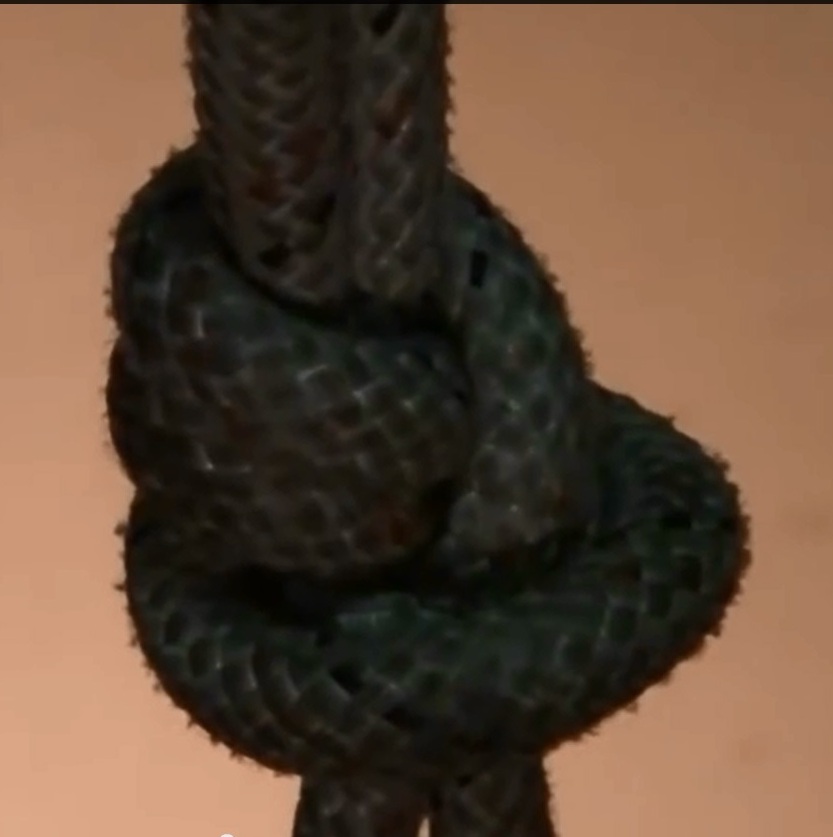
First, I like one way that he refers to the difference between the forms: by the path of the standing end; so we have an “inside” version, and an “outside” version. I find these two terms superior because they don’t have any implied judgment attached, they just describe the topology of the knot.
Second, his article is mainly about how easy it is to untie the knot after heavy loading, not pulling to rupture. But this is very interesting in what he finds, and one conclusion he proposes. He found that the “inside” version (aka “weaker”) was harder to untie after heavy loading. He also saw that often (but not always) the “outside” form “flipped” (his term) such that the outside bend flipped to the inside position with applied tension. He loads the knot on common 11mm static ropes used in the ropes access industry, and chose to test them up to, and exceeding the Safe Working Load of the rope.
Lastly: He draws this conclusion (in the form of a hypothesis)
“Further tests may be also confirm that that figure-of-8 knots that are difficult to untie may have been loaded above 5kN and thus above the SWL of the rope. If this is the case then the figure-of-8 knot is certainly a good choice for anchoring ropes in tech rescue and rope access work.”
I find this an interesting thought, that the knot is both the anchorage, and the indicator of potential abuse.
Ok then, Dan Lehman, thanks for clearing up the link to the HSE report. I’m no wizzard with computers, and have no idea what went wrong there, but thanks for re-posting. It turns out I have seen this report, but I had forgotted or neglected the information about the inside/outside versions of the fig 8 knot. To summarize for the thread (you had already, but I will too) for the overhand loop, the outside version is stronger, for the fig 8 loop inside and outside are the same strength, and for the fig 9 loop, the inside version is stronger (all according to the HSE report). It’s off topic, but anyone who climbs or does rope access work should read section 7 of the report about “cowstails”, and be VERY cautious about using sewn cowstails.
more from DL:
Really, my point isn't obvious to you --and I gave it
in fuller terms than you quote?!? You pick 65 & 75%,
and I questioned explicitly (a) how someonElse's figures
can be seen as relevant to your materials (and nature
of loading/forces), and (b) how you would you deal with
the 30%-points (51 vs. 81) difference in the CMC two
reference works!?
Ergo, ... "dubious"! (& QED ;) )
You seem to imply --don’t explicitly say-- that your different
(75/65%) figures attach to distinctly different terminations;
my point mainly was, in addition to taking that value at its
face, how you deal with the multiple values given for the
–nominally/apparently-- SAME termination!
How do someone’s else figures apply to my materials and conditions? They don’t, but the information is applicable in that the materials and conditions are approximatly the same. In other words, I have to make a judgement call. I base my decisions on the best knowledge of knot efficiencies I can find, then employ a large design factor to (among other things) protect against inaccuracies in reported knot efficiency.
As far as the figure 8 bend goes, I would used the most conservative efficiency of the two from CMC (and/or the most conservative I can find from multiple sources) Specifically to the fig 8 bend, I choose not to use this knot! There are stronger bends for high load applications (double and triple fisherman) and more convenient to tie bends for low load applications (double sheet bend). [the zeppelin bend may be better for both applications, and I use it, but I haven’t yet seen good efficiency data on the knot, and avoid it for life critical applications]
To make a judgment call about any given knot efficiency, and how it affects what knot I use, I would employ these criteria:
(1) compare as many published accounts as possible of knot efficiency
(2) consider failure states (does it slip, jam, break, etc)
(3) consider the application to determine what is the most important; security, strength, ease of tying, ease of untying
(4) consider that my work will be inspected by others, and for that reason I may choose a more widely know knot over a “superior” one

 ). I also like to explore new things and I tie every offering here and elsewhere. I show the one’s that have merit to me to others who climb and work, they decide whether it is for them or knot. When your life is dangling on a knotted rope, the climber/rescue tech or the sailor of yesteryear or today keeping his rigging working is the one who makes the decision.