It’s been said that a picture is worth a thousand words and I would add that a video is worth at least a couple hundred pictures. At least that’s the way it is for me when it comes to learning knots. With that in mind, I have made a YouTube video showing how to tie the Gleipnir knot. I couldn’t find any other videos on this knot.
I am not as thrilled with this knot as some other forum members have been. Sometimes it works great, other times it seems kind of weak. Probably my fault.
https://youtu.be/Kxxhg-tf8Ug
This is the second knot video I have made, the other being on the Eskimo bowline/Cossack loop/Kalmyk loop, also on my youtube channel.
I welcome any comments.
Hi Harold Kahl,
you should/could show a TIB tying method too (better if with only one hand  for an idea look at
http://igkt.net/sm/index.php?topic=5821.msg39392#msg39392 ).
By the way, perhaps you have just noticed it, try to compare:
- Cow Hitch - Kellig Hitch (#1697) - Cat’s Paw (#1891)
and
- Clove Hitch - Gleipnir - Racking Hitch (#1892).
Happy knotting.
Ciao,
s.
p.s. if you want to improve your videos (the lateral view is not the best) watch the videos by JD or by Alan Lee
Thanks for the suggestions. Maybe I’ll give the one handed knots a try, after I figure out how to do them with two hands. It could be a while.
…
for the (two hands) TIB method you can tie a Clove Hitch on air with the 2 loops one over the other and then you can move the loop underneath over the other (obviously without untying the Clove: in the other direction) and you have done.
For the one hand method please learn first the Clove Hitch method as shown by Ashley…
and then try the Great Gleipnir.
Ciao,
s.
I have modified the video by adding a section with what I think is proper tightening method, thanks to a comment made by Xarax on my youtube page. Also shows knot tied in mid-air. I wasn’t able to change the existing video as posted on YT, so I published the new one as
https://www.youtube.com/watch?v=oz_CbZtRscg
New section starts about 2:24 of the video.
Hope this helps someone.
This seems like more trouble than it’s worth. Is there a practical reason to do this?
oh my poor English!? :-
Look at the attached picture: it takes 1" to tie the knot!
The practical reason is evident if you can use a TIB method!
Ciao,
s.
Look at the attached picture: it takes 1" to tie the knot!
The practical reason is evident if you can use a TIB method!
Ciao,
s.
Sir, you greatly overestimate my knot tying skills. Now, if I did manage to figure out how you made that, would I have something I could actually use in the real world? Let’s see. One end of my rope is tied to an anchor point, and the other end has a long coil of rope. Would I really want to tie a Gleipnir in between?
ok!
but please do not underestimate your knot tying skills!
Now, if I did manage to figure out how you made that,
please try! a good start is from the end! (by the way, I think you know a Clove Hitch, don’t you?  ) you have to obtain a Clove Hitch from the knot shown in the picture above…and then by starting from a Clove Hitch you can obtain the knot in the picture: that is a Gleipnir (the object hitched by the Gleipnir has to go through the white point).
would I have something I could actually use in the real world? Let's see. One end of my rope is tied to an anchor point, and the other end has a long coil of rope. Would I really want to tie a Gleipnir in between?
In this case the possibility to use a TIB method means that you “have access” to the ends of the objects that have to be hitched, for instance your books: you can tie the Gleipnir in your hands and then put the Gleipnir around the objects (or put the objects through the Gleipnir)…
Hope this helps.
Ciao,
s.
p.s. you can simply call me knotsaver (or saver or saverio)
well, you’re right. It’s not that hard. When would you use this in preference to the other methods? It seems like some extra steps to adjust it to the right size while trying to keep the ends from coming off the object while you are fiddling with the knot.
That conversion of two, easily tied half-hitches
/turns into the Gleipnir at about 1:23 looks
quite effective. There should be a crossing of the
ends such as you show at the end, where one can
pull at a perpendicular angle to the binding wraps,
as without that there is a tendency of pulling the
tails to pry open the nipping loop.
And in some cases, as Xarax found, it is beneficial
for the nipping loop to have its ends come into it
from away from the inner area vs. what is shown.
(Were this knotted area over space, it cannot matter;
where it’s against a surface, it can.)
Thanks,
–dl*
Yeah, I liked the way that worked out.
And in some cases, as Xarax found, it is beneficial
for the nipping loop to have its ends come into it
from away from the inner area vs. what is shown.
I don't really know what you mean by that.
BTW, after practicing with the TIB from clove hitch method, I'm starting to kind of like it. I'll make a video of that, probably tomorrow.
Video of Gleipnir tied in bight starting from TIB clove hitch.
https://youtu.be/ZsnNJIFOP4M
If you’ve got the ABoK, try to use, for tying the Clove Hitch, the method shown by Ashley at #1774…
Ciao,
s.
I don’t have an ABoK, but I found a video where the guy snaps a rope in a carabiner, then grabs one leg of the rope with one hand, twists it and snaps it through again forming the clove hitch. Is that the one you meant?
Here the pictures…
(search the internet and you’ll find the ABoK).
Happy knotting.
Ciao,
s.
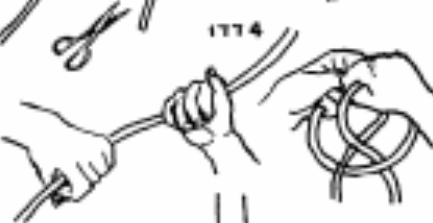
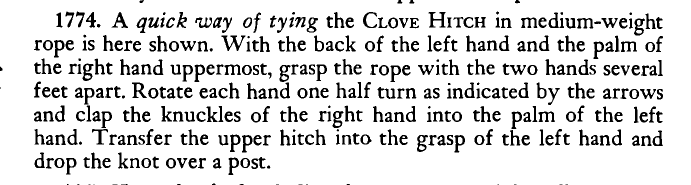
That’s a pretty slick way of doing it.
If you cross the bitter ends inside the loop like this, you will get a much better Gleipnir.
https://igkt.net/sm/index.php?action=dlattach;topic=2981.0;attach=3729;image
How you tie the knot you need to tighten the working ends in the direction of the rope going around the object. In this version it doesn’t matter in which direction you pull the bitter ends. You will get a much tighter and stable binding no matter what.