I always seem to get the half hitch and overhand confused and end up tying who knows what?
A half hitch is normally tied after the rope etc has passed around an object as in the classic round turn and 2 half hitches. However if you place a rope/cord around something, tie a half hitch then slide the cord off the object you will have an overhand knot - the 2 are structurally identical it’s just that pulling on the standing part after a half hitch has been tied causes it to assume a different form from the usual appearance of an overhand. Conversely place your cord around something, tie a granny knot (not a reef knot) and pull on one end (tie the granny loosely or it’ll take a sharp tug) - it collapses into 2 half hitches. Tie a reef knot and it collapses into a cow hitch around the part you pulled.
Simples!
Barry
Barry,
With all due respect to you, the two are not structurally identical when speaking of the half hitch and the overhand knot. If they were structurally identical then it would be possible to ‘tramble’ one form into the other. I agree that a half hitch tied around the standing part of its own end will form an overhand knot. If you tie an overhand knot around an object it forms a marling hitch, such that an overhand knot is left when you remove the object. If you tie a half hitch around an object and remove the object, the hitch disappears. This (marling hitch or overhand knot around an object) is one that we use regularly in maintaining a schooner’s sails (Spirit of Dana Point) where we use it to secure the foot and head of the sail to the boom or spar respectively. The half hitch does not do the same job as the marling hitch in this application.
Firebight,
When tying the half hitch you will see that one part of the line crosses the other part of the same line but once. When tying an overhand knot the line crosses itself twice, once going over and then once going under. Try spreading the tie open when you next tie one to see whether there is a single or a double crossing. I hope this helps. 
SR
Thanks for the input guys. I am really embarrassed that such a simple knot would trouble me so. Other thing that always gets me is trying to remember which side the working end of a rope is when making a loop. Sometimes under, sometimes over. The sheepshank comes to mind. I tried to make an acronym to help me remember like WOF (Working end over free end),
and FOW (Free end over working end).
I think my reply #1 may have been misunderstood. I intended to refer only to one or more half hitches tied around the standing part of a line not half hitches tied directly around an object - I am well aware that a half hitch tied around a bundle for example bears no relation to an overhand knot. I agree that at first reading this may not be clear.
Barry
Whoa : “tramble” was Mandeville’s vehicle, and it takes paths
beyond what would be allowed to retain structural identity.
This ([i]marling hitch[/i] or [i]overhand knot[/i] around an object) is one that we use regularly in maintaining a schooner's sails (Spirit of Dana Point) where we use it to secure the foot and head of the sail to the boom or spar respectively. The [i]half hitch[/i] does not do the same job as the [i]marling hitch[/i] in this application.
And yet here the two knotted (meaning “where the crossings are”)
parts are (rather) identical ! --it’s just that in the one chosen
for surer gripping, the 2 ends (of 4) that go away crossing OVER
the other 2 do so by turning down around (pressing closer to)
the bound object, rather than running more evenly above it
to the next such binding. (This of some knots within the sequence.)
I admit to some uncertainty on what a half-hitch is, myself,
for those put in for a series of HHs in say Two HH & more
are much the same as “nipping loops”, in contrast to what is done
in the common commercial-fishing binding with (my name)
reverse ground-line hitching --where spiral wrapping of the
bound objects (e.g., a clump of netting at its edge, bound to be
sort of cordage like to be in turn bound to a head line) will
regularly take a turn back under the spiral to haul down tight
upon itself (the half-hitch), then immediately repeat this
in the opposite (original) direction, to lock; and the two steps
might be repeated one or more times, building the binding.
But I think I know what half-understanding is.

Well THAT certainly clarified things! I am more confused than ever now - Firebight, I hope you have been helped from your original question. Your inquiry about making a loop over or under is understandable, because sometimes the loop is made overhanded and sometimes underhanded. I try to limit my description to what happens with the working end of the line and the movement it makes when forming the knot, hitch or bend. If it is an overhanded loop, the working end goes over the top of the standing part. If it is an underhanded loop the working end goes under the standing part. Each of the overhanded and underhanded loops can be made clockwise or counterclockwise (anti-clockwise). Does that help?
SR
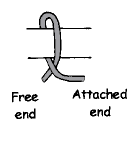
Hi firebight,
I saw that you own a copy of ABOK:on page 14,you can see clearly the difference between an object wrapped in way merely “Overhand”(#47),and an object wrapped in Half Hitch way(#48),see the little"x" in the left drawings in the two
illustrations.
bye!
Hi,
If it is true that in the pictures of ABOK that I have indicated above,both illustrations of #47 and #48 starts with an Overhand,it is equally true that on page 518, where it shows # 3114 (Half Hitching) and # 3115 (Marline Hitching), about #3114 Ashley says"this is really single hitching",and"a series of Single Hitches"(#49);on page 267 shows the Marline Hitch and Half Hitch bend(#1477):in the picture related,the"half hitch"resembles to me"technically" a Single Hitch around the SPart of the other rope(this to maintain"the water a little cloudy").
Removed from the object that wraps,the Single Hitch disappears;running a Half Hitch around an object,pass the rope around the object, go back and perform a Single Hitch around the SPart;if removed from the object remains an Overhand Knot.Would not it be more appropriate that these two knots (Single and Half) to be interchanged the names?
Bye!
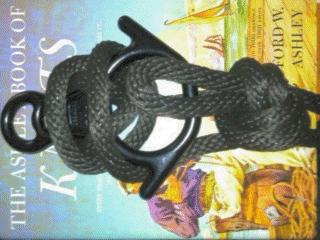
I took a look on page 14 of ABOK, thank Luca. Where I use the hitch most often is for tying off a rescue 8 descender. (pic attached), I have also been told tying off the rescue 8 with a mule hitch followed by an overhand knot is good. (Now would that overhand really be a half hitch)?
Thanks
Hi firebight,
Unfortunately the picture is not very clear to me, where exactly the Half Hitch?
Moreover I did not understand your question about the overhand/half hitch((I do not intend to the use of rope with tools such as the one you show).
Sorry for the bad picture and lack of clarity to my question. Essentially I was pointing out that I often confuse the half hitch and overhand, so perhaps not so much a question as an observation. I have some white 1/2 inch rope, maybe I will redo the pic to see if it comes out more clear.
Thanks
Thanks firebight, but do not take more trouble, I saw a couple of videos on You Tube that have clarified to me.
Actually I have to apologize because I could understand even before.
You have been clear in fact, the only thing was that I did not understand was where/ how began and ended the knot,that I was looking for a half/overhand who knows where!
Now that I’ve seen the videos (http://www.youtube.com/watch?v=m9B5XASL3Wc - http://www.youtube.com/watch?v=WMvralRauSE&feature=relmfu ),finally I realized that the double overhand was there, in front of my eyes, even in your photo!If you still doubt,what you run around the rope to finish the knot,is a overhand with doubled rope,if instead you run a half hitch,the movement would be to perform a simple single hitch around the rope, in this case, in order to tighten the knot, you would be forced to slide until it stops, and the knot does not remain fixed at a certain distance from the descender, such as when you do an overhand around.
EDIT: Regarding what I wrote at the conclusion of the post, it is better to refer to the videos, because as far as I notice now from your image, you seem to conclude otherwise, performing an overhand loop on the same part of the rope,
without using for wrap the other part.
Stay well!
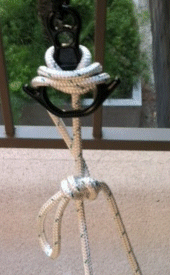
Luca, I think your right, I tied it wrong, I redid the setup with a better pic.
Hi firebight,
What I’ve written here, is not exact, because in reality, how can it be performed a full overhand knot around the other part of the rope, the same can be performed with a full half hitch.
If with the running end of rope make a full overhand around the SPart, get a simple noose(#43), which disappears once tight if there is not an object placed through;if instead make a full half hitch,the noose obtained does not disappear,because the overhand is positioned so as to prevent it.
thanks for the new picture,but I want to tell you again that you should not bother you!
EDIT:
I do not really know absolutely how to judge these knots must be performed with this type of instruments, it was just that I’ve noticed that you had done differently, but I do not know absolutely how things are done in this field (in many fields!).
Thanks again