Hi, some years ago now, a member posted a picture of oldworld Lumberjacks standing on a huge section of log. Log hardly describes the chunk of wood which must have been over 20’ diameter.
The log was wrapped around with steel ropes that would be used to roll the log out of the forest.
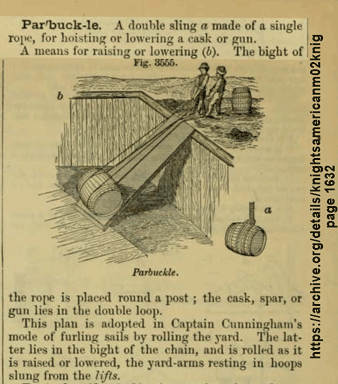
The picture gave the name of this method of rolling.
Does anyone remember the image or the name of the method of rolling huge logs please.
My wife and I parbuckled a 3 foot x 24 inch oak section into the boot of a station wagon by hitching a bight to the latch staple and each lifting a running end. Worked a charm.
I’m thinking of posing a challenge for a Team Building Exercise of getting a 50gal barrel over a 3ft hurdle using only 3x2 ramps and 550 paracord, and of course, they must not touch the barrel or they loose points. They will be introduced to cordage, strength, knots, leverage, and of course, the Parbuckle. As it is a Team building process, they will be scored on planning, organisation, method, execution, safety and speed.
Any thoughts on twists or ‘bumps’ I can add would be appreciated.
A thought - include 2 stout pegs (and a mallet?) but no attachment point on the hurdle itself. That way the solution would be to anchor the cord(s) with the pegs on the receiving side of the hurdle, take the cord over and around in a parbuckle configuration. Takes a bit more ingenuity perhaps? I would suggest a soft landing area for the barrel so that it doesn’t bowl somebody over!
Hmm, double points if they lower the barrel instead of just dropping it. Make available enough ramp timbers to have ramps bith sides and see if they can work out how to transition from the lift ramp to the lowering ramp.
Just happened to be passing by..
.
To me.
Parbuckle is best used and thought of as a ‘walking pulley’.
.
Can lead with a pulley on load and have 2:1 over DRAGGING load up ramps.
.
Or Parbuckle around round load to get 2:1 that powers rolling load to make it 2:1 WALK up ramps(rather than 2:1 drag)!
Without bearings frictions of pulley!
The walking pulley action can be an immense help!
.
Parbuckle is also pretty fair without the ‘walk’ free-spinning to lift logs, bodies up from water to pier or boat.
They also used Parbuckle to right ships after the Pearl harbor attack!
.
In a truck pull on parbuckle (like up ramps to trailer)
i prefer anchor ends of rope on trailer spread 2/3 length of load, put on load, fold bight over load to pulling truck.
Then the bight in middle is pulled by truck..
BUT bight is free-floating thru ball or hooks on truck to self-adjust/not be fixed length on either side (no Butterfly over ball).
In this way, if one side of log is fatter or slower up ramp:
Line Adjusts to keep working both ends of log/load by not being slack on the ‘off-side’.
Can LOSE LOAD if fixed 1 side of parbuckle all loose.
.
i also maid a ‘half-buckle’ or ‘flip-parbuckle’(?) by going around load and then back towards pull and tie on load.
This also pulls on opposite side of load as main pull pulls in opposite direction also for more ‘flip’ for 1/2 a turn i think.
.
Employ frictions for safer, easier lowering.
.
These pix are some of the earliest i drew, certainly old enough to vote!
.
And yet you return,
without the learn,
for another burn.
Just consider the amount of rope in the system
–you might do well to exaggerate the length so
to make things clearer–,
and realize that one walks --hauling on rope–
twice the distance (i.e., the length of rope,
which goes down and repeats that reach on return))
that you move the barrel.
Now, yes, a fat barrel does something messy in taking
rope neither up nor down, sorta, but those are details.
Contrast the situation with one where you pull on rope
that is attached to a squared bridal of metal connected
to the barrel’s (newly added for this example!) axel
(this bridal connects left & right sides and brings all
that connection in rigid material to a convenient center
point for a single rope (for this example :o) .
In this case, you pull X units of rope,
and the barrel moves the same.
Let’s do X units down from anchor to tangent contact point,
same around half circumference to departure tangent point,
and of course same reaching back up to anchor/done-with-pull point.
When the barrel has been pulled up to done-point,
the anchor’s X now has replaced the half-circumference’s,
and the latter’s PLUS the initial reach-back length (2 Xes)
run in the hauling direction aft of the done-point
.:. You’ve hauled 2X to move barrel X,
which bears striking resemblance to 2:1 MA.
.
If please can see 3 rope parts in parbuckle : to load, around load, back from load (U shape)>>
Same amount of line remains around target load, when rope contracted/ minimized still around target,
so that whole contracted length; still around load becomes Zer0 benchmark length.
So rule out around load part and see that you have to pull 1ft of line from both other line parts:
Shorten both ‘to’ and ‘from’ load rope parts 1ft. each(2ft total ‘purchase’) from system.
2ft. rope pulled to move target load forward 1ft. (so 2:1 Peak force less in-efficiencies/ Law of Conservation of Energy)
.
Nothing is free;
have to pull 100# for 10ft.
to exert 200# for 5ft.
Then, there will always and all ways be a tax/loss/inefficiency against the 200#
.
Apply same rope pattern mechanix input force to make load drag or walk:
Pulley on same load 2xEffort DRAGGING;
but this parbuckle beauty WALKS load if allowed;
urged by 2xEffort = totally different game/ same U shaped rope pattern with load and pulls same!
(load weight you are trying to move actually helps walking traction!)
There will be more rope wear w/parbuckle,
allowing load to drag when lowering w/pulley mite be considered/but i like the walker/parbuckle ATV!
.
Can lower and remotely retrieve tools (rope) w/parbuckle strategy;
where would have to climb down and fetch or lose sling/pulley(after pulled rope out of pulley) if used to lower
edit:or have another pull out line on sling to pulley for us to manage!
.
Parbuckle is classy olds-cool in it’s clean simplicity, of minimal parts!
The load rolls forward 6’, feeding off 6’ of rope, so I have to walk back 6’ for the rope and 6’ for the travel of the load. So the load has moved 6’ and I have moved 12’. 2:1 advantage.
I should have known better, but at least now I understand.
Pattern is deceptively simple; as it constantly hides in plain sight!
.
This pattern works the same inside the microcosm of a knot/lacing;
here we just have a magnified view of the rope’s secrets whispered.
.
Pattern is so consistently applied, but have to squint to see sometimes:
If sit in Bowline;
and rope goes up thru pulley and back to you;
and you pull yourself up with free end of rope;
YOU HAVE 2:1 OVER LIFTING OWN SELF (dumb-waiter in old movies)!
.
You have to pull enough line out to shorten both legs of support from pulley to you 1ft.(2ft total);
To move up 1ft.
This can be very counter-intuitive;
but if can confidently follow the principle thru these straits; is then easier to discern in other things i think.
.
Also,works backwards; see around this curve and have fuller view!!
Pulley always in bight of line, powers depend on where input effort/output work pulls are in system to anchor pivot.
SO:
Anchor free end of rope as pivot,
place load on pulley,
pull free end gives 2:1 as shown.
Pull 2ft. to move load 1ft. (load force 2x but moves at 1/2 input speed) 2nd class lever
BUT:
Anchor free end of rope as pivot (like before)
INPUT PULL on pulley(!!)
put load on free end.
Gives 1/2 power;but at 2x speed
You are pulling 2 legs of line by inputting effort at pulley;
that pulls 1/2x at load, and 1/2x effort dead ends at anchor pivot. 3rd class lever
.
Rolling Lever/pulley classes same as stiff lever.
If output work on load is between pivot and input effort is 2nd class lever gaining power /losing speed.
If input effort is between pivot and output on load is 3rd class lever losing power/gaining speed.
2nd/3rd class levers input effort and output on load move in same direction.
BUT, if PIVOT/ANCHOR is between input effort/output work on load(pulley doesn’t move)
then is 1st class lever / redirect of direction / effort input and work on load move in opposite directions.
In flexible lever with rope and pulley 1st class lever is always 1:1; in stiff levers have reverse direction but can vary power.
Original pic shows massive load, due to era of pic, and the way both ends have bark chipped away with axe;
it would seem that this beast was cut with a 2 MAN HAND SAW!
(it would also seem the multiple pull lines lead to horses(?)
.
Drawn backwards with the grit of old black and white photo, the massive size of project and handtools;
easier to ‘feel’ the extra horsepower needed i think; from an already exhausted crew!
Test of self like this really bare out why to use parbuckle over pulley!
.
We used this many times to pull and load trees for a straight run;
To turn some, pull with parbuckle onto rock or wood-block as pivot.
Can spin fairly easily when both ends off ground; as they balast each other to float!
If 1 end heavy; 1 man hangs on opposite end some.
Years later saw on TV; man discovered/proposed this as a method for pyramid building;
but treemen been spinning logs on center pivot like this to change roll direction for generations, as it was handed down to me!
.
Parbuckle: a walking 2:1 ‘pulley’
Easier work against giant round load with less tools!
.
This also shows an olde world perspective of ‘knots’;
as not just a lacing pattern used for certain jobs.
But rather, the ancients listed parbuckle to us as a knot because it is more clearly a mechanic maid in rope(like Trucker’s Hitch);
thus a i say all (working) knots are mechanical functions formed in flexible devices(rope, cable, chain, web etc).; these just display that notion better.