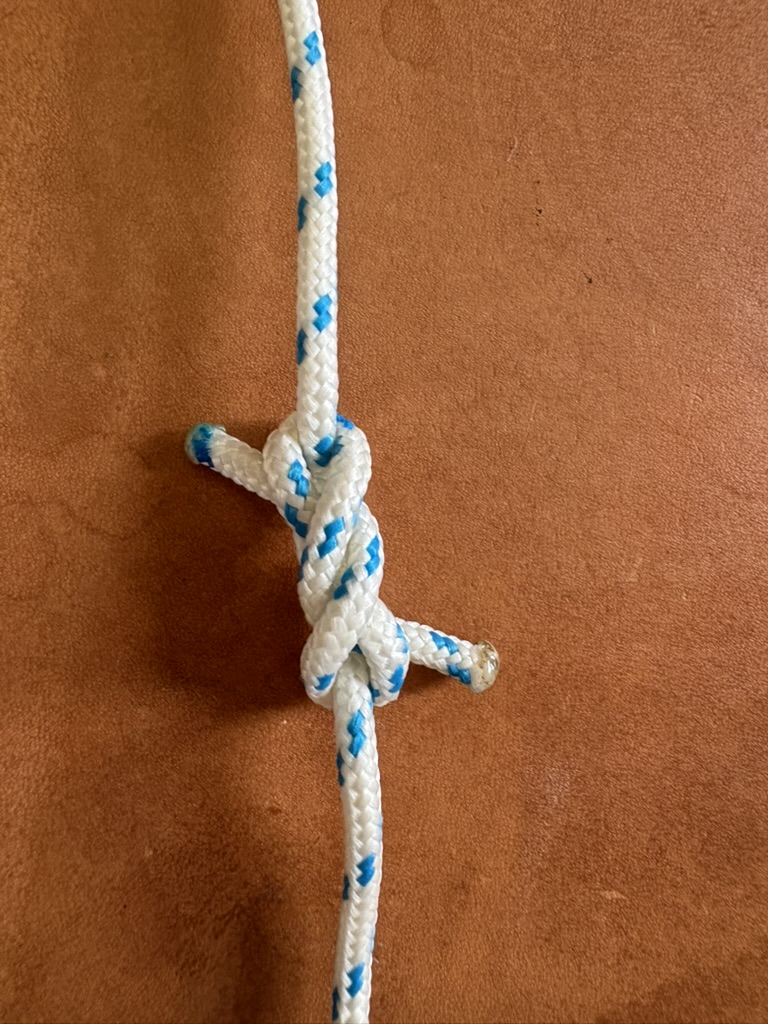
Can anyone identify this bend? Planning to test against Reever Bend…
There are two quite similar variations of what you
show one of --and yours is the easier-tied one, with
less tucking.
Here’s a quick grab of relevant discussion ::
https://discourse.igkt.net/t/i-love-bends/3875/37
[I love bends - General Discussion ]
(-;
Thanks for your reply Dan, much appreciated.
Btw, in regards to your “going to test…”,
what do you have in mind?
E.g., a common testing of end-2-end joints is to tie
a round sling with knot and load the sling; but this
suffers the problem --for assessing KNOT strength,
if not sling strength-- of there being knot compression
and material lengthening on the knotted side of the
sling but pure rope taking the load opposite --lengthening
by material stretch not knot compression and material feed!
SO, one should (IMO!) make the sling with
TWO joints, one on each side :: one knot will break
and and the survivor knot will hold the near-rupture
geometry for examination. (Albeit that with
the broken sling in relaxed form, things might’ve
changed from what was there at rupture.)
(-;
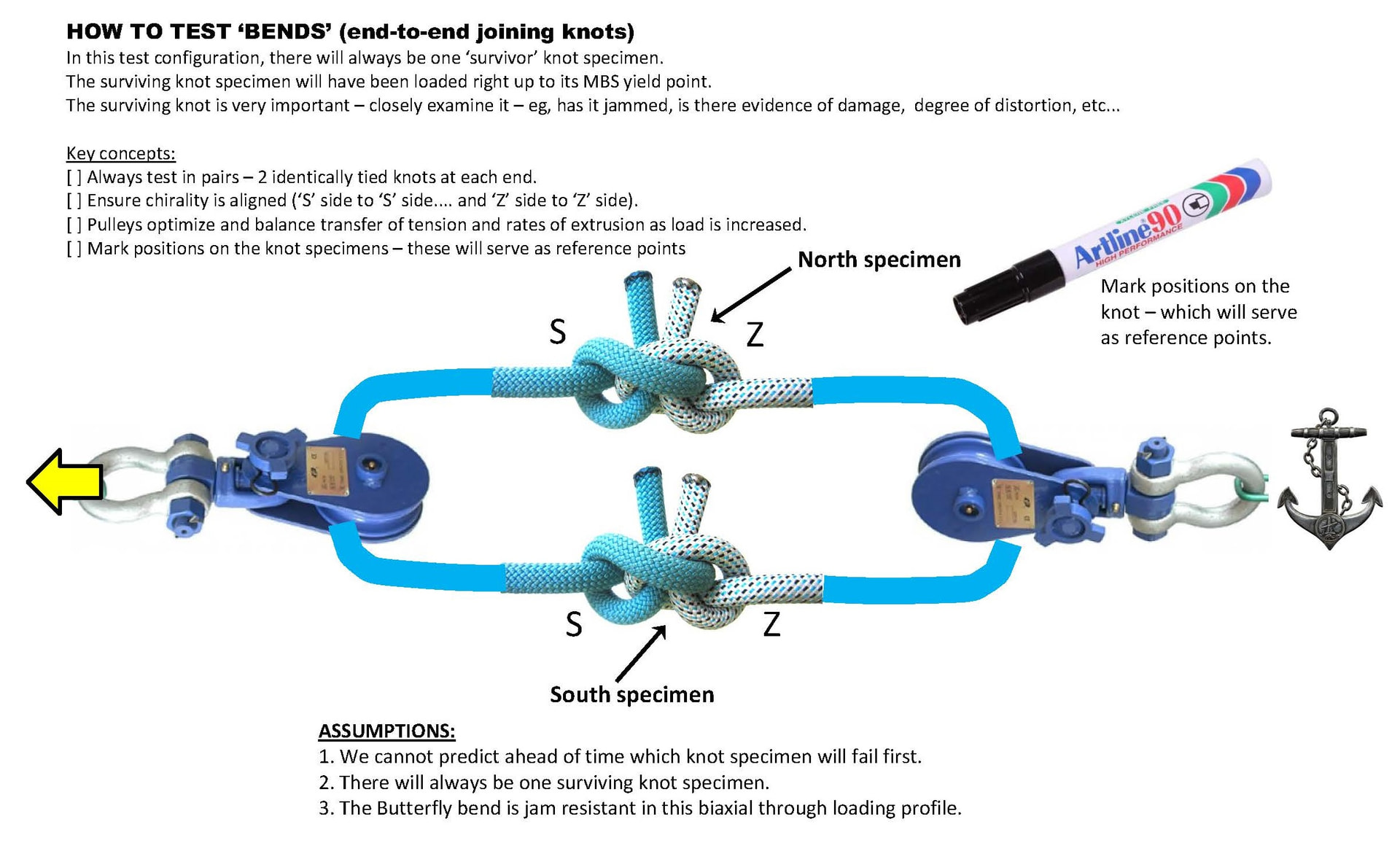
Here is an example of what Dan is explaining (in pictorial form).
In this example, there are ‘Butterfly Bends’. Obviously, you could configure the test rig with any knot you desire.
You also need to define your test parameters and objectives. That is, what are you actually testing? The default mindset seems to be… “pull-it-till-it-breaks”.
But what does that prove (or disprove) exactly?

I have been doing comparative bend tests with the two knots in series, rather than in parallel with pulleys, is this better or worse than the parallel/pulleys arrangement?
Using thin Dyneema cord…
Series arrangement takes pulley friction out of the equation and tests knots directly against each other
Hello ‘peterrkater’,
It all depends on exactly what you are purporting to test.
Most knot testers are infected with the “pull-it-till-it-breaks” mind virus.
I’m not saying that you are infected with said mind virus… I’m simply saying that the majority of knot testers seem to be unable to conceptualise knots in any way other than ‘strength’ (which mostly proves nothing).
Testing in series introduces problems associated with extrusion and stretch. A common configuration is the knot specimen is attached to a fixed (non-moving) anchor point and the opposite end is attached to an input force (ie some type of winch, or lever hoist). As force is injected, the knot responds to load - rope material is extruded out from the core and the entire system stretches in the direction of the input force. In every knot test I’ve performed, there is always evidence of melting/fusing - which is caused by heat build-up (a thermal camera can be a useful investigative tool).
There is typically a delayed response when knots are aligned in series - the knot closest to the input force s-t-r-e-t-c-h-e-s and material is extruded out from the knot core. The knot core undergoes compression in response to force. Some of the input force is converted to heat (due to friction as the knot core compresses). The next knot in the linear series might extrude and s-t-r-e-t-c-h at a different rate.
There have been no peer reviewed studies on knots tested in series - I can only give you my own observational experience. I think a parallel configuration will remove any delayed response. Parallel configuration should therefore remove some of the variables.
Pulleys actually reduce friction (if they are high quality). A rope/cord turning 180 degrees around a shackle would have more friction than a pulley.
In my view, meaningful knot tests investigate things such as; jamming, stability, and security. Some knots are more vulnerable to slack shaking, cyclic loading, and whiplash (which occur at lower loads).
Obviously, the rope material significantly affects the way knots responds to load - and so you need to declare exactly what type of rope material was employed.
Apparently you’re doing what might be called “A-vs-B”
testing, and measure not in calibrated force but simply
in which of A&B “wins” the test?!
The concern with series testing is with how the particular
compressive feed of material from each knot affects the
other --a matter of the strands/fibres being loaded in a
way that might aggravate weakening, there being only
so much material between.
(I was surprised/dismayed that in one testing done for
my (by NERopes, arranged with the late Brion Toss),
my specimens were asked to be about 2m long (5/16"dia cord).
Now, in my case, I was testing eye knots and getting
force-at-rupture measure, and I had the EKs at each end
but identical (to have a rupture force that they both reached,
and a survivor that would show near-rupture geometry,
or so I hoped).
)
And, if using 2 samples of same knot, in the end-2-end
joints Mark shows, I’d not bother with pulleys, thinking
the compression & movement at pins would be pretty
well equal. But in A-vs-B in a round sling, then one could
have a quite compressible knot (Grapevine Bend, e.g.)
versus an much less-compressible knot (OH), and then
the bias of rope on each side would have influence, IMO.
–dl*
====*
Thanks for your insights Dan, which are definitely relevant here. I normally put an identical pair of shackles between the two knots being tested against each other to isolate them and prevent any uneven core-fiber tension transfer between them. I normally fix the rope ends to the shackles with a constrictor hitch.
Peter R. Kater+44(0)7869 629036(m)