In this posting I do three things: endorse detailed research into knot strength, describe what might be a new hitch, and describe modifications to two kinds of noose.
Let me jump into the middle of things. I think that the question of knot strength is interesting on its own. I also think that it is prudent to know the strongest knots (knots which weaken rope least) in case of, for example, unexpected natural disasters where the strength of available rope may be unknown. (It is easier to always carry around knowledge than it is suitable ropes.) I want to be prepared in this large sense and so want to include knowledge of the strongest knots.
Unfortunately, scientific research on knot strength apparently has been too spotty to generate a robust consensus. Furthermore, when a hypothesis emerges which several experts agree is plausible – e.g., the one about the importance of the first curve severity in determining knot strength – it appears to be largely ignored. Why is there no research comparing, say, the strength of plain butterfly-bends to ones with the tail ends tucked through the center (once; twice), to determine how much the reductions in first curve severity increase strength? Wouldn’t it encourage new approaches to knots if we discovered that, say, adding one rope diameter to the first curve can increase knot strength 10%?
My main purpose is to urge this kind of research.
My second purpose is to run a little with the mentioned hypothesis, speculatively anticipating the research. I’ve been interested in single-loop hitches which begin with a half-hitch first curve. The simplest way to reduce the severity of the first curve here is to turn the tail one or more times around the first curve – but the results are usually clumsy (the tail-turns aren’t held firmly in place, or conflict with the need to tug on the tail for adjustments, etc.).
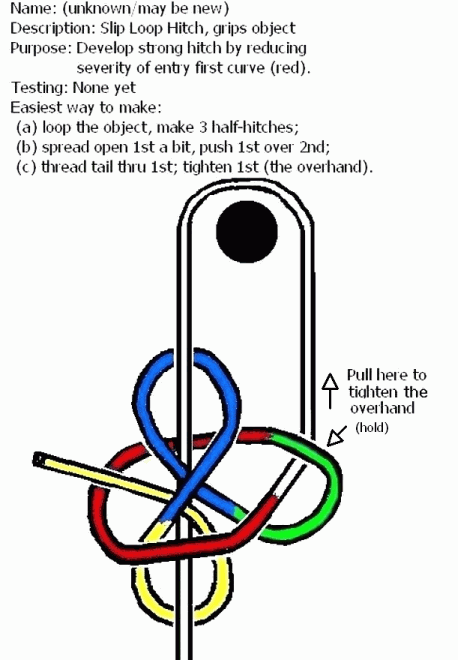
My idea (which might be a new hitch – I don’t have Ashley, et al., to check) is this:
(a) loop the object, make three half-hitches on the standing: 1, 2, 3.
(b) spread open 1 a bit, push 1 over 2, so 1 now encircles the rope between 2 and 3.
(c) thread the tail through 1.
(d) center and tighten 1 between 2 and 3; tug the tail to tighten 2 and 3.
This expands the first curve from 1 diameter to 4 dia. It seems stable and stronger (on my 10mm climbing rope), and has a certain knotty attractiveness. What do you think? (If it is not new, what is it called? If it is indeed new and merits a name, I welcome suggestions!)
Another idea originated with a look at the “running knot” or “lasso”, where a fixed knot can in effect be strengthened by taking a reduced load from one leg of the loop rather than directly. I found lassos ungainly in practice, at least with climbing rope around smallish objects. But the lasso idea led me to examine the famous knot which doesn’t require the lasso’s sub-loop – namely: the “noose”.
If a noose is a ‘hitch’ (in that it takes the load from one leg of a loop and grips the object), isn’t the Gallows Noose one of the strongest single-loop hitches? I tried to address the tight first curve by (a) tying the knot with four wraps, instead of the usual three, and (b) turning the tail twice around the first curve (the wrap furthest from the loop). The wrap holds the tail-turns firmly in place. The result looks a bit peculiar, but successfully reduces the severity of the first curve. (It also makes the knot much easier to untie, which might recommend it to the grapevine bend for its jamming problems). Is it stronger?
Finally, I examined a ‘noose’ tied “underhand” with an “Uni” knot, modified by using only four-wraps, placing the last half of the fourth wrap over the first three wraps, and then adding one turn with the tail around the curve. The resulting first curve is much less severe than the modified Gallows-style’s curve, and there is no jamming problem, but the wraps don’t add supporting strength as they do in the Gallows-style. (It looks ok with my climbing rope, but I might be missing something. Why is the Uni only discussed as a fishing knot? Perhaps its general fortunes will improve with interest in less severe first curves.)
Is the modified Uni stronger than the modified Gallows? Is either one stronger than my ‘maybe-new’ hitch above? (Its first curve is only slightly more severe than the Uni’s, and much less severe than the Gallows’s.)
Moreover, what single-loop hitches have (or can be aptly modified to have) less severe first curves (and so perhaps be stronger) than these three knots?
Thanks in advance for your comments. (I’ll try to be responsive, but I only have access to the web once a week via public computers…)