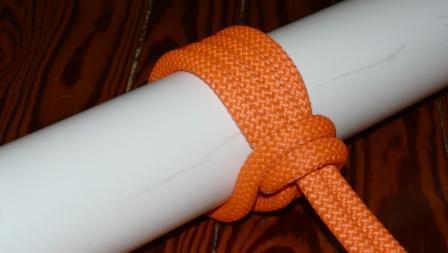
I don’t see how the part after the word “then” logically follows what comes before it.
If a Bull Hitch is jammed (whichever variation), then it’s difficult to “loosen the knot by moving the round turn back on the SPart/tail and readily break the knot”. However, a Slipped Bull Hitch (whichever variation) comes loose relatively easily with a firm yank of the working end. The slip option is there for someone who wants to ensure the knot will be easy to untie.
I agree that the Cow Hitch has ample hold when there is loading. Without loading, the Cow Hitch has essentially no hold. In other words, the internal forces of the knot are not doing much to keep the knot pressed tightly against the object. Again, I view that as a feature, not a flaw.
This is specious, as I showed : in a truly jammed knot, there is
no effective “slip option” --nothing moves. (And even if by some
force multiplier (capstan, winch) to assist, in many ropes there
will be at least some snow-plowing effect AND a bulge of a
folded slip-bight tip that will not pull out.)
.:. With the Bull Hitch variations (of which only the “distal” one
is much a jam threat, I think), if one can move a strand within
the collar’s nip, then one should be able to move a half-turn
of the collar and continue such working to break the knot
–it is movement of whichever, relative to the other : strand
to collar or vice versa (jamming denying both).
I have jammed a Buntline where a Slipped Buntline would not be jammed. I consider a knot to be jammed if I can’t work it loose after a reasonable amount of time. A slip provides a leverage that is otherwise non-existent without the slip.
Anyway, I don’t even know why I’m arguing with you. A Slipped Bull Hitch was clearly easier to untie to a regular Bull Hitch in some testing I did, and the other characteristics of the knot did not appear to change.
Hot dang, good show! We could use some new old blood here,
even with purple rope.
Now, what’s the point of this Pile o’ Bull? --looks to me as though
it could do with more turning, to become adequately secure when slack.
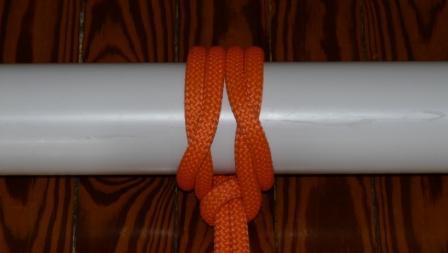
You are aware that rockclimbers might have a use for the Bull Hitch,
or what they might prefer to call "an Improved Girth Hitch" --using
it to keep in place a typically tape sling/runner on a chickenhead
or extending piton (huh? who uses such things, you say!). For
the former --i.e., on a relatively large-diameter object–, it might
be better to replace the Bull’s round turn with a Clove Hitch (i.e.,
the loaded parts are drawn through a nipping Clove Hitch).
Which reminds me that I was just fiddling around with a structure
derived from a slip-knot/-noose for such a purpose.
I was hoping we wouldn’t have to consider the peculiarities of other worlds
or conjecture myself special powers. But you do come up with some strange
observations and so I must wonder … . As told, I did the quick testing that
I reported, with the serious pulley-generated forces which amount to hundreds
of pounds.
Now, I had at one point (in a too transient text) put in some
allowance for exceptions re my assertion about slipping’s merits
being specious, and then trying to focus on the OP’s knots as
heeding the rule, but that … well, was transient indeed. Still,
I might grant that some “YMMV” applies depending upon the
knot structure, where the slip-bight might come under less
stricture but the usual points of breaking the knot be jammed.
And I thought that you might’ve landed one right away, with
the Buntline, and so I have now given that some quick testing
too --same materials : the quarter-inch CoEx laid rope and 3/8"
(multifilament PP?) “Home Depot” rope (I found it, so can’t
speak w/assurance re its origins --but it fits the description).
The former is more frictive than the latter, which yet has some new feel & slickness. .:. In both cases, I was able to break
the Buntlines by pushing the outer turn w/thumb, working on
the away-from-SPart side of the turn in the CoEx case, which
was the more tightly jammed. (force? well, the 'biners were
locked from stretch --I think they are supposed to be able to
be opened at at least 200#, by UIAA standards? --Alpineer?)
And in both cases, pulling the slip-bight tail was not very
helpful --harder (& futile?) w/CoEx; likely problematic in
the harder-loaded, 2nd time, with Home Depot, at the
point of the final bulge coming to the knot (the very bight-end
bulking, w/torque, to boot). Still, I’ll allow that perhaps in
some stretchy Nylon under suitable load the material extension
could lead to a tight nip of the diminished-diameter SPart
such that on relaxation the SPart could not feed back into
the knot, and the tight nip would be considered jammed,
and yet the tightness upon the slip-bight might not be
so great as to preclude its coming undone. That sure
wasn’t the case for my two ropes around a 'biner, ring
hitches.
And I’ll reiterate that there was NO MOVEMENT in the case
of the jammed Bull Hitch (distal).
Now, if in your world you’re playing with tiny stuff such
as boot laces, you will have (1) much more difficulty in
getting the sort of push purchase because of such great
disparity between your digit size & material diameter; AND
(2) you’ll have “Paul Bunyan” strength advantage for pulling
a slip-bight out. (Though we should remark that for the Bull
Hitch the slip-bight’s tail isn’t well oriented to be pulled, as
it points back at the hitched object; one might hold the SPart
and pull … , but that’s awkwards.) But I should hope that
you (and if not, at least others) will come to see that your
belief that one can adequately test knots by using small
stuff and then project that behavior more broadly is highly
dubious.
This issue is not that complicated and unworthy of this much attention. Bottom line, I’ll still be using a slip in my Buntlines and many other knots because they otherwise jam on me.
Complexity is not at all what is at issue here,
but observation/testing and reporting,
which certainly IS worthy of attention for it’s what
knotting has been lacking for so long. And so it is quite
a curious thing to see such conflicting reports of behavior.
And I should not be the only one checking these claims
of jamming or superior strength or whatever. But at least
I have been checking.
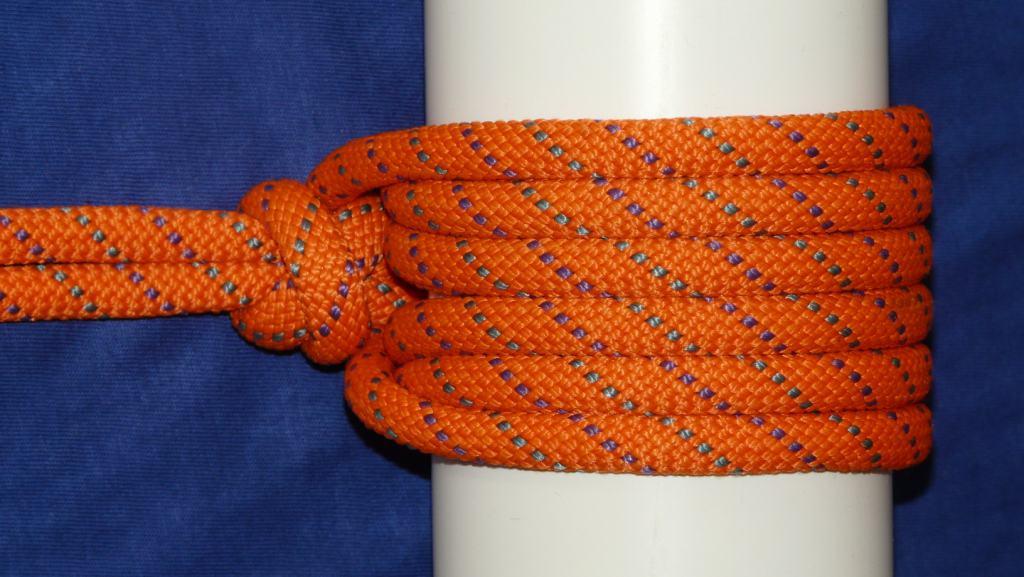
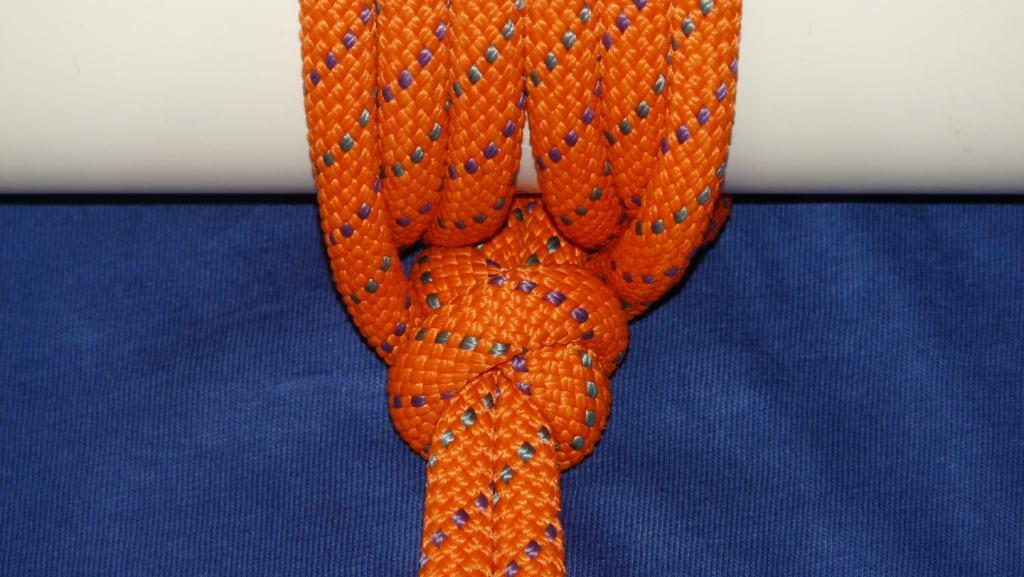
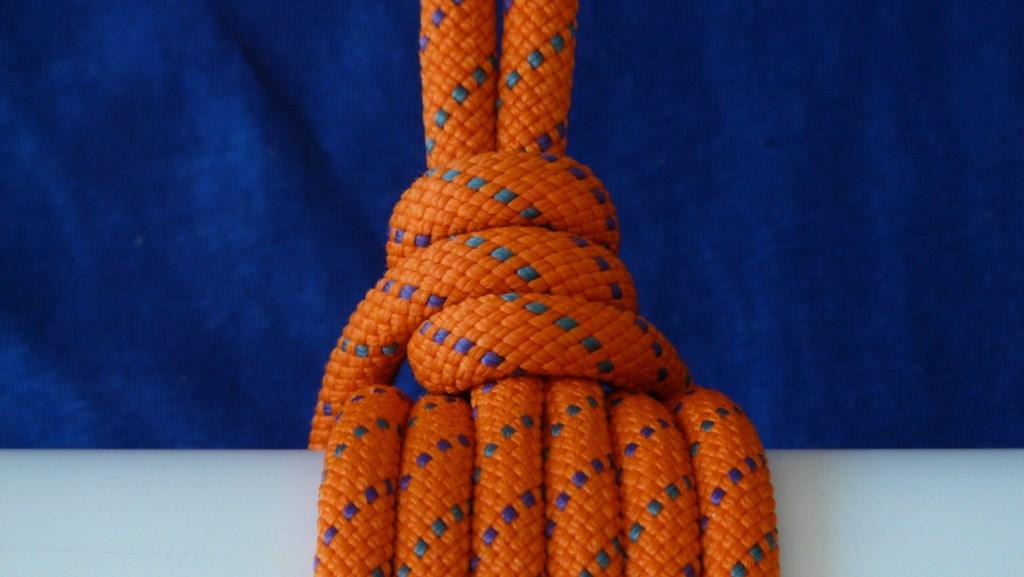
If we use more coils, we can pre-tighten the two standing ends of the improved Cow hitch / Bull hitch, and this pre-tightening will able the coils to remain perpendicular to the axis of the pole, be squeezed between their neighbour coils, and grip it very tightly, even during a lengthwise pull. ( See the attached pictures, and read the posts at (1), and all the other posts there, describing the “pre-tensioning” / pre-stressing effect. ).
The long, double X “neck” will nip the two standing ends sufficiently, and retain this blockage even when the standing ends are not pulled any more. So, the standing parts will not be allowed to slip though it, and release their tension, and the enhanced friction of the coils with the surface of the pole.
This is and has been my preferred knot on my Purcell prusik. It makes the foot loop so much easier to use. It stays in shape throughout all the gyrations of ascending.
I am not accustomed to such helpfull, nice words in this forum, so I can not say I am not just a little happy with them…
I have posted some similar hitches somewhere in this forum, but I do not remember where any more…See how I have named them !
The four diameter “prusik” is interesting and I will have a go using it on a climbing rope soon as the weather allows.
My initial, knee-jerk response is that it will not be as good to the task I will use it for than the prior “improved cow hitch” you’ve share pictures of in reply #28.
These latest look like they will bight too deeply, concentrating the load mainly to the area between the encircled four diameters and the rope/pole and not through the coils.
I’ll have a better comment once my weight has been on it and gyrated a bit.
The other (the first two pictures) look like they as well will bite too hard and therefore make this knot harder to release for the use in ascending a rope or backing up a rappel, grip and slide scenarios, etc. The x’d crossings being like the related parts of a constrictor, locking whatever is underneath very hard.
That was the purpose of the double parallel or the double crossed ( X ) neck… that is, to bite hard into the standing ends, and prevent any subsequent slippage of them through it. Do not let the (superficial) name suggest we are looking for any sort of a climbing hitch here, that would need to be released easily, when “used in ascending a rope or backing up a rappel, grip and slide scenarios, etc.” Perhaps the name is really misleading, and we should describe those knots only as “multi-coiled Bull hitches”. It was just a hard gripping hitch around a pole that I was looking for here, without any concern for easiness of tying or untying, possibility of sliding alongside the pole or tensioned rope, etc.
I believe that the climbing hitches is an altogether other world, strange and unknown to me… The functions that climbing hitches have to fulfill, are many, and much more complex than what we require of a common hitch. I would never dare to suggest any climbing friction hitch to climbers, or pretend I have discovered a way to “improve” the Prusik…
I have also to point out that it is a very different thing to tie those hitches around a pole, than to tie them around a tensioned rope. I am talking here about the fact that a segment of the pole can not revolve in relation to another, as it can happen in a rope. When the standing ends pull the ends of the coil tube to one direction, say, clockwise, while the transverse, bight element pull the other ends to the other, counter-clockwise, a rope at the core of the coil can adjust itself and follow the local twisting, by twisting itself, while a pole can not. A rope can never resist to torsion forces as much as a pole ! So the final geometry, and the tension forces inside the different segments of the coil tube, would be different at the hitch-around-a-rope, than at the hitch-around-a pole. In short, I expect those hitches to be more effective when wrapped around poles, than when wrapped around ropes.