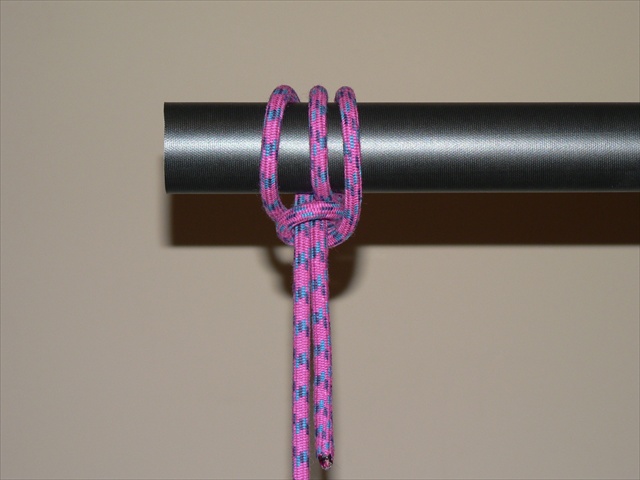
Improving the humble cow hitch
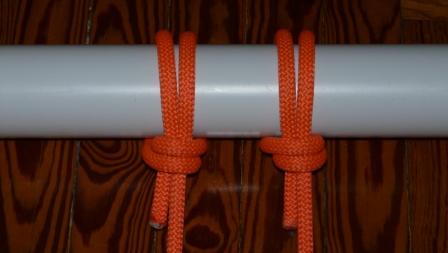
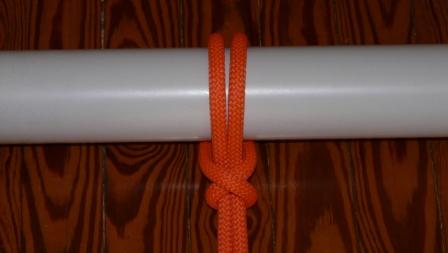
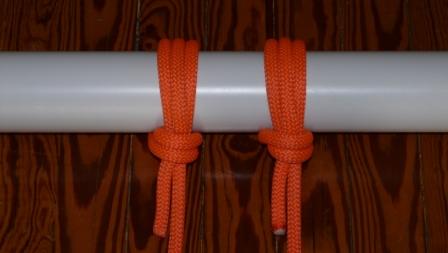
Improving the humble cow hitch
That’s a Bull Hitch.
http://notableknotindex.webs.com/bullhitch.html
It jams up like a champ if you use it as a regular hitch. I’ll use it for lightweight stuff like rings, lanyards and whatnot.
You need to be more careful, here : XaraX has shown TWO versions
of the Bull Hitch; they behave differently.
I have just pulley-loaded the coil-in version --i.e., where the
SPart reaches to the away point of the coil-collar and wraps
back towards the object; and I’m feeling like I’m wrestling with
a “champ”, indeed ! (7mm soft-laid CoEx PP/PE, not new, on a 'biner)
(… had to cheat to untie : i.e., slid the knot off of the 'biner’s gate!)
But the other version took if anything a greater load
(I did some bouncing) and untied pretty easily.
Thinking that adding another turn would ease the difficulty of
the jamming version, I gave it a go : … “champ” time again!
.:. It appears that one can pick one’s behavior per orientation
(and do so appropriate to need).
Even using " marks, I’d be very careful saying/naming this an improved Prusik. I have a hunch that it does not actually improve the gripping/sliding action of the Prusik.
A hunch says that it transfers more of the bite to the center, limiting the spread of the grip.
But I do like the idea of adding round turns to some established knots, to ease strain, friction, load bearing ability and ease of untying. Not necessarily all of the before.
And it adds a little “something” to them for me in the decorative knot zone.
Scott
I do think the adding of the additional wraps increases some potential load bearing of the cow hitch, but it still depends upon the actual loads and its behavior, i.e., dynamic or static.
Maybe even more wraps around the we/sp.. Though we may be back to lashings. lol
SS
I tied a Bull. Then, I tied what looks like your Improved Cow. Both knots look exactly the same. If you’re saying they’re different, then you should loosen those knots in the pics to show the difference.
Anyway, in the original post, let’s pretend that both ends have equal lengths. In that case, the only difference between the two pics would be that one hitch is tied “left-handed” and the other is tied “right handed”, right?
BEFORE you go off on an extended lecture, try to answer that question directly, thanks.
Now that I understand the pics, I’m more confident in my naming it a Bull Hitch. 
The author shows 6 diagrams of the Bull Hitch. Examine the diagrams closely. The author ties it two ways like the two ways in your original post, and he calls each way a Bull Hitch.
Actually, I’m right. You conveniently deleted the sentence before, which was there to set up my question. There is no short rope in my question. I said pretend the ends are equal length. I asked the question for my personal understanding of how the knot is tied. You went ahead and answered a different question that I was not asking. A simple yes or no to my question would have sufficed. That’s why I asked you not to lecture because, as I predicted, the lecture was useless, as it answered something I was not asking.
Apparently, you don’t understand the issue. Your knots in the original post have been published before with color illustrations and pictures. If you showed pics that are easier to identify, then I could have informed this thread sooner. However, since you seem to know everything, carry on with your virtual classroom with your virtual students, pretending as if those knots are new when they’re not.
http://books.google.com/books?id=GbeV0iKl8EgC&pg=PA120&lpg=PA120&dq=piwich+knot&source=bl&ots=ItGK6RAM3q&sig=KLg1jQv7cGjqjXMMFsezfAkVDUo&hl=en&ei=Mhb2TLXoDYLQsAOQz8CoCw&sa=X&oi=book_result&ct=result&resnum=5&ved=0CCgQ6AEwBA#v=onepage&q=piwich%20knot&f=false
Regards
Communication is an high art and it seems that we get stuck sometimes finger painting.
I am enjoying (up to a point) this discourse that has perhaps been looked at or tried by many others before us, but I do not want to stifle the process in any way except to ask that we stay on track and not dive into the heated abyss to which no one really succeeds.
The smell down there is vile.
Just distractions.
To whomever: Please continue to write away in intelligent fashion so that we can, with open minds, give considerations to what is presented.
Korgan: Can you please moderate your language? Not everyone appreciates a discussion that veers into Anglo-Saxon invectives.  If a thread begins to annoy you, I can heartily recommend the “Mark as read” button.
Thank you.
The added round turns encircling the hitched to object certainly does not hurt to spread load as shown in the pictures, but I do wonder if additional nipping turns are worth anything. Unless there is a pendulous swinging action then these additional rings of cord can spread across the nipped area.
I think it better to keep this hitch in its simplest form and if the need is greater, graduate to a more likely hitch to better suit the situation.
???
You informed this thread immediately --the first reply.
To which I followed up with a point about the effective differences
between the two orientations. This should have informed you and
anticipated/precluded your later antagonizing questions.
Good find with Budworth, who glosses over the differences without remark
–typical of knots books (and a thorny question about making Book Reviews
to point out the lazy presentations of celebrated IGKT members in their own
quarterly! --a current thread under ChitChat).
I concur in Scott’s doubting the “improved Prusik hitch” vis-a-vis that
knot’s raison d’etre ; but with regard to Knot4U’s point about jamming,
one can view this Prusik variation as what XaraX casts it as (if only nomimally),
viz. an improved Cow --the improvement being an extra wrap around the
object to absorb force and mitigate the risk of jamming (when used,
as Knot4U implies, to secure a circular sling to something) : i.e., one can
get more moderate tightness in the knot-securing turns around its ends
(and for what it’s worth, some better security at holding its position on
the object, to boot).
An important note, I don’t consider the Bull to be an improvement of the Cow. I tie the Cow specifically because the Cow has NO hold when there is no load. That’s not a flaw. That’s a feature. The Bull removes this feature and competes in the realm of tightly holding hitches, such as the Buntline, the Anchor Bend, the Lobster Buoy, the Round Turn With Two Halfs, the Boom, etc. I don’t view the Cow as being in this space, and the unique features of the Cow are highly preferable sometimes. By the way, I like to secure the working end of the Cow with a Double Bowline for a combination that is quick tying/quick releasing. This combination is usually my anchor knot in a Trucker’s Hitch.
If you want security when unloaded, then yes the Bull is obviously an improvement on the Cow. Regarding the Prusik, I view that knot as a similar concept to the Cow. When not loaded, the releasing of the Prusik is a feature, not a flaw. If you add the nipping loops, you place these knots (Cow and Prusik) into competition with a wide host of other options that are more likely to be preferable. It all depends on the application obviously.
To address jamming issues, I tested a Slipped Bull. On the positive side, the Slipped Bull (each variation) works well to address jamming issues, and it’s a compact knot.
On the negative side, the other limitations with the Bull are also present in the Slipped Bull. The Slipped Bull must be flush against the object to work properly, or else the knot capsizes and does not hold securely. For example, the Slipped Bull works well with relatively small round objects, but does not work well with large square objects. In contrast, a Round Turn Plus Slipped Buntline holds securely with a wide variety of object shapes and sizes.
I slipped both versions in your original post or both versions here:
http://books.google.com/books?id=GbeV0iKl8EgC&pg=PA120&lpg=PA120&dq=piwich+knot&source=bl&ots=ItGK6RAM3q&sig=KLg1jQv7cGjqjXMMFsezfAkVDUo&hl=en&ei=Mhb2TLXoDYLQsAOQz8CoCw&sa=X&oi=book_result&ct=result&resnum=5&ved=0CCgQ6AEwBA#v=onepage&q=piwich%20knot&f=false
The slip involves nipping a bight at the final exit of the working end. It’s the most obvious way to slip it. Don’t over think it.
The Cow hitch has ample hold in many materials qua ring hitch,
where it improves on the Clove hitch in being easier to loosen & untie.
To address jamming issues, I tested a Slipped Bull. On the positive side, the Slipped Bull (each variation) works well to address jamming issues, ...
Your testing is insufficient (and you gave few specifics).
Repeating the quick-test I did with quarter-inch laid CoEx-PP/PE
I find the jammed slipped distal** Bull hitch damn-jammed.
Getting the round-turn collar to slip over the 3 diameters of the
knot is maybe harder than doing so for just the 2 dia. of the
unslipped version --the trio of strands making the ideal circular
grouping of material to be compressed & nipped without need
of as much bending of the encircling wraps.
– I’ll have to “cheat” and take this hitch off of the 'biner
by sliding it, then untying it! ouch!
[** “distal” in a quick “away” denotation in reference to the
Bull H.'s nipping coil-collar; “proximal” would be the other loading.]
NB: It is bad to refer simply to “the Bull hitch” without further indication
of the particular loading, as behavior depends upon that.
I dedicate this knot to xarax. I call it the PILE O’ BULL HITCH! ;D
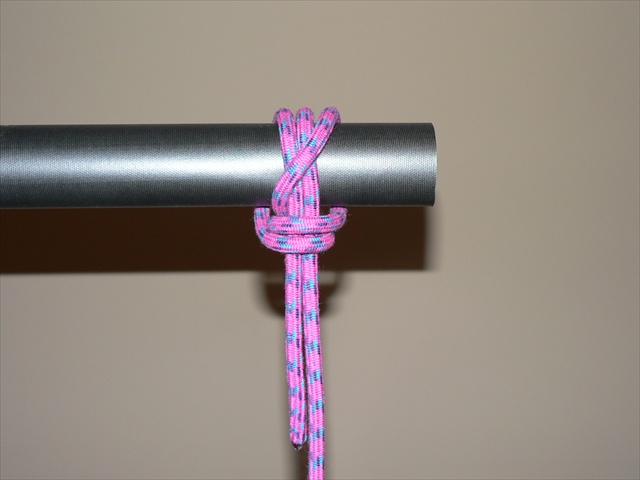
Basically, the performance of the Slipped Bull in your testing is even worse than what I found. How you managed to jam a Slipped Bull Hitch, I don’t know, but I’ll take your word for it that you could.
By the way, I indicated above that I tested both variations from the original post. I tested that cheap rope from Home Depot. I also tested boot laces. I used various different object shapes and sizes. The performance was too poor to get me motivated to write too many more details here.
?! It jams just as any other knot would. If you can liberate
this knot by pulling out a slip-bight --i.e., getting a strand to
move through the round-turn nip–, then you could loosen
the knot by moving the round turn back on the SPart/tail
and readily break the knot. As I said, having the 3rd strand
to surround might even add to the tightness as its a little
easier for the turn to flow and increase tension around 3 strands.
By the way, I indicated above that I tested both variations from the original post. I tested that cheap rope from Home Depot. I also tested boot laces. I used various different object shapes and sizes. The performance was too poor to get me motivated to write too many more details here.
Yes, both versions, you said, re the slipped knot. Now, if
you got jammed rope with the “proximal” (XaraX’s righthand in OP)
version (unslipped or otherwise), that’s hard to figure! With boot
laces (flat, round, …?) you can give pretty high relative force rather
easily; with the Home Depot (3/8" ?) kermantle, no so easily.
I used a pulley (5:1 but hardly in great working order) and body
wgt (180#) w/some bounces --and that’s a serious load; should
be well more than my rope’s WLL, for that matter.
One could revise the knot with the following variation:
make a full (round) turn and then flow into the round-turn
collar ; finish as usual. (not sure what Alpineer’s done–maybe this)
The tail has the collar-tightening advantage and so the knot
can be set pretty tight ; the SPart is impeded from making
the knot overly tight by both the version choice (the “proximal”
version --SPart wrapping into collar away from object–,
and the extra turn around the object further impeding delivery
of force into the nipping collar.
It should be remarked that we here might have all been hitching
to a smooth object (e.g., I to a 'biner, as a ring hitch); but the
transmission of force around a rough object (tree limb, say) is
far less, and the jamming (even setting tight) harder to get.