In Search Of The Holy Grail Bowline: A Bowline For All Reasons

I do not look the knots, I tie them and try to feel the forces that run through their body, as if it was mine s ! :slight_smile: This is an “intrinsic” “view”, which can tell us things that are not shown in pictures. Imagine you are a snake, and you are knotted and pulled by your head and tail - what do you feel ?
The geometry of structure is the same, obviously, but you are right, this is never the whole story - not even the most important part of it. I can feel that the torsion in the structure you show in much less than in what I show, indeed. However, I believe that this is another advantage of the later in relation to the former ! :slight_smile: This torsion is beneficial to the gripping power of the two wraps, because it works as an invisible “skeleton”, it stabilizes the form of the “coil tube”, and it will not allow it to lose its initial symmetry when it will be loaded in this eccentric way it is to be loaded. Torsion is a very effective force, and that is why the torsion springs were used in tanks and the VW beetle ! :slight_smile: It is a good thing, if we can use it to our behalf. I know that there is a common misunderstanding, that torsion “absorbs”, in some way, the tensile forces, so what is added in torsion should be subtracted from tension. This is not correct. You can have torsion forces alongside tensile forces- a rope or a rod can be “twisted” AND pulled/pushed, at the same time, without the amount of the twist absorb, and diminish, the amount of pull/push.
So, the test I propose to you is not visual, it is corporeal ! :slight_smile: Tie the two structures with a lose collar, and “see” / “feel” what holds better.
The twisted / torsioned rope segments of the wraps of the knot I show will be constricting the encircled body of yours, like the turns of another snake ! The head and the tail of this snake will almost cut you in two, with this scissors-like action - the one pulling towards the standing end, the other towards the tip of the bight.
I had tried the “common” application of this crossed coils double nipping loop many times, before I had discovered the “Eskimo” version…I agree that the visual simplicity of the “common” version is very attractive, while the “Eskimo” version looks like a …whatever. However, I was amazed by the constricting power of the “Eskimo” version - which also utilizes the L-shaped continuation of the standing part and the returning eye leg, the “handle” and the “step” which facilitate the job of the nipping structure - and that is why I had preferred it. I can assure you that I have a soft point in the simplicity of the knot structure, and I would nt hesitate to sacrifice a reasonable portion of gripping power, to retain it. However, here we have a GREAT difference ! The one structure can work even without the collar, as an adjustable loop, while the other is only stabilized by the collar - moreover, the nipping structure is much more complex than the collar structure, which remains rudimental … This discrepancy between the amount the ante-eye and the post-eye knotted structures is something that bothers me, and I always try to tie bowlines where the rope segment will be almost as much convoluted in the nipping part as in the collar part. If I see a bowline where the one part is elaborated, and convoluted more than the corresponding part in the common bowline, while the other part is left unchanged, I sense that the design of this knot has not been finished yet ! :slight_smile:

I have tied [i]many[/i] nipping structures, if not ALL of them, in a systematic way, I can assure you. However, I can not confirm what you say - and I very much doubt it. However, you can persuade me VERY easily : Tie all the structures I propose, test them, and report your results !  :) Your very high-flying tone about the "Open Elbow Structure" will lower a little bid, but, in the mean time, we will have learned many thing we still ignore .. :) Is this structure more [i]simple [/i] than the Water bowline s or the Mirrored bowline s ? No, of course not, and I would nt even argue about it. Is it more [i]secure [/i] ? We have to [i]test[/i] them to tell. Is it more [b][i]stable [/i] [/b] ? Here, my dear alpineer, I will resist my temptation to lough loudly. It is [i]a most unstable structure[/i], that has to rely in the collar structure s belt to remain in one piece! It imposes a great strain on the base of the legs of the collar - I almost "feel" the pain they feel ! My KnotGod, it is but a poor loop-sided fellow that needs the collar stick to walk ! Is it [i]untiable[/i] ? Yes, it is - but have you tried to untie the Twisted Pretzel structure, for example, to see the difference ?  :) "[i]Broader range and nature of cordage"[/i] are not of much concern... I tie and try the secure bowlines in climbing ropes, 9-12 mm, because those are the ropes that will be used, if any of those is going to be used as a replacement to the retraced fig.8 knot. I do not tie and try them on small, soft cordage, or on monofilament fishing line, for example, because I see no point of using a [i]secure bowline[/i] in non-critical applications - the common or the "Eskimo" bowlines are just fine for them. 

Simplicity is imperative to me, too.. But tell me, please, alpineer, do you really believe that the asymmetric 8 shaped structure you show, is really simpler than the Girth hitch of the Mirrored bowline, or the Constrictor of the Constrictor bowline ? Have you tied MORE times this almost crippled 8 structure ( which is beautiful only in the eyes of a blind mother… :)), than a Cow hitch, or a Constrictor ? Simplicity is depending upon the amount of information of something, that is needed in order to store or retrieve it. May be the simple Clove hitch is simpler than the Constrictor, indeed - or the Water bowline than the Constrictor bowline. However, the “Open Elbow”, or the “Pretzel”, are not - they are more complex, and an indication of this fact is that they can be tied wrongly in more than one ways !
Perhaps you have not noticed my argument about the difficulty of adding a second collar in this structure. Do you believe that such a modification would be redundant ?
Now, it often happens that we come to see a cup that may look like it is made of pure gold - or that it IS made of pure gold, indeed. Is it the Holy Grail ? You can believe it - but the prudent thing is to not bet anything you have on this… :slight_smile:
I would also like an experimental comparison of this bowline to the “similar” Locktight bowlines tied by Dan Lehman - because I can not find why they would be very different. I prefer the U-turn of the eye leg around both legs of the collar as at the structure you show, that is true, but this might not be the whole story (1).
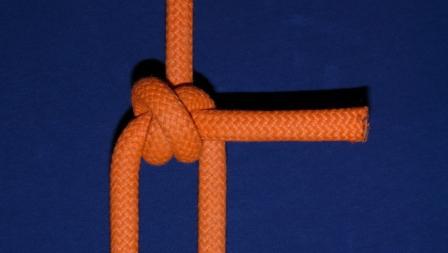
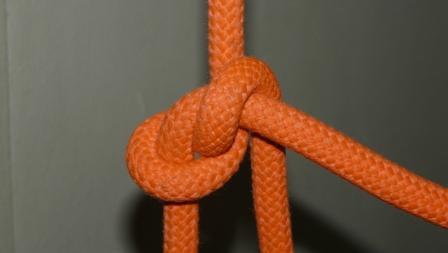
  1. http://igkt.net/sm/index.php?topic=1234.msg8419#msg8419

I have read my previous post, and I feel that it sounds too critical… :slight_smile: So, I have to repeat that this bowline is a very simple, easy to remember and tie eyeknot, with a very tight double nipping structure, that deserves further, detailed examination and evaluation. I do not say it is no good ! - I only doubt that it is “the best”, the Holy Grail … because there might be no such thing, and because I have met a number of other tight double nipping structures, of about the same complexity, that are as secure and simple ( and perhaps even simpler) than this.
One of my concern is that the nipping structure is much more elaborated / sophisticated / convoluted than the collar structure - which remains the old “proper” bowline s collar, in a knot that is meant to go beyond the common bowline… One possible way to do something about it, without spoiling the character and the simplicity of the knot, is shown at the attached picture. Another similar solution to the same problem is the slightly different “braided” collar structure, offered by the very clever and original “Braided bowline”, by SS369 (1).

  1. http://igkt.net/sm/index.php?topic=4283.msg26651#msg26651

P.S. The interested reader might notice that the shown bowline, as well as a number of other similar eyeknots, can be derived by a simple modification of the Sennit, the Symmetric Simple Sinon (SSS) and/ot the Vice Versa/Versa Vice/Reever bends. Usually, an untucking of a limb of the one side, which afterwards is forced to make a U-turn and be connected with a limb of the other side to form the eye, would be sufficient.

So, if we wish to go one step further, we will ask ourselves : why does the second leg of the collar ( the tail ) has to follow the same, first leg s path ? In the “Eskimo” versions ( there are more than the one I have shown), it passes in between the first leg ( the continuation of the returning eye leg) and the standing part. That is the place where it is squeezed harder, so it seems reasonable to try to replicate this situation in the “common” version as well. See the bowline at the attached picture, which is a modification of the knot presented at the previous post. The interested reader would recognize the symmetric bend which lies at the core of this eyeknot - it was published in this Forum some time ago, and it is a modification of another member s similar but more complex knot.

I understand that many people would not understand what I am talking about here …so I have to show some pictures. :slight_smile:
One does not see any collar in the double, crossed coils nipping structure shown in the attached picture, does he ? However, the interested reader who does not only look at knots, but also ties them, would be surprized by the holding power of this structure, even in the absence of any collar, even when it is deformed That is why I say that we should better place and manage to maintain the shaped “8” structure perpendicular to the axis of loading, not parallel to it - where it would not be stable any more, and would need the active presence of the collar to remain in one piece. If the collar, for whatever reason, gets loose, the “perpendicular” double crossed coils nipping loop would still hold, while the “parallel” double crossed coils nipping loop would open up, like a peeled banana ! :slight_smile: In any crossing knot bowline, we mainly seek one, and one only thing : to keep the form of the nipping structure closed, without much aid by the collar, in any loading configuration. We can not suppose that the two eye legs will always be equally loaded, or even that they will be loaded at the same time ! The one leg can be caught up somewhere, and be forced to carry the whole load, while the other will get loose. A more self-stabilizing nipping structure would be able to maintain its integrity, remain closed, and hold during this phase, while a structure that is heavily depending upon a loaded leg, would be deformed and lose its gripping power altogether, if this leg happen to be loosened.


initial form of loaded double, crossed-coils nipping loop.JPG

deformed, yet holding (1).JPG

On Thursday a friend and I set up a pull-testing station in his back yard between two stout mature trees and at near ground level. Sorry, no photos. I forgot my camera. A ratcheting cable winch puller (1000 lbs. first layer capacity) was used to apply the forces, which were estimated as we had no means for measuring them accurately. But, really, all that we wanted from the tests was to see how well the Tresse Bowline resisted deformation under severe loading and thereafter how easy it was to untie. A large plastic tarp - folded several times - covered the entire setup when the forces were being applied. Even so, the high forces reached scared me, as this was the first time either of us has done something like this.
The tests were conducted in the normal loading mode. Only two tests were performed, one with 10.5?mm KM (brand unspecified) and the other with 4mm nylon accessory cord. The test pieces consisted of a Double Bowline tied on one end of each test piece and Tresse Bowlines tied at the other ends. The accessory cord was tested to near failure as best as could be judged [~600-750 lbs.], the knots were checked for movement and ease of untying, after which the knots were reset. The accessory cord was then loaded to failure, at which point the Tresse Bowline ruptured. Of course, the highest forces were reached when testing the KM and could have been as high as ~1000 lbs.
The test results showed that the Double Bowlines and the Tresse Bowlines maintained their forms well under heavy loading and were similarly easy to untie.
I would like to do more testing to gather some data points regarding movement at or near the knot. FWIW, I will also test the T.Bowline for ring-loading issues and see if I can get it to jam.

Cheers,
alpineer

The puller used was similar to this product. http://www.texastooltraders.com/Contractor-Supplies/Pullers-Bars/Comalong-Pullers/Maasdam-CAL-1-1-Ton-Capacity-p8447136

Perhaps I’m missing something here but on the face of it the double bowline outperformed the tresse bowline in that the tresse bowline ruptured and the double bowline didn’t. That would put the double bowline in pole position awaiting tests against say the EBDB? I have in mind something like the “knot wars” used for fishing knots but I don’t have the kit to contribute to testing unfortunately.

Barry

Hi Barry,
I indicated in my opening post that the tresse bowline appears to be weaker than ABoK #1010. Commercial and sport fishermen and climbers… value many of the same characteristics in their knots. Where each discipline can differ is in what specific characteristics of knots they must necessarily place greater - or lesser - focus on. For a climber, the threat of a knot causing a line to fail from being overloaded is simply unacceptable, so climbing ropes are necessarily overbuilt, and knot strength becomes a lesser factor in knot choice because the required strength is always there in enough measure. Even a weak knot is strong enough for any task, but for other undesirable properties… it may not be used in certain applications.
One could argue that strength is the most important of all cordage properties. Knot efficiency isn’t a major issue concerning climbing ropes because of the high margins of safety built into them. So the focus on specific attributes goes elsewhere.
Fishermen are at the other end of the scale (haha). Their lines must necessarily be of smaller diameter for several reasons, I would guess (bulkyness, weight, cost, stealthyness, manageability…). Fishing requirements don’t allow for overbuilt lines with high strength margins, in fact, in the case of sport fly fishing the name says it all. The focus naturally tends toward knot strength efficiency to get the most performance from their lines.
So, did you miss something Barry? No, not really. You read correctly. But so what. It is what it is. I’m just reporting my observations as honestly as I can. Why come to conclusions about a knot based on one parameter when there’s a host of others to consider? I’ve just begun the quest to test and prove my claims in a public forum. Pole sitters don’t always win the race!
Everyone here has an opportunity to engage themselves in evaluating this simple adaptation to the standard Bowline.

Cheers,
alpineer

My thoughts on Bowline security:
It would be most desirable to get the security feature of a Bowline derived knot up front rather than at the tail end of the tying process. There’s a human psychology aspect to my thinking on this. Considering reports of accidents implicating failed Bowlines, I suspect that most were a result of not tying a tail security feature. Better for the security feature to be first - before tying the Bowline - rather than last, regardless of whether you feel the need to do something with the tail - i.e. if you remember to after being distracted, say, by the scenery around you ;), or feeling rushed or for whatever reason. Perhaps those accidents, and the bad press that followed the Bowline, could have been prevented.
In the tresse bowline’s case the first nipping loop is the knot’s security feature, after which you’re tying ABoK #1010.

alpineer

Really?

http://en.wikibooks.org/wiki/Knots/Components
http://www.ropebook.com/information/knots/terminology
http://www.itstactical.com/skillcom/knots/knot-of-the-week-terminology/

You have a point here. However, why not have a secure nipping structure AND a secure collar structure, at the same time ? Regarding good things, most of the time “two” is better than “one”. Bowline is a knot made by two good components : the nipping loop and the collar. If we decide to go forward, it seems reasonable to me to use both feet / to improve the nipping loop AND the collar. When you replace the tyres of your car, either of the front or the rear wheels, you replace both of them, don’t you ? I never use one single anchor, or one single mooring line - and I admit there is a human psychology aspect in my thinking on this ! :slight_smile:

Simplicity, Simplicity, Simplicity. Complicating a structure further generally results in more bulk, more time required for tying, and more opportunities for mismanaging the tying process . At what point do you stop adding complexity to your structure? Do “we” decide to go “forward” further still, and take agent smith’s cue and throw in a Yosemite finish? If you feel the need, you have those as options.

:o ;D You had me fooled, X1!

Good question ! :slight_smile:
“I” would say, when “we” decide to move, “we” have to move both feet, just one step each. “I” think that the bowline is a two-components knot - so if “we” decide to go forward,“we” have to tie a more complex nipping structure AND a more complex collar structure. How much “more complex” ? Nec plus quam minimum.
Simplicity is a most complex thing do define ! Is an astronomical model that explains the orbits of planets with dozens of more simple cycles and epicycles, more simple than a model that uses only a few more complex ellipses ?
More to the point, “I” tend to believe that the more complex nipping structure offers safety in relation to strength, and the more complex collar structure offers safety in relation to slippage. “I” have not seen any experimental proof that a double nipping loop, of whatever shape ( be it an Open Elbow, an untwisted or twisted Pretzel, a Clove hitch, a Girth hitch, a Constrictor… ) nips the penetrating eye legs harder and more efficiently than a single nipping loop. “I” think that the double nipping loop is needed for its greater strength and self-stabilizing properties, rather than for its greater gripping power. The main obstacle against slippage is the collar - so, if “we” wish something beyond the common bowline, “we” have to improve the nipping loop AND the collar.
The two collars offered by the Janus bowlines, the two collars offered by the Double Collar bowlines, like the Mirrored bowline ( a Girth hitch(ed) Double Collar bowline), the braided collar offered by the Braided bowline, the Yosemite finish bowlines, all are means to the same end, a more secure collar structure. The problem is how to combine one of those solutions with one of the solutions that throw the other shoe, that of the safer nipping structure.
To me, the common or “Eskimo” bowlines are perfectly safe 99 % of the time - so I think we are talking only for the rare rest of the cases, for people that are not going to change their routine, the retraced fig.8, for the next hundred years (at least), for people that do not read any post in this Forum, and for ourselves. So, let us not get too exited in defending our personal beliefs about what would be the best mousetrap. :slight_smile:

I definitely prefer the open form, but expected tyers would “instinctively” scrunch the nip. But yes, I was not clear enough in stating that the nip should be left in the open form, although my photo #4 clearly suggests this dressed and set form. Or, I could have stated with more elaboration that it’s definitely not critical :). I will try to confirm with more testing.
Were you able to tame that old ornery B W II stuff?

The first strength comparison tests, admittedly crude, were done with cotton thread of expectedly non-uniform nature (what I had at hand that I could break by hand). Maybe a half-dozen tests were done, enough to satisfy my curiousity for the moment and cause me some mild disappointment re the results. The higher load tests were done with a friend, and used small dia. nylon accessory. The test appartus consisted of a screw-eye in a ceiling beam and a 3 ft. long section of 2x4 placed through the test loop for us to stand on and create the necessary forces to break the knot. Only two strength tests were completed because of the lack of control we had over the test apparatus. A minor injury was sustained by the friend. For safety reasons alone this is not a good means for testing knots.
Those tests are preliminary at best. I would like to conduct more testing that would support the gathering of more relevant data.

Re: the strength test results, I too, was surprised by the findings.
Re: SuperSnug369 test specs, I believe I did in the cotton thread. The results were the same. I’ll retest at some point.

Really. (To that first site I put in some corrections --no telling
whether they’ll survive (“bitter end” my arse >:( ).)

I see a helical structure, and don’t succumb to dumbing down
to two-dimensional simplistic-ness.

You mention “no torsion” : I suggest that you do your loading
in braided rope and check this --I think you’ll see obvious
torsion, with unloaded strands arc’d upwards in obvious
non-tension (there goes 50% !) and the opposite-handed
strands tight. Once can see this in a fig.8 end-2-end/eyeknot.
Maybe this helps give #1010 its gain (it’s lack of loss)?!
(Note that torsion in laid rope should affect the rope as
a whole --i.e., all of fibres gain or lose–, whereas braided
construction has fibres going in different directions!)

Now, the question of "Holy Grail"ness was put in particular
by seeking comparison of the OP knot with the mirrored bowline
–one that seems to have good slack-security and tested-in-HMPE
(lacking final tuck, alas) high-load (to rupture) security
(devoid of SuperSnugging! ;D ). --as one example.

–dl*

Heinz Prohaska --responding to the infamous (but often mis-told)
Lynn-Hill-falling-unknotted story (she didn’t tie her intended bowine)
suggested using the anchor bend (fish.bend) as the base, which
would give a sort of Prohgrip /Blake’s hitch grip to the tail inserted
through it --security at first closure of the tie-in eye! His full knot makes
a “proper collar”, IIRC. Oh, the insertion of the tail to form/close the
eye is in the same direction that it goes in completing the base knot.
That sounds like about as “up front” as one can get --SOMEthing has
to be tied, after all.

For myself, I’m looking at two-stage knots, where the first stage
is some sort of hitch, hoped to be able to serve securely should
everything else somehow fall apart --though one must presume
that that situation implies that the base hitch too will be loose
(for how else … ?) ! I’ve come to the conclusion that those
compound knots that don’t look so good on this condition
nevertheless give slack-security so great that there is no need
for their being this back-up security element; but there is
one that seems secure when open --ironically, it is less
accommodating of forming so secure a compound structure!

These are ungainly and complex-looking, but their tying is
one of building upon simpler elements; the knowledge of
what one is doing should make this feasible. The payoff
is having a tie-in that (1) securely endures to hold, (2)
might give better load absorption (in not so tightening
that is loses knot-compression), and (3) is easy to untie.

–dl*

A hitch tied on the returning eye leg around the rim of the nipping loop can serve this purpose - so, even if the nipping loop itself opens up, something would still remain closed !

If the “nipping structure” and/or the “collar structure”, as a whole, happens to resemble a well-known knot, there would be a real or virtual aspect and sense of “simplicity”, which would help the average knot tyer to remember how to tie, and to tie, the post-eye-tiable eyeknot utilizing it/them easily - a ready-made pattern, a built-in mnemonic, so to speak. That is why it pays to examine each of the two parts, the “nipping structure” and the “collar structure”, as separate entities, although their entanglement into the “compound” finished eyeknot is usually very complex. That is why I have argued that the Constrictor bowline is, in fact, not less simple than the Tresse bowline - or, at least, it is not much more complex, to the point one should not consider it as a practical and convenient solution.

It’s better for your health and well-being to succumb to “two-dimensional simplistic-ness” than to bitterness, Dan. ;D I stated at the beginning of this thread that the proper elbow contains 720 deg. line torsion. I also see a helical structure. The tresse bowline has no helical structure (certainly not in the same sense). The line’s construction is of no matter in the context of this discussion.
The tresse bowline’s elbow is not a “proper elbow”. Nevertheless, it’s as legitimate a structure as any other elemental form from which knots are built, and deserves to be acknowledged as such. It needs a name, and because of it’s two-dimensional resemblance to the proper elbow (but without torsion) I call it open elbow. It doesn’t contain any torsion*. Have you not coiled a power cord using the alternating handedness method? The coils exhibit local line torsion only. Throw the coils back out and all that torsion diappears, period. The “tressed elbow” elemental form doesn’t contain even local torsion.

  • Unless you want to be nit-picky about the small amount of torsion initially required for a three-dimensional linear structure to cross itself, it’s perfectly reasonable to ignore this incurred torsion.

… “in ignorance of its history” didn’t make it through the review – guess it wasn’t politically correct. ::slight_smile:

Wrong. “from none” would be “It goes”. Such criticism! Over nothing. Or am I being too sensitive? :-\

alpineer