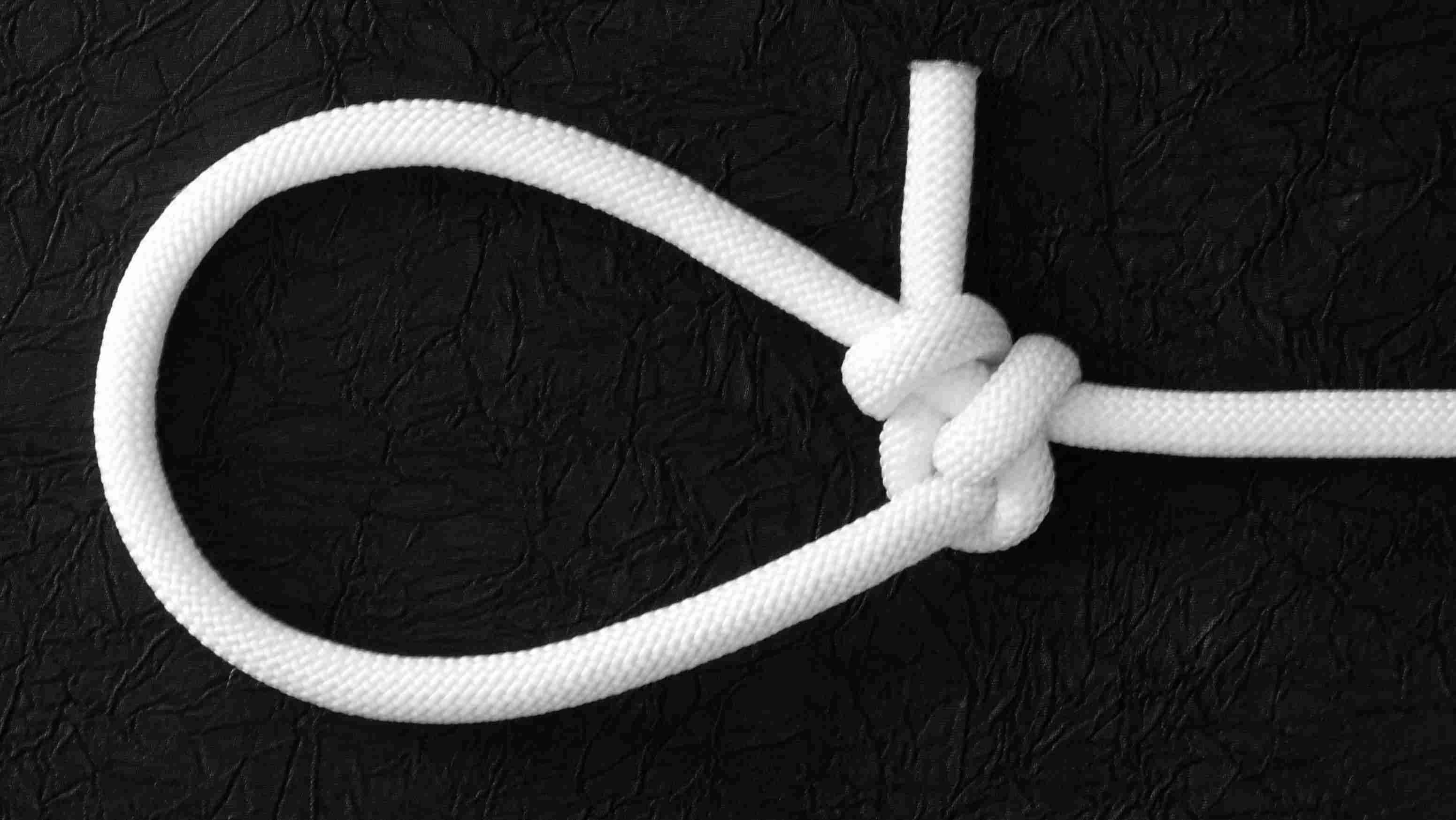
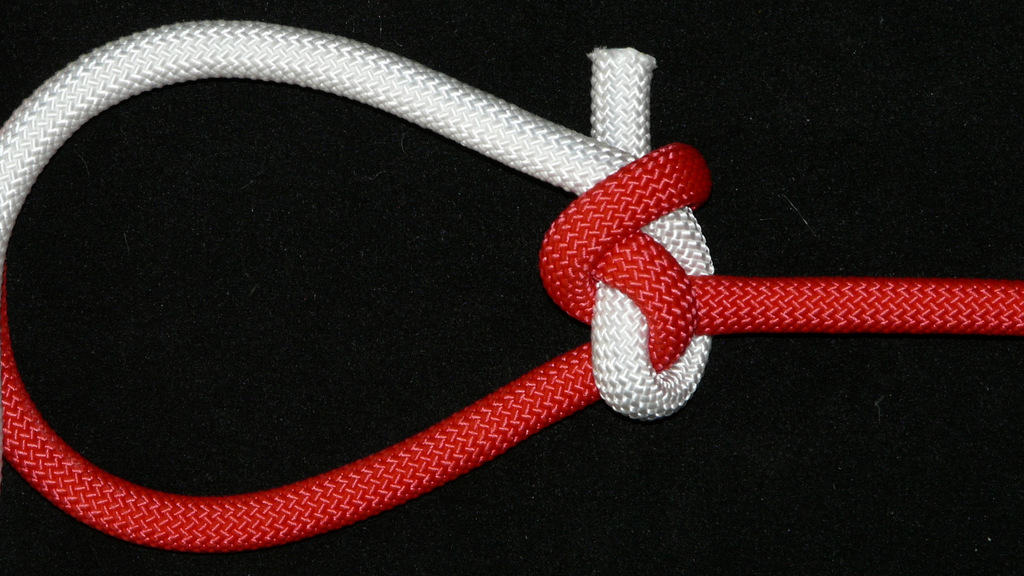
;D Yes, you would be remiss! No qualms here over it being moved to Practical.
Yes Dan. But it’s the Spectra Bowline 1 test video http://www.youtube.com/watch?v=ZFRQcExLA34 that I’m interested in for the very reasons you quote. I want to know; will the Tresse Bowline hold the eye’s size and capture more of that elusive strength component?
alpineer
Note that the double bowline shown in this video has its tail
stoppered (with what appears to be an overhand knot) ; IIRC,
that was not the case with the incomplete mirrored bowline (!).
Perhaps the “tresse bowline” --or the like knots I’ve shown above–
will tighten upon its SPart so as to prevent the material from
being drawn out under loading. (Btw, I wonder how the knot
so slipping will behave in dynamic loading --I don’t believe that
the slippage will become adequately fast … !) But one can’t
hold much hope for strength, given the hard U-turn, I think.
(My hope for the “locktight” eyeknot’s strength looks to there
being enough friction within the coil to draw off load over the
rather broad area of compression --perhaps something that,
if possible, varies with rate of loading : dynamic loading cheating
this hoped-for frictional assistance?)
When I saw this video, I was shocked --all bets were off,
my ideas of strength-building / material-behavior shattered :
“Huh, it can DO this??!”. :o
I could see that the gradual-bends tactic would amount to just
some wavy route to the U-turn w/o consequence (or maybe
there would be a price in torsion to pay!), just as running
a line over a good block puts in a U-turn but hardly diminishes
the force delivered beyond this point (i.e., no off-loading of
force in the block).
So, I didn’t hold out much hope for what were already quite
inefficient-in-material-use knots of a tortuous SPart path
hoping to offload force over its long run --no, that would
all slide too well. I did test one knot with such a theme,
but whereas I had in mind testing the fig.9 eyeknot (which
one test report suggested --knot name wasn’t clear-- had done
well (for HMPE, which means about 50% !)), I opted to load
this structure in reverse, looking at that geometry being
one that gave a broader initial U-turn, and then … <just hope?>.
In fact, this was my strongest knot in the test of 5 eyeknots;
but only by so much, and absolutely nothing to shout about
(= +/- 42% of “capwrap” tensile --a precise-looking value),
with others in the range from 33%-ish).
Interestingly, it appears that the break in the reversed fig.9
eyeknot came a little past the U-turn --or late in the turn–,
at a point where compression against the eye legs was great,
and maybe some movement added a kick of frictional heat?
(see attached photo of the broken & opp-end unbroken,
equally tied & pulley-set knot, thread-marked [nb, Agent_Smith :
Dan takes his own medicine!  --to some benefit, yes?!] )
In the attached photo, one can see the absence of the
ruptured SPart (lower knot) in the void of the interior
of twin strands flowing from the left through twin collars
(these are the U-turn of the eye legs --remember, it is
the reverse of the better-known “fig.9”),
and around and up over the knot to wrap the eye legs.
It appears that the break comes after a half-wrap?!
My thread-marked points are color coded, and as follows:
W) white threads (bit yellowed in image, a white-balance issue)
mark the point where the SPart & resp. eye-legs exit the knot;
these will show how much material yield there is on knot
compression, and any slippage (I think that most reports
call this “slippage” which to me seems wrong-headed --there
must be some feed out of material when the knot compresses,
but I don’t see that as “slippage”, which has connotations
of insecurity --but perhaps its all a matter of balance, hmmm?!).
P) Pink-red threads --one per knot-- mark the suspected
point of rupture (my surmise (what have we learned if we
can’t surmise accurately --and the guess & test game should
be an iterative one of improved surmise!).
G) Golden threads mark a 2nd-guess rupture point,
based on some surmise of the yield of material to compression.
What I see in this photo is that the SPart entered the nub,
moved rightwards → upwards → back downwards → and
then in coming up around towards the viewer broke at
about the low point of this wrap, as viewed. The puff of
white ruptured fibre ends will fold down to about this
point, and the examination of the broken SPart vis-a-vis
its markers with the intact upper knot similarly tied &
loaded also place rupture here.
The P threads started out nearly where the G threads are
at rupture --I’d say that they were just a little before
this point (i.e., slightly closer to exit, roughly right atop
the 2nd-crossed (SPart flowing into nub) twin eye leg).
And the break was even farther along the SPart’s path
than this point, by about a half wrap (180deg).
Note that eye legs pulled out just a little, evenly. And
perhaps the only real measure of “slippage” is the white
thread at the tail --was it pulled into the nub? Here, it
is not; perhaps a mm or two at most.
–dl*
I would surmise that a second strand was on the verge of failing just before the first strand failed. Beyond that, I would think there’s not much to say which would be of any statistical significance from a single sample.
I have tested the four variations of the Tresse bowline : the “left” and the “right” hand ones, and the “under” and “over” ones ( “under” / “over”, regarding the way the first diagonal element of the “8” shape nipping structure crosses the second - the variation shown at the first post is the “under” ). I can confirm that this nipping structure is very stable, and grips the penetrating segments very efficiently, EVEN WITH A LOOSE COLLAR. The mere presence of the two legs of the collar, even if they are not tightened, is sufficient to keep the returning eye leg in place. I have seen that the “under” variation is better, indeed, because the standing part remains closer to the axis of loading of the returning eye leg, and does not twist it as much as it does in the “over” variation. I have also seen that the tail of the “left hand” Tresse bowline is squeezed more efficiently by the standing part s first curve, AND by the returning eye leg s first curve ( the variation shown in the first post is the “right hand”, which I believe is a little inferior regarding that matter ).
So, I believe that all that is needed in order to have a “safe” bowline, is a more safe collar. The only way I have been able to improve the collar, and retain the basic element of this bowline, its double nipping structure, is the braided collar shown in (1), copied from the ingenious “Braided Bowline” presented at (2).
Hi,
A banal idea: to make Inuit/ Eskimo forms for the versions of the knot’s nub of the Tresse Bowline:to do an example,the diagram below shows a(corresponding to type A(because I want to give a chance also to the losers)) Inuit/Eskimo “translation” of a left handed+“over”(or"improperly dressed"Doubled Cowboy Bowline) Tresse Bowline(OK I admit it: I did not feel more than continue to ruin the thread of Alan Lee, so I decided to start doing it with the thread of Alpineer, to which I apologize right away);I do not know if it adds something to a normal Inuit / Eskimo or to a “regularly dressed” Doubled Inuit / Eskimo.
Bye!
I am not able to attach more than one image in one post: the complete knot is this:
Is this your loop, Luca, or not ? If it is, it is a fine variation of the 8 Loop, shown at (1), so I guess you should keep doing what you have been doing there ( you will be much welcomed !  )
)
A problem with those tight “Eskimo”- like loops is that, even under moderate loading, they would clinch around their compact nub and they could jam - while the elongated common bowline - like loops, as the Tresse bowline, would not.
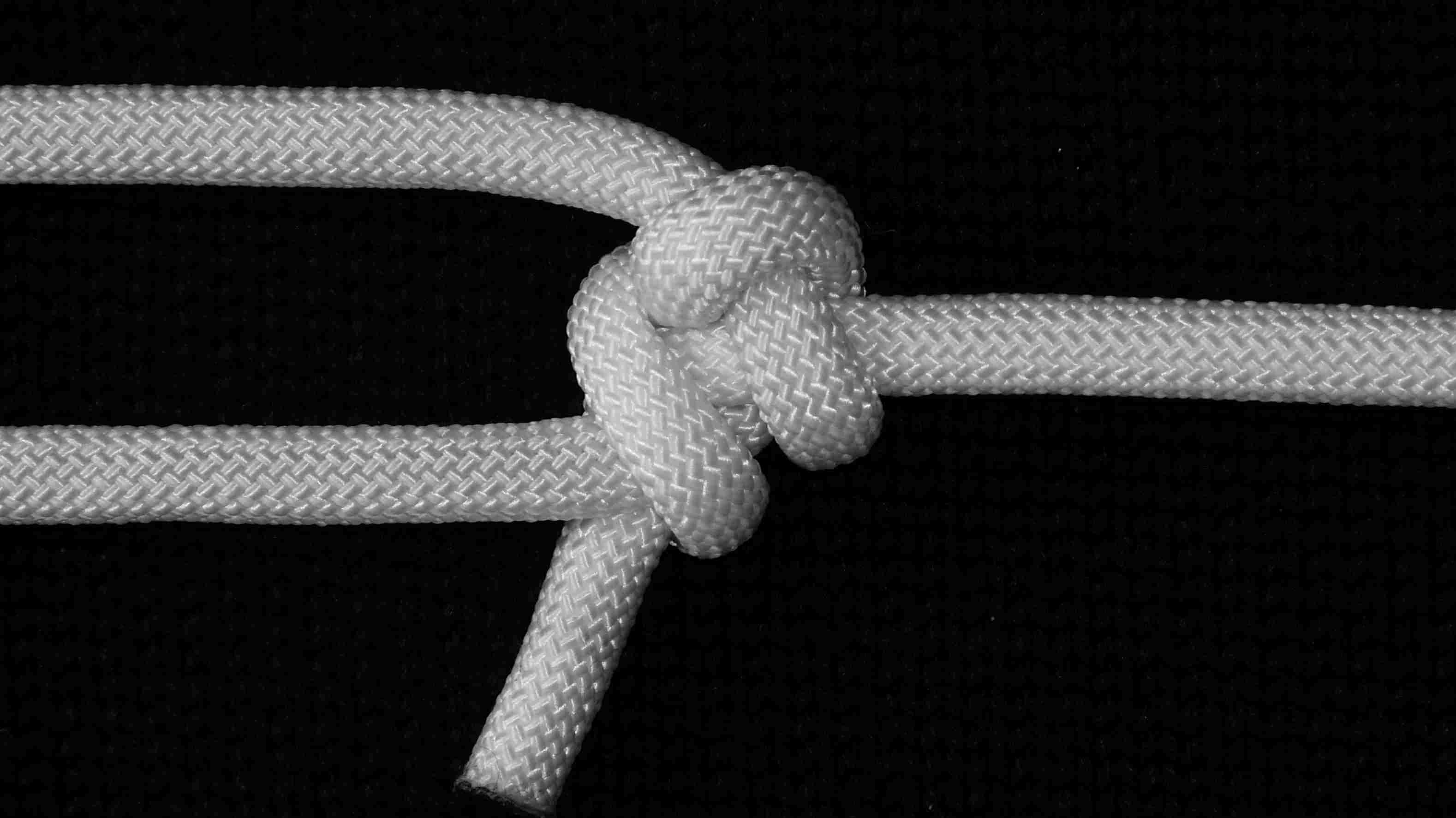
Really? I wonder why not --how does this IGKT
system fail to work for you (but works for others)?
The knot you show is an eye-knot correlate to one
variant of Lapp knot end-2-end knots. You should
find that the variation jams. A way towards getting
a knot that can be pried loose (by pulling tail and
tail-side eye leg apart, to pry IN some SPart material)
is to have the tail-side of its collaring bight --i.e.,
that part after its U-turn heading straight out
through the SPart’s turn-- go outside of all of
the SPart wraps until its tuck out through the
turn. The wraps, then, won’t bing this tail,
enabling it a fighting chance at working as the
lever to pry out some SPart, and thus liberating
itself, and untying.
Conceivably, the SPart wraps will just bind too
tightly; but, often, the loosening is possible,
as one is pulling (initially) the SPart straight
out, with no deflections in its path to impede
such movement --and you need only enough
to free the nip on the tail. In the end-2-end
knot, the SPart’s tail won’t be loaded, so there
should be a little less tightness in its wraps.
–dl*
Hi X1,
I thank you again, I’m glad I made a decent knot for once!(well, after the cockroaches and various junk I have presented, you are fully empowered to think that I gave money to someone for secretly pass to me a knot to show it as “mine”…but I did not understand: If the loop is by someone else becomes something else? :D)
In fact I have started from a simple idea to make an Inuit/Eskimo version of the Tresse Bowline , and from there I started to fumble;now that you mention it, in fact, there are similarities with the 8 Loop; I noticed that just by appropriately changing the way the second leg of the collar enters the nipping turns I get a knot nub’s very similar, but arranged in “common bowline sauce”(I did not expect this!).
Or perhaps yours was instead a reference to a couple of unfortunate loops that bear my name without having a guilt?
It is true, I actually quite easily untie this loop, but not acting more immediately on the tail, as it should be the most direct and fastest way to untie a loop, but that in this case is too tight to be pulled out easily, if not before I act by pulling on the portion of the rope adjacent to the first eye leg,that passes through the collar’s bight;but, thinking about it, if, during the loading of the loop, it happens that the second eye leg pull tight the collar’s bight around this portion of rope,before the tail is closed (too) strong,as is more likely to occur in the bend version, also this operation may become difficult.
I do not know where I’m wrong! Saves only the last selected image
Thank you!Is that so?(Below)
Bye!
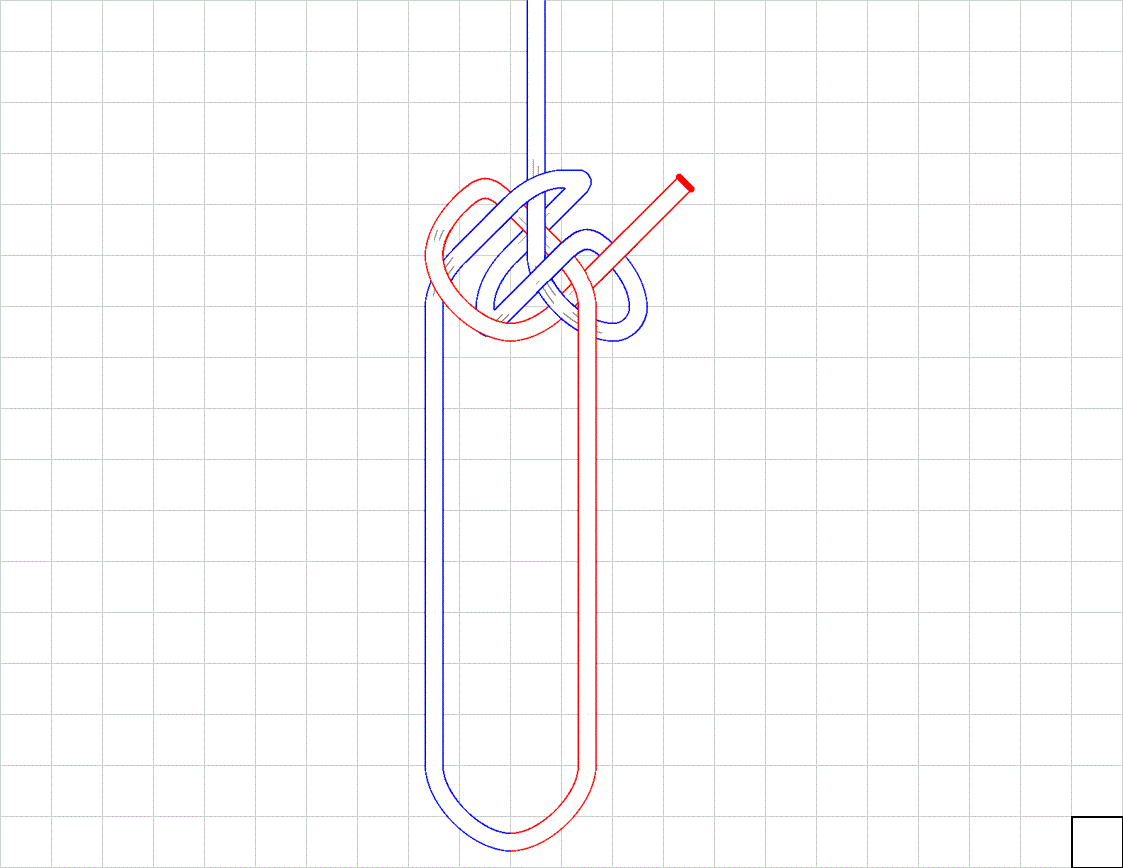
I guess not ! There are many knot tiers who have not yet noticed this simple fact, I am afraid…
No, I was not sure about the spatial order of lines, at the point where three of them are superimposed, and it is difficult to tell witch goes over or under which… I believe it is better to draw the knots without such “triple” points.
( The Luca s TIB bowline, where the collar structure is a fig.8 knot entangled within the nipping loop, is a very secure / very nice post-eye-tiable AND tiable-in-the-bight eyeknot ! )
I do not know who ordered this knot, because I have not been able to pay a visit to the Oracle of Delphi lately (1)…
However, I think it is a very secure and nice knot - which will not jam so easily as the previous one.(*) ( Although it is not related to the Tresse bowline any more - it is a variation of the “Eskimo” bowline, where the single nipping loop is transformed into a 540 degrees coil ).
(*) Noope ! It jams, as easily as the previous one ! I have now submitted it in the same torture as the previous one ( same amount and pattern of loading, same rope ), and I know !

This sounds as though you are clicking the wrong space
for the subsequent files --you need to click the spot
for attaching another file and not the one with a filename
listed beside it (which, as you’ve seen, will replace that
first-named file with the new (which can be useful to
correct a mistake)). Look more closely at your options!
[quote="Dan_Lehman post:49, topic:4777"] A way towards getting [b]a knot that can be pried loose (by pulling tail and tail-side eye leg apart, to pry IN some SPart material)[/b] is to have the tail-side of its collaring bight --i.e., that part after its U-turn heading straight out through the SPart's turn-- go outside of all of the SPart wraps until its tuck out through the turn. The wraps, then, won't bing this tail, enabling it a fighting chance at working as the lever to pry out some SPart, and thus liberating itself, and untying. [/quote] Thank you!Is that so?(Below)
Close : I see myself tying to a bight, not a loop which
is more what your drawing shows in its crossed legs.
The draw of the SPart should bring the tail with it
up against the other parts. And X1’s exclaimed “nope”
can be discarded to the pile of his others; “yep” is fine,
but high loads and various conditions leave the judgement
to one of tools and forces for untying --“YMMV”. The
advantage is the pulling pretty well aimed at a part
running straight, although tightly bound w/wraps;
and just to gain enough material to enable loosening
–not immediately “loose” after merely prying.
(Elastic line might be the more difficult.)
–dl*
The knot shown at the pictures I have shown, is not “yep, fine”… unless one belongs to the “over 105 kgr” weightlifting class (and use to bend coins with his fingers…), or belongs to the “light flyweight” wrestling class - although it would be more than “yep, fine”, indeed, if one could belong to both those Olympic athletic disciplines- not possible under the present rules, I am afraid.
I do not believe that there is an objective way we can tell if one knot jams or not - but I was under the impression that, when we are forced to use tools to untie it -any tools -, we are talking about a jammed knot. I had loaded the knot shown in the pictures ( tied on the same 8mm cord I had tied the previously presented one ) with my weight, and submitted it to 8 bounces / jumps - then, to untie it, I was forced to use a pencil as a marlinspike. Even when the “higher” turn of the coil is released, the “lower” one holds very tightly, because the “Eskimo” s collar does not allow any material be inserted into it - and it does not allow it, because itself it is constricted and immobilized by the tensioned standing part s first curve / bight, so it can not be eased even a little bid…
Noting that that image shows the tail on the opposite
side from what I’ve recommended --and when, e.g.,
tying to an eye, whose legs are both loaded, one should
model a leg-free bight by putting such slack into
the side first drawn by the SPart–,
I’m a little surprised that you don’t find enough
ability to loosen the SPart-side eye leg,
for I’d expect the collaring bight to not be drawn
so tightly given the SPart’s nip of it; but you do say
“bouncing”, and that can do the tightening! (And
this way isn’t what I see as the knot’s “forcible
loosening” avenue, anyway.)
I do not believe that there is an objective way we can tell if one knot jams or not; but I was under the impression that, when we are forced to use tools to untie it --[i]any[/i] tools--, we are talking about a jammed knot.
Well, I see “jammed” in a couple senses. The first is
that the knot will stay tied when slack, which can be
a highly desired atrtribute; this need not exclude there
being a method for untying the knot, reliably. THIS
knot’s corresponding end-2-end knot I believe fits
this criterion pretty well, with some vagaries per
material(s) and forces. And then there is the sense
of “welded”, where tools and maybe not even tools
only can untie it. (I recall being happy to find that
I could fit the fairly pointed tip of a pulley hook into
a part of a knot and use the 5:1 MA to haul it loose!)
There is some merit to being able to at least untie
using tools, maybe in a not so difficult manner,
but mostly to get one’s man-sized force up to the
rope-sized forces (think, large lines). --as contrasted
with the rather hopeless cases of “jammed”.
I had loaded the knot shown in the pictures ( tied on the same 8mm cord I had tied the previously presented one ) with my weight, and submitted it to 8 bounces / jumps; then, to untie it, I was forced to use a pencil as a marlinspike.
–a pencil qua marlinespike??!!! Wow, that
sounds quite feeble! * * S N A P * *
I’ll later give this a try with relatively frictive (age)
7mm kernmantle, whose smoothness should enable
fairly severe tightening, yet whose frictiveness impede
the movement I hope to see. AND, to show that I’m
not so confident of success, my pulley will be applied
deliberately at lower effect first, and only increase if
successful.
Still, I think that for many applications, one can already
see utility in the end-2-end version, where the main
goal is slack-security. (In my pocket, this knot qua
bight-hitch in 3/16" silky flexible nylon solid braid
regularly loosens tied around thinner binding cord
–essentially, a knot that is a stopper-ish one tightened
by itself (the binder cord hardly adding much of bulk);
and #1425 joining the ends of the solid braid also
gradually loosens after being set tight.
–dl*
I have just followed Luca s interpretation of Oracle s “description” …
It did nt move ( a hundredth of ) an inch ! The Standing s part nip immobilized it, and that, by its turn, was immobilized by the lower coil.
The " bouncing" / alternating loading can make a difference, indeed. The jamming mechanism of the reversed Buntline hitch (1) was a revelation to me… The two ends of the jammed tangle ( the limbs of the Clove hitch) leave the nub towards opposite directions, while, at the same time, they are squeezed upon each other by the tensioned “bridge” ( the riding turn of the Clove hitch ) that encircles them. At each “bounce”, any portion of the rope that, at the peak of loading, manages/suceeds to be pulled out of the tangle, however small it might be, reduces the remaining rope length inside the tangle a little bid more - so the “bridge” gets shorter and tensioned even more, and it pulls and then pushes the two ends of the tangle the one upon the other even more forcefully. With each "bounce’, the friction forces between the two ends are getting stronger and stronger - in fact, they become so strong that the two ends themselves become almost “geared”, and coupled to each other : any small portion of rope that is released / set free by the one, is automatically gathered / enslaved by the other : a rope-made racheting device, that can only reduce the total amount of rope length within the jammed tangle, just because nothing can get inside this most tight “gate”.
The jamming of the adjustable loop based on the reversed Buntline hitch, this rope-made racheting mechanism, has offered me a most valuable lesson that I was not able to receive from anywhere else. In the light of it, I can now understand / explain much better the “miraculous” ability of the Gleipnir to “lock” within its bights any accumulated tension inserted into them by the pull of the two opposing ends. I advice any interested kmot tyer to tie this most simple knot, the adjustable rev. Buntline loop (1), submit it to a heavy "bouncing’ / alternating loading, and, for once, enjoy the jamming of a knot, that he will now understand / explain !
Nooope ! No shear forces ! Just compression. Use the pointed conical shape of the pencil to pin it into the jammed knot s nub, i.e. use it as a nail, and so force the widening of a previously tightly shrank opening. We can consider a cone as a 3D wedge - and a wedge is a “simple machine”, that uses its small angle to gain a mechanical advantage. I guess that this fact was implemented in sparrows, hooks and arrows, well before the tying of any jammed knot !
I do not deny that this is an interesting, secure and nice knot ! However, now we have its non-jammable twin, the original 8-loop, that is also very easy to remember how to tie and to tie ( to my view, it is even easier - but perhaps I am biased on this…), why we will ever have to risk by tying the jammable variation ?
Hi,
I’m sorry, nothing significant to write, and I write it also delayed due to lack of time + connection problems that I encountered in these last days.
Uuh.. just now I get it! Your doubts was related to whether the photos you showed in that post (with regard to them I have forgotten to thank you)were corresponding to my diagrams; now everything makes sense! (I’m sorry, I did not realize, I thought your were a joke,due to the fact that it seemed strange that I showed an acceptable loop!)
It’s just what I said: a deserving loop..which must bear my name …poor fellow loop!
Indeed it is written: “MORE ATTACHMENTS”: I’m just a block-head! Thank you for having the patience to explain to me!
OK, I take the opportunity to show a further correction of my diagram, + a diagram of what may be the corresponding “Common Bowline version” of the loop that I showed at reply # 46, performed with the intent to show (following the line of Alpineer in his first post) a(perhaps) useful way to prepare the nipping turns,and(as actually I only realized last night, due to a link posted by Sweeney from another thread!) then “modelling” to get the # 97 http://igkt.net/sm/index.php?topic=4321.msg26999#msg26999 (i.e. it does not show the # 97 setting(is more corresponding as initially I set the knot,in a more “compact” manner,similar to the Inuit/Eskimo version), but a way that however might be helpful to get there).
Thanks again, and bye!
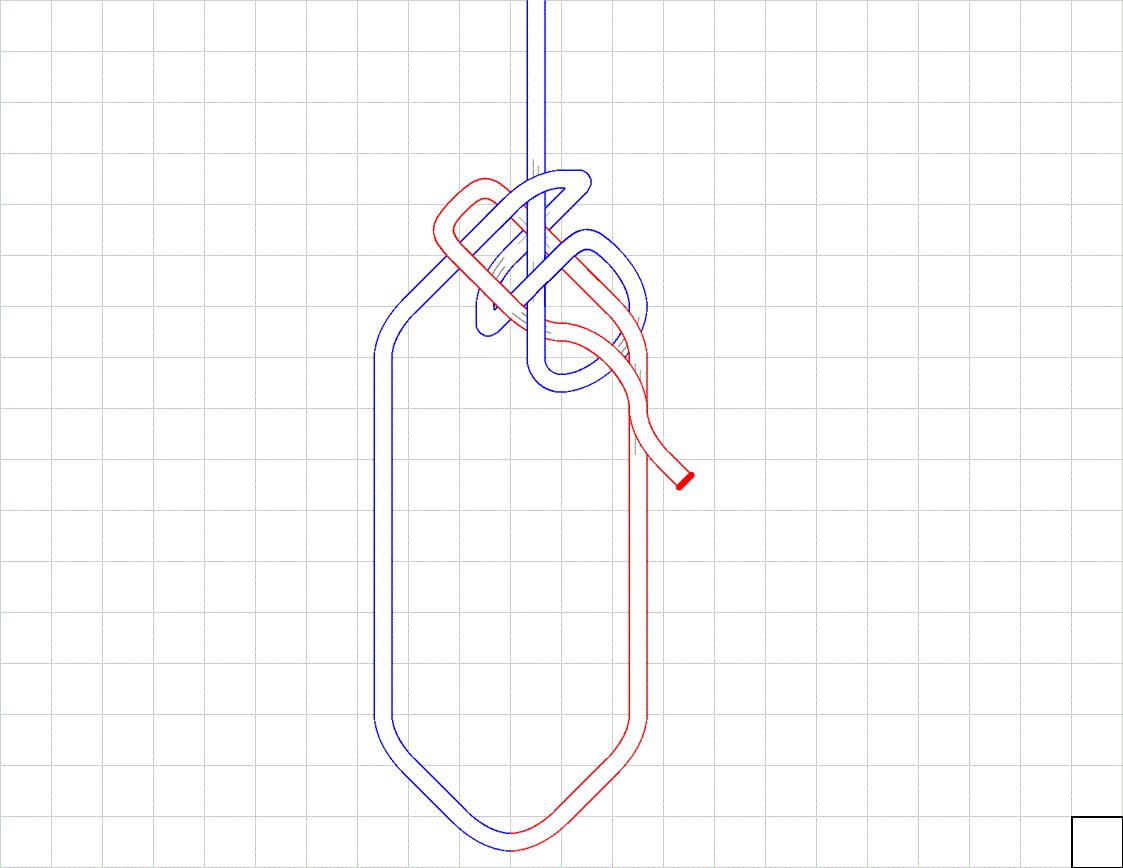
Oh, that’s hardly my #97 --which is, after all,
a significant re-dressing of the double bowline
(so, one can see that dressing is critical to getting it right).
Glad you’re now past one-attachment-per-post limit. 
–dl*
The first two pictures show the Luca s Nice Jamming Loop - it is a pity that it jams, but it does jam, no question about it.
The third picture shows Luca s Non-Lamming loop. Not very different from the Tresse bowline itself ( in fact, it may be considered as a variation of the Tresse bowline, where the tail and the continuation of the returning eye leg are crossed ) - or even from the 8 Loop, shown at (1) and at the fourth picture : more “common” bowline-like, in comparison to the 8 Loop, which is more “Eskimo” bowline-like. I hope Luca is going to actually test those two variations, and report his results to us.