Greetings,
I have been using a prusick as part of a safety rope system while deer hunting from a tree. I have been experimenting with different friction hitches and came up with this knot configuration (see attached image). Is this an existing knot? The prusick cord is rather stiff when tied in a standard prusick, but this variation seems to overcome the stiffness and bites the main dynamic kernmantle rope really well, in fact it jams really tight, which is ok for my application. Any thoughts are welcomed. Thanks.
I just called it a hitch series in my book. There are just too many combinations to give separate names to every combination. I suspect that the girth hitch at the top and the overhand knot below the combined hitches are not doing much of anything.
Bob,
I have read numerous references to your book, but have never been able to obtain a copy.
Do you have any intention to have it reprinted or perhaps converted to pdf and made available through the Guild ??
Derek
Bob,
You are without question one of the often quoted ‘experts’ on this group of knots, so I was a little surprised to read your comment that you felt the Girth hitch and the Overhand knot were “not doing much of anything”.
OK, I found it moderately hard to tie this assembly (I hesitate to call it a knot) with just one hand, but despite this, I found this particular rendition of sliding/grip hitch to be worthy of specific attention from a number of perspectives.
First, it works; indeed, it works well. I used two of them to ‘walk’ myself up a tree with ease.
Second, it opened easily; a quarter turn (towards the OH Knot) opened the locked hitch and allowed it to slide easily along the main rope. At this point the value of the OH knot became apparent because it stopped the hitch from opening excessively. It did this by holding the loop against the OH knot, allowing it only so much room to open and no more. Although its presence weakened the sling cord, it was still a valuable addition to the overall ease of use when ascending/descending.
Third, the presence of the Girth knot helps to demonstrate how this group of knots work - in this instance, the Girth knot is the ‘Root’ or ‘Anchor’ for the knot. A Girth Hitch by itself will afford some grip on the main rope but will slip under heavy load (unless the sling cord is quite thin). But without this light anchorage, the whole assembly would fail to work.
The ‘small’ amount of grip afforded by the Girth hitch, is amplified by the doubled two round turns and the ‘crossing force’ created by the loaded cord crossing the cord from the Girth Hitch in almost an exact extension of the round turn friction explanation posted by Roo on http://www.geocities.com/roo_two/friction.html .
The construction might not be formally named, but I like it and I think I am likely to carry on using it (albeit not to help me kill helpless creatures by hiding in the treetops with a gun - big man Jack - still, hey, if that’s what floats your boat…).
Derek
Just a little info on the “knot” in question. I tie it using a loop and it probablly is more of a hitch than a knot. Upon further research, I find that it resembles an icicle hitch or a pile hitch. I have added another picture to show how I really use it. The carabiner allows the hitch to be connected to my safety harness. Again, it really seems to anchor well. Thanks for the comments.
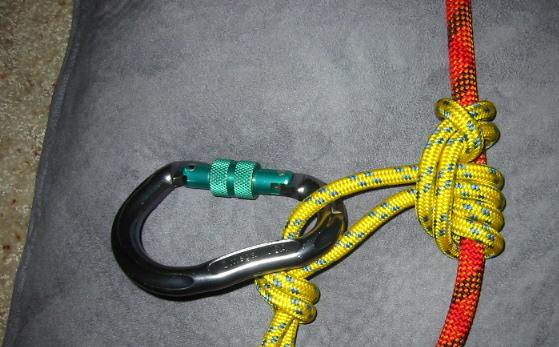
It would NEVER have occurred to me that you had made your sling by tying up the ends with a simple OH knot !! Consequently, when I saw your first image I assumed that the OH was a midline stopper knot and part of the hitch, NOT THE TERMINATION OF THE SLING - that came as a real surprise.
My slings are terminated either by a double Fishermans or a rethreaded 8, so when I tied the knot, I had the OH up tight to the hitch and then it became a good ‘limiter’ to the amount the hitch could be slackened off and effectively stopped the hitch from becoming sloppy between moves. I could just push the hitch around a quarter turn to ‘undo’ its grip and the descending lines would only open as far as the OH stopper.
By the way, I also tied it using one of my tape slings and to my amazement it works rather splendidly - I think I would be quite happy taking a fall onto this fixing (if one could ever really be happy taking a fall of any kind).
Derek
Hi Jack,
Upon first glance of your friction hitch I thought it was an upside down diestel friction hitch.
But upon further examination it is something else. I will try it next time I go to my cities local climbing
gym. Oh, and tying the ends of your sling is not a very good idea. The double overhand knot has been
known to roll and fail. I would recommend a Double fishermans knot. A link to this knot can be found here
http://www.animatedknots.com/doublefishermans/index.php?LogoImage=LogoGrog.jpg&Website=www.animatedknots.com
TH54
I looked in my book, Prusiking. I misspoke in my previous post in this thread. I used the term “hitch series” for configurations with a free end at the top. I did show something similar to your hitch. I showed a prusik knot with the sling tied into a half hitch below it. The half hitch multiplies the gripping power of the Prusik above it. In your configuration, you have a round turn half hitch multiplying the gripping power of a girth hitch. I think that starting out with the better gripper on top is a better idea.
About my book: When I started caving I tried to find out all I could about methods of climbing a rope. I found that the information was very scattered. In 1967 I wrote a long article that was what I hoped to find. Al Haar encouraged me to expand the article into a book. He provide with many copies of articles from American caving newsletters. The book came out in 1973 with a press run of 1000. I gave the copyight to the National Speleological Society. When it needed an update, two other authors wrote On Rope.
I suspect that the girth hitch at the top and the overhand knot below the combined hitches are not doing much of anything.
Or they might do something, depending on materials and other factors.
E.g., I could see the Girth H. providing some bit of grip sufficient to help the later turns
“get a grip”; using some stiffish old 8mm climbing kernmantle on 11mm PMI rope,
the simple, Pile-Hitch-like structure (no Girth, just bight around object rope) didn’t
hold, but putting a Girth H. there (w/Offset Ring Bend there!) led to gripping.
As for joining the ends of the cord with an Offset Ring Bend, one can make this
more secure, by simply casting a Half-hitch over it, or in other ways; and other
bends can be substituted. Or one can position the ORB as I did, above; but note
that the means the sling is formed prior to making the turns of the gripping hitch,
which then imparts some torsion into the sling (as opposed to tying off the ends
apres such turning, and being free of torsion).
Were the Overhand knot a mid-structure stopper as Dereck perceived it to be,
it could have the effect of enabling/preserving some tension bias to be in the
gripping hitch (possibly a good thing, as single-strand gripping hitches seem
to grip more surely than twin-stranded ones).
One reason this hitch might work better than did the Prusik (note spelling–no “c”)
is that this knot’s turns have a 1-diameter-increased helix angle, which means
that they don’t have to bend so much in order to grip.