Is this thing a bend, or a hitch ( around a bight or around an overhand knot ) ?

Leaving aside the Sheet bend ( which can be considered as a hitch-around-a bight ). I do not know any other asymmetric “bend” that is worth its salt. When the structures of the two links differ substant
ially, I think that we should better characterize the knot as a “hitch”, not as a “bend” . An example is shown in the attached pictures. We can say that this knot is a ( ABoK#1821) hitch around the tip of a crossed-legs bight, or a ( ABoK#1875) hitch around the rim of an overhand knot - but can we say that it is a “bend” ??

hitch (n.) 1660s, “a limp or hobble;” 1670s, “an abrupt movement,” from hitch (v.). Meaning “a means by which a rope is made fast” is from 1769, nautical. The sense of “obstruction” is first recorded 1748; military sense of “enlistment” is from 1835.
hitch (v.) mid-15c., probably from M.E. icchen “to move as with a jerk, to stir” (c.1200). It lacks cognates in other languages. The connection with icchen may be in notion of “hitching up” pants or boots with a jerking motion. Sense of “become fastened,” especially by a hook, first recorded 1570s, originally nautical. Meaning “to marry” is from 1844 (to hitch horses together “get along well,” especially of married couples, is from 1837, Amer.Eng.). Short for hitchhike (v.) by 1931. Related: Hitched; hitching.hitch (n.) 1660s, “a limp or hobble;” 1670s, “an abrupt movement,” from hitch (v.). Meaning “a means by which a rope is made fast” is from 1769, nautical. The sense of “obstruction” is first recorded 1748; military sense of “enlistment” is from 1835.

bend (n.2) “broad diagonal band in a coat-of-arms, etc.,” c.1400, from earlier sense of “thin, flat strap for wrapping round,” from O.E. bend “fetter, shackle, chain,” from PIE *bhendh- (see bend (v.)).
bend (n.1) “a bending or curving,” 1590s; “thing of bent shape,” c.1600, from bend (v.). Earlier “act of drawing a bow” (mid-15c.). The bends “decompression pain” first attested 1894.bend
bend (v.) O.E. bendan “to bend a bow; confine with a string, fetter,” causative of bindan “to bind,” from P.Gmc. base *band- “string, band” (cf. O.N. benda “to join, strain, strive, bend”), from PIE root *bhendh- “to bind” (cf. Goth. bindan, O.H.G. bintan, Skt. badhnati “binds,” Lith. bendras “partner;” O.Pers. bandaka- “subject”). Modern sense (early 14c.) is via notion of bending a bow to string it. Cognate with band, bind, and bond. Related: Bended; bent; bending.
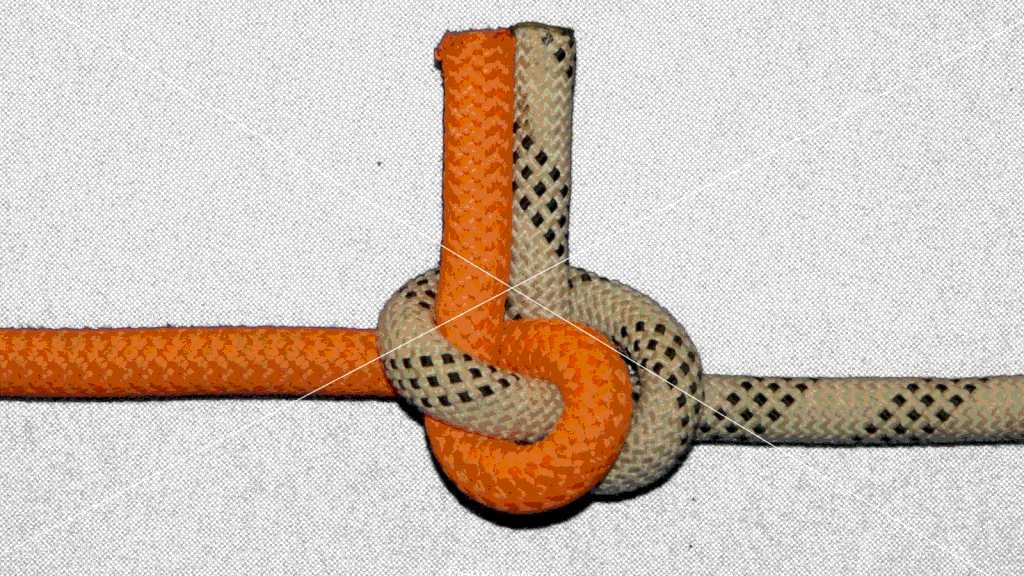
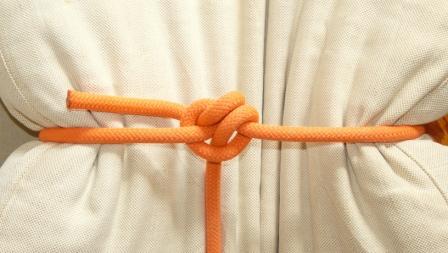
back view.jpg

a bend or a hitch.JPG

Possibly because you dismiss such knots for being asymmetric!
The butterfly/strait bend is one that many others regard favorably,
and there is a near-zeppelin end-2-ender that is worth its salt,
even if agreed to be missing something better in not being z.

But a quite worthwhile “bight hitch” --my urged term (for now)
is the double reverse sheet bend = double Lapp bend . It improves
on the sheet bend in being secure-when-slack and maybe
forcibly untiable (YMMV).

When the structures of the two links differ substantially, I think that we should better characterize the knot as a "hitch", not as a "bend" .

??? This is quite a non sequitur**, IMO : what has the mere
i difference[/i] have to do with the essence of hitching?
Rather, I’d look to some analysis of the roles played by the
structures themselves, which might be suggested by the
tying method --though we can note that the venerable
sheet bend has various ones, leading to “weaver’s knot” for express
nominal distinction.
** [Perhaps I mis-read you : I take “structures” to be knots,
but perhaps you mean materials/lines? --a BIG-2-thin joint. ]

I have thought about considering those applicable knots as
belonging to the “bight-hitch” sub-class --hitching to a bight,
as you describe. What can be said of this? --that one doesn’t
really “loop-hitch” in tying a sheet bend backwards, though
such tying is possible (in the bowlinesque quick-tie method)!?
.:. For a hitch must secure the hitched line we could stipulate
–and argue that it is the loop that nips & secures.

(I was thinking about arguing that an overhand --unlike a bight
is closed and thus already a knot, so ineligible for being a
target of a hitch : but in the above case, a loop isn’t all so closed
–not itself a knot. And, if the bight doesn’t play a role in the
nipping (e.g., if the hitching can be secure at some remove from
the bight-tip, u-turned tip), one might challenge the assertion
of “bight-hitch” on the basis that the u-turn is quintessential!)

Back to “bight-hitches” : I consider 3 groupings --to wit:

  1. “closed”, i.e., where both bight legs are tensioned;
    these might called “eye hitches”;

  2. “open”, i.e., where one leg only is loaded;
    and

  3. the union of 1 & 2.

Some knots might belong to #1 only. Note that #2 can be
modeled with an eye by making one leg slack when tying
the knot. The double Lapp bend is somewhat of this sort
–it seems to work better if the draw of the hitching line
will pull the leg it first nips towards the wraps (and from this
orientation, the loosening goes better, I think).

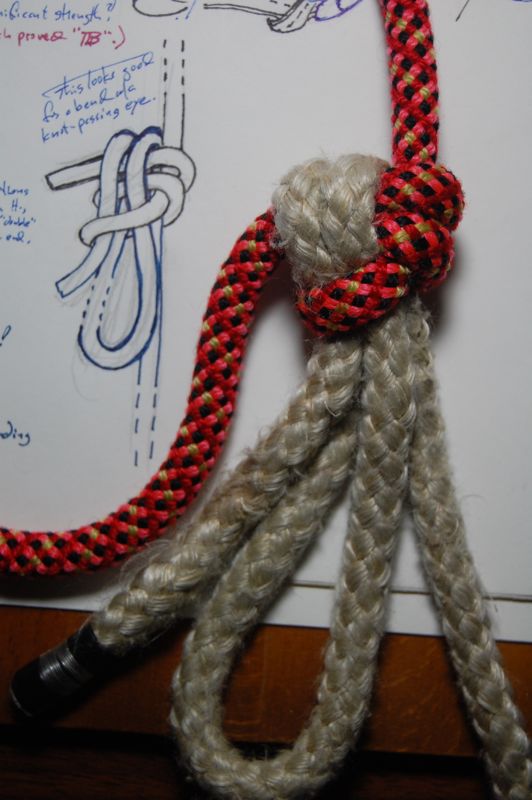
I’m attaching a photo of a version of this knot in which it’s
employed to form a knot-passing eye : for those who, when
ascending/descending a knotted line want to use an eye for
a temporary, secure attachement/clip-in point while they
adjust their device from one line to the other. (This might
not be so common an exercise --using an eye.)

–dl*


I do not know which knot is this bend/hitch - is it in the ABoK ? I think you may call the double Lapp knot “a bend”, only because it is related to the Sheet bend… However, the fact that we have only two, or three, or even a handful of cases of a-symmetric knots we use to call “bends” - among the hundreds of symmetric bends - can not be a coincidence ! I think that, with the term “bend”, we tend to describe the knots that allow us to re-connect the two parts of a ruptured rope, or two short pieces of the same rope, and with the term " hitch", we tend to describe the knots that allow us to attach one end of the rope on something different - be it another, different knot tied on another rope, or another object.

The substantial difference, if it exists, it exists for a purpose - it does not exist to offer some strangeness into the proportion ! It probably means that the two sides that are to be connected, differ in material and/or in size, the knot in the one side must be tied at the end of the rope while the other must be tied in the bight, the knot in the one end should better remain untied, and serve as a more permanent anchor for the attachment of the other, etc. In all those cases, it is probable that the optimum solution would be an asymmetric knot- and I think that this knot should be called “a hitch”, and not “a bend” .
( By " different structures", I meant something more than a difference in the geometry/dressing of each link - like the difference in the shown hitch, where the knot tied on the one end is a crossed-legs bight, while the other is an overhand knot. I would nt consider as two " different structures" a pretzel-looking and a shape eight-looking overhand knots. for example. )

Things are not so simple…Look at ABoK#1821 the hitch-around-a-bight, where each part nips and secures the other…
The U-turns are always quintessential , inside a bend s knot nub, or around a hitched object…Anything that can be said against the concept of a “bight hitch” , can also be said against the vast majority of bends, that include a U-turn of their standing parts.

An “open” curved segment of a rope can also be a knot / serve as a knot. The self-crossing of the line of each link at one or more crossing points is not something that distinguishes the knots from the not-knots ! :slight_smile: The " helical loops" shown elsewhere involve a nipping structure tied on the standing part, in the form of an open helical segment.

Good, but I think we should better find a way to group the bends and the hitches in two different groups - before we proceed to multiply number two by number three by number X … :slight_smile:

The double Lapp knot/hitch turned into an anchor for a third rope is a neat knot, indeed, and very interesting - but it is the most remote thing to what I would have imagined I could ever call “a bend” ! ( I noticed that you had not called it a bend either !) It is a hitch, that can be used as an anchor for the attachment of more ropes.

!! It’s but a quick Google removed from you, surely.
It’s amply (re)presented on the Net, and I think without
much error, though sometimes w/different dressing.
(If you find the mid-line eyeknot, just mentally cut off the eye,
and there you have the end-2-end knot --and note that this
relation is different to the more common one!)

[quote="Dan_Lehman post:2, topic:4520"] what has the mere [i](substantial) [u]difference[/u][/i] have to do with the essence of [i]hitching[/i]? [/quote] The substantial difference [and here "knot-form" is meant, not "material"], if it exists, it exists for a purpose - it does not exist to offer some strangeness into the proportion ! It probably means that the two sides that are to be connected, differ in material and/or in size, the knot in the one side must be tied at the end of the rope while the other must be tied in the bight, ... it is probable that the optimum solution would be an asymmetric knot --and I think that this knot should be called "a hitch", and not "a bend" .

Well, there might be some tying methods that benefit from
asymmetry of working and of the structure of the two halves
without stemming from a material difference. (IMO) The weaver’s
knot
forms in uniform material the same knot … = sheet bend
although a squaREef knot might have been used.

( By " [u]different structures[/u]", I meant something more than a difference in the geometry/dressing of each link - like the difference in the shown hitch, where the knot tied on the one end is a crossed-legs bight, while the other is an overhand knot. I would nt consider as two " different structures" a pretzel-looking and a shape eight-looking overhand knots. for example. )

Wow --but such IS asymmetric (and is all you’ll find
with the butterfly in even more similar overhands).

[quote="Dan_Lehman post:2, topic:4520"] [b]For a [i]hitch[/i] must [u]secure the hitched line[/u][/b] we could stipulate - and argue that it is the loop that *nips* & secures. one might challenge the assertion of "bight-hitch" on the basis that the u-turn is quintessential!) [/quote] Things are not so simple...Look at ABoK#1821 the hitch-around-a-bight, where each part nips and secures the other.... The U-turns are [i]always[/i] quintessential , inside a bend s knot nub, or around a hitched object...Anything that can be said against the concept of a "[i]bight hitch[/i]" , can also be said against the vast majority of bends, that include a U-turn of their standing parts.

That’s not what I meant (which took me a while to figure,
reading my own words!) : the bight in the sheet bend I call
“q.” because it’s necessary in effecting the joint; in contrast
to a case where the hitching line could secure itself without
such assistance to the twin legs along (tie a rolling hitch).
No, in the sheet bend the u-turn bears upon and helps
secure the hitching line, shifting w/load a little (more with the
same-side than opposite-side version).

Hmmmm, maybe I’m out on a breaking limb here … !
A becket hitch --i.e., rope tied to an actual becket,
rigid object-- can have the same form (loop) and hold.
In the case with cordage, the U-part can be active, though;
but then by logic must I abandon “hitch” in all rope-2-rope
cases?

For now, I’m content to consider “bight hitches” but will
need some convincing about going further afield with “hitch”
unless the hitched-to line is unknotted.

[quote="Dan_Lehman post:2, topic:4520"] an [i]overhand[/i] --unlike a [i]bight[/i]--is *closed* and thus already a *knot [/quote] An "open" curved segment of a rope can also be a knot / serve as a knot.

??? Not at all. I cannot conceive of a definition of “knot”
that would qualify a mere curve as such.

( I noticed that you had not called it a bend either !) It is a hitch, that can be used as an anchor for the attachment of more ropes.

I follow CLDay in this rejection of “bend” :
[[u]The Art of Knotting & Splicing, 4th ed., p.14]

Ashley tried to reestablish the word [i]bend[/i] as a noun; he wanted, on the one hand, to limit its applica- tion to knots whose function is to join the ends of two cords or ropes, and, on the other, to call every such knot a [i]bend.[/i] This system of nomenclature, however, cannot be justified on the grounds of traditional us age. The sheet bend for instance, is so named be- cause it was formerly used to bend the sheet to the clew of the sail, not to the end of another line. The fisherman's bend is not a bend at all according to Ashley's definition. And the fisherman's knot, though classified by Ashley as a [i]bend,[/i] happens, per- versely, to be called a [i]knot.[/i]

While I had thought that the answer was to find a more
suitable substitute for Ashley’s wanted “bend”, I’m now
less keen even then to have knots bear the burden of
classification nominally --eh, they can all be “knots”.
But maybe some good substitutes would again change
my feelings about this. (Barring cases where the knot’s
use changes from one to another class --ringloading an
eyeknot yields an end-2-end knot, presto!)

–dl*

If by the “Butterfly/strait” bend you mean this :slight_smile: :
http://en.wikipedia.org/wiki/Butterfly_bend
I have to ask where do you see the asymmetry…When I am talking about a symmetric bend ( not a symmetric knot…), or not, I mean that each one of its two links is identical ( in topology and/or geometry ) with the other, or not. The two links of this bend are identical - although the knot itself, as a whole, is not point or line symmetric.
The last time we were arguing about this, you might had a point…The Zeppelin X bend might be considered asymmetric - or, at least, not as symmetric as the Zeppelin bend - because the geometry of the two links may be a little different, indeed ( a difference forced by the different relation, inside the knot s nub, of some parts of the one link with similar parts of the other link. This difference, although insignificant most of the time, may be revealed when the two links are pushed against each other under heavy loading ).
However, in this bend - as well as in many others presented in REM, for example, I can not see any asymmetry.
Anyway, if it is only a matter of definition, I have to explain/clarify that I was talking about symmetric or asymmetric bends only in this sense. An asymmetric bend is the bend shown in the picture of the first post of the thread, where the one link is a crossed-legs bight, while the other is an overhand knot.

It is difficult to imagine situations where a tying method is forced, and this tying method, in its turn, forces us to use an asymmetric bend, instead of a symmetric one… However, I have to suppose that there would probably be some, because there is already one : The bend shown above is tied as such, because it is used as an mid-air binder - so the one link should be tied first, and serve as an anchor for the second, while the binder has not been " locked" yet.

OK, I may be mistaken here. I was just not ready yet to characterize as “asymmetric” the Water 8 bend - although it might be the case that I should.

Here we come again ! I have explained, time and again, that I mean “a mere curve” ( actually, I was talking about an open helical segment ) ON ONE LINK of the loop or the bend ! ( and I have referred to the " helical loops" ). The nipping or the collar structure can be " mere curves" , yet they serve as a knot that binds the two legs of the bight. As in the case of the symmetry-asymmetry of a bend, I examine the structure of each of the two links, not the whole knot. ( The (end-of-line) loop is a three-loaded-limbs structure, so there can be no such knot that would also be symmetric.)

Good point - but it is one of the very few that one can think of, I am afraid. I propose that we limit the application if the word " bend" even more, by denoting the name " hitch" to knots that join the ends of two ropes, but use quite different structures for each of the two links. I believe we have enough tradition in the field of knotting, but not enough present or future…so the value of traditional nomenclature is of a secondary importance only.

Now I do ! :slight_smile:
See the two variations of the bend at : http://igkt.net/sm/index.php?topic=4116.0

I have been putting quite some thought into this, and so far, i would classify that even symetric bends are often a set of two hitches around each other. There are still true bends, that seem to have no hitching component, like a figure 8 bend, but a majority of symetrical bends are just as much hitches as asymetric ones. Consider a zeplin knot. this knot is two munter hitches , with the tails passed through both of them for security. I do not consider these loops half hitches, as the tails are brought at least half way around the object they are being hitched to before being secured. A carrick bend is also just two munter hitches around each other. Mikes bend is, if a little confusing at first, two interlocked marlingspike hitches. A fisherman’s bend can be considered two interlocking half knots used as hitches.

On the note of a fisherman’s bend, a lopsided fishermen’s bend (ie. a single fisheman’s in one rope and double in the other) is a very useful knot even though it is asymetric. mostly, it is useful in cases where rope is limited, and it is more secure than a single fisheman’s but less secure than a double fisherman’s. Although running out of rope is seldom considered in ideal knotting, in practice it is a problem i, and i’m sure many others, encounter very frequently. Also, often an asymetrical knot is significantly easier to tie, with little disadvantage over a more complicated symetrical knot.

I think it would be noteworthy that while there several symetric bends, there are many more asymetric loops. Of course, this is because of wierd angles produced by asymetric bends, but nonetheless, considering loops to be hitches is equally president.

Overall, I think that if you do classify these as hitches, then it may be very beneficial, but symetrical bends are equaly subject to classification as such. However, because bends are not always systems of hitches, it is perfectly fine to leave them as bends in their own category.

The majority of the hitches known to somebody may be the minority of hitches known to somebody else… :slight_smile:
Moreover, we have not yet defined what we mean by “a hitch”. So, how we can compare what you try to compare ? Define first what a hitch is, specify the bends you are referring to, and then we will be able to count which is what.

Noope ! :slight_smile:

One would think that a knot which consumes less rope than another, is also simpler than the other…Great mistake ! Simplicity has nothing to do with size, scale, length, area, or volume. It depends upon the existence of transformations and patterns. The Zeppelin bend is much simpler than the bend presented at (1), although it consumes more rope. A simpler thing is easier to set up, to dress and to inspect, and it is much more easy to remember !

  1. http://igkt.net/sm/index.php?topic=4116.0