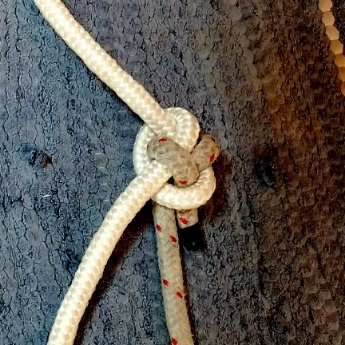
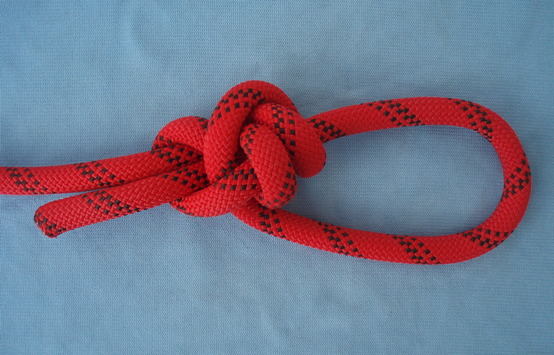
hi, I have a simple TIB slipped loop that is tied similarly to the kalmyk loop.
Loose, it is more stable… and jams less under heavy load than the kalmyk loop. Under very heavy load I’m not sure.
Someone wants to test it?
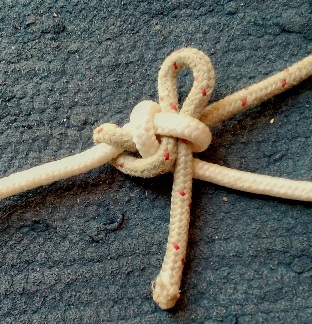
hi, I have a simple TIB slipped loop that is tied similarly to the kalmyk loop.
Loose, it is more stable… and jams less under heavy load than the kalmyk loop. Under very heavy load I’m not sure.
Someone wants to test it?
Thanks for your presentation Andreas.
I noticed your comment:
and jams less under heavy load than the kalmyk loopI would comment that all types of 'Bowlines' are resistant to jamming (whether based on #1010 or virtual/psuedo). The so-called 'Kalmyk loop' doesn't jam.
The so-called ‘Kalmyk loop’ is simply a slipped anti Bowline.
And there are variations; tail inside or tail outside the eye.
One could also refer to an ‘anti’ Bowline as a ‘Boas’ Bowline or ‘Eskimo’ Bowline, or ‘Cossack’ knot… although in this politically correct world we live in, some view the term ‘Eskimo’ as offensive? Hmmm.
And ‘slipping’ the ‘anti’ Bowline then yields the so-called ‘Kalmyk loop’.
…
As for your presentation, I find it to be insecure.
Interestingly, an ‘anti’ Bowline can be made TIB by ‘slipping’ it,
The same tactic is not true of Bowlines based on #1010 geometry (ie ‘slipping’ it does not make it TIB).
thanks for the input!
have you watched Allen Lees video testing the kalmyk loop in regards to jamming?
https://www.youtube.com/watch?v=YodM4Yww9Pg
the one shown here opens clearly more easily.
can you explain in which sense the loop shown is not secure? you mean under load?
I had a look at Alan’s video.
As far as I could determine - it appeared that Alan made no attempt (on camera) to loosen the knot.
When I’ve load tested a simple anti Bowline (aka Boas.Eskimo/Cossack) - it was jam resistant.
I haven’t load tested a slipped anti Bowline…but; the act of ‘slipping’ the knot actually puts another rope diameter inside the nipping structure/loop. In theory, this shouldn’t cause jamming.
I might revisit this with my own load test to confirm…
take a look at min 3.55
the cossack end he gives up more quickly because it’s even more tight
Hi Andreas, very nice offering, here are some additional comments/queries by me.
I am not really sure if the terms Kalmyk, Cossak, Eskimo, Anti-bowline, fit in your case.
At the structures i mentioned, their bight components, conventionally collar the on/out going eye leg, while your returning eye leg segment, captures the Spart first, and comes back through the nip, therefore your eyeknot tends towards a more conventional bowline topology i think, provided that i have tied it properly.
With respect to its jamming profile, i wouldn’t underestimate the crossing area’s friction of your nipping component. Of course the slack at the collar helps a lot, but a quick test showed more than enough constriction there, which might be problematic at heavy loading, so it needs testing to confirm its jam resistance.
Having said that, i wouldn’t characterize it as insecure, it almost reminded me the strength of Alpineer’s tresse bowline. In particular, if you tie it in cowboy fashion, you subject the exiting bight leg to that friction, hence boosting security.
Very nice approach to slip the tail and get the tibness, but that does not give you a Kalmyk, does it? 
One other path for the tibness, would be to continue with a turn around the incoming bight leg, tracing then the Spart as it exits through the collar (yosemite).
PS: I have the impression that Alan Lee has explored/tested such structures before.
Hello Andrea, hope you well 
Reference your comment:
take a look at min 3.55 the cossack end he gives up more quickly because it's even more tight
I am going to make an outright absolute declaration Andreas.
Anti Bowlines based on #1010 or #1034 1/2 are jam resistant.
In other words, they do not jam!
I’m not sure how much clearer I can be?
…
Now - with specific respect to the Alan Lee video.
You might need to look more closely.
For reasons known only to himself (ie Alan) he did not ‘break’ the knot at its ‘collar’.
When loosening ‘Bowlines’ - it is always best to begin at the ‘collar’.
This is a general rule for all knots - I find it best to first target the segment that can be readily loosened - and then work the other more stubborn segments.
…
I just performed my own load test today.
I loaded the anti Bowline based on #1010 and the anti Bowline based on #1034 1/2 right up to their MBS yield point.
I did this with the ‘slipped’ versions as well (ie both ‘slipped’ and without ‘slipping the tail’).
Result: No jamming.
I was able to loosen all test specimens in less than 2 seconds!! (even after being loaded right up to MBS yield point).
NOTE: I used EN892 human rated dynamic rope (11mm diameter).
…
COMMENTARY:
This is an example where drawing conclusions from one persons video can lead to what I call a false positive.
This is in no way intended to be disrespectful to Alan Lee.
I consider Alan to be a genius knot tyer.
However, I have openly criticized Alan with some of his test methods in the past - and I am entitled to give such critique.
Giving criticism is not by itself evidence of hatred, disrespect or belligerence.
It is simply professional criticism from one knot enthusiast to another.
I would respectfully invite Alan to repeat his jam tests on the Anti Bowlines (both slipped and un-slipped).
He should focus on breaking the knot at its ‘collar’ initially.
In doing so, he will find that the knot specimen can be loosened in mere seconds…
I think Alan knows all of this anyway (I don’t need to remind him)…
Thanks everyone.
About naming, my bad. I did not try to name correctly, more put into the same box of how it’s used: opens fully with one tuck… like the kalmyk. Could be used instead…
Tsik… if you take a picture of the cowboy version you mentioned? Would be very educational )
About jamming, maybe Allen can clarify. My observation was that the two knots are not equal in
regards to ease of opening.
per Andreas:
About jamming, maybe Allen can clarify. My observation was that the two knots are not equal in regards to ease of opening.You know that there is nothing to stop you from experimenting with these types of 'anti' Bowlines yourself. You will find that they are resistant to jamming. What I am saying is..."Why not prove this for yourself?"
I am not entirely clear what Alan Lee was attempting to do (or prove).
All ‘Bowlines’ can easily be loosened by starting at the ‘collar’.
Alan appeared to not really try - watching the video gave me the impression that he was more interested in checking other segments of the knot core?
I honestly don’t fully understand what his intentions were?
As stated, I’ve loaded the slipped and non-slipped versions of these ‘anti’ Bowlines and could not induce jamming (and this was right up to the MBS yield point).
I used EN892 human rated rope - but, that shouldn’t make any difference.
Anyhow, I’m sure that Alan will weigh-in with his comments…
Hi All,
Very interesting the test from Mark, maybe every one tie and dress the knot difference, maybe I am too old and weak. I tested many times it just easy to jam.
Mark, can you please make a video, how you tie and dress the knots and test it just for one time only, and show me how you do it.
[Quote] PS: I have the impression that Alan Lee has explored/tested such structures before.
[/quote]
No, I never tie and test it before. Excellent idea from Andreas, even though is little complicated to tie the knot, I like the idea will keep in my tool box.
[Quote] However, I have openly criticized Alan with some of his test methods in the past - and I am entitled to give such critique.
[/quote]
Till now I still believe most of you criticized don’t make sense to me.
When I got tsik’s knot done, I will go back to RT Butterfly page, Item by item tell you what I see.
To Andreas and Alan,
The jamming mystery is now solved.
The so-called ‘Kalmyk loop’ - found at illustration #97 in Lev Skryagin’s knot book and also at this link: https://en.wikipedia.org/wiki/Kalmyk_loop is topologically the same as an ‘anti Bowline’,
Interestingly, #97 Kalmyk loop has an induced twist in the collar + legs of the collar - it is rotated.
This geometry is (in my view) ‘forced’ - and it pushes the tail upwards so that it is situated outside of the eye.
It does indeed appear that this ‘forced’ geometry affects its jamming properties.
However, if you rotate/twist the collar and its legs so that the tail is now inside the eye (which is a more ‘relaxed’ dressing) - it becomes totally jam proof.
To advance a theory as to whats going on:
When the collar and legs of the collar are rotated to ‘force’ the tail to a position outside of the eye, it affects the operation of the nipping structure - which now acts like #206 Crossing hitch.
The nipping structure is not able to rebound - it continues to contract.
The SPart also presses against the tail which further occludes the nipping structure.
Summary:
The ‘anti’ Bowlines where the collar and its legs are dressed in a more ‘relaxed’ state are totally jam proof.
Induce a rotation/twist in the collar to ‘force’ the tail upwards so that it is outside of the eye - and it now causes jamming.
I’ll post some pictures when I get a chance.
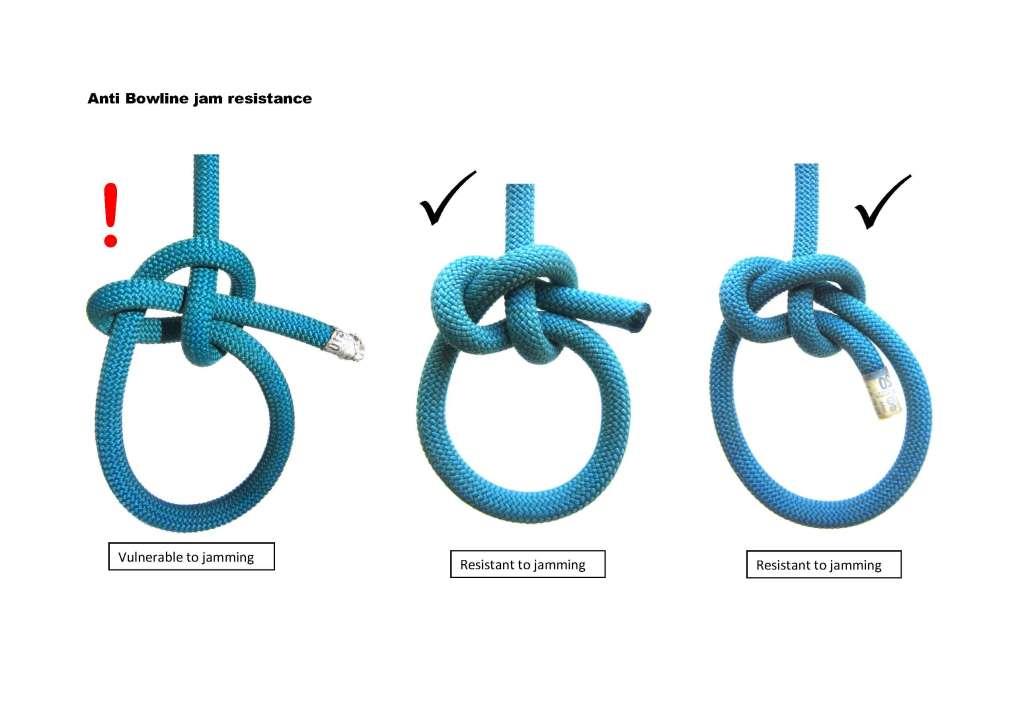
such a nice pic came out of my post, I didn’t expect this. thanks Mark, for creating the clear image.
I would comment that all types of 'Bowlines' are resistant to jamming (whether based on #1010 or virtual/psuedo). The so-called 'Kalmyk loop' doesn't jam.Hmmm, May be I didn't try hard enough or too weak ? will try it again may be I can do some twisting on the slip bight see if I can untie it or not ?
Posted by: agent_smith ? on: June 09, 2021, 06:17:46 PM ?Insert Quote I had a look at Alan's video. As far as I could determine - it appeared that Alan made no attempt (on camera) to loosen the knot. When I've load tested a simple anti Bowline (aka Boas.Eskimo/Cossack) - it was jam resistant.I haven’t load tested a slipped anti Bowline…but; the act of ‘slipping’ the knot actually puts another rope diameter inside the nipping structure/loop. In theory, this shouldn’t cause jamming.
I might revisit this with my own load test to confirm…
Posted by: agent_smith ? on: June 10, 2021, 03:19:17 AM ?Insert Quote Hello Andrea, hope you well :)Reference your comment:
Quote
take a look at min 3.55
the cossack end he gives up more quickly because it’s even more tightI am going to make an outright absolute declaration Andreas.
Anti Bowlines based on #1010 or #1034 1/2 are jam resistant.
In other words, they do not jam!I’m not sure how much clearer I can be?
…
Now - with specific respect to the Alan Lee video.
You might need to look more closely.
For reasons known only to himself (ie Alan) he did not ‘break’ the knot at its ‘collar’.
When loosening ‘Bowlines’ - it is always best to begin at the ‘collar’.This is a general rule for all knots - I find it best to first target the segment that can be readily loosened - and then work the other more stubborn segments.
…
I just performed my own load test today.
I loaded the anti Bowline based on #1010 and the anti Bowline based on #1034 1/2 right up to their MBS yield point.
I did this with the ‘slipped’ versions as well (ie both ‘slipped’ and without ‘slipping the tail’).
Result: No jamming.
I was able to loosen all test specimens in less than 2 seconds!! (even after being loaded right up to MBS yield point).NOTE: I used EN892 human rated dynamic rope (11mm diameter).
…
COMMENTARY:
This is an example where drawing conclusions from one persons video can lead to what I call a false positive.
This is in no way intended to be disrespectful to Alan Lee.
I consider Alan to be a genius knot tyer.However, I have openly criticized Alan with some of his test methods in the past - and I am entitled to give such critique.
Giving criticism is not by itself evidence of hatred, disrespect or belligerence.
It is simply professional criticism from one knot enthusiast to another.I would respectfully invite Alan to repeat his jam tests on the Anti Bowlines (both slipped and un-slipped).
He should focus on breaking the knot at its ‘collar’ initially.
In doing so, he will find that the knot specimen can be loosened in mere seconds…
I think Alan knows all of this anyway (I don’t need to remind him)…
Posted by: agent_smith ? on: June 10, 2021, 09:23:11 AM ?Insert Quote per Andreas: Quote About jamming, maybe Allen can clarify. My observation was that the two knots are not equal in regards to ease of opening. You know that there is nothing to stop you from experimenting with these types of 'anti' Bowlines yourself. You will find that they are resistant to jamming. What I am saying is..."Why not prove this for yourself?"I am not entirely clear what Alan Lee was attempting to do (or prove).
All ‘Bowlines’ can easily be loosened by starting at the ‘collar’.
Alan appeared to not really try - watching the video gave me the impression that he was more interested in checking other segments of the knot core?
I honestly don’t fully understand what his intentions were?As stated, I’ve loaded the slipped and non-slipped versions of these ‘anti’ Bowlines and could not induce jamming (and this was right up to the MBS yield point).
I used EN892 human rated rope - but, that shouldn’t make any difference.Anyhow, I’m sure that Alan will weigh-in with his comments…
To Andreas and Alan,The jamming mystery is now solved.
The so-called ‘Kalmyk loop’ - found at illustration #97 in Lev Skryagin’s knot book and also at this link: https://en.wikipedia.org/wiki/Kalmyk_loop is topologically the same as an ‘anti Bowline’,
Interestingly, #97 Kalmyk loop has an induced twist in the collar + legs of the collar - it is rotated.
This geometry is (in my view) ‘forced’ - and it pushes the tail upwards so that it is situated outside of the eye.It does indeed appear that this ‘forced’ geometry affects its jamming properties.
However, if you rotate/twist the collar and its legs so that the tail is now inside the eye (which is a more ‘relaxed’ dressing) - it becomes totally jam proof.
To advance a theory as to whats going on:
When the collar and legs of the collar are rotated to ‘force’ the tail to a position outside of the eye, it affects the operation of the nipping structure - which now acts like #206 Crossing hitch.
The nipping structure is not able to rebound - it continues to contract.
The SPart also presses against the tail which further occludes the nipping structure.Summary:
The ‘anti’ Bowlines where the collar and its legs are dressed in a more ‘relaxed’ state are totally jam proof.
Induce a rotation/twist in the collar to ‘force’ the tail upwards so that it is outside of the eye - and it now causes jamming.I’ll post some pictures when I get a chance.
Hi Andreas, that’s the cowboy version of your virtual bowline.
I realize that the tail slipping, as you did, does not support the tibness this time.
However, the very next illustration, with the figure eight incoming eye leg structure, leaves no remnant knot when untying, supporting the TIB property.
I have placed the yosemite turn close to the nub behind Spart, for in this geometry, is more compact and it does not affect the form of the knot at heavy loadings.
Hello Alan,
Withe regard to your comments:
I don't like it these two sentences at all.
Now you are talking.
My words were not intended to offend you Alan.
I’ll restate my position again:
I honestly was confused by the jamming results.
It was the first time I saw your video - and the prevailing view was that anti Bowlines don’t jam.
So you video took me by surprise…until I realized exactly what was going on.
The so called ‘Kalmyk loop’ is topologically identical to an anti Bowline and so I assumed it would also follow the same general rules.
Its incredible that a simple twist/rotation of the collar upsets the jamming properties.
In my opinion, the ‘Kalmyk loop’ is a ‘forced’ dressing state, and it upsets the nipping structure, which can no longer ‘rebound’ when load is released…
Anyhow, the mystery is now solved - and I will have to go back and update my Bowlines technical paper to describe how a simple rotation/twist of the collar completely upsets the jamming properties of anti Bowlines.
Thank you tsik for clarifications ) it’s better like this in cowboy fashion. But can not open with one tuck anymore…
I found that the same tie can be dressed into the knot shown below. I tried the same with the cowboy tie. But I prefer the one shown.
This one seems to be more compact and secure than the initial dressing.
It might jam … Might not )