I understand the Karash double loop for legs. The following knot for the waist loop is bowline, but what happens with the short section of rope connecting these two knots? It needs to be woven within the final waist loop bowline tie in, but how - there seem to be more than one option.
p.s. Would Karash double loop be an improvement from double bowline on the bight? - usability-wise, not how to remember to tie the structure.
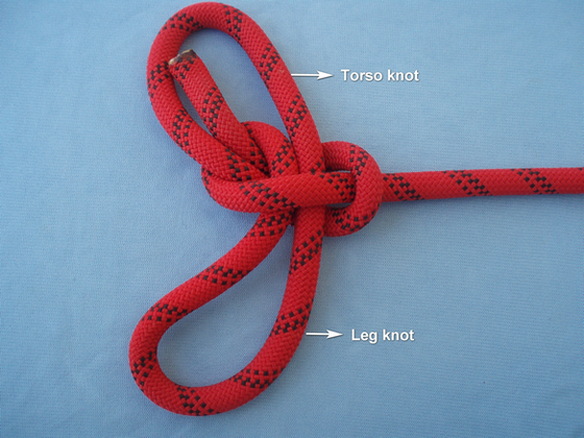
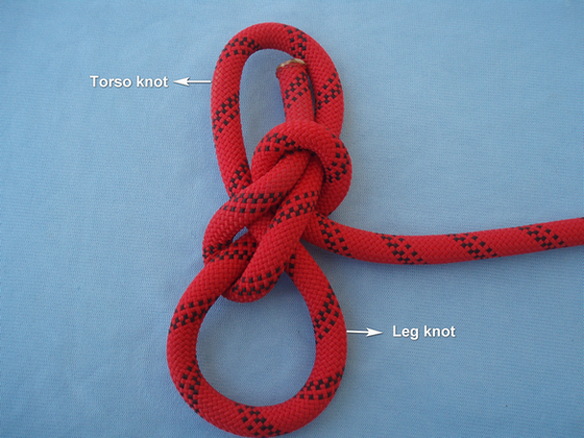
In the video (1:40’) it says the Karash double loop is supposed to be ‘better’ than double loop bowline on a bight because there is no ‘crossing lines’. What does it mean?
You don’t see the crossed lines in that video because he doesn’t tie the bowline on the bight he ties the karash version.
If you go to a video that shows the tying of the bowline on a bight and have a look at the loops that are formed you will see the ‘cross’.
Or at least they do the way I tied it.
Another good way to see the cross is by tying the Portuguese bowline/bowline on a coil.
There are various vids out there that show how you can tie it so the loops aren’t crossed.
Look for vids that are showing it in rescue set ups.
If you can’t find it, let me know and I will have a look, I might have favourited and forgotten it! ;D
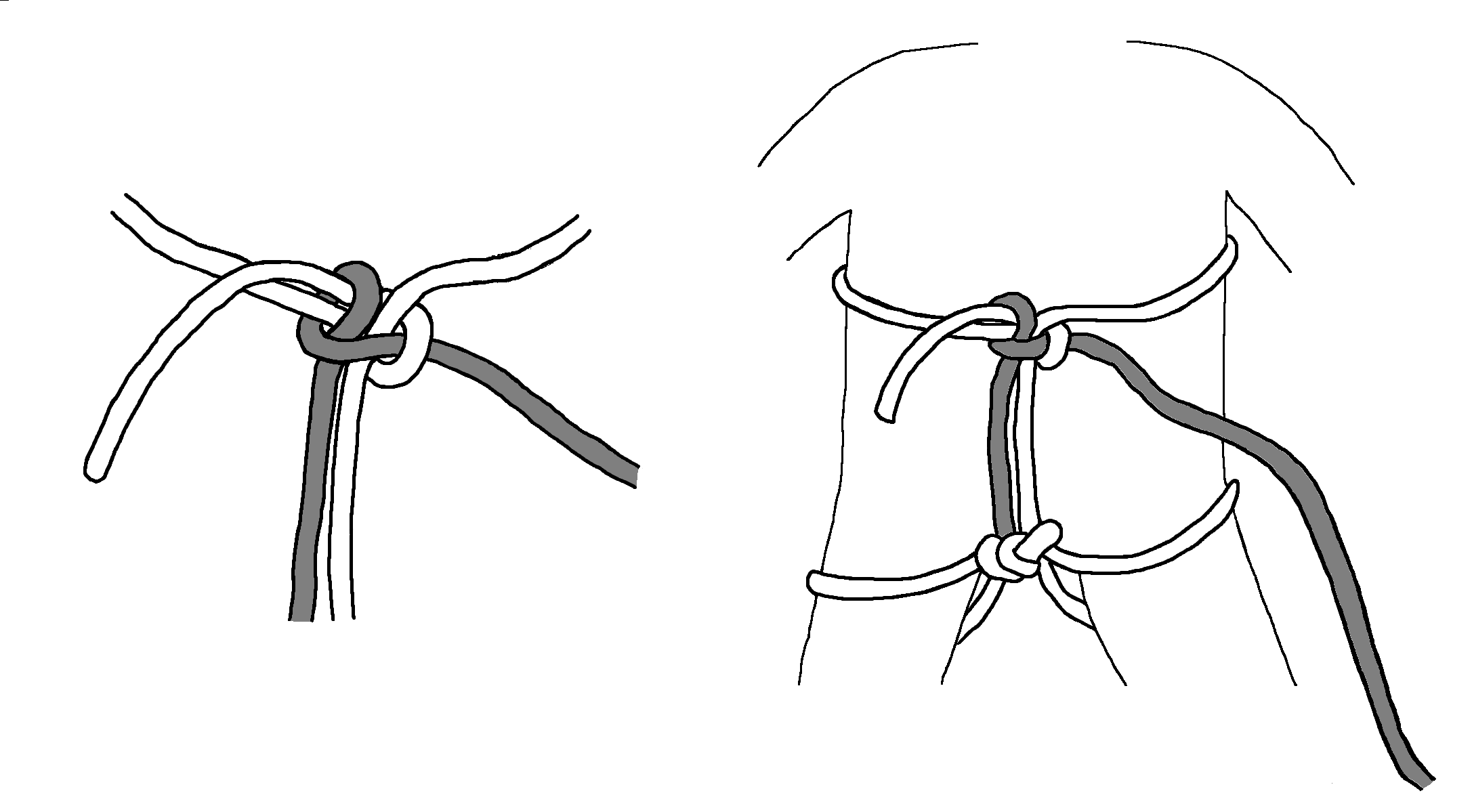
Here are more details about how you could tie the “chest harness” part. The Rapid Tying Method for making a Bowline is very similar to Ashley’s Hawser Bowline #1014. In the video they actually tie a Cowboy Bowline #1034 1/2 which I have switched to a regular Bowline by going the other way through the slip knot. I do not think it matters much. The detail you seem to be asking for is how the other line is captured within the Bowline. This is similar to a Portuguese Bowline.
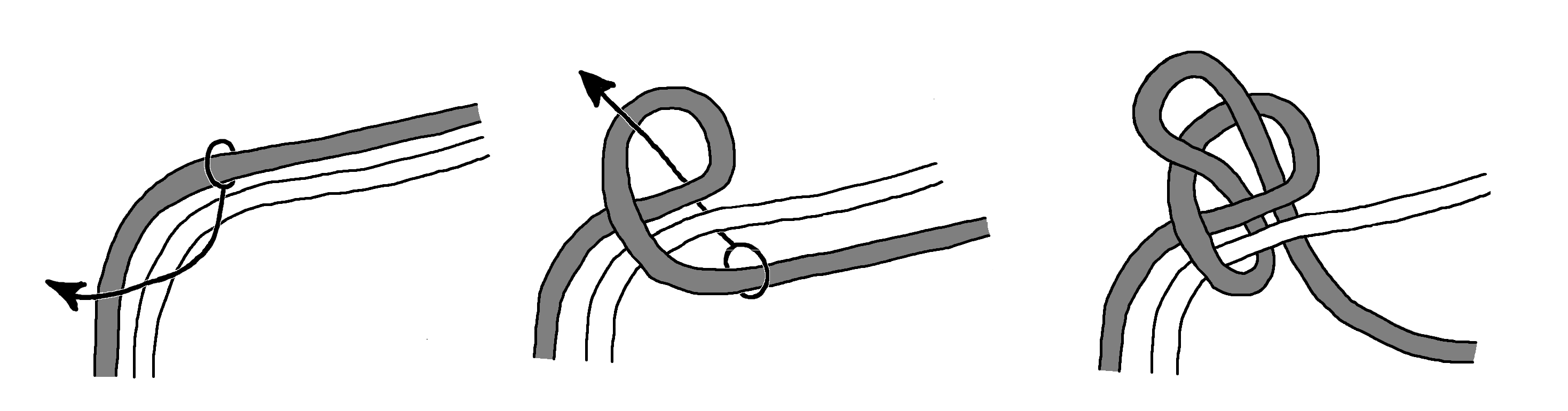
The Karash Double Loop is very similar to a Bowline on the Bight, and Karash’s method is similar to Ashley’s third method for tying #1082, but he just starts with a doubled Figure Eight instead of a doubled Overhand Knot. Here is how to tie the Karash Double Loop using a method that generalizes the more common method for tying a Bowline on the Bight #1080. I am not claiming it is a better method (it is not), but it better shows how a Karash Double Loop and a Bowline on the Bight are related.
Did you develop this method of tying? If so, don’t sell yourself short. The Karash Double Loop’s old method of tying has had problems with memorability and tying errors that can lead to shrinking double loops. It could be argued that by drawing out the similiarities to the bowline on the bight method, it may help eliminate some common paths of error.
The double loop Bowline on the bight can also be tied in a similar fashion to Karash by starting with an overhand rather than F8. While I found it somewhat difficult at first to remember which part of the initial knot to pull once the bight is flipped over the knot in both cases so that the loops do not shrink (in the double loop bowline that would become a Palomar hitch, I think), one way to memorize it is to pull the part of the initial overhand/F8 that is the ‘closest’ to (or is ‘communicating’ with) the working end/bight being drawn in the last move.
p.s. Forgot to thank Dennis for the drawings - I got it now - cheers!
BTW @Dennis: how do you make your drawings? I just discovered the Knotmaker but I like the Ashleynesque feel of your drawings (but need some computer crutch to make them).
I just use Microsoft Paint 3D for my drawings (and I have to keep them simple enough and small enough to stay under the 100 KB limit). If you pull them into any bit-mapped drawing program, you will see that they are not fancy enough for publication. I have tried to learn one of the vector-based drawing programs, but I like the simplicity of Paint. It also helps that I have over 20 years of experience creating similar things for scouting activities, originally putting them into Word Perfect documents and later into Word documents. I have a library of several hundred knot drawings, so I rarely start from scratch. Instead, I just edit something old. You are correct that I model them a lot on Ashley, but I now find that if I am copying something from Ashley to give to scouters (both adults and youth), I use at least twice as many diagrams to show the steps as you will find in Ashley.
I did a handout many years ago on the Karash Double Loop and Harness. One adult scout leader who was an EMT liked it enough that he shared it with his fellow workers. At that time (2015) Michael Karash had a website in addition to video you referenced. The website had more details about the knot and the harness, but sadly it does not seem to exist anymore.
I have been reading and enjoying this forum for decades, but only recently (in retirement!) did I decide to participate.
Not exactly, because as you see, the SPart (rescue line) does not participate at all at the eye construction, (around waist,chest) as it should, according to the definition of any bowline.
On the contrary, it is just forming one (or two nipping loops) and gets out of the system.
It’s the long tail component coming from a different configuration (karash leg knot) which completes the knotting around the torso in a sheet bend like fashion.
I think Karash is doing this trick, in order to be able to work with an end, and avoid tying anything else in the bight.
I believe, a bowline on a bight, tied in your hands and then passed through your body from the head, would make the harness simpler.
Or one can look at it as the #1073 (or its Cowboy version): one of the loops around your chest, and the other holding your legs via the Karash loops tied on it.
From a geometrical point of view, i can’t think of the two splayed loops of the portuguese bowline, in axial alignment, as required in this application, some sort of distortion would probably follow, but nonetheless it’s clearly a clever thought.
One could tie a portuguesse double splayed loop for the legs, with a retraced, very large bight, down through the collar, for the torso.
In doing so, the convention of axial alignment would be in force, with the use of just one core knot, as it was brought up in the other thread of Desmond Doss.
The bowline with a bight, tied also with a large retraced bight, would also do the job.
Not that important, but it appears to me that the Karash harness, as Dennis depicted it and as I tie it, already is the same as #1073. The one loop of it sits around your waist, the other loop of the #1073 (which has an extra Karash Dbl. Loop tied in it) goes around your legs.
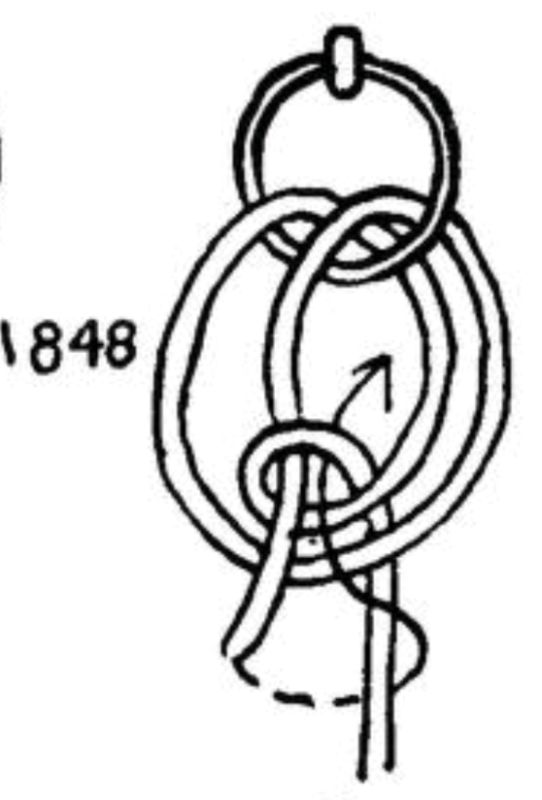
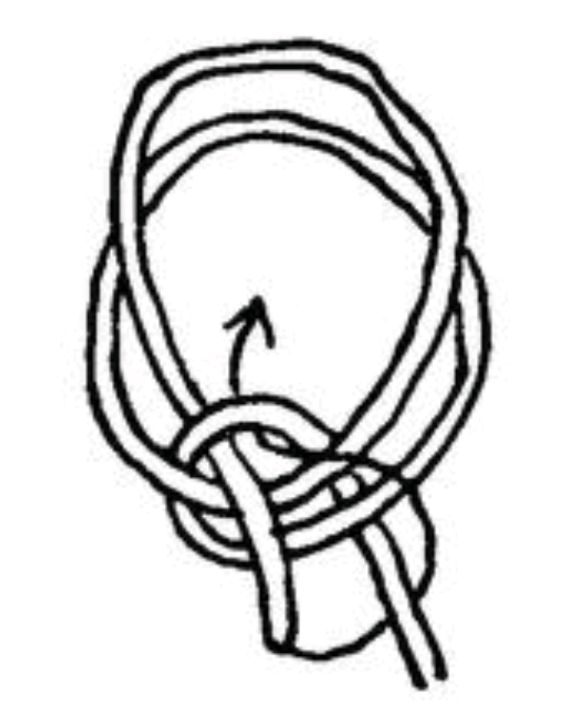
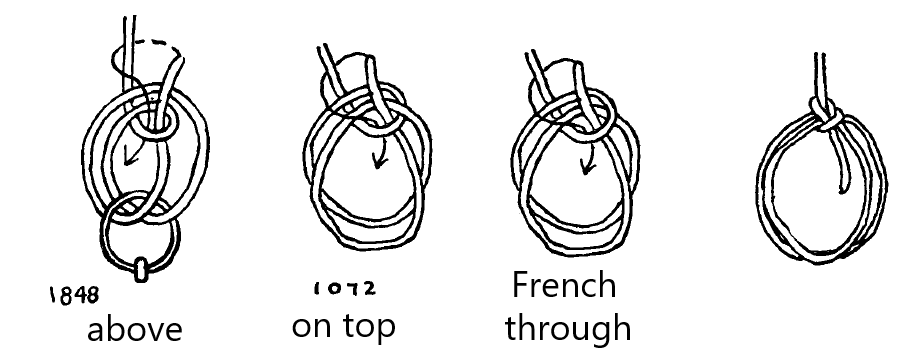
Yes, the Wipedia entry for “Portuguese Bowline” is pretty terrible. I wish I knew how to contribute to Wikipedia to help fix it. The main entry (to the right on the first page) has a Cowboy Bowline finish and the tying instructions give a weird Portuguese Bowline with Splayed Loops (see ABoK #1073 for a more natural way to get the splayed loops). In one of Ashley’s descriptions of the Portuguese Bowline [ABoK #1848], he references a Riesenberg book where it is called a French Bowline. If you look up that reference (you can find it on Google), you find tying instructions there where when you start to form the second loop, you pass the free end through the nipping loop. Ashley either passes this free end above the nipping loop [#1848] or lays it on top of the nipping loop [#1072]. It took me awhile to realize that you can move this part after you complete the knot but before you tighten from any of these three positions to any other. However, if you add any of the many “locking mechanisms” for a Bowline to this Portuguese Bowline, you may “lock” the part between the two loops in a particular postion where it then cannot move to the other positions. Still there is a tradition in knot-tying books to call it a French Bowline if this part between the two loops is placed through the nipping loop and to call it a Portuguese Bowline if this part between the two loops is placed either above or on top of the nipping loop. You can also get a splayed loop version using any of the three positions (but you may not be able to move to the other positions).
The point I was making about the upper part of the Karash harness was that the structure locally looks like that of a Portugues Bowline (with the part between the two loops replaced by the lead coming from below which is placed either above or on top of the nipping loop).
Ashley either passes this free end above the nipping loop [#1848] or lays it on top of the nipping loop [#1072].
I’m not sure if I’m seeing it right, but those two seem identical, just rotated 180 deg? The way I remember where the strand for the second loop goes is to place it between (underneath) both strands of the final tail U-turn and the S-Part.
p.s. This video uses the French? variant (with the second loop strand going through the choking loop) to form a nifty clip/soft shackle at the end of the line, locked by a long tail.
Here I try to show the three positions (mostly as you tie them, because they might even move when you tighten). After the knot is tightened, you can hardly tell the difference.
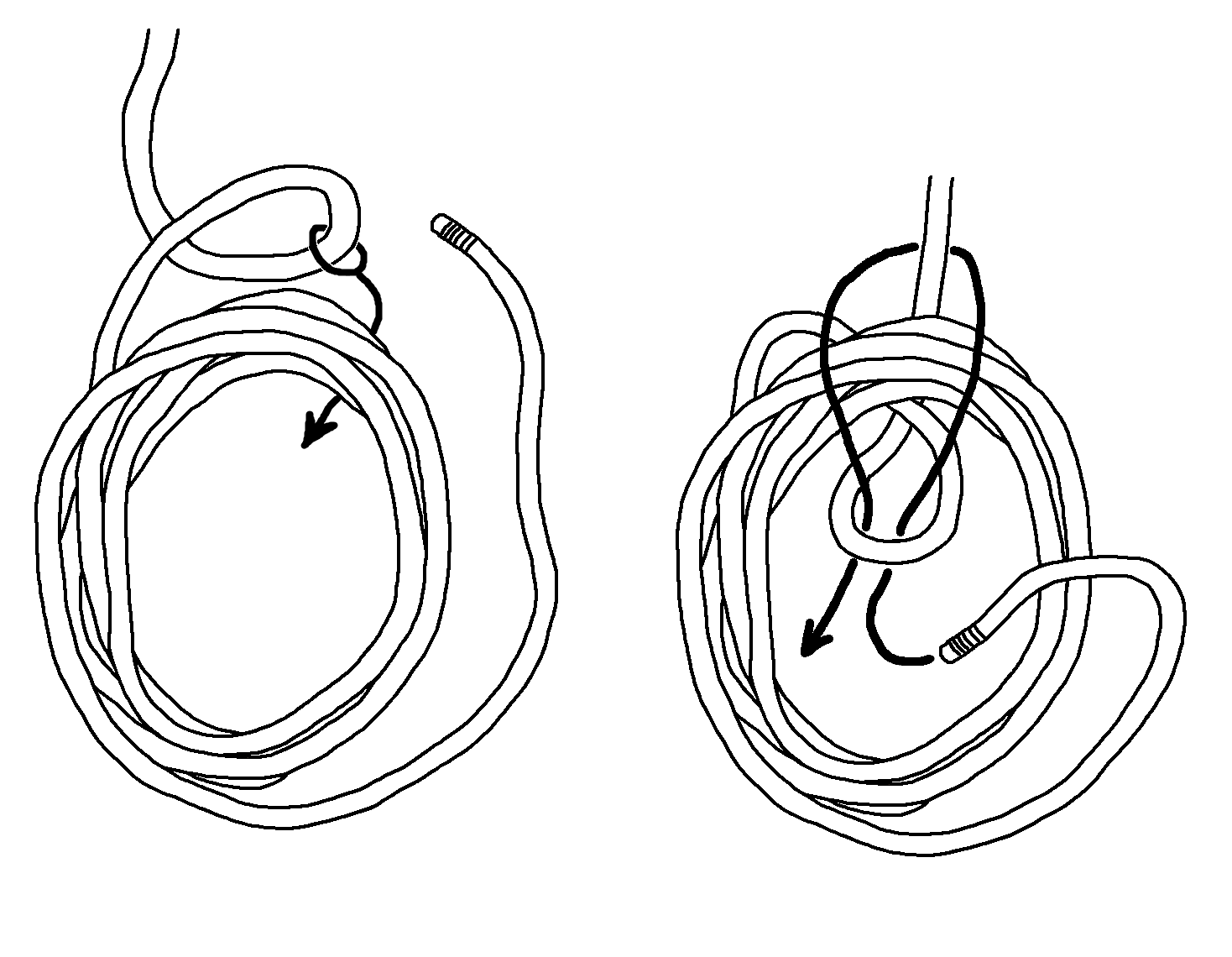
There can be more than two loops as well. The Bowline-on-a-Coil is an extreme example of a Portuguese Bowline where the coil is placed usually above the nipping loop.
You can do virtually all of the enhancements to an ordinary Bowline that Mark Gommers has in his Bowline Analysis paper to a Portuguese Bowline. I do not think there is any need for such enhancements for the Karash rescue harness set up because the person being rescued is usually immediately hauled up. The Bowline has a problem in climbing and rescue ropes when it is not going to be under tension and might work loose before it is needed in a fall.
If you start the tying proccess from a well dressed overhand loopknot, you’ll probably get a perfect bowline on a bight with no crossing lines (i think Karash is starting from a well dressed figure eight too).
When it comes to life critical applications, one should check the property of redundancy of a double eyeknot, which means that if one of the eyes fails, there has to be the other one as a back up.
if the secondary eye fails (secondary eye=direct continuation of the tail), we would still have the primary bowline eye.
However, if the primary eye (primary eye=direct continuation of the SPart) fails, things might get tricky, one has to check if the remaining secondary bend eye, is strong enough to hold efficiently without failure.
So, in answering this question “which is better”, one has to take into consideration, which one of the two has the strongest secondary bend loop, with the hypothesis that both primary eyes of karash double loop, bowline on a bight, would induce failure.