This is a work-in-progress…and I of course welcome any comments, and constructive feedback.
The history of the zeppelin is unclear…and I am trying to present all the known facts. I am trying to find the Knotting Matters edition that features the report from Dr Giles Camlin (in relation to Charles Rosendahl dismissing any knowledge of the ‘zeppelin bend’). Cant seem to find the report…
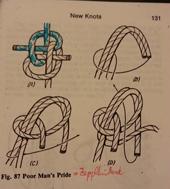
Hi Mark, your third paragraph is talking about HB, it is not relevent to ZB. I suggest you should delete it and leave for further HB Bio. Here are some information from G. Budworth’s “The Knot Book”. I beleive the Poor Man’s Pride is exactly as ZB.
I wonder how many knots you think you can get a bio
for? --even this first attempt is highly dubious, but one
I’d have thought could be nailed, at least if the U.S. Navy
did indeed originate or even just insist on using the knot
(and might have some documentation…).
Hi Mark, Zeppelin Bend is not composed with interlocking loops. Please ammend your first paragraph.
yChan
Hello yChan. Which version are you reading? VER 0.2 corrected a few typos (this one included).
Please ensure you review the most up-to-date versions otherwise we will be chasing ghosts
Hi Mark, your third paragraph is talking about HB, it is not relevent to ZB. I suggest you should delete it and leave for further HB Bio.
I wanted to include #1425A (Phil D Smith’s) Riggers bend because it is based on inter-locking overhand knots - and because it is the closest knot structure to the zeppelin in ABoK. But, I may try to put most of the current info in a footnote, so as not to hijack the papers theme.
Here are some information from G. Budworth's "The Knot Book". I beleive the Poor Man's Pride is exactly as ZB.
yChan
Thanks for this…but, Budworth’s knot book was first published in 1983.
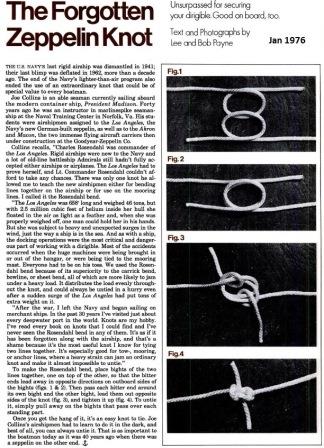
The ‘Boating’ magazine article was published in 1976.
So the ‘Boating’ magazine illustration on the zeppelin pre-dates Budworths ‘Poor man’s pride’.
And yet, Budworth also refers to a Desmond Mandeville - who allegedly discovered the ‘zeppelin bend’ in 1961.
As for tying method, Budworth refers to Ettrick Thompson who discovered a better tying method depicted at fig 87 (B-D).
…
By the way, your attached images are a little hard to read - very compressed…I have to try a different way to see them clearly.
I wonder how many knots you think you can get a bio
for? --even this first attempt is highly dubious
A very limited number!
Zeppelin bend
Lee’s link Bowline #1047 F8 eye knot (and here I might even include your ‘Lehman 8’, + your ‘strong/weak forms’) - a lot to examine with this knot (also that it is not ‘PET’). I will also address the attitude to adding a ‘stopper knot’ to ‘enhance’ security (which I think is of dubious benefit).
Not sure why you think this is “highly dubious”…I am inviting IGKT members to contribute.
I would have reasonably thought that you would regard the zeppelin bend as ripe for a new (fresh) perspective.
I see this as an opportunity to do some good work for benefit of all knot tyers… for our collective knowledge bank.
I have the motivation to do it - and I think I can get the photography right to do it justice.
There is a reference to the Zeppelin bend in ‘Knotting Matters’ #8 (July 1984) at page 22.
The article is titled: ‘Hunting Zeppelins’ and was authored by Percy Blandford.
Once again, the author refers to Charles Rosendahl.
There is also mention of the ‘Poor mans pride’ - and Budworths ‘The Knot Book’ and Ettrick Thompson’s new method of tying the zeppelin bend.
There is also further reference to ‘Knotting Matters’ #4 (July 1983):
A Desmond Mandeville article titled ‘The Alphabend’ (starts at page 2) which includes the ‘Poor mans pride’ knot (aka zeppelin) illustrated at ‘P’.
However, all of this was pre-dated by the ‘Boating’ magazine article authored by Lee and Bob Payne in Jan 1976.
Mark,
you could write “Parallel (knot) Bios”, as Plutarch wrote “Parallel Lives”!
Here are some information from G. Budworth's "The Knot Book". I beleive the Poor Man's Pride is exactly as ZB.
yChan
…
And yet, Budworth also refers to a Desmond Mandeville - who allegedly discovered the ‘zeppelin bend’ in 1961.
…
Mark
Mandeville, in KM #18 - Jan 1987 (On Tramble Territory with Desmond Mandeville p.11-15), re-named the “Poor Man’s Pride”/Zeppelin (letter P) with “The Izzard” (letter Z) explaining in a note: “Izzard is the Old English name for letter Z. The bend is the Zeppelin Bend (Rosendahl Bend, Poor Man’s Pride)”. In the article there is a reference to Guild’s Chart 55 too. You can find it at http://www.surreyknots.org.uk/55-rosenthal-zeppelin-knot.htm
but there the name is: “Rosenthal Zeppelin Knot”!?
“Rosenthal”? ???
(By the way, at p.15 (last page of Mandeville’s article) there is an interesting Appendix: “The category of Handedness”)
But what I really need to find is anything on the zeppelin bend that pre-dates the Jan 1976 ‘Boating’ magazine article authored by Lee and Bob Payne.
The earliest known published information I have is this Jan 1976 article.
Do you know if there is anything that pre-dates that Jan 1976 article? If yes, I would like to know about it
Also, I really need to know which ‘Knotting Matters’ issue has the content from Dr Giles Camlin which disputes the Joe Collins account (and in so doing, may cast doubt on the whole Lee and Bob Payne story).
As for #1425A Riggers Bend - no, I don’t think I will write a separate/distinct ‘Knot Bio’ on this…
But I think that it should be compared to the zeppelin bend in a knot Bio - on account of their same /class/order/family (but differing ‘genus’). #1425A belongs to a ‘genus’ that is inter-woven overhand knots
Zeppelin belongs to a ‘genus’ that is inter-linked overhand knots
I am waiting for Xarax to supply written content explaining the differences between these 2 bends - and to explain why the zeppelin is jam resistant while Riggers bend jams.
Xarax has previously posited that terminology and definitions are tricky with these types of bends…for example:
inter-linked
inter-weaved/woven
inter-connected
superposed / superimposed
So for example, #1425A Riggers bend is ‘inter-woven (overhand knots)’… while zeppelin bend is ‘inter-linked’ (overhand knots)?
English language is complex…and I am a native English language speaker…and I struggle !!
Change-log:
Re-drafted wording on first page.
Added new content and images at page 4 (these are the most difficult images I have ever photographed…but I think I captured the 3D aspect reasonably well).
Added new image and content to page 10 (interesting comparison of prusik loops).
…
This is still very much a work in progress…
Contributions from interested persons are most welcome
I need to find that information from Dr Giles Camlin in Knotting Matters! Somebody please help
It’s labeled as Charles Rosendahl’s Los Angeles ZR-3 with what looks to be a bunch of cruciform knots. :o It’s too zoomed out to be sure. It could just be handles of some sort, too. Most of these old photos are taken from a distance, sadly.
It looks suspiciously like ‘toggles’ but only to my eye - because the lateral sides of the ‘cruciform’ appear too straight/rigid.
I would have expected to see less rigidity on these lateral extensions of the cruciform shapes (knot tails shouldn’t necessarily be so straight)…
But - I would like to believe that this is the smoking gun we need to prove that the zeppelin bend was used as part of the ground-lines / mooring system.
Might need to recruit a few people from this forum to try and dig up some more detailed photos…
Surely this knot wasn’t lost to history only to resurface in a ‘Boating’ magazine article in Jan 1976 ?
(at 9:20 there is what appears to be rope join of some sort…similar cruciform shape as per your previous photo). I think it is only a matter of time till we track down some better images/videos.
In paragraph 5, you refer to “Lee Paine,” but the authors of the article are given as “Lee and Bob Payne.”
In paragraph 7 you refer to the “Lee and Bob Payne article,” but you have not at this point in the paper mentioned that the Boating article was written by Lee and Bob Payne.
Changelog:
fixed page 1 citations
fixed spelling error Payne (not Paine)
fixed Dr Giles Camplin spelling (Camplin…not Camlin)
added reference to Dr Giles Camplin re his doctoral thesis on ground handling and mooring of zeppelins
improved blueprint drawing of #1425A on page 5
added new content on page 10
…
Comments:
I dont need to locate any info from ‘Knotting Matters’ re Giles Camplin. This was all reported in a ‘Wingfoot Journal’ (according to Dan Lehman). So what I now need is to track down that ‘Wingfoot Journal’ which has references from Dr Giles Camplin.
I need Xarax to write about the structure of the zeppelin bend (how it works and why it is jam resistant)
My favorite bend is the [i]Rosendahl Bend[/i] because [b]I re-invented it and published it in 1967[/b].
I published in a local caving club newsletter. The club had about 70 members and a bunch
of exchanges with other clubs. I would guess that the press run was over 100 copies.
I think that I had the first publication of this bend. The exchanges were free to reprint my
article, but did not do so. At the time I wondered why none of the exchanges picked up my
article. It is not often that a knot that is new, simple, compact and useful comes along.
The Rosendahl Bend was later described in an article by Lee and Bob Payne in the March 1976
Boating magazine. Boating has a circulation in the hundreds of thousands. My method of tying
the bend was the same as given in the Payne article. I can’t remember the supposedly easier
method that Budworth gives.
I use the name “Rosendahl Bend” because that name has priority. My article did not give any name.
My article was entitled “An Easily Untied Bend”. Biologists have a rule that the first person to describe
a species gives it its name. A particular dinosaur was known for decades as Brontosaurus was found
to have been named earlier Apatosaurus. Scientists switched to using Apatosaurus. The Paynes
learned the knot from Joe Collins who is clearly quoted in the article “I called it the Rosendahl Bend”.
The name “Zeppelin Knot” was invented by some Boating magazine editors who wanted a snappy title.
The article may be found at www.motherearthnews.com/Homesteading-and-Self-Reliance/ .
The Mother Earth article reprint is identical the the Boating article except for references to dates.
As for #1425A Riggers Bend - no, I don't think I will write a separate/distinct 'Knot Bio' on this...
But I think that it should be compared to the zeppelin bend in a knot Bio - on account of their same /class/order/family (but differing 'genus').
[ ] #1425A belongs to a 'genus' that is inter-woven overhand knots
[ ] Zeppelin belongs to a 'genus' that is inter-linked overhand knots
This displays an unhealthy bias. Not only does one have a fairly
UNcontested/unconfused history for [i]"SmitHunter's bend"[/i] --and
I can toss in "1973" for my self-discovery of it (and a year or few
later for the [i]zeppelin[/i], btw, which I too initially #'d (my then
*naming*) as a derivative of the former!)),
BUT also the knot has firmer published presence,
AND also a definite result --it's the knot that (figuratively)
tied together the IGKT (and SHOULD be(come) the logo,
and not some darn --non-practical-- mat knot!) --as #1425a
has 4 right-angle ends which nicely thus can be taken as the
major compass points indicating the "I" of "IGKT" ! IMO !!!)
I am waiting for Xarax to supply written content explaining the differences between these 2 bends - and to explain why the zeppelin is jam resistant while Riggers bend jams.
Note that a version of that latter end-2-end knot
is pretty resistant to jamming. (Asher --sic-- sadly
rejected it as uninteresting(!?), which the original
does because the collar is able to constrict around
the SPart tightly --which mostly doesn't happen in
the [i]zep.[/i] because of that latter's geometry in which
the it must swing wider for all it does (and nevermind
any bit about "hinge"!).)
Oh, the "false zeppelin" --i.e., where the b & q are
instead d & q (shaped SPart turns)-- can be made
more stable by a similar version twisting of tails,
AND if set from trying to make it an offset knot
--i.e., tails hauled hard for setting.
BTW, good catch on transforming#551 into that
lookalike-to-1425a structure!! (I believe that [u]Hansel
& Gretel/EKFRopework show it in the obvious form,
but I don’t want to wade into their swamp to confirm.)
And you should omit the fanciful conjecture about Ashley
knowing … but disguising. There is way too much obvious
evidence that things are simply overlooked. (#1031/1048
e.g. have also a single-strand correlate, and also neither
of these led to the proper (loading-wise) shakehands
though smack before Ashley. (And I can attest to like
overlooking of what might be considered obvious, alas.)