Changelog:
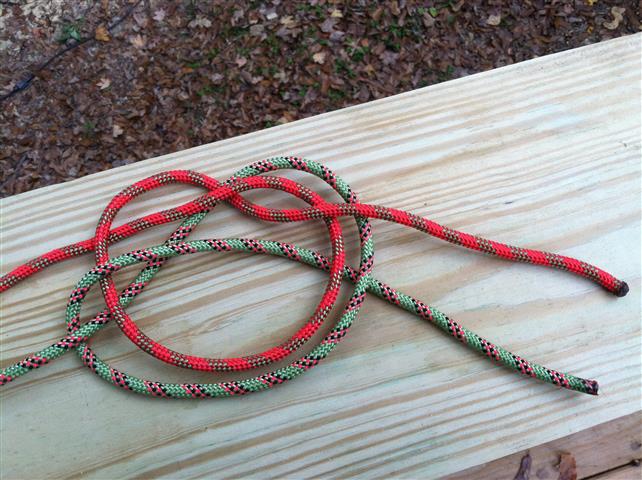
amended anatomy of Zeppelin bend photo image (hopefully Xarax will stop shouting at me now :o )
amended page 8 (removed #1425A Riggers bend…inserted image of Zeppelin bend to enable side-by-side comparison)
added new content to page 9 (bends and their corresponding eye knots)
added reference from ‘roos’ website and supplied link to his Zeppelin eye knot
added new content to page 10 - tying methods
added new content to page 11 (symmetry) - this one was difficult since it involves complex geometry and its myriad of definitions
Hopefully roo will reply faster than you can say "roo’…and either instruct me to remove the link to his website or provide some sage words of wisdom re the Zeppelin eye knot.
…
I need assistance to advance this paper further.
I am struggling with geometry and trying to describe the geometric symmetry of the zeppelin bend…so anyone who is a wiz at geometry I’d like to hear from you
Hi Mark,
first of all, it’s growing nice!
oh you just posted another version…
but these 2 notes are still valid:
p.4 could it be interesting a lightly lateral view of the Zeppelin and the Hunter?
p.5 I think that the image of the toggled bend is wrong, as far as I know the toggled bends without the toggle are not bends! see ABoK #1494 [edit: (#1521 - #1524, but #1522 is a bend! (“Adjusted in this way, it never jams and is less liable to spills.”)]
…
about the point of symmetry of the Zeppelin Bend, it is internal at the centre of the Bend…see Miles’ diagram b8 p.88. [edit: your picture (left up) at p.11 is right because the transformation in that case changes the sign of all the coordinates (x,y,z) → (-x,-y,-z). -z indicates a crossing change]
Changelog:
added acknowledgements to contributors
added content to page 9 (reference to lack of historical data on Zeppelin eye knot)
added content to page 10 (more details about tying methods)
added content to page 11 (symmetry) - tried to improve the X/Y axis and added red dots to aid in interpretation of point inversion symmetry
also added information about Roger E Miles and his publication.
…
What I still need:
A copy of BobThrun’s article in the caving newsletter from 1967 showing the Zeppelin bend (per Dan Lehman?)
More content for page 11 - need an expert in geometry to write additional content.
Need historical info for the Zeppelin eye knot (roo?)
An explanation of how the Zeppelin bends works (per Xarax?)
I think it was in the general knotting community awareness as soon as the Zeppelin bend became widely-known. The problem was that it was difficult to communicate a simple tying method to the average rope user who may consider even a bowline to be a little tricky. Difficult-to-tie knots tend to get ignored.
After a few private conversations about the Zeppelin loop, I tried to put together a follow-the-leader method that might be memorable (March 2003). A few years later (June 2010) I included another method that drew off the b & q technique for the bend in hopes of consolidating techniques for those who wanted to reduce the mental burden of memorization.
I’ve not unearthed any history other than what has been proffered by others, but have have a tying method to offer.
Most tying methods show a p&q, etc., the standing parts heading in opposite directions, arrangement which seems to need to lay upon something. My method keeps it out of the dirt.
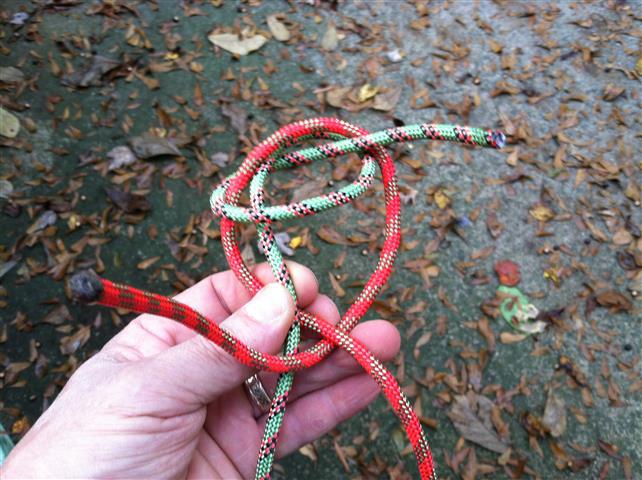
I tie the Z bend with both ropes held in one hand (s-parts), working ends on the same side. Take one end and tie an overhand around both s-parts. Then take the remaining working end, go behind its own sp and between both s-parts to dive through the overhand the opposite direction of the first working end.
Maybe a picture will say it better. Here’s the layout.
Just a figure of speech. But, there could be some truth to it.
The method I’ve offered allows for easy tying with gloves or cold hands.
Thanks for the video.
Changelog:
page 1: further enhancements to ‘anatomy’ (per Xarax) - reaching limit of what can be shown with current image. Will take photo from different angle so another anatomy image can be shown.
page 8: added another variant of the Zeppelin bend
page 9: Added date for Roos Zeppelin eye knot (March 2003)
page 10: some new content and some enhancements to text descriptions of tying methods
page 13: new content…covering knot ‘efficiency’ - work in progress
…
Still need a copy of that darn 1967 caving newsletter from Bob Thrun!
Paper is taking shape nicely…with the addition of response to load - the planned design/structure is virtually complete (just need to work on content).
Changelog:
page 9: added tying method for zeppelin eye knot
page 13: corrections made - kN figures advanced for some knot jamming thresholds
page 14: new content (response to load…work in progress)
All of these whiz-bang-both-ends-at-once tying methods
are too clever by half, and go some ways to obscure the
differences among these related interlocked-overhands
knots.
.:. IMO, best to show ONE end tied (fully) into an overhand
AND THEN the other reeved into it appropriate (to whichever
of these knots one desires). Pretty much, once the initial
insertion & U[turn of the 2nd end into the knotted first is made,
for the zeppelin, then the making of a symmetric completion
dictates the rest of the tying. Why keep things obscured in some
whiz-bang (but only after some tedious care in setting up!) tying]
method, like the bowline’s been obscured by showing it
from the wrong side?
(Yes, Roo, it is a stretch, I admit, to calling your tying all
that I just vented; but, still, I prefer for ALL of these …
to share a common tie-the-one-side beginning and
then to take their distinct paths. The knotted differences
vs. the tying differences are better driven home, IMO.)
These are prime sources, in that they found daylight
via publishing --one vastly more visible than the earlier.
(Recall that Burger published lineman’s loop only to later
see Wright & Magowan’s Alpine Journal make it more well
known as the butterfly.)
And you can know that I too discovered the zeppelin and
saw it as a SmitHunter’s/1425a variation, circa 1976.
And I can try to check on Desmond Mandeville’s claimed 1961
self-discovery of it; Budworth should be credible on this if
he’s got it somewhere among his numerous books (or in KM),
which I can seek.
.:. So, you have this end-2-end knot that was found by several
knots fiddlers following various muses?! We don’t really know
about the main one --i.e., whether Rosendahl discovered it or
got if from elsewhere (which hasn’t shown up to us!), or if it
might’ve been a Joe Collins (or Bob Payne!?) invention wanting
an impressive legend. I’ll guess I speak for Mandeville in thinking
he like I was just fiddling around; Bob Thrun might’ve been more
directed in his looking.
(And probably Xarax & Allen would produce it in their moving
though the knots universe, too.)
The method of tying diagrams aren’t trying to show the final structure in detail, nor do they dictate that both ends be tied at once. They are meant to show a clear, unmessy, highly-memorable blueprint.
Now, once the knot is tied, it can be inspected or photographed from 1000 different angles. But as a substitute for a blueprint for memorization and execution, such photographs would confuse people and drive them away.
Dan, I am requesting an electronic copy of Bob Thrun’s article from the caving club newsletter from 1967.
Can you do either of the following?
Scan the relevant pages (using a scanner/copier) and email them to me; or
Take a photo of the relevant pages using a digital camera and email them to me (this presumes you cant get access to a scanner/copier).
I would like to add these captured images of Bob Thrun’s article to the Zeppelin knot Bio. I think this is of historical interest…and if nothing else, a tribute to his inventiveness and contribution to caving/abseiling techniques in general.
AHA, lead me to wonder if somehow the subject knot
came about in altering the tying of the carrick bend
by the classic “lattice form” (my term),
where one also sort of lays 270deg turned loops
together (well, forms one and then interweaves
the other end, but …) !?
And the carrick bend was something in the running
and known in zeppelin days & arena, yes?!
Changelog:
page 1: added contents
page 2: amended with new image (anatomy of zeppelin bend)
page 12: new content added (from S Lentini)
page 15: new image and content added (200kg loading with content describing effect of load)
…
Once Dan Lehman supplies electronic copy of Bob Thrun’s article from a caving club newsletter, the main body/structure of the paper will be completed.
After that, its a matter of dealing with any typos or last minute additions to content.
Saying that nearly all known knots have an Ashley #
is saying implicitly that neither I nor Xarax nor … know
knots :: IMO, I’ve sketched perhaps 2000 “new” knots
by now (and most weren’t in [u]ABoK but some were,
I later realized --quite the Sherlock I was!).
There are many known knots not there --as you should
know, most “friction/climbing/ascending hitches” are NOT
there, nor medical, nor fishing knots.
Asserting that the sometimes jamming of SmitHunter’s bend
is “likely a result of the inter-woven overhand knots”
misses the point that Ashley’s " " " -based #1408, #1452, #1425a-with-“twisted”-tails, & #1425 do not
have this characteristic. (You’re inflating your zep.knot
article with hot air!)
But I can see merit in your note, in that in #1425a’s case,
the SParts lean towards each other and give the collar
a single-dia to wrap tightly around,
whereas the z. and other knots have ways to resist
this (Z. turns are trying to pull apart; so, too, #1425,
where tail wraps resist the opening; #1408 is most
z.-like in geometry here).
Asher’s Eastern Z. w/crossed tails might not benefit
the parent knot, but such crossing does wonders for the false zep., if tails are hauled tight (as though to set
it for an offset knot!).
And such crossing improves #1425a (#1425b, call it).
“Most bends can be converted into their corresponding
eye knot(s)” both tickles a noun-# issue (avoid by writing
“A bend has a … knot” or some such),
and presumes one version of “corresponding”.
I believe that this forum carries some of my images
of a quartet of corresponding, z.-like eye knots.
(Consider that presumed to correspond from eye
to end-2-end re the lineman’s loop / butterfly :
THAT is a different relation (eye is chopped)!
=> “An eye knot can be formed by …” and one can
give both the presumed but also an arguably more
direct correspondence, wherein one begins with the
end-2-end knot, twins one side’s part, and then
fuses one tail end to the opposite side’s tail.
(With the zep. one thus has 100% load of
SPart around X’s “axis” opposed by 100% from
eye legs, but in the more voluminous form of
twin strands (2x50%) and that volume-wise
imbalance. We’ve fiddled versions to get the
SPart in between … , with some success.
(( to tie the first-sort :: at point of making
final, tail-tuck of SPart’s overhand (for eye knot),
TUCK IN A BIGHT and continue to tie the
opposite overhand backwards with this bight,
which of course emerges in the end-2-end’s
usual SPart place with instead a bight-eye. ))
(((Suffice it to say that this method does NOT
like the grapevine bend !! --but came
to me upon seeing a blood knot presented
for joining a “leader” to a bight’s legs --works
fine, for that knot.)))
3b) “The idea of converting end-2-end … into eye knot
… by Harry Asher” !! Holy Hot Air Headaches, Bat Man!
This is as silly as Asher’s Law of Hitch Bight … whatever ::
it celebrates the obvious. (Looks like someone wanted
a bigger footnote count. ;D )
“tails … crushed together … limit slippage” :: One might
note that there is much LESS such crushing-together going
on in the z. than in the aforementioned other knots!
(And that these things don’t hold in HMPE, egadz!)
[ ] page 15: new image and content added
(200kg loading with content describing effect of load)
It occurs to me that you might benefit from showing
like loading in some different rope/material. The knot's
been cited as jamming and I'd guess that might come
with firmer line in some cases, with SPart's turn not
compressing so much?! Do you have any "static"
kernmantle?
Re slack-security, you might have trouble convincing
folks that such a loosely open knot can be trusted to
get no looser --esp. with the grapevine de rigeur
for such tasks. You can play around with shake testing #1408 & the z. to get some idea of how the latter might
be doing better --is it how there’s (in more flexible rope)
a nearly right-angle bend for the center tuck,
and this doesn’t enable easy flowing out?
–or that tails want to --from this angled bend–
spring into each other, which arrests them?
(Well, hmmm, ditto for SPart’s somewhat sharp
U-turn, as contrasted with the roundness of a bowline’s turNip. !?)