I tested a number of bend and loop knots for jamming and thought I would share the results here. I used 3/16 inch braided polypropylene rope rated at 60 lb working load limit. I cut the rope into short pieces and tied a series of knots, loaded the rope to 180 lb. then attempted to untie them. Here are the results.
Knots that could be untied without tools:
bowline required 15 seconds to untie, bowline on bight, bunny ears, yosemite bowline, about 30 seconds, zeppelin loop 40 seconds and zeppelin bend about a minute.
The bunny ears (double figure 8) was a bit of a pleasant surprise because the regular figure 8 is not a jam resistant knot.
Knots that required a tool (pliers) to untie:
butterfly loop (eye loaded), butterfly bend, and butterfly bend loop all required about a minute to untie with tool. The eye loaded butterfly loop was actually a little quicker to untie than the bend, contrary to what I expected. The Hunter’s bend took me over 2 minutes to untie, and I almost gave up on it.
Knots that were jammed and I could not untie: Directional figure 8, double dragon, double fisherman, double harness bend, double uni, edk, eskimo bowline, figure 8 loop, figure 9 loop, honda, perfection loop, reever bend, sheet bend, simple simon over.
The eskimo bowline and sheet bend were surprising to me as I expected them to be jam resistant based on similarity to the bowline. Figure 9 didn’t seem to have any advantage over Figure 8. Double dragon was a mild surprise since I have seen it touted as jam resistant.
This appears to have been a pretty harsh test, so some of the jammed knots may well have survived less extreme loading.
It would help immensely to be able to see your test knots
before and after loading. There are many ambiguities in
the knots you list (e.g., the butterfly is asymmetric, so
it matters which end is the SPart; and its dressing is most
often shown in a way that is inferior to resisting jamming
(to what e.g. Wright & Magowan presented, with the eye
legs crossed within the knot).
I’m surprised irrespective of knot-geometry clarity about
the zeppelin end-2-end joint, as there the versions IMO
all should yield a non-jamming knot! And, like you, also
for the Eskimo bowline --and the butterfly end-2-end
vs. eye knot (though, again, what version/dressing?!).
This is the sort of “backyard” testing that we all should
be more engaged in performing; we likely all have some
rope for which ease of untying can be lost with a wrong
knot and some serious loading, which can be generated
with 100# or so, and maybe some dynamic application
(e.g., body weight amplified by standing in the end of
a 2:1 pulley arrangement --even inferior ones w/carabiner
for the block-- on 9mm rope.
Thanks, Dan. I made some video of the knots being untied, but I don’t know if they would help answer your questions. Not sure what you are asking in regard to the zeppelin, as both the bend and loop were untied without tools. I think I will redo the alpine butterfly tests for you, and post either pics or video. It’s easy enough to do.
I redid the test for the Alpine butterfly knots and the Eskimo bowline. This time, the butterfly bend and butterfly bend loop came untied without tools. The eye loaded butterfly loop jammed as did the Eskimo bowline. I’m not sure what the difference was compared to the last test.
Tying video: https://youtu.be/gyxdacyqqBw
Mainly, I was just expressing surprise that the ends joint
wasn’t easily untied --I might’ve guessed that it would be
the easiest (tho’ there are various factors …) !
(IMO, Ashley’s #1408 is most like the zeppelin
in should-be-non-jamming.)
The zeppelin loop was at the end of a string of knots, so it was probably looped over the hook of the chain hoist or whatever it was looped over at the other end. This may have kept the knot from bunching up as tight as it might have otherwise. Just another variable to consider.
As I see it, the butterfly end-2-end joint is tied in the
way recommended by Wright & Magowan. I try
to remember this as the pretzel form’d overhand’s
SPart bears against its own tail, and so --tails crossing
within knot-- the opposite end (timber hitch form)
doesn’t bear directly upon its tail (but also upon
the other tail).
1 minute to untie a Zeppelin??? I have loaded a Zeppelin harder than that in the same material. I got the knot loose in about 5 seconds.
Double Dragon has a trick to untie that practically makes it impossible to jam. To untie, you ring load it strongly. It should be obvious to identify which strand has no choice but to loosen. Then, you go from there.
By the way, I want to note that jamming is not always undesirable. I had an application just yesterday where I wanted only jamming knots throughout. And, of course, I want a fishing knot to jam.
I retested some of the knots where previous results were unexpected or inconsistent. This time, the bunny ears jammed, as I had originally expected, though it came untied rather easily in the first test. The end-to-end butterfly came untied in a little under a minute, though the butterfly bend was jammed. Not sure why this would be different because it is the same knot if you join the tails of the butterfly bend. Likewise, the butterfly bend loop was also jammed as was the eye loaded butterfly. The zeppelin bend (2 examples) and zeppelin loop all came untied in around 45 seconds or so. Two examples of Hunter’s bend were jammed. Other than the bowline, the zeppelin bend (including zep loop) is the only knot I’ve tested that could consistently be untied after loading.
Video https://youtu.be/ZUISW-t0Diw
I watched your video, thanks. Regarding the times to get unjammed, the time comparisons would be more useful if you to stop the clock the moment you get a strand loose in the knot. At the moment you get a strand loose, it is pretty much guaranteed the rest of the know can be untied. So, there is no need to continue timing after you get a strand loose.
The knot complexity or the particular knot’s dressing may cause the remainder of the untying to take longer or shorter. Including that extra time (beyond the loose first strand) makes the time comparisons mostly useless. So, the untie times you have posted here are not that useful (to me). However, again, thanks for your video.
Z, I agree, you shouldn’t read too much into the time to untie the knots in these tests. There are just too many variables like how strong one’s fingers are, the skill of the person doing the untying, etc. and it isn’t even consistent from one trial to another. My objective was to compare the knots relative to one another, and I feel like I learned a lot. Mainly, if I ever need to pull a car out of a ditch with a rope, I’ll be using bowlines, zeppelin loops, and zeppelin bends. I learned to avoid sheet bends and eskimo bowlines in situations where jamming may occur. As far as hitches are concerned, that may be a subject for
future testing.
As to ending the timing after getting a strand loose, I’m not so sure I agree. There were some knots where one part came loose right away but the rest of the knot was still jammed.
As a footnote to the last test, I later worked at the jammed knots using tools and was able to get them all untied eventually except for the eye loaded butterfly.
I think we need to keep in mind that all knot testing generally falls into one of the following categories:
Backyard testing
Pseudo lab testing
Certified testing done in an accredited test lab (which is typically a purpose built facility with expensive calibrated equipment).
Expectations of quality, repeatability and statistical accuracy scale accordingly.
When thought of in this manner, some of the criticisms arise from having too high expectations.
For example, NautiKnots strongly argues for statistically valid data points - which requires some knowledge of math and reasonably accurate tensile force generating equipment to capture data.
This may be placing too high an expectation on the ‘backyard’ style testers.
Harold is certainly a ‘backyard’ tester - and so he doesn’t have access to thousands of dollars worth of calibrated force generating equipment and sophisticated software to sample and capture data points. And, he likely isn’t an expert in statistical mathematics.
Be that as it may, ‘backyard’ testers can still make a valuable contribution and should be able to follow some simple rules.
Some simple rules:
Take reasonable quality photos/video
Use a ‘control’
Have a specific objective in mind
Dont just follow the default and mind numbing ‘pull-to-failure’ line of thinking (but if you do, give valid reasons why)
Use ABoK reference numbers (where they exist) to aid in positive identification of knots
Report on the type of cord/rope material used in the test - including its diameter (ie if testing an end-to-end joining knot, report whether equal rope diameters were used or unequal diameters).
Write a conclusion that summarizes your findings.
Good to see that Harold was investigating something other than the default and mind numbing pull-it-till-it-breaks mentality. He investigated vulnerability to jamming. So well done
Z’s comment re untying was not entirely correct. Harold correctly pointed out that in some cases, he could loosen one rope segment only, but, the remaining structure was jammed.
As long as Harold is bench-marking against a ‘control’ - his timings should be valid. I think this is where NautiKnots could chime in with advising what type of control would be valid for Harold to measure against.
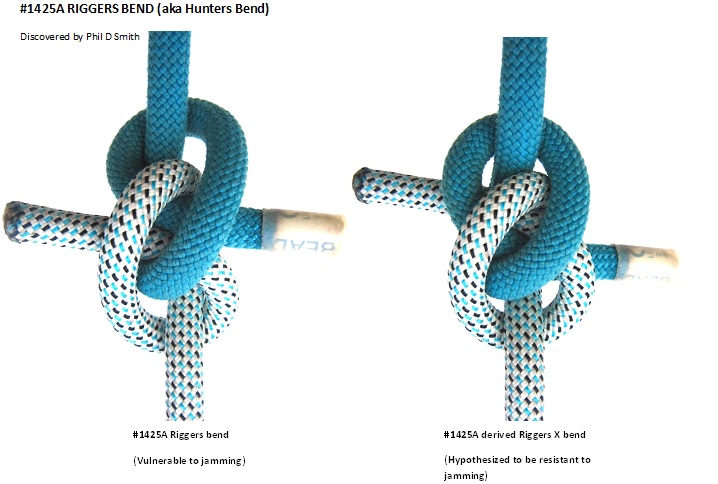
I would like to see Harold perform a test of the #1425A derived Riggers X bend…using #1425A Riggers bend as a control.
Is #1425A Riggers X bend resistant to jamming?
And, if it does have vulnerability to jamming, what is the load threshold at which jamming is triggered?
Refer attached photo.
The “#1425A derived Riggers X bend” is one I found for myself several years ago. I liked it enough I did trials in various rope materials (not dynamic rope at the time). I never trialled/documented it properly then (even from a home-tester perspective) and the material I used in the display was once described (unfairly) as “grandma’s thread” : With those things in mind, take what you can from the link below if you wish.
The "#1425A derived Riggers X bend" is one I found for myself several years ago.
The term ‘Riggers X bend’ (derived from #1425A) is one that Xarax I think prefers…and I believe that he was first to investigate the effect of crossing the tails in some known bends (I’ll check with him…no doubt knotsaver will also confirm/refute shortly). Although I think Dan Lehman had also been aware of this ‘X’ modification for some time too…
So I think your naming the structure ‘infinity bend’ may be in the same situation as your alleged ‘M’ bend…which Xarax also predates (did you check the link he gave?).
I think ‘Riggers X bend’ is more in tune with its structure and heritage - in that it is simply a transposition of the tails within the structure.
Good to see your prior work on the Riggers X bend - and thank you.
…
I am hoping that Harold could re-examine the Riggers X bend and conduct further homebrew style testing against #1425A Riggers bend as the control. Maybe also look at the load threshold which triggers jamming in #1425A? And is the Riggers X bend immune from jamming? More data points would be nice so we can build a case and reach a solid conclusion.
Thanks for the suggestion, Agent Smith. I’ll do that test soon. For some reason I like that whole series of interlocking overhand knots, and now I have another one to learn. I also want to test the Kalmyk loop (slipped version of the Cossack knot) and also some hitches.
My testing is definitely in the class of backyard tests, but I find it interesting and useful anyway. I apologize for the quality of the videos. I have gained a lot of respect for people who can make good videos. it’s harder than it looks.
Xarax did not originate this bend. It had been discussed on this forum prior to Xarax ever taking a picture of it. I believe Dan Lehman when he told me that he had discussed this knot with Asher, prior to any Xarax image. Maybe we should name this knot a SmitHunter L Bend.
I gave the Infinity Bend a decent name several years ago when nobody showed much interest in it and I alone was promoting it. Now all of a sudden it is the Riggers X bend, really?
As for the alleged “M” bend (it is a bowline) is something I have been promoting with the tentative name M-Bowline in another thread. Xarax has apparently laid claim to this knot as well. I should have known better immediately and started calling the knot that I alone am promoting the “Xarax’s 2013 2a.JPG image Bowline”. Silly me :
I checked my previous post and I couldn't find the words; [i]"Xarax originated this bend"[/i].
Where did you find these words?
per agent smith:
...and I believe that he was [b]first to investigate the effect[/b] of [b]crossing the tails in some known bends[/b] ([b]I'll check with him...no doubt knotsaver will also confirm/refute shortly[/b]).
I thought that I stated that ‘I believe’ Xarax was first to investigate the effect of transposing the tails in some bends.
and:
Although [b]I think Dan Lehman[/b] had also been [b]aware of this 'X' modification[/b] for some time too...
And I thought that I stated that Dan Lehman had been aware of the ‘X’ modification (ie transposition of the tails).
I’ll have to be more careful with my use of language next time, as it can be reconstructed to a different interpretation.
Although this is now somewhat drifting off topic - and distracting from Harolds good work…I nevertheless feel compelled to reply as follows…
[and I hope Harold finds time to conduct hobbyist/enthusiast testing (formerly backyard style testing) of the #1425A derived Riggers X bend Even though his testing may not actually be physically in his ‘backyard’. And it may be a ‘trial’ rather than a ‘test’
per Mobius:
I would be much happier for Dan Lehman to name this knot, not have "Riggers X Bend" [b]thrust [/b]upon [b]us[/b]
Hmmm I am not sure where you entertain the notional view of something being ‘thrust’ upon ‘us’. No one is thrusting anything and I am not sure of the implication of the use of the term ‘us’.
Xarax made this comment about what constitutes a new knot versus a modification to an existing knot (via direct email to me):
Per Xarax:
As I have told many times, in writing, I do not think that such a minor modification deserves to be considered as "tying a new knot"- even if the geometries and structures of the derived knots may become slightly different / better.
A “new” knot is a knot that is unpublished, unknown, untied AND it is not an obvious variation, or even alteration, of a published, known, tied knot.
What is an obvious variation or alteration of a knot ? I have examined the knots I have taken and published pictures of, especially the many bends : No wonder there were many: it is very easy for one to imagine a tangle of two ropes that prevent them from slippage, simple enough so we can claim it to be an “interesting” , and possibly, just possibly, a “practical”“knot” as well.
Xarax furthers states that:
Implementing a working definition - I had advanced the following :
" Now to the specific examples of my personal collection of bends:
I have published pictures of those not-new, by my newest definition, knots :
: double line Zeppelin bend, double line double overhand bend.
: re-tucked Hunter s bend, true lover s bend, Rusty s/ ABoK#1450 bend,
: un-tucked Sidewinder s bend, un-tucked 88 bend (S88 bend)
: interchange free ends in the Rusty-S88 bend
: twisted Hunter s bend, Hunter X bends, Zeppelin X bend, Water X bend.
: interlocked trefoil (double overhand) hitch, interlocked clove hitches, interlocked cow hitches, interlocked strangle hitches, fig S or fig 8, interlocked with clove or constrictor, mid-line bends.
: different dressings of the double 8 bend, of the Water bend, of the Diamond/75 DSC bend.
I am very glad that, using this "new" "new knot" definition, I got rid of the burden of giving birth to so many "new" bends ! So, the order established via a more general definition, pays a lot. It achieves great economy. "</blockquote>
As for your suggestion of happiness that Dan Lehman ought to name the Riggers bend with transposed tails (and rejection of the ‘X’ term):
I personally hold the view that a simple transposition of the tails within an existing/known bend (ie end-to-end joining knot) does not constitute an entirely new creation. In my view, it is a modification.
This is why Xarax used the term ‘X’ to denote that the structure was not ‘new’ - rather, it was a modification.
The use of the term ‘X’ implied a ‘crossing’. In this case, a crossing of the tails.
Applying this concept, we can thus have: #1425A Riggers bend -----> Riggers X bend
Zeppelin bend -----> Zeppelin X bend
NOTE: Although Harry Asher had previously used the name ‘Eastern Zeppelin’ in his book ‘The Alternative Knot Book’ 1st published 1989, at illustration #94 on page 59). His concept for the use of the descriptor ‘eastern’ refers to a direction that one of the tails takes in relation to a reference frame. However, my view is that his reference frame for delineating an ‘eastern direction’ is arbitrary. His concept of ‘up’ and ‘down’ and cardinal points of the compass all require a fixed reference frame. Depending on the orientation of the knot tyer (and possibly if left or right handed) - and the orientation of the rope/cordage held, this direction could also be ‘west’ (note that one could mirror the diagrams drawn by Asher in his book to get a reversal of ‘direction’).
The notional concept of ‘X’ is directionless. It is simply a reference to a transposition of the tails.
And here is a reference to why i also thought Dan Lehman had been exploring the effect of transposing the tails in #1425A Riggers bend:
per Dan Lehman Ref Link: https://igkt.net/sm/index.php?topic=5357.msg35684#msg35684Dated 26 May 2015
from Smith's topmost diagram of the knot, get the improved
version (better resisting jamming, if not also stronger)
by taking one (either) tail OVER the other en route to its
tucking through the central nipping zone and then finally
out UNDER (giving reciprocal "over" to opp. tail).
What this does is stuff tail material into the collaring bight
which prevents that from so tightly gripping the S.Part
and jamming --by significant degree, at least.
To be honest, I am not sure who first started to investigate jam resistance of #1425A Riggers bend via modification with transposed (‘X’) tails. Given that Dan Lehman posted this information in May 2015, obviously, he already had the concept in his mind.
Maybe Dan Lehman himself can advise?
I had also remember reading a post from Dan Lehman where he wrote that Phil D Smith’s use of the name ‘Riggers Bend’ was bogus (his words). If memory serves me correct, Dan’s reasoning was that widespread use of this bend was not apprarent by riggers working in the construction industry. Quite the opposite…in that Dan was unaware of any riggers who routinely used the #1425A ‘Riggers bend’. And so I believe this is the reason why Dan thought the name ‘Riggers bend’ was ‘bogus’.
But then, the obvious question is; Why did Phil D Smith give rise to the name ‘Riggers bend’ in his book?
Whew, what a load … crying out for (further OT) comment!
In short, knots nomenclature --including knot-names–
is a tough problem to get a grip on.
To cut to the chase on some of the above points, I’ve
been looking at so-far-known trio of inventers of #1425a --viz., Phil Smith, Edward Hunter, & moi–
yielding a name “SmitHunter’s” (nothing from “moi” ).
To which X’s “X” qualifier for the better version does
seem to fit appropriately, as stated above.
But what if that knot had been first-to-knowledge,
and the 1425a one came as a variation to IT?!
Would you retrofit “X” into it, or try the amusingly
awkward "SmitHunterman’s [<-there’s moi!] Un-X Bend" ?!
For common parlance & understanding, X’s “X” name works
–and working is more than one often gets, in knots nomenclature!
Re the “bogus” aspect of some knots naming, well, given
the double-entendre aspect of E.H.'s name, one could see
it going (esp. sans capitalized “h”) as an indicator that
somehow hunters --of what?-- used the knot; or, I guess,
for that matter did smithies use it?!
Naming can seem a solvable problem at least when
considering some (mere) 10-20 knots set within some
particular application; but trying to work in the entire
infinite (or merely so-far-known-to-knot-tyers) field
of knots leads me to … no good result.
As for the long debate about “new”,
in a similar spirit if not exact reasoning,
I count all differences as “new” and prefer thus
to diminish the signficance of that adjective
–that “new” in itself can be trivial (either in the
degree of difference, or in the given knot’s intrinsic,
useful value << NB !!
And, to further complicate the matter, there is the
issue of “dressing & setting” --things that can lead
to pretty contrasting results, including quite different knots, IMO. (Beyond this and along these lines,
one can wonder about the identity of a knot changing
per force?! --“nipping turns” opened into helixes, e.g.?!
< argh & sigh ^^(n+1) :o ??? >
This was one reason I opposed Derek Smith’s notion to hand
out certificates of newness creation to those eager-for-fame
would-be inventers; I feared encouraging more knotting nonsense
(I have plenty of my own originated such stuff --literally STILL
some heaps/clumps of new knots to record in illustration
(or, with a sigh partly of relief, to just discard “into the waste
basket” (H.Prohaska)). --same relief Xarax feels in his raising
the bar for new; but I lower the presumed importance of it.
For who can know so well what is in fact human-wise known?!
What if the infamous zeppelin bend later shows up in some
historical digging around, or in some heretofore isolated human
community?
As for creativity/inventiveness, were any of us to meet some
little/young person who, left out of sight with curiosity playing
among our pretty ropes and who doing so came up with some
batch of well-known & indeed well-regarded knots,
should some acclaim for invention be denied?
To the particular case of “SmitHunterman’s” bend", I probably am well enough right-dated as having taken
fondness for the “X” version, which I had tested circa
1985? (I can I think exact-date this --as I have the test
correspondence (fyi, about 65% vs. 62% of these two
versions --small victory in one case, 1/4" nylon laid rope).)
I was dismayed that Asher quickly dismissed it (in his earlier [u]A New System of Knotting), just as I’m dismayed with
AshLEY’s lack of precision for #1452 & his unenthusiasm
for it & same-digits #1425 (which can lead to interesting
& useful eye knot(s)).
In my own world, I’m abashed to admit such changes of
heart/opinion, recently (re-)inventing the Final Solution
to securing the bowline, proudly documenting it (well,
a bit of special note in the quick drawing), only to later
find it well shown among other options and without
even a hint of its later-believed superiority! --and this
not something coming from a change of materials!
(Nor did I mean to say “wouldn’t”.)

 ).
).