Hello, IGKT.
First off, being new to the forum, I’ll apologize in advance if I misuse any knot terminology in these descriptions.
I have 2 variations of a knot that I have not found elsewhere. Beyond just learning if they are already known/documented, I’m also curious if they would potentially be good tie-in knots for climbing. I have some ideas that I’ll describe below, but as a knot-novice, I’m interested to hear thoughts from the experts.
Tying Process:
I describe my tying process from perspective of climber tying into harness starting with standing part on left side and working end on right. I have experimented with some other methods, but for me, this remains a simple method that is easy to remember and teach.
[ol]- Starting with a simple overhand loop on the SPart as with a standard bowline #1010
- Flip the loop up onto the SPart again as if forming a marlinespike hitch (SPart passing up under the center of the loop forming what I am referring to as 2 eyes - again apologies if terminology is incorrect, as I suspect this is really just one eye)
- Pass the working end up through the right eye (on the right side of the SPart) (rabbit comes out of the hole)
- WE passes around behind the SPart (rabbit around the tree)
- WE passes down through the hole on the other side of the SPart (left eye)[/ol]
Now the collar is formed similar to a bowline, but the nipping structure is different.
To complete the knot, simply trace along (underneath) the nipping structure in the following manner until the working end exits the knot forming the tail in parallel with the outgoing eye-leg:
[ol]- Bring the working end and over the outbound eye-leg and then across to the right behind the 2 legs of the collar, under the back side of the nipping structure, but in front of the rope formed by the SPart below the entry through the collar.
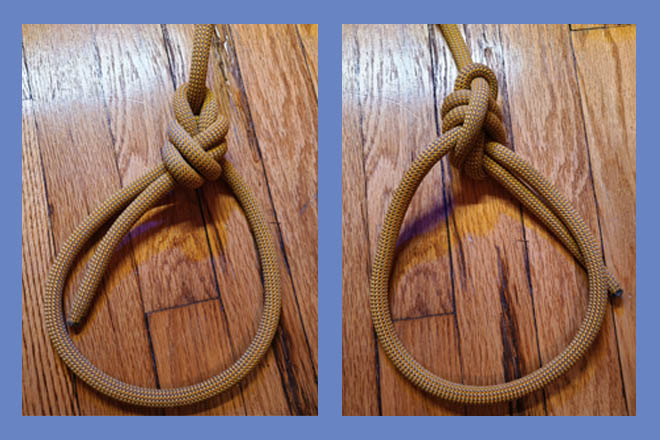
- Working End comes around to the front and follows through the two loops on the left, exiting along the outgoing eye-leg on the inside of the fixed eye loop. I’ll refer to this as the IT or Inner-Tail version.[/ol]
The first 2 diagrams show the IT version diagram and knot tied in a climbing rope.
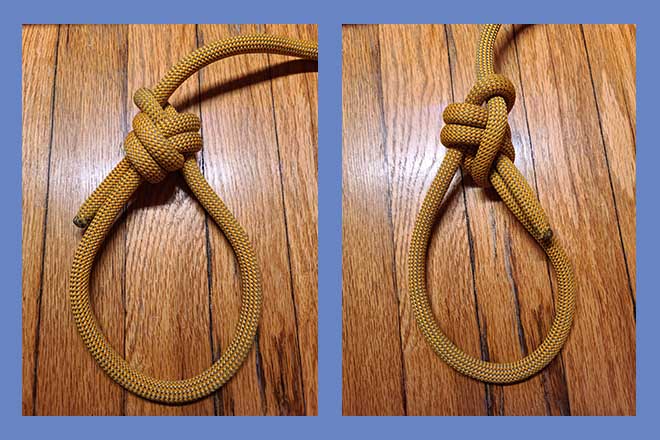
Because of the way that the rope loops around the outgoing eye-leg, the same topography can result in a slightly different knot. This would be the result of the rabbit going back through the same eye-hole it came up out of, and then the working end retraces along the top of the nipping structure. This still finishes with the tail exiting the knot in parallel with the outgoing eye-leg, but on the outside of the fixed eye loop. Therefore, I’ll refer to this version as the OT or Outer-Tail version of the knot. This version of the knot could also result if while dressing the IT version of the knot, the loops around the outgoing eye-leg flipped in a similar way to the Yosemite Finish concerns if the Yosemite loop passes up and through the nipping turn of a bowline. However, unlike the concerns raised about the Yosemite Finish essentially converting the bowline to something other than a bowline if the loops swap positions, I don’t think the reversal in this case would really change this to a truly different knot. It would, however, change the nipped rope diameters. The 2nd pair of diagrams attached illustrate this OT version.
At this point, I'll add some thoughts I've had about these 2 variations. Whether or not these knots are new, I'm interested in understanding their merits and/or shortcomings. I do not have access to any testing equipment, so these are mostly just perspective, opinion, or theoretical hypotheses.
Hypothesis of MBS:
The number of rope diameters in the nipping structure seems to be the primary difference between the IT and OT version of the knot, and from what I’ve read one of the factors in a bowline’s maximum breaking strength. My hypothesis is that the IT version should actually have a relatively high MBS - The main force from the SPart acts on a nipping loop that circumnavigates the knot with 4 rope diameters and compresses the whole knot increasing internal friction. I’ll refer to this as the major nipping loop. Tension on the outgoing eye-leg (which I believe on a frictionless harness should be 1/2 the force coming from the SPart, while the other 1/2 comes from the returning eye-leg). This eye-leg tensions a second nipping loop within the nipping structure that I’ll refer to as the minor nipping loop with only 2 rope diameters (the 2 legs of the collar), but the force is already reduced by the constriction of the major nipping loop acting on the outgoing eye-leg, which should reduce the constricting force that might risk rope failure at the small diameter turn of the minor nipping loop.
The OT version of the knot does not have this advantage, since the SPart enters the knot and immediately forms a nipping loop around 2 rope diameters (the tail and the outgoing eye-leg). I imagine this knot would have similar MBS to a normal bowline, which from what I understand typically ruptures at the nipping loop, since it makes a small diameter turn under high tensile force.
I’m sure that MBS of the tie-in knot is not really a concern in climbing safety, but I have seen it raised as an issue of wear and tear on the rope.
Hypothesis on being inherently secure and ease of untying:
It seems that many bowline variants increase internal friction and therefore improve inherent security, though doing so slightly reduces the fantastic ease of untying after loading that exists in the standard #1010 bowline. But they almost all remain tremendously easier to untie than a typical F8 tie-in. I have found this knot similarly easy to untie (anecdotal) - as soon as a little looseness is introduced to the collar, the fact that the major nipping loop readily receives slack from the SPart, the knot has been easy to untie in my completely non-scientific tests. (I did a quick test by taking 3 consecutive body weight factor-1 falls on approximately 1 ft. of dynamic climbing rope between the knot and anchor and easily untied the knot, while the clove hitch at the anchor was considerably more fused and challenging to untie).
While I think this qualifies as inherently secure, I didn’t find a specific and objective test to confirm it. As long as the collar is drawn snug while dressing, it appears very resistant to loosening under cyclical loading. I compared this to EBSB (my go-to tie-in for years), Scott’s, and Lee’s Link by jiggling and manipulating the 4 ropes exiting the knot - twisting, bending, pushing, and pulling on the 6 possible pair combinations to see if I could get the knot to loosen without handling the structure of the knot itself. I found it similarly resistant to loosening as the other inherently secure knots mentioned.
Ease of checking:
One of the great advantages repeatedly cited for the F8 is the ease of checking, due to its symmetry and paired rope strands. I’m not sure that checking any of the bowline or virtual bowline variations is as straight forward as checking the F8, but I do find this knot to be easy to inspect. Much in the same way that one might inspect a figure 8 by tracing along a pair of strands throughout he knot, this knot also has 2 strands of rope running in parallel from the tail across the front, around the back (underneath the SPart below entry at the collar,) over the tail again and then under the knot (through the fixed eye loop) where the ropes finally part ways with one strand becoming the SPart and the other strand going through the loop to form the collar. (That description actually sounds more involved than it actually is when visually inspecting the knot)
TIB: I don’t think so, unless someone has a creative way I have not yet discovered
PET: Yes
Rope Consumption:
I’m not sure what the best way is to measure this, but in comparison to a Figure 8, my primitive measurements using some 6mm cord show roughly the same length of rope within the knot body.
Bowline or Virtual Bowline?: I’m curious to hear how these would be classified. I think this would probably be considered a virtual bowline by the description that Mark Gommers presented on page 44 of his Analysis of Bowlines paper. The nipping structure in these knots has a similar (identical?) initial topography to that in the Karash single loop prior to retracing with the working end.
Cowboy #1034 1/2 Variation?
Both the IT and OT versions seem to be resistant to ring loading relative to a simple #1010 bowline. Are there potential further advantages or disadvantages of a cowboy variant? I’ll point out here that a cowboy version must still come up (rabbit out of the hole) through the right eye of the marlinespike hitch loop. Coming up on the left side is effectively returning on the same path as the outgoing eye-leg, which seems to create an unstable structure. So, starting from the right, passing behind the SPart in cowboy fashion, there are IT and OT versions with a cowboy collar, each with the returning collar leg passing above or below the incoming collar leg. In my manipulations, these all seem to perform similarly to the non-cowboy versions, though the extra crossing of rope by the 2 legs of the collar may add some additional friction and internal space within the minor nipping loop. Is that beneficial or detrimental?
OK, I’ll leave it at that for now - I’ve probably overthought this enough for a first post.
-apb