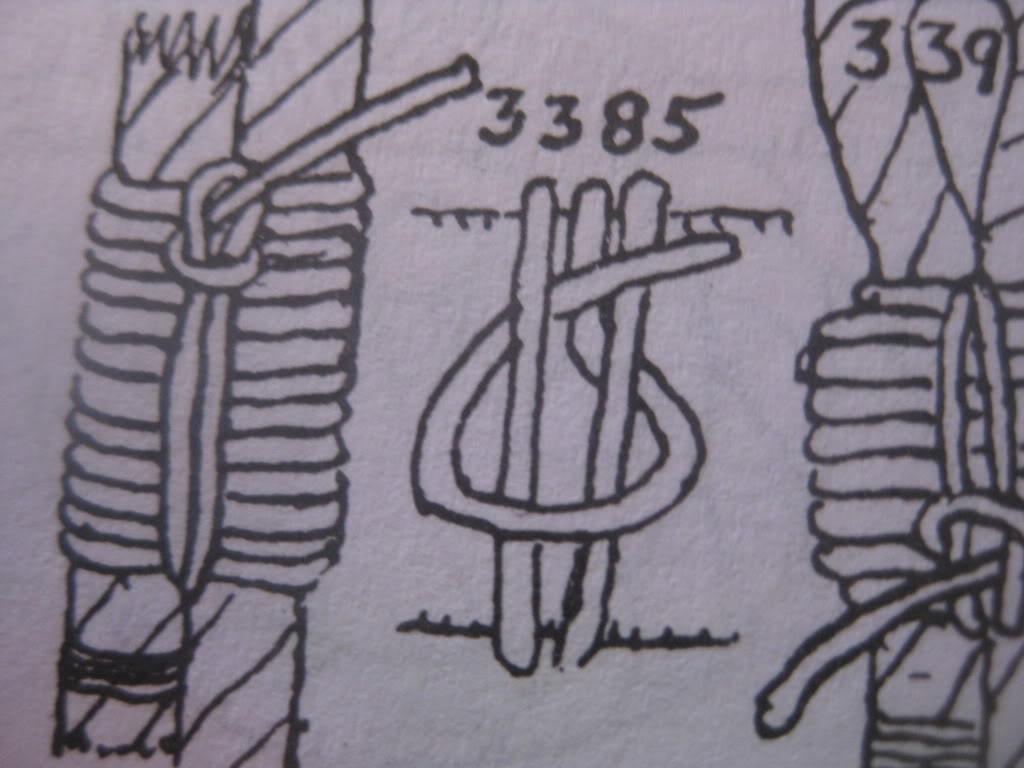
I’m dissatisfied with a current knot attachment with something I use at work, and I thought it might be an interesting puzzle for the collective group.
I am looking for a good hitch to use on an I beam, for a length-wise pull. The I beam is approximately 6" high and 5" wide, and the current line used is 1/2" static kernmantle. The current attachment is a bowline, with most of the loop protected by a rubber hose a chafing gear. However, the bottom flange of the I beam has no chafing gear, and has chafed the rope significantly over time. The I beam and rope both are constantly underwater. The I beam is a fixed structure, that the line is tied too it, and the free end is then used to temporarily position a raft. It is wrapped around a smooth pipe on the raft (again, underwater) and kept in tension by hand (I actually use an awning hitch, but I doubt anyone else does). The orientation of the pipe is horizontal to the I beam, at about the same height (depth) as the bottom flange of the I beam. As the line is kept in tension by hand, other people step onto the raft, so the line is dynamically loaded, and it bounces a bit on the beam, contributing to the chafe. I have about 2 or three inches of beam area to hitch upon, and I can use chafing gear to help minimize wear. But it would be really slick if I could tie a great hitch and not need the chafing gear at all!
Hopefully I’ve described the problem at hand.
My initial instinct is a variation of the rolling hitch, but this hitch doesn’t perform so well on square shaped beams (let alone I beams).
How is bowline taking a lengthwise pull? Is it fairly tight?
No it’s loose.. it load’s sorta diagonally, and there is a groove that has rusted into the top flanges of I beam over time that it has settled into (with the chafing gear tube) so that it doesn’t slip along the I beam. There is also an attachment flange on the I beam on the end closest to the raft, that the loop of the bowline would eventual check up against, if it ever slipped.
OK. You’ve got a tough situation there with little room. You could try to make a few turns around the beam as you deem appropriate and finish with a Gnat Hitch. Just be sure to get things as tight as you can before applying a lengthwise pull.
You may still have to deal with chafing. I would be mighty tempted to look for an easier attach point, maybe sacrificing a cheap clamp to attach to a flange or web of the beam.
The “Double Overhand Noose” aka “Poachers Noose” aka “Scaffold Hitch” might suit your needs - pulled up taught it stays firm and will take a pull in any direction. Try it on the legs of a chair, which will replicate the four edge contact points of your I beam - prepare to be amazed!
It seems to me the scaffold hitch holds well, but I’m not sure about the chaffing issue. It does “take” a pull in any direction, but as the direction changes around the object the two loops roll rope from one into the other.
Ropes don’t have to solve everything, permanently. Other tools do exist.
The simple solution --using your rope-- is to make several
wraps around the I-beam and essentially hitch to these;
and a Portuguese bowline is a model for doing this.
The SPart loads the mid-span of the multi-wraps, and
thus acts like “frapping turns” in drawing them tighter
–and giving a terrible angle for aggravating forces on
the wraps, except that they have strength in number.
It will be hard to slide such wraps along the beam.
One could also tie --around space– an anchor/fisherman’s bend
and take its tail around & around as the wraps, tying off with
something simple.
Note that in some situations a hitch such as the poacher’s h.
suggested here will aggravate chafing aspects, as they
put force entirely on the line’s turn around the object,
whereas an eye splits force between its legs.
FYI re chafe guards : I recall one study with rope over
some cliff edge (not necessarily a severe “edge”) in which
there was more rope degradation WITH a guard than
without --a matter of heat generated with, IIRC, a carpet
(vs. what was presumably pretty smooth, stone-cold rock).
I’ll play around with all the suggestions and let you know what works and what doesn’t.
I haven’t used the Gnat hitch much (yet) roo. That fact that it’s not well know is something of a drawback, as this line will be inspected by my co workers, who are almost certain not to know this hitch.
Farilead: I haven’t ever tried a scaffold hitch on a square object. Thanks for the idea. I’ll play with it. A scaffold hitch has the advantage that it’s widely known, and therefore easily verifiable.
Ropes don't have to solve everything, permanently. Other tools do exist.
Tex! What’s the fun in that? I didn’t post this on the “international weld a bracket to an I beam guild forum” I can easily just leave it as it, replace the chafed line with new, and call it a day. Or drill and bolt in an eyebolt, but it occurred to me that there must be a better Knot to use without resorting to other mechanical devices.
Dan, you have an intersting idea of a two step solution: tie a binding hitch to the beam, with a leg loaded hitch tyed to the the binding hitch. That could be the ticket to minimizing the chafe the best. It’s a little complicated, I was really hoping for an elegant single hitch solution.
How do you all think an anchor bend would deal with an lengthwise pull on a square I beam?
It’s a good chance for them to learn, and it’s simple. I’m surprised that your coworkers are going to be inspecting an underwater attachment. If it works, their recognition of the knot or knots shouldn’t really matter. Are you expecting them to remove it and re-tie it on a regular basis?
I think that I would consider a beam lashing, leaving a tail long for securing the raft the way you do.
If you wrap over the previous round turns and frap in the free area till snug, there will be very little, to none, chafing.
The first wraps will cushion the outer wraps and this will be basically permanent. Should be very easy to inspect if you use knots your compatriots are familiar with as well.
Should handle the varying loads at all angles.
Looks like a job for xarax! And waddaya know, he’s silent. But not for long, I suspect.
I like the lashing concept similar to the method mountaineers use to secure a coiled rope. The rope would be doubled along the beam, the tail end crossing over the standing part first, then continue wrapping away from the lead line toward the bight’s closed end, and the tail then passed through the bight’s loop. The lead line is then pulled tight to secure the tail. I imagine the tail may need further securing of some sort.
I'm surprised that your coworkers are going to be inspecting an underwater attachment. If it works, their recognition of the knot or knots shouldn't really matter. Are you expecting them to remove it and re-tie it on a regular basis?
Roo, perhaps my co-workers would see a new attachment and miss-identify it as a “hope Knot” and erroneously determine it as inadequate. It’s the kinda thing I might do. It’s a challenge to using an unfamiliar knot.
I think that I would consider a beam lashing, leaving a tail long for securing the raft the way you do.
SS369, I’m not familiar with a “beam lashing” or maybe know it by another name. Maybe you could cite a reference or a picture?
I like the lashing concept similar to the method mountaineers use to secure a coiled rope.
I like this idea a lot, It’s easily recognizable, and solves the problem well. I am curious how tight I could get it to avoid chafe, as there are no frapping turns in this method, but it seems that the load would tighten it to some degree.
It seems like you and Alpineer are suggesting essentially the same idea. I’ll let you know how it works, but it may be some time until I’m scheduled back in the water at work. But in the mean time, I’ll try and mock up the same scenario on dry land.
nice picture. This idea seems most promising to me. when you tried that, and snapped the pic, did you try and load it at all? How did it behave? I’m gonna try this on dry land today and let you know how it behaves for me.
It passed my hard pull hand power testing. I could get the tail to suck under the wraps somewhat, but the lashing as a unit never failed to lose it’s grip on that square aluminum stock. Of course, the tighter the wraps, the better. Re-tucking the tail between itself and the bight’s end and from the opposite side of the bight should stop the tail from getting sucked under the lashing, and provide further locking of the tail. It’s simple, effective, and esthetic (looks a bit like a wall knot from the end), although you may find that re-tucking the tail isn’t really necessary for your application.
To illustrate better, I hope, the idea I offered, here is a picture using what I have on a job site. Its the closest item I have to an I-beam. As I am familiar with the term I-beam it means two flanges separated by a web thus leaving a space both sides behind the rope, in this situation. In this webbed space is where you can do the frapping wraps and then tie off, perhaps bowline-like as shown with the standing part long enough to use for your needs.
Alpineer’s suggestion is very much like a whipping, such as at a rope’s end and may need the body of something inside of it to snug against. It may work…
The riding wraps will spread the load and chafing forces and the frapping will further tighten it. Then the tie off will centralize the load and allow it to swing in any direction.
Surely this cannot be --as I have an idea in the hat!
Dan, you have an intersting idea of a two step solution:
tie a binding hitch to the beam,
with a leg loaded hitch tyed to the the binding hitch.
That could be the ticket to minimizing the chafe the best.
It's a little complicated,
I was really hoping for an elegant single hitch solution.
You missed the sense of my qualifying "essentially, ..." :
which was merely to signify the functional aspect of what
I intended as a more-or-less one-step solution. E.g., one
ties an [i]anchor hitch[/i] around nothing and turns the
[u]long[/u] tail around the object 'a la Alpineer's wrapping,
but taking the tail through the waiting-for-it hitch, and
maybe tightening at the end a little back'n'forth between
hitch's gripping and holding of binding lines and those
lines themselves to effect the tight binding to the object.
(One could try "slipping" the hitch-around-nothing so
to then run with a bight (= 2 strands vs. 1) to wrap
the object; this also requires one to have a good sizing
of material needed ... .)
(One might wonder if some working of the rockclimber’s
old around-the-waist, bowline on a coil could effect much
the same!? --I’m thinking that it would not tighten so well.)
Hi guys, thanks for all the great suggestions. Hopefully I can make some time to “dry” test the ideas soon.
E.g., one
ties an anchor hitch around nothing and turns the
long tail around the object
Dan, you’re right, I didn’t fully understand your suggestion, thanks for clarifying, it’s quite elegant.
I could get the tail to suck under the wraps somewhat, but the lashing as a unit never failed to lose it's grip on that square aluminum stock. Of course, the tighter the wraps, the better.
Aplineer, Your solutions is almost exactly the same as a common whipping, where you’d want the tail to get sucked under. But that won’t happen with a hard surface so much. The trick with both methods I think will be getting the wrapping turns tight enough. I do have the benefit that the rope will shrink in length (and grow in diameter) as is gets water logged over time.
SS, you’re suggestions is great as well, and solves best the need for frapping turns to take tension on the lashing. It wasn’t completely clear from my description, but the tail of the knot needs to come off the bottom flat face of the I beam. I took a 2nd look at the beam and raft last night to be sure. If the knot tail comes off the side of the I beam, at the gap between top and bottom flanges, the tail would chafe on the bottom flange as it went to the raft.
thanks agian for the suggestions, I’ll keep you informed as how it all works out.
 I didn’t post this on the “international weld a bracket to an I beam guild forum”