P.S.
For the overhand vs. underhand knot, for right-handed persons :), see the picture of two over-hand knots, in : Knots, Splices and Rope Work, by A. Hyatt Verrill
As we tie the over-hand knot, holding the Standing End with our left hand and the Working End with our “good”, right hand, tracing the same directionality of the left-to-right form of most letters and of writing itself, the Working End passes over the Standing Part at the first crossing.
I tried to tie an overhand automatically (with closed eyes, w/o thinking) and got the same as on the picture. But, found myself holding the Standing Part with left hand. (I am right-handed.)
You are right :), right handed people tend to keep an object steady with their left hand, while they “move” ( translate and/or rotate ) an object with their “good”, right hand - because that ( to tuck an end, the Working End, through an opening of a tangle, i.e. to make it follow a rather complex 3 D path ) requires more dexterity. ( That is was what I wanted to write, but I had mixed the adjectives - I have now edited my phrase in the previous post. )
I think that zoranz s test, described at Reply#3 (1), was very interesting and revealing - if we could repeat it with a sufficiently large number of individuals, we could possible explain the origin of the “overhand” term.
I believe there were at least 3 external sources listed (with images) in that thread that describe exactly what a turn and round turn are. I’m sorry if that is not good enough for you.
However, even if the Working End passes “over” the Standing Part at their first crossing, we may still tie a mirror-symmetric of that knot ( which is identical to the under-hand knot ), if our “good” right hand, which holds the Working End, will move in a counter-clockwise way - that is, if the “belly” of the knot, which connects the first to the last crossing point, will be at the “upper” side of the nub, in relation to the knot s axis. Therefore, it seems that there is something more which determines the form of the knot which the majority of the right-handed persons will tend to tie, and that is their preference to weave their hand in a clockwise rather than in counter-clockwise way.
I would love to know what a left-handed knot tyer would say about this theory !
I see only discussion and opinion - I dont see universal consensus. Most importantly, I dont see a lot of clear photos/illustrations to support the terminology. Words can be misunderstood - a photo in my view leaves little to speculation.
The only thread that grabbed my attention is http://igkt.net/sm/index.php?topic=1616.0 Yet again it is lacking in photographic detail and solid indisputable evidence based agreement.
I also am starting to find the abruptness and clipped responses somewhat distasteful. I am unclear what the source of the irritation is.
I merely ask the questions - yet I still don’t see anything approaching concrete evidenced-based universal agreement. I only see debate and opinion.
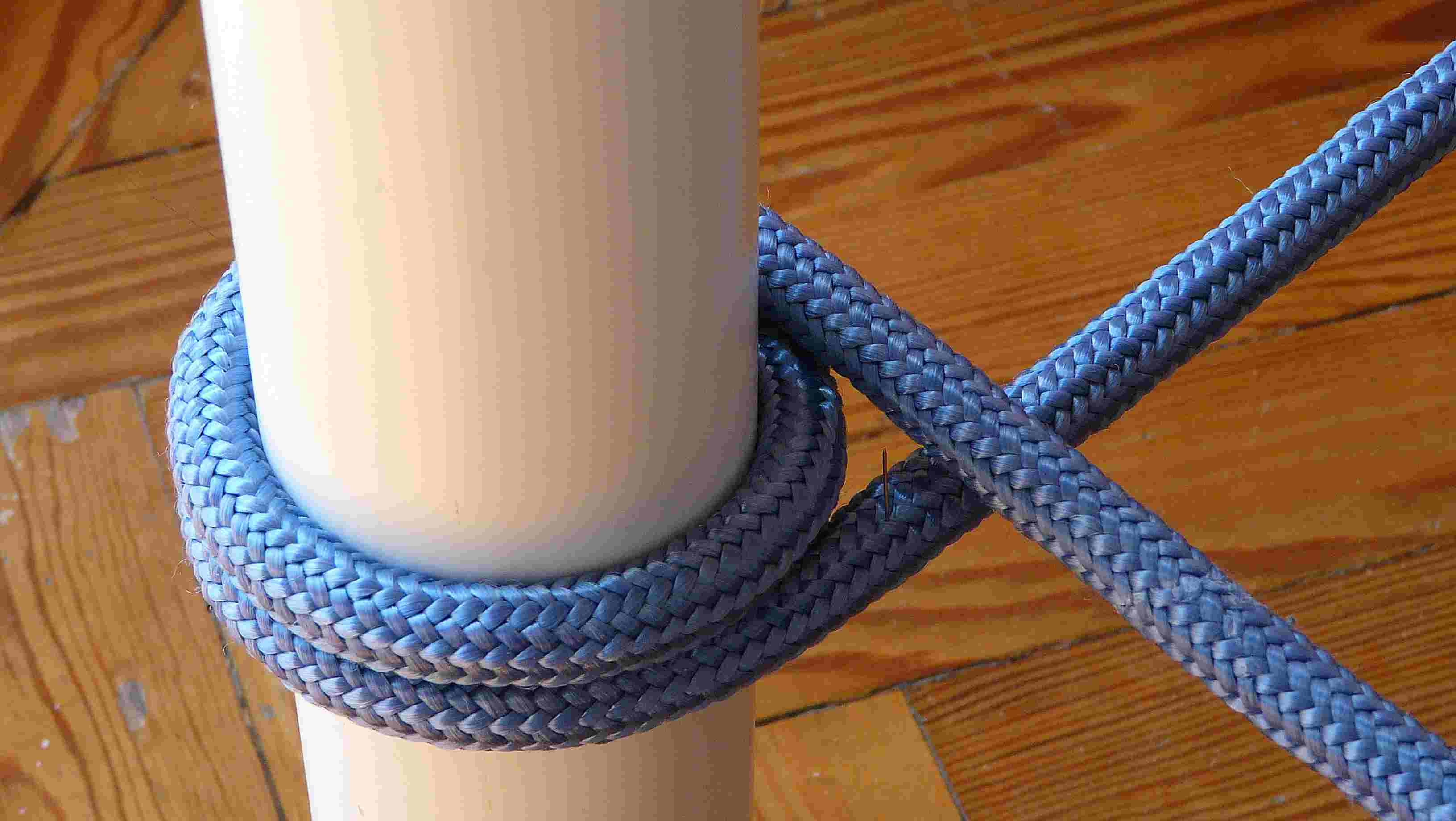
I consider a round turn to be a complete encirclement of an object with respect to rope work. The rope goes around the item completely (not a bight), returning to the start.
2/3 of that is a turn, where the tail is away from the standing part.
As shown in the image at the page bottom at this link http://americanboating.org/safety_knot_tying.asp
Starting from the basic turn, which is the single turn ( 360 degrees ), I believe that the round turn should be any turn between 1 1/2 single turns ( 540 degrees ) and 1 3/4 single turns ( 630 degrees ) - then, 2 single turns is a double turn ( 720 degrees ). This is because, even if the two ends, when they leave the encircled object, are not parallel to each other, but perpendicular ( as it happens in many cases when we tie a not-too-tight round-turn-and-two-half-hitches hitch ), we still have a round turn, and not two single turns = a complete double turn.
Just thought this might be interesting. The user instructions are obviously aimed at the mass market and a person with typical knotting skills found within the rope rescue community.
I am not stating that these user instructions are using correct terms…I am merely advising that this info is out in the public domain.
So, it seems there is a consensus for multiples of 180 degrees, i.e, when the ends are parallel to each other ( half turn, single turn, round turn, double turn ). The problem arises if we further add/subtract 90 degrees, i.e, when the ends are perpendicular to each other - and in all intermediate positions.
I’m clear and concise out of respect for the time of others and to give others the chance to respond before I go on. It should not be construed as irritation.
Roo presents “bight” in one of the definitions, which leads
to some seemingly consistent terms “turn” & “round turn”,
but whereas I think you’ll be able to find tying instructions
that say “make a (round) turn …”, you’ll find NOTHING that
says “make a bight around …” --“bight” isn’t used in
such circumstances (and is used in “tied in the bight” (TIB)
which doesn’t really fit with anything we’re talking about here)!
On a similar idea, I think, I’ve pushed for enumerating the
series “grapevine”, “dbl. grapevine”, … vice “…overhand” JUST
to have the visible number of wraps/“turns”? match the
verbal cue “double” or whichever --an overhand knot lacking
any such “overwrap” (my term), and so “double overhand” gives
a verbal two-count to a structure with just one visible turn (but
two tucks-of-end(s), one might counter). Similarly for “strangle
knot” and then multiples of that.
One could see that a specification to “make a full turn around …”
was aiming to close the loop with 360deg, but necessarily, being part
of tying to a spar, say, led to 540deg with returning the working end
to further tie off --i.e., the thought is closure, regardless of how much
wrapping beyond that one goes (up to making an obvious repetition).
In such a nomenclature, “turn” would be 180deg, “round turn” or
maybe “full turn” would be 540deg (hey, if exactly 540, you’re just
parallel and separate from the other end --need to go 540+ for the
convergence!), as the context would imply the ultimate “U” turing
of the end for subsequent working.
.:. I’d be leery of trying to put much importance on this nomenclature,
but, still, building a consistent and usable nomenclature should be good,
if it doesn’t entail much spitting into the wind of common parlance.
(And consider that “loops” in common parlance --and in much knotting
chatter-- are what might be strictly called “bights”, as an example of
a heavily “overloaded” term; to which I have used “eyeknots”, variously
as one/two words vice “loop knots” in hopes of clarity.)
That is why I had proposed the limit of 630 degrees ( 540 + 90 ), which is an easily recognisable form ( the two ends are perpendicular to each other, and 90 degrees is an easily recognizable angle ). After this, I think we are approaching the two whole/full turns = one double turn.