I’ll be damned. I guess nature prefers the granny knot over the square knot. 
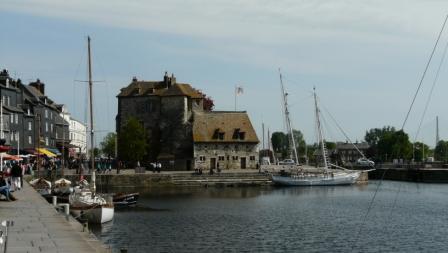
A not-so-beautiful knot, in such-a-beautiful harbour…Well, we should not expect everything to be of the same quality at the same time, should we ? 
(Honfleur, Normandy)
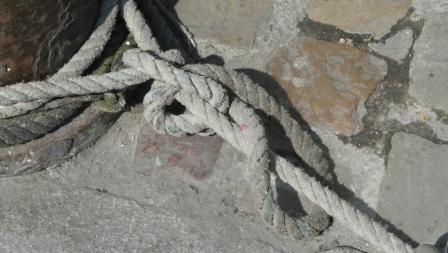
^It looks like Three Half Hitches came loose, which could happen over time and with jostling.
AND the round turn around the large diameter bollard is also questionable, in such a use and material.
OK, great…What would you have tied? Also, without using hindsight, why is a Round Turn and Three Half Hitches inherently wrong here?
The (additional) round turn around a bollard of such a large diameter, with this material, means huge friction at the wrong place. It only reveals a naive - but mistaken - intention to, somehow, “secure” a mooring knot…
However, doing this, the knot s nub can not move freely around the bollard, following the movement of the ship s hawsehole or bitt, and the tension on the eye leg of standing part can not be trasferred to the second leg, that with the half hitches. So the half hitches will get loose, sooner or later, because they are not loaded at all times, as they should.
There are many better ways to tie a mooring knot. I always prefer some “fancy” secure form of the bowline - just for show off, because the simple bowline is always secure a 100% for such use and material.
Your pictures are not very clear, but I think they show a Gleipnir without crossed tails. If you want more friction and resistance to vibrations, I believe you should cross the tails. If the Gleipnir is adjacent to the object, there are two variations ( A and B ) to do that, shown at :
http://igkt.net/sm/index.php?topic=2075.msg30227#msg30227
http://igkt.net/sm/index.php?topic=2075.msg30228#msg30228
http://igkt.net/sm/index.php?topic=2075.msg30229#msg30229
http://igkt.net/sm/index.php?topic=2075.msg30230#msg30230
This does not happen to ANY other Gleipnir variant ( the ones based on the Clove hitch and the twin crossing knot included ), except “yours” (1) So, I guess that the “Gleipnir” discussed in KM is the not-so-bad ( but not very good either ) binder #35 ? (1). However the need to enter through opposite directions is universal to all Gleipnir variants - it is dictated by the need for a “balanced” nipping loop, i.e. a nipping loop which can not revolve on the spot. In the bowline, this is achieved by the bowline s “proper” collar, so we do not need tensioned lines entering into the nipping loop from opposite sides.
Indeed, for TWO reasons :
First, because the lines, before they approach to and enter into the nipping loop, they come from the same direction. Therefore, they can not form stable L-shaped segments, which, then, can be crossed, and form the “elbow” configuration.
Second, because “your” Gleipnir variant is more symmetric than the “tight” Gleipnirs I had shown, so there could had been no difference between the A and B variations ( based on twisted / left- or right-handed double helical tails ), even if those variations could had existed.
However, this was the reason I had not presented this variation, but the “variation finally presented” as the “simple-hitch-a-la-Gleipnir”. The advantage ( re friction ) of the crossed / twisted / helicoid tails is too big to be ignored.
By a double or triple nipping loop (2), we can get a “nipping tube” long enough, to engulf a more pronounced twist.
However, we should be careful and should better avoid using a too-long such nipping tube, because then it may easily revolve around itself, and make the whole construction quite unbalanced and unstable.
The direct delivery of tension, during tying / tightening, which may be considered an advantage, means also a direct delivery of tension during un-tying / un-tightening - which is definitely a disadvantage…
The Achilles heel of the each line is located near the end of its course around the bound objects, in the proximity of the nipping loop - because any pull of it ( by the displacement of one of the bound objects, for example ) in this area, will be directly transferred to its continuation, and to the end of it, the tail end, inside the nipping loop. ( A pull of the line coming from an area far away from this, to be transferred to the nipping loop, it will first have to confront the friction forces generated between the line and the bound objects along its path around them. Therefore, such a pull will only be in-direct, and its force will be dissipated and reduced ). As we approach the final “lock”, the Gleipnir nipping turn, any pull is more effective in/during tightening, but also in/during untightening the binder ! ). In the binder#35, both Achilles heels, of both lines, are located in the same area - and this fact can NOT be considered a safety measure !