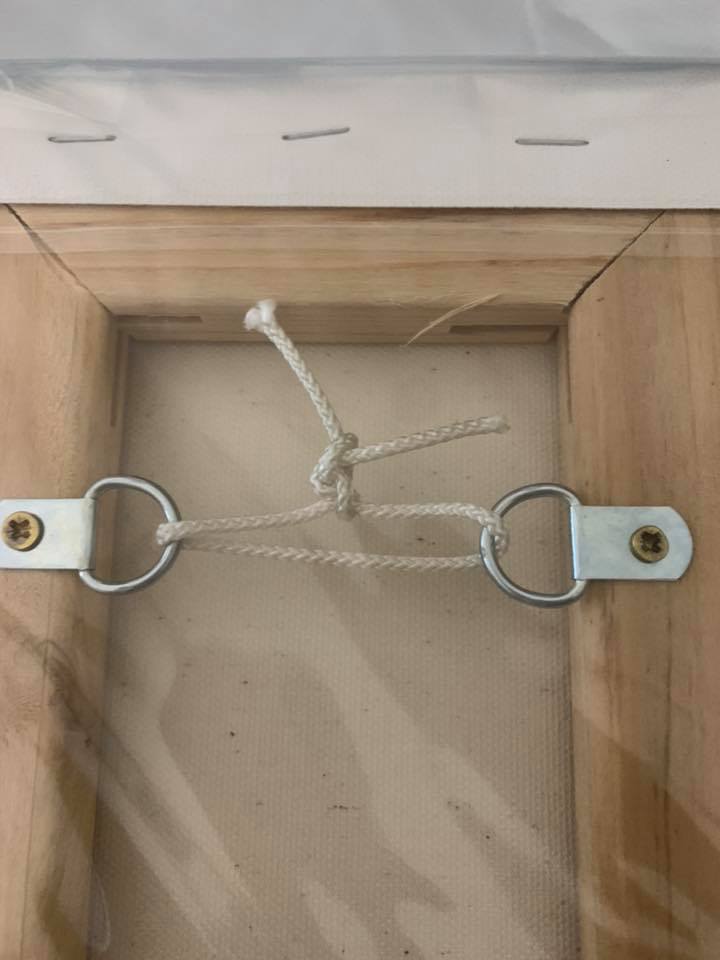
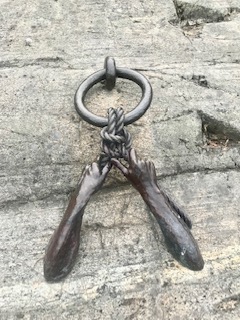
I know the store owner and asked him where he learnt the knot. He told me the handles arrived bound with plastic banding around them, and when he sold two, the banding slid to the floor and the whole bundle flopped all over the place - he had intended to rebundle them with Ducktape, but next time he went past the pile, they were tied up as shown. There are a whole load of crafters use the store for lessons and demonstrations, so he has no idea who tied them up.
He asked me why I was interested in a bunch of broom handles and had no idea of the perfect nature of that particular knot for that particular purpose. When I showed him how to use it he was amazed at how useful it was and had me show him how to tie it. You never know, it is so simple to make, he might actually use it next time he has a loose bundle that needs sorting out.
I do not recognize this knot and am not able to reproduce it. Could you present a untightened close up of it so I can start using it. Thanks in advance. Tont
Thank you Wed. I am familiar with the Gleipnir knot and have used it with a single twist. I did not recognize it when the additional twist was added. Senior moment. Tony
DerekSmith,
The red and blue strands appearing in the middle of the ‘nip’ made it appear to me as if two twists were involved. On closer inspection using a magnifying glass i see my error. Thanks for clearing it up. Tony
Hi Tony
I am not allowed to reply to personal massages at this stage. Just saw your query, been away a while.
Answer to your question re Johnny Debt. https://www.youtube.com/watch?v=gfTWgMTqGqY
Regards
Brian
!! And using such expensive and excessively strong
material with a plastic connector makes any sense?! :
.:. => polypropylene. (And beware UV degradation,
though it can be somewhat ameliorated w/proper
additives to the material (and black vs. blue).)
Here, the “wild” is cordage in venetian (window) blinds
discarded in favor of replacements, the discarded ones
being of unknown age. (Alas, as of course the supporting
hardware for the blinds --i.e., what is screwed into the
window sill to hold the blinds top frame-- is included in
each blinds box and never used --the old suffices to hold
the replacement blind. So, … made, boxed, sealed, sent,
and into the trash w/o a second’s use/benefit to anything!
(I’ve salvaged & saved now 25 such boxes of brackets &
screws … , but to what end? Who will ever need these
things, which likely come with any new blinds bought?)
I have two photos of drawings of the knotting; my illustrations
are mostly AS FOUND and not loosened for the sake of showing
structure --maybe I made some concessions thus. One of
the blinds is from an older vintage (w/me a while), maybe
a different maker; the arrangement and cordage differ
from most everything else I’ve found
(just two pieces of line --one long, one half-length–
joined into a single stopper knot (in use; eye knot in form)
for a single conical pull housing
(others are 3 lines of 3 lengths each into a conical pull housing) ).
The cordage is a fine/thin/well-made (finely stranded)
double-braid (at least in one that I’ve separated sheath
from core).
I was/am a bit surprised that the knotting has some
variety, some individuality to it, and not all done
by or as though by a machine --yea!
It is the overall 2-lines structure shown in photo #2
that impresses me : it is what I’d think would be most
natural & well effective for making a 3-leg pot bridle
for round conch (whelk) pots, which are raised straight
upwards. The longer line forms the eye and the shorter
one is tied into that eye; why not do the whole lot in
one fell swoop of an overhand?! --but I’ve never seen
that, but rather some other joining where the 3rd leg
is inserted one way or another into the OH eye knot.
–dl*
ps : “venetian” gets red-underscored as a misspelling
here & in my Hotmail!?
Egadz, yes, it has been FAR longer than “120 days” since
we’ve seen a post here,
but the point of this thread was to continually collect
information --sightings, mostly-- of actual-factual knots
in use.
To that end, I’ll just revive the thread with a URLink
to some of the Alaskan crab fishers videos. In this
particular one, I’m struck by the apparent TWIN
leg snoods/gangions (tied-to-longline connections
to pot bridles) coming up with these relatively small
pots.
There are some big pots early on.
But at 10:29 one can see that THE SNOOD IS UNTIED
by the fellow at the rail & pot-line hauler,
who hands the detached pot to near fellow in yellow,
who empties and tosses the pot away.
One can see that it’s a LOOP/eye tied into the long
line, and the snood is slip-hitched to that sling!
And again … at 10:41, the untying done quickly
and an empty sling is all we see (and the pot &
capture must not weigh all that much).
11:18 gives a better, side view of the fellow
bringing up the pots. I’m guessing it’s a
slipped sheet bend, and then see that the
snood joins a bridle of another, dark piece of
rope tied to two points at the top of the pot,
the snood making probably a sheet-bend/BWL
tying loop through the folded bight as the 3rd
bridle leg, tied to the larger bottom ring.
–new to me.
Now, at 2:48 a big pot is brought up, a dble
(or trpl?) sheet bend to OH eye knot, but I can’t
make out the 2-leg bridle hitches.
At 7:28, big rope, and another oddity to me :
seems that a thimble holds a stopped snood
w/long stopper tail spliced/tied to a float (which
was surely way under the water?!) --an anchor
bend form of dbl. OH. (And then the rope
gets coiled!)
pot (700-800 pounds, empty) being brought up
to the rail (note the ice!!). The hoist has hooked
the bridle below the overhand I think eye knot
(loading “the shelf”, to rockclimbers), to which eye
a double or triple sheet bend is tied.
I cannot make out the bridle hitches to the pot.
I think we can assume clove hitches ON the pot,
but what is it away above the blue sleeves
–the tail of which points either perpendicular to
or along with the twin legs (which would not be
the case for an overhand or fisherman’s eye).