Knots **In The Wild**

Just putting in view here, as I put in postscript to my post #96
of 2010-02-15th --notice of other knots in the wild !

2010-12-22 postscript : More (& repeated) photos and discussion
of the “reverse groundline hitch” can be found in a separate thread:
http://igkt.net/sm/index.php?topic=2265.0

:slight_smile:

A Bowline with added security ?

http://www.flickr.com/photos/benboncan/5494157304/

Need some help here Whatever I am doing HTML BBcode url inside inserting image doesn’t work.

http://www.flickr.com/photos/benboncan/5494157304/

In response to some discussion elsewhere about stopper knots,
here are some photos of knots found in one (?) commercial
fisher’s conch-pot rigging --mostly to stop against foam floats,
but in one case an overhand stopper is shown used as part
of the pot bridle’s hitch to the pot (with tail “hog-ringed”
stapled to S.Part --and I’ve seen such a hitch used to bend
to a steel line clip).

(Port Norris is adjacent to Bivalve, a surviving crabbing and
oystering (by use of cages) place along the Delaware Bay/River,
near Bridgeton. Ashley (pp.6-7) tells of a visit there, departing
the (very tortuous) Cohansey River from Bridgeton and sailing
down to Bivalve, in a discussion coincidentally about stoppers.
It remains a fertile ground for finding knotty things, illusory
or actual --depends on the eye of the beholder! )

–dl*

Today I made a some pictures of old barge, where I found old ropes, rest of knots etc. The pictures (not all - first part, today) were uploaded to galleries on my facebook page: http://www.facebook.com/media/set/fbx/?set=a.180137795372009.64325.100001273706937

Please enjoy.

The barge was found in the 50’s last century, but few weeks ago was rise from the bottom of the Oder river in Szczecin.

brgds

Marcin, Takler

P.S.
The album added fully now

I came across some utility trucks parked for the evening,
and couldn’t help but notice the short lengths of ropes
hanging from them. Having the LX3 w/me, I snapped
some shots of knots in the wild --some pretty interesting
ones, too!

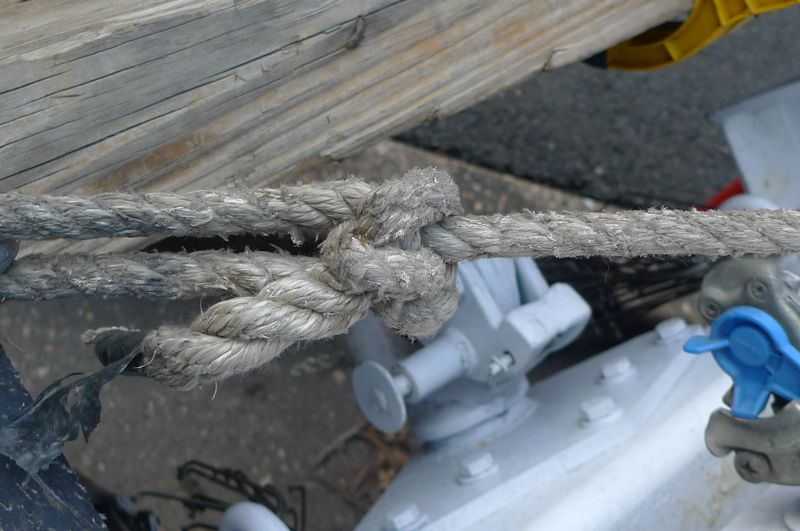
Derek esp. should like seeing what he called the myrtle
eyeknot, which ties to one eyebolt in a pretty heavy, thick
board; the other end of the rope was probably intended to
be the same knot (one or the other, i.e.), but the tail comes
in from the opposite side of the nipping loop (what defines,
for me, an “anti-bowline”). In the latter case, the tail
is better wrapped around towards the eye, unlike here.
Given the weight of the board and the broad angle of this
rope, the knots see a good amount of tension.

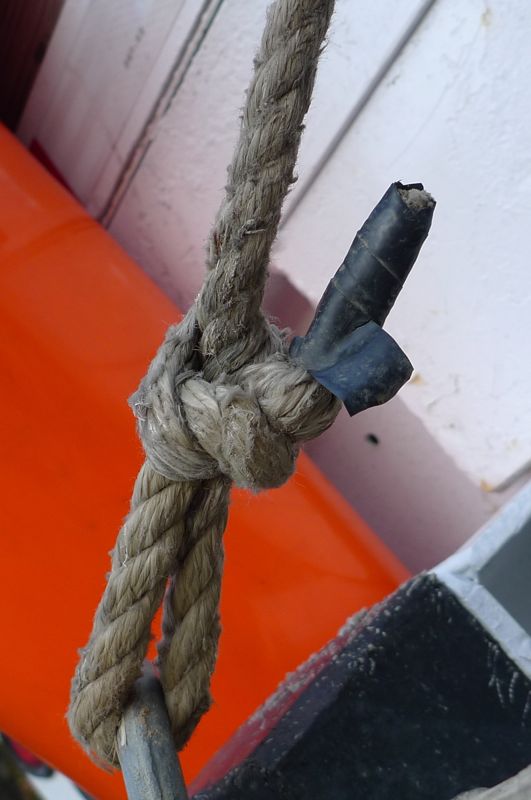
Next comes something familiar, and something … --well,
it makes a good puzzle. We might borrow the twisted
(twisting) language of a former high official and say that
it is “an unfamiliar familiarity” ! ;D I’ll leave it as the hint.
This eyeknot’s eye is to the lower right, SPart atop tail,
which are taped together, at the left.

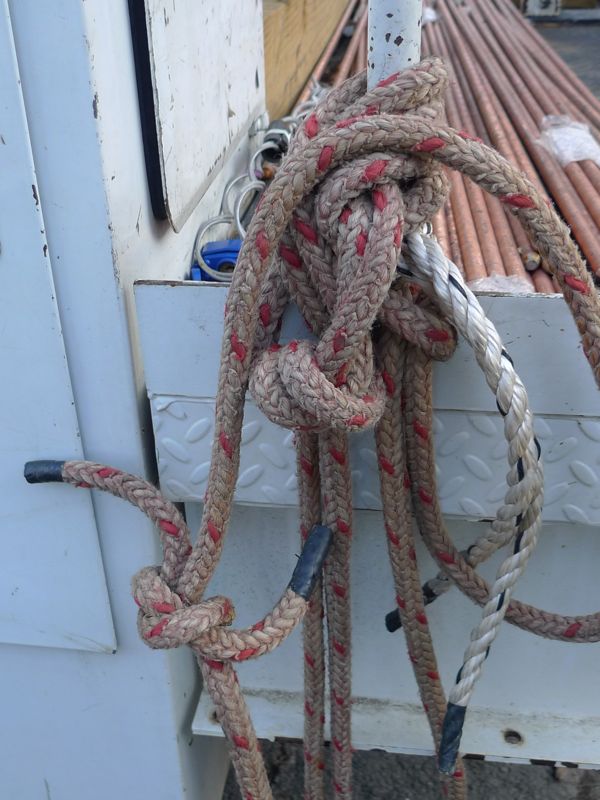
Finally, comes a common bend, what I blendedly call the squaREef
knot. Interestingly, it takes a geometry here much like what
forms naturally in webbing --one U-turn being pretty straight,
the other folding around the first (and it is this side, in tape,
that seems to have the breakpoint)!?

Finally,
–dl*


Here is a further look at commercial-fishing knotting,
manifest in one lobster fishing boat’s gear, as found
11 March 2012.

I’m only just remarking in looking over these photos
–though it seems apparent, also, in those @msg.#28 or 28–
that the “near groundline hitch” (my name) is set
quite loose, to be tightened (such as might happen) only
during usage!? I think that this enables the knot to remain
rather loose, with the initial turn nipping like a bowline’s
central loop, unless loaded from the line being hauled in
the opposite direction, in which case the turn might close
to the rest of the knot better.

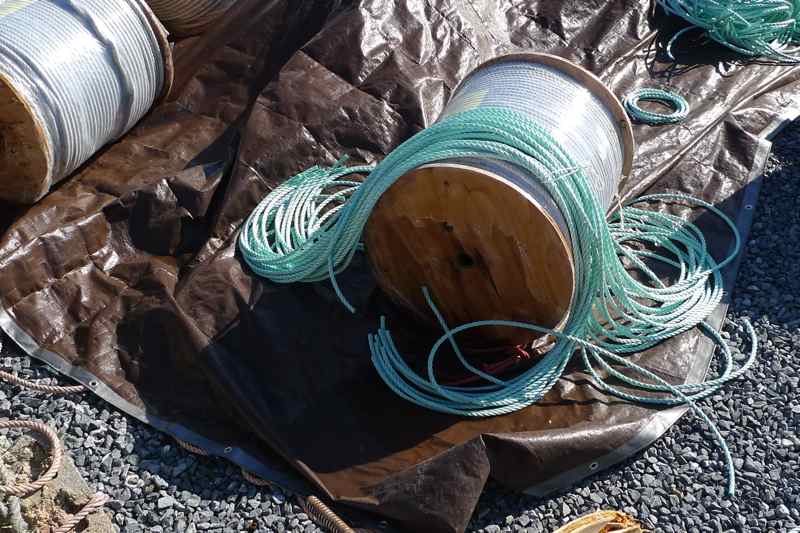
The first set of 4 (of two posts of 4@) shows the overall
layout as I found it on the evening of the 10th. There
are heaps of floating (PP or CoEx PP/PE) groundline on
the dock lot --and some new-looking snoods with very
loose hitches tied to them. There is a spool of new,
sinking longline being unspooled with snoods tied on
at the spool, then hauled (by pot hauler, apparently) out
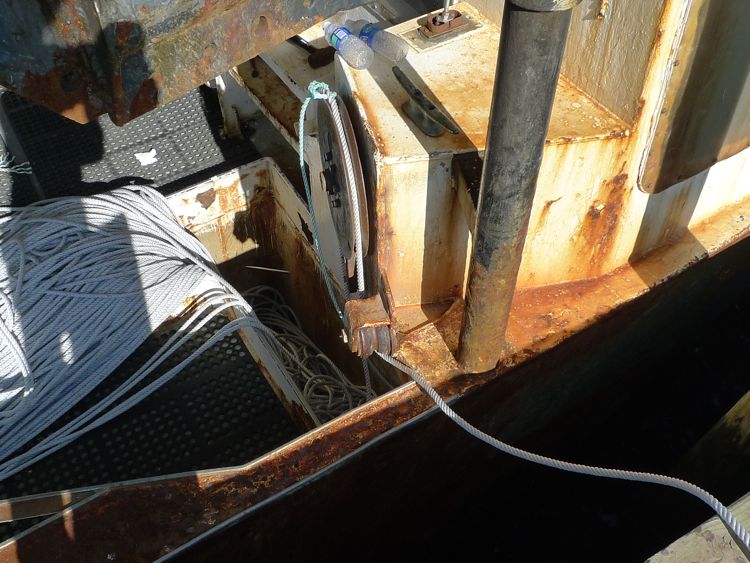
through a re-direction block (which I regret not photographing
and noting its clearance, vis-a-vis a snood hitch passing
through it!), and back aboard boat --at which point, its
having passed the knot tyer, the next snood is then
attached.

In photo #2, the boat is behind the viewer,
and the spool below-left, hauled line returning lower-right
–you can see that the snood is hitched at the spool.
In a later photo, you can see that the knot is still loose
as it is turning over the pot-hauler V-grip wheel; and
later still one can discern the looseness by the pot stacks.

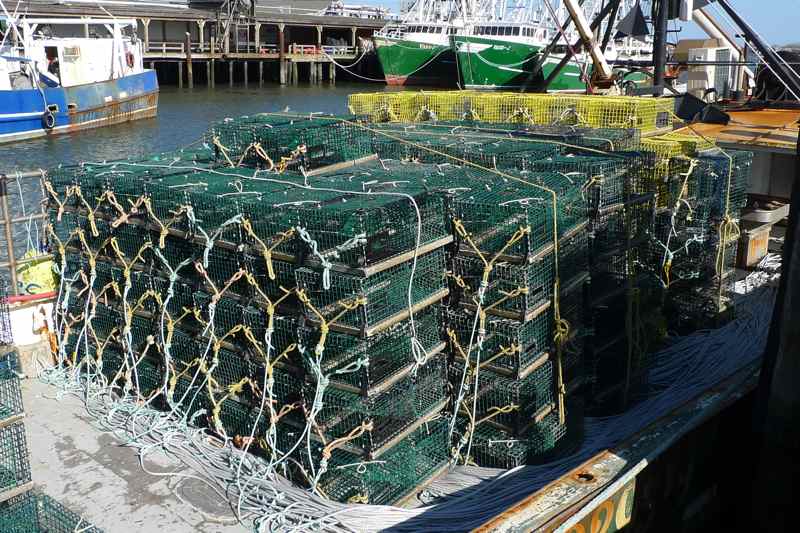
Aboard the boat, where stacks 7 across and 6 high are
in place, tied down (from an elevated metal rail on the
port side to the lowest pot to starboard, w/trucker’s hitch),
and … well, at some later point, the pots need to get bait!
(Maybe it was figured that this was something that could
be done to while away the hours sailing out to sea?!)

The pot bridles are of roughly 1/2" PP laid line, with
an overhand loop as the center knot, each end tied
onto respective pot sides with a clove hitch with its
end tucked back through the bridle’s lay. Snoods are
hitched to the eyes with a double sheet bend with
the tail tucked back through the lay. The spanking new
snoods in that pale blue CoEx PP/PE 3-strand line are
about 9’ long (by crude measure), as cut.

–dl*


Here is the completion to a set of 8 photos of lobster
pots and their associated rigging.

#5 shows a trio of what I have named
“near ground-line hitches” --which means that they
are nearly the familiar hitch but instead of tucking
the tail out through the initial turn, it is tucked down
through the lay of the object rope, which is more
secure in keeping the lines attached and in position.

#6 shows the pot hauler dumping line into a small
hold. Someone must walk the snood-hitched parts
down the boat to the needy pots (here, the top row
wants attachments to the ground line).

#7 & #8 show the stacks of pots (and one can see
the considerable expanse/run of ground line along
the starboard deck!).

–dl*


Saw this in an Orthopedics office. Used when setting a badly broken wrist. Fits on the fingers and weights are then placed on the arm to pull downward. Then the Docs fix & cast the wrist.

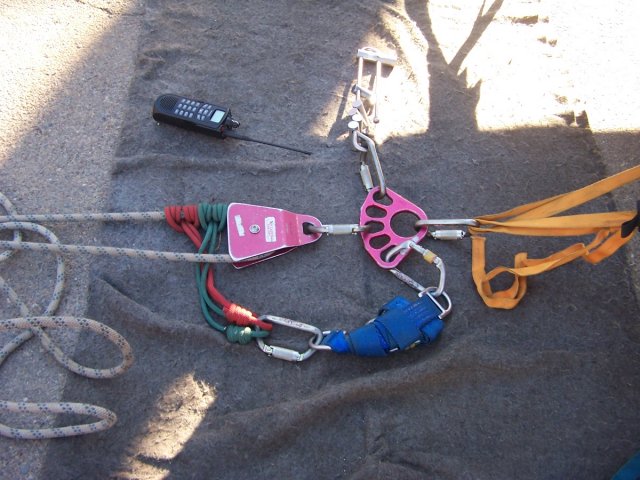
Does this count as a Knot in the Wild? Our typical Rack, Pulley, Mariner (RPM) system used in rope rescue. The anchor is a wrap 3 pull 2 webbing. Tandem prusiks on the main line. The setup is configured for raising with the pulleys in a Z configuration.


RPM Rig.jpg

I bet there are some good knots in the wild on the Star of India. The Star of India is the world’s oldest active sailing ship and is located about 10 miles from me. I might take a drive down there and post some pics.

http://www.sdmaritime.org/star-of-india/

Thanks for that URLink.
Yes, you might find knotting of interest aboard the ship.

I want to caution that (a) this KITWild theme is intended
to seek out, simply, what is --what folks actually DO
in knotting–, irrespective of any quality (“good knots”) judgement;
and (b) it could be that what’s aboard The Star… is not all so
“in the wild”, i.e., original/natural, but possibly somewhat
contrived by what was believed to be appropriate for the ship,
maybe copied from dubious information in some knots book.

Further, I’m assuming that there might be other floating
vessels with associated knotting to observe, in the wild;
note that, too.

Good hunting,
:slight_smile:

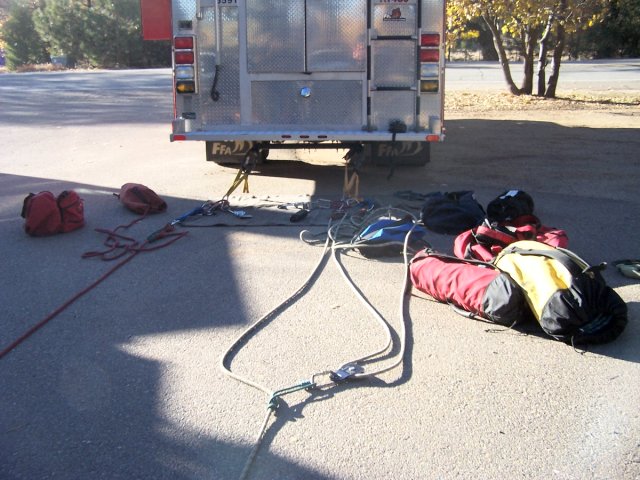
ps: To the fire dept. gear, I missed an opportunity, myself,
last wknd to ask about bags of 200’ (looked to be) 11mm?
kernmantle rope : was there a knot (fig.8 eye ?) in one
end?; why were bags plastic-lock-tie sealed? ; what uses
were expected, and what would happen to rope(s) after
use? (aha, hopes for test specimens!). . . . now I’m at
“next time”.

ps: To the fire dept. gear, I missed an opportunity, myself, last wknd to ask about bags of 200' (looked to be) 11mm? kernmantle rope : was there a knot (fig.8 eye ?) in one end?; why were bags plastic-lock-tie sealed? ; what uses were expected, and what would happen to rope(s) after use? (aha, hopes for test specimens!). . . . now I'm at "next time".

Well, the kernmantle rope we use is 8mm to make prusiks. I think the kernmantle does not have enough elongation for lowering rope. I believe we use a 13-14mm Composite double braid dynamic rope.
Yes we usually put the end of the rope, push through the hole, and tie a fig 8 on a bight. This is mostly for a stopper knot, but in a pinch you could put a carabiener on the bight and anchor the line. As for the plastic lock tie seal, never gave it much thought other than keeps the rope clean and prevents it from dumping out while in a rig. I attached a image of a training drill I was at a few months ago. You can see the rope bags just laying around.


ropebags.jpg

Very strange, I think this thread hexed me ??? Just hours after my last post, my boss (The Captain) calls me up. He asked me to clean and inspect our 18 bags of rope (Oh joy) :-.

Sometimes if an end is bad, we will cut the bad end off and record the new rope length in the rope log. So I just may be able to get you a sample. No promises though.

:slight_smile:

I think the kernmantle does not have enough elongation for lowering rope. I believe we use a 13-14mm Composite double braid dynamic rope.

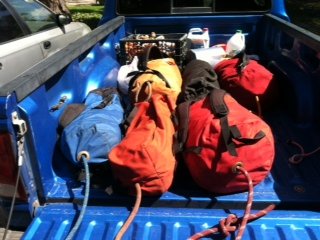
I have to make a correction, I was wrong when I made the above statement. I get my climbing and rescue rope confused. Well, anyways, it is Kernmantle rope, my bad. Here are a few images of the rope bags in the back of my truck.


ISropebags.jpg

So far, I have washed about 1200 feet of rope, only 12 more bags to go. I have found that loosely daisy chaining the rope before putting in the washer prevents the rope from getting tangled.

I came over this picture of a workplace. The company is trying to give work experience to youths which have dropped out of school.

I found the rope interesting, since it serves a job at a place where being effective is important, as well is security (the object looks heavy).

http://g.api.no/obscura/pub/978x1200r/04584/1352206809000_Jan-Eirik_Bj_rkly__4584041978x1200r.jpg

I’ve identified a cow hitch and an overhand knot at the working end. Rest of it seems to be a a lot of mess. There’s also some rope work in the background to the left.

i have seen a lot of these knots used by pilots. i would have put this here earlier, but i didn’t even know this thread existed. http://igkt.net/sm/index.php?topic=4112.0

A boat at the harbour was tied up with a bowline in the front and this knot in the back.

http://bildr.no/thumb/UWZMZk02.jpeg

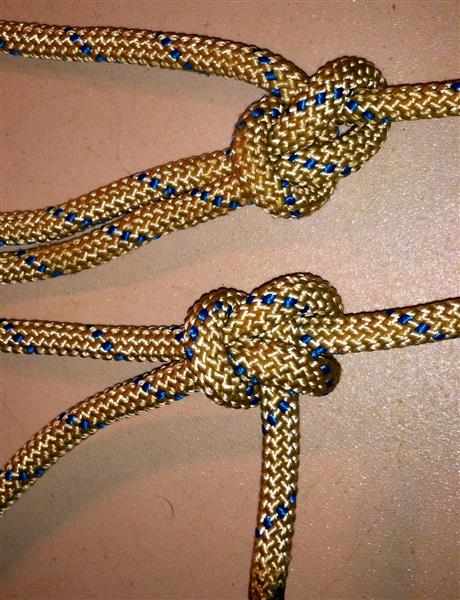
Is it a perfection loop? Sorry I could only get a picture of the front side of the knot.

Looks just like the Perfection loop to me. A bowline has one eye leg that comes out sort of perpendicular to the other.

It looks like it has seen considerable loading and probably never has been untied.
I wonder what the screw shackle is used for?

SS

Edit: Added picture of bowline and OP loop for comparison.


bownperf2 (Custom).jpg

+1
Also, if one ties & loads the angler’s/perfection loop,
the result will show similar disposition --i.p., the way
the upper eye leg is slightly more down than
the other vis-a-vis the rough plain one might
see the nub set in.

And, yes, to the loading/usage and lack of (maybe
little possibility of) being untied (as much as would
be a splice in its place!).

–dl*