Many current mountaineering books describe the “lark’s foot hitch”, which is also known as the girth hitch, lark’s head hitch, ring hitch, and other names. I believe the origin of the name “lark’s foot” was an error by Bill March in 1973 in his book Modern Rope Techniques in Mountaineering. He probably meant to say lark’s head, but was looking at a drawing of a foot and wrote lark’s foot. I made the same mistake in typing this message! After March’s mistake, other writers of mountaineering books copied it. Unfortunately, Bill March died in 1990, so we can’t confirm my theory.
March’s book was popular and influential. I have the 1976 first revision, which was the second printing and the 1997 14th printing, which was of the third redition. His book was responsible for propagating the names klemheist hitch and kreuzklem hitch. The kreuzklem is the same as the Hedden knot, published in a climbing magazine in 1960. The klemheist is an upside-down Hedden. March’s names and emphasis on the klemheist (snappy name?) get published more than Hedden’s work, demonstrating that a book can have more influence than a magazine article.
The name lark’s foot hitch is a translation of the French name for the hitch that appeared in 1870 in The Book of Knots by Tom Bowling. Clifford Ashley decried the use of translated French names for knots that have well-established English names (Ashley Book of Knots, pages 11-12).
The French book, Techniques de la sp?l?ogie alpine by Marbach and Tourte, 2000, was published as the English-language Alpine Caving Techniques. 2002. The French “t?te d’ alouette”, literally “head of lark” was translated to “lark’s foot” in ACT. A head was translated to a foot! I contacted the translator. She said she used lark’s foot because that was the prevalent name among climbers. The drawings have crossouts because, to quote ACT, “A girth hitch alone (lark’s foot; fig. 60) should never be used, and backing it up with a figure eight is just a flimsy substitute for good rigging.”
The ‘Cow Hitch’ is another name for the same knot as far as I can tell. Some knot sites seem to distinguish between a ‘Cow Hitch’ and a ‘Girth Hitch’, though the material tied (rope or strap respectively) hardly matters to this new knot tyer.
[edit: changed Cows Hitch to the correct name Cow Hitch]
I would favor, perhaps, a distinction between whether
one of both ends are loaded --this is a fundamental
aspect.
It can be wrong to say that the material hardly matters,
between round & flat stuff, as there is an aspect of whether
the tail (if one-end-loaded) is nipped between collar & S.Part
or between S.Part and object in the case of flat material;
such positioning is not possible (impractical) with rope.
(Similarly, in the water knot, tape leads to there being
an interior/exterior difference in what is a traced knot
–i.e., join an orange to a green tape, and the knot will show
one or the other of those tapes, not both (and it has been
shown that the exterior tail is vulnerable to slippage!).)
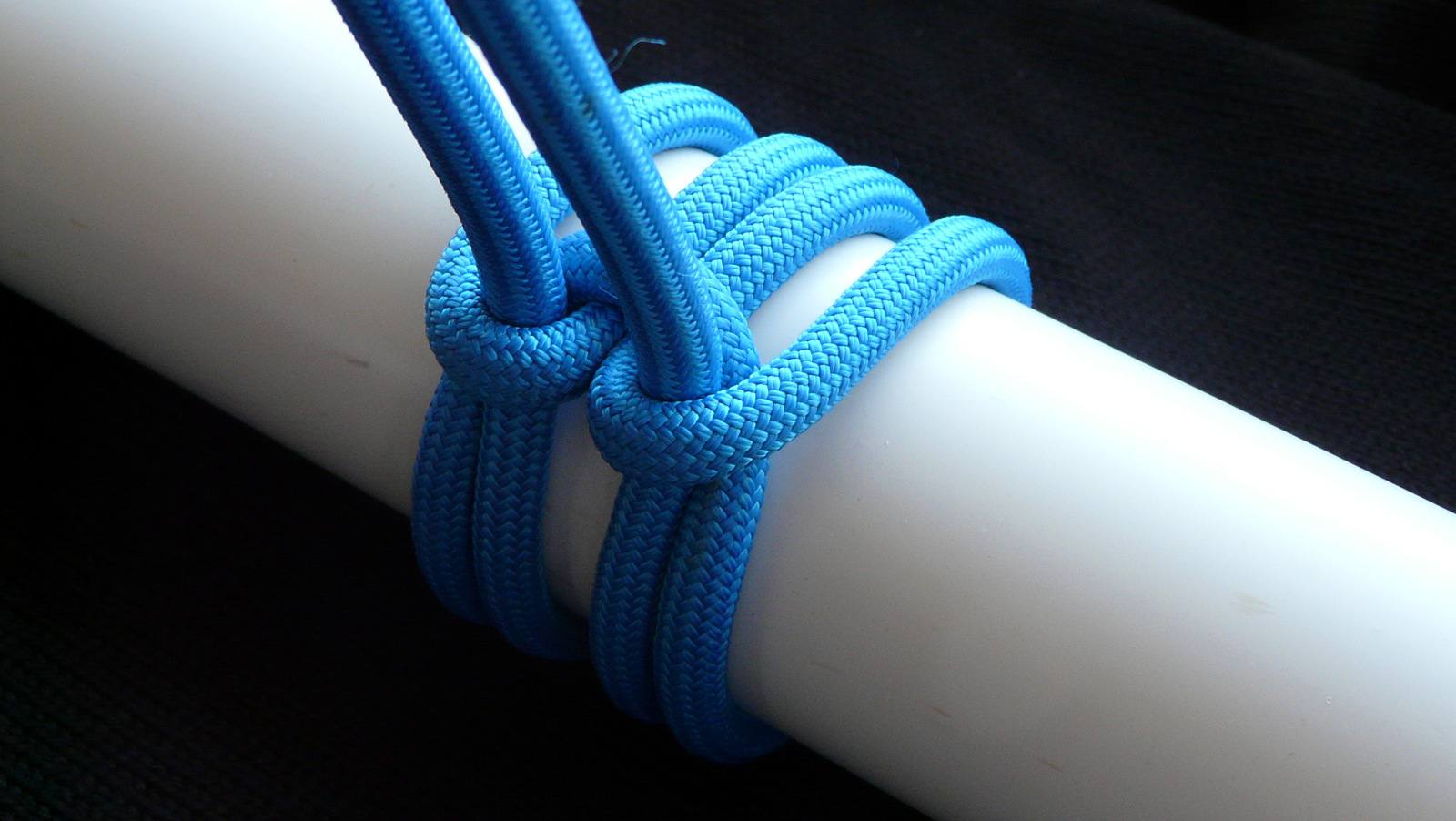
Hmmm… And what happens when, in a compound knot when a Cow/Girth hitch is used as a base ( see the attached pictures ), the one end, the Standing End, is loaded by being pulled from outside the knot, while the other end, the Tail End, is also loaded, by being pulled from inside the knot ?
I had encountered this nomenclature problem when I had tied the single and the double Locked Cow hitches, which use one or two Cow/Girth hitch(es) as base(s) - and I had decided to use the term “Cow”… However, if somebody would persuade me, with sound arguments, that they should better be viewed as single or double locked “Girth” hitches, I would be glad to rename them.
I now believe that both ends being loaded outside the knot is the functional difference between a Girth Hitch and a Cow Hitch.
So using the above premise: We could take a rope and first tie a Cow Hitch, which we know is only ever designed to be loaded on one end, the standing end. Now, however, if we were to then eye splice (I think that is the right splice term) the working end to the standing part you would create a knot better described as a Girth Hitch since both ‘ends’ are loaded.
Following on from that idea it seems reasonable to me call the ‘double Locked Cow Hitch’ (DLCH) you show a ‘double locked Girth Hitch’ instead. The DLCH you show was TIB, so presumably it was designed to be loaded on both ends.
The Locked Double Cow hitch was designed to serve as a “tight hitch” = a binder, where NO end is loaded ! In other words, it was designed so both ends are “locked”, that is, no portion of them is “swallowed” inside the nub when the wraps are under tension ( when they seize and squeeze the encircled object(s) tightly ), even when the ends themselves are not loaded any more. It CAN be tightened by both ends, of course ( and, indeed, it is better/recommended to become tightened like this, by pulling both ends, the one after the other ), but it remains tight even while it is not loaded by any of them. And it CAN be loaded by both ends, although I can imagine only a few cases when something like that is required - normally, when used as a classic hitch and not as a binder, it is loaded by one, only, end.
The Locked Single Cow hitch, which, when the Tail End that is locked underneath the riding turns is slipped, is also TIB, can only be loaded and tightened by the Standing End - but again, once loaded and tightened, it remains tightly wrapped around the object(s) even if/when/while this end is not loaded any more.
In short, I think that the situation with the tight hitches = binders which are based on a Cow/Girth hitch is a puzzling ambiguous situation, where the borderline between the Cow and the Girth is not ( perhaps because it can never be ) as sharp as we would had wished.
I always thought a hitch was a knot tied to something that would tighten to conform to that object’s shape and potentially have some load on its standing end. A Cow Hitch is/was commonly used to tether a cow, one would assume That knot binds to what it is attached, cow or no cow. However, without the cow attached to the standing end is it still really a hitch?
A binding knot (like a Constricter) is designed to have no potential load on it’s ends. Is it still also a hitch, in particular a “tight hitch”? If so, isn’t a tight hitch just a binding knot and it would better to avoid the word ‘hitch’ altogether if you are just binding something.
About the origin of those tight hitches / binders : I was searching for a way to make one hitch able to withstand a lengthwise pull, without adding more wraps than it already has - or with minimizing the number of required wraps. The only thing one can do in this case, is to make those wraps more tight, so the force by which the line is squeezed on the surface of the pole becomes greater, and, consequently, the friction becomes greater, too. It is this friction which enables the “nipping tube” around the pole to be able to better withstand a lengthwise pull, without sliding on the surface - or, alternately, enables a pole which is pulled along the direction of its axis, to remain stationary, and not slip through a stationary “nipping tube”.
Having this in mind, I had met the superb (regarding its attainable and sustainable binding force ) TackleClamp hitch. Then, by trying to simplify this hitch, I had arrived at the Double LCH - and only at the very end, following this completely indirect and lengthy path, I had manage to arrive at the Single LCH. I say that this path was indirect and lengthy, because a more clever or experienced knot tyer would had seen the flaw of ABoK#1683 at an instance, right from the first sight ! However, the Great Ashley himself was probably the most clever and experienced knot tyer ever, and yet he missed this opportunity (1) - so it may be the knowledge gained by studying the efficiency of the opposing bights locking mechanism, which helped us see the light of this bulb .
So, besides the ability of a “tight hitch” = binder to act as a hitch and/or as a binding knot, it is its ability to act as a efficient hitch able to withstand a lengthwise pull even if it utilizes the minimum number of wraps, that made me use this term, and not the term “binding knot”.

 That knot binds to what it is attached, cow or no cow. However, without the cow attached to the standing end is it still really a hitch?