Hi Alan,
If you’re reading this post, can you please confirm the discovery date for your wonderful ‘Lees link Bowline’?
Mark G
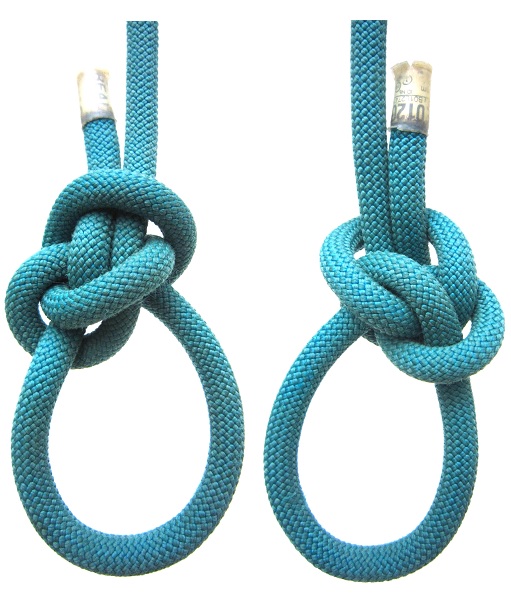
Hi Alan,
If you’re reading this post, can you please confirm the discovery date for your wonderful ‘Lees link Bowline’?
Mark G
I might have a date for all that up to /excluding
the Yosemite-like tail-tucking,
what I’d called "the bowl-in-a-bowl in light
of the two, interlocking looParts. --something
that came along with ideas producing the end-bound
dbl. bowline, in which the tail-looping came
after forming the collar and not upon returning
eye-leg entry.
Hi Mark, Here is the link for Lee link Bowline (care by Xarax)
Retuck the Tail end through the collar - you may end up with a TIB bowline.
http://igkt.net/sm/index.php?topic=4695.0
謝謝 alanlee
Thanks Alan,
But, I am a little confused by this…
Xarax posted the knot with date time stamp: November 20, 2013, 02:49:35 PM
What I am really looking for is a date/time stamp when you personally posted the knot.
Can you help me here? I am updating my ‘analysis of Bowlines’ paper - and want to get the facts correct - and give credit where due credit is warranted.
…
Many of your creations are truly works of genius and I want to do them justice!
In this thread: http://igkt.net/sm/index.php?topic=3908.msg27595#msg27595 Xarax started to do some housekeeping to regroup and reorganise all of the knots into a coherent body (at reply #22).
I am still scratching my head trying to nail down a definitive discovery date for your ‘Lees Link Bowline’.
This structure is remarkable (for me personally) because it has no sharp turns…all rope segments pass around at least 2 rope diameters…and, it is secure and stable. I personally use it routinely as a tie-in knot for lead climbing. The only downside is that I don’t find it as intuitive to tie as say #1047 (F8 eye knot) but, this is really just a question of practice practice practice and developing long-term muscle memory.
My EBSB Bowline is also an excellent tie-in knot for lead climbing but, the rope makes a sharp turn around the ‘returning eye leg’ which is a single rope segment (aka ‘Yosemite finish’).
I have heard Dan Lehman sounding concerns about any Bowline that sports a ‘Yosemite’ style finish - I think his concern lies with stiffer ropes (to which I agree with). The root of the concern perhaps is forcing the tail to make a sharp turn?
And here is where your ‘Lees link Bowline’ avoids such sharp turns…
Mark G
I might have a date for all that up to /excluding the Yosemite-like tail-tucking,
Dan, any historical info you can provide will be most welcome 
I am updating the analysis of Bowlines paper (again)…so there is an opportunity for you to jump in here.
Also, if there are any technical corrections you would like to make - now is the time…
I am holding steady on the nipping loop being the defining component of all Bowlines…the absence of which automatically disqualifies a knot from being a ‘Bowline’.
I am also holding steady on sorting Bowlines into categories by the type of nipping loop (eg single nipping loop versus double nipping loop etc).
Mark G
Surely you know that but…
First a Myrtle (collar)
then a Bowline (collar) through the “nips” (nipping loops)
then tuck down and that’s all

I don’t remember if a simple TIB tying method is available…
Ciao,
s.
Seems I am popping up on a few peoples radar screen after my ‘intuitive’ comment re tying Lees Link Bowline.
(I’ve received personal email and PM on IGKT).
So this is straying off-topic…
I guess it all depends on how one wishes to interpret the term ‘intuitive’.
Without wanting to open pandoras box or suffer from ‘foot-in-mouth disease’, a case could be argued that tying #1047 (F8 eye knot) via the re-threading/follow-through method is ‘intuitive’. Tying #1047 (F8 eye knot via the re-threading/follow-through method) is a two stage tying process:
Having tied #524…you now have a road map to work with. You just maneuver the tail by tracing a parallel pathway mapped out by the existing #524. I am of the view that once you have established the initial 1st stage (#524), the remainder of the tying procedure can be solved relatively easily.
In the case of Lees Link Bowline, there is no pre-existing pathway to follow.
I personally don’t find it difficult to tie any of the secure Bowlines per se…
Its just a comment…
However, there are some deeper issues at stake here…advocates of #1047 (F8 eye knot) argue ease of teaching and relative ease of memory recall. They use this in arguments against ‘Bowlines’. I think the underpinning issue is that #1047 is tied in a two stage process - and once you have established #524 (the 1st stage) - you now how something to work with (a road map if you will).
Bowlines aren’t tied in the same way…it is all done in one continuous process - and so from a memory recall point-of-view, I think there is some level of argument that it is less ‘intuitive’ to learn and tie. And here is that term ‘intuitive’ again
Anyhow, this is all off-topic and might be best left for an entirely new thread!
Mark G
What does Xarax call “Lee’s Link Bowline”?
What does Xarax call "Lee's Link Bowline"?
Do you mean ‘what’ or ‘why’ ? … They have different meanings and hence different ways of answering your question.
If you mean ‘why’…
Xarax is a prolific knot tyer…and he certainly has made huge contributions to world knotting knowledge.
Alan Lee is a true Jedi knot master - and has created some knots that are at a level of genius.
Alan Lee did the creative work and discovered a bunch of Bowline derivatives that were based on a ‘myrtle’ maneuver.
Xarax referred to the rope turn that forms around the crossing point of the ‘SPart’ and the ‘ongoing eye leg’ as a ‘link’.
A whole family of eye knots were thus created using this ‘link’.
Xarax will no doubt correct me if I have got this wrong… and I can already feel a sharp blade digging into my back
Note that these types of creations differ from the common #1010 Bowline due to this ‘link’ / ‘myrtle’ maneuver.
It has been theorised that the fundamental component of all Bowlines is the ‘nipping loop’ - the absence of which automatically disqualifies a knot from being a ‘Bowline’.
Bowlines also must have a ‘collar’ - which normally forms around the SPart and has 2 ‘legs’ (that is, there are 2 legs to a collar).
The term ‘myrtle’ is understood to originate from Derek Smith (another long time Jedi knot master) who one day stumbled across a rope holding up a Myrtle tree - where he noticed that the knot was a little odd (not formed like a common #1010 Bowline). Legend has it that since this odd looking derivative was propping up Myrtle tree, it was named a ‘Myrtle’.
Derek Smith will jump in and correct me if I am wrong.
Mark G
Thank you for your reply.
I meant ‘what’. I can’t find the thread where Xarax coins “Lee’s Link Bowline”. In the housekeeping post you linked to, he has Lee Zep A1, A1 X, A2, A2 X, B, and C–in all of which the tail terminates perpendicular to the standing part. None of these resemble what you call in your paper “Lee’s Link Bowline” where the tail terminates parallel to the standing part, which is the subject of this thread (correct?–or are you asking Lee about the family of Lee Zeps?).
I received this reply from Xarax… (re Lee’s link Bowline)…
Me, "I" had tied it and named it - but what I did is just to re-tuck the tail through the collar of a pre-existing bowline, in an attempt to make it TIB ( it was not ). And this attempt was.luckily, successful, ( it is not always...), and the bowline was turned into its TIB sibling, indeed. And I had tied and named this previously existing bowline, too - but what I did was just to cross the direct continuations of the tails inside the nub ( as I had done in the Zeppelin X bend, gor example, the Mark s X bend, etc...) of an ALREADY TIED BOWLINE, BY ANOTHER KNOT TYER - in an effort to enhance friction between those two segments, in a place which can be seen as "the last line of defense against slippage", as I use to say for the section of the Working Parts before they exit the nub, and become Tail Ends. Guess who this "other knot tyer" was... So, it was natural to me to name it as Lee s link bowline - because the initial bowline was tied by Alan Lee, and on this bend I only added some "ornaments", I made some modifications which were minor changes of an already created thing, a totally "new", at least to me, knot.I do not believe that the crossing of the tails was absolutely required, nor that it offered to this bowline some security which was missing - it was just a “plus”, one of those psychologically motivated “improvements”. The bend works fine even when its tails are NOT crossed. I do not also believe that the fact that this loop became TIB, by the “trick” of the retucking of its tail through its collar, was required - by anything, probably, than my own passion for the TIBness of knots !
I always find wonderful / marvelous the fact that a tangled line, which looks like a plastic ball and seems impossible to “repair”, yet it can become again an elegant, straight unknotted line, just as it was before we tied it up - and without any involvement of its( ends !
Whoever was fishing with a naylon fishing line back in the 50ies from the shore when he was a toddler, and still remember, deep inside him, the great happiness he felt each time he managed to untangle his tangled line, will understand me…There is, indeed, something in which Alan Lee has no involvement. It is described in the thread about the various " Link bowlines " - I had just tied all the simple possible bowlines which incorporated such a structure, a nipping loop tied around their crossing points. As usually, nobody paid any attention to that thread, and it is burred there, so nobody will lose some moments to tie them… The fact that one variation of those bowlines was similar to the crossed-tails ( = Xed ) Lee Zep bowline, and I happened to notice it, does not make me co-inventor of Lee s knot, does it ?
The Lee s Link bowline is just Alan Lee s Lee Zep bowline ( a nice knot indeed, altough not-TIB😉 ), with some modifications which I consider almost “cosmetic” - and, certainly, are not necessary in order this bowline works as a fine end of line loop.
http://igkt.net/sm/index.php?topic=3908.msg23804#msg23804
https://igkt.net/sm/index.php?topic=4314.msg28456#msg28456
Thanks, mate.
As posted also in another thread,
what I came to refer to sometimes as a “bowlinabowl”(ine)
I find among my myriad note papers date-stamped/-ID’d
“#20020301f1022” (with no final Yosemite tuck out collar),
and the same w/opposite-handed returning leg loop
being #… b22" (I change ‘:’ to ‘b’, ‘c’, … as needed,
for versions, retaining the date part of the ID, of which
the letter is day-of-week (m-t-w-h-f-a-s).)
Upon some recent (re-)reviewing, I again found this,
and from something tingling my mind on seeing Mark’s
orientation of that “Anti-Lee’s Link” I realized that ::
take Lee’s Link BWL, and reduce the knot to a joint;
then use the opposite S.Part of that joint (to what LL’s uses)
and one has what I call “Doubly HAH!” (“HAH” for “Happy
As Harry (Asher)” !! --this, a working of my inchoate
viewing of knots as loadings of tangles.
To clarify : my images of Doubly HAH! are with the eye knot
oriented horizontally (which isn’t something I always do, but
in this particular case have done). With Lee’s Link BWL shown
vertically, I didn’t look at it well enough to make the connection;
but the horizontal image grabbed me! Yes, there it was, DlyHAH!,
fore<=>aft’d, so to speak.
Put a knot as a Tangle --all “ends” (S.Part(s), Tail(s), (eye legs))
run off from knot & outside the Tangle boundary. I’m pretty much
only musing about “2-Tangles” --of simple joints & eye knots,
mostly, with 2 pieces of knotted material ID’d as “1-2” entangled
with “A-B” (1, B, 2, A the 4 “ends”).
Canonically, see an eye knot as a 2-tangle with S.Part end “1”
loaded in opposition to outgoing eye leg “2” & other-piece’s
end “A” --and note that we don’t really need to say that
“2” is fused into “A” : just that the two ends are loaded
in opposition to end “1”; “B” is the tail.
So, take either Lee’s Link or Doubly HAH! and back
off of either of the eye knots to view as tangles, and there is
the joint 1-vs-A. I worked from “1” qua S.Part, Xarax “A”
(actually, he saw the obvious variation to Lee Zep of tucking
through turNip and so on).
(The sheet bend is often seen as having the BWL as its
naturally corresponding eye knot; but as the SB is asymmetric,
there is a “natural” connection to be made from the U-fold’s
S.Part of this joint --which, sure, isn’t so good. But, then,
there are other ways of correspondence of ends joints
& eye knots to explore.)
In relation to reply #14 (per Dan Lehman):
Put a knot as a Tangle --all "ends" (S.Part(s), Tail(s), (eye legs)) run off from knot & outside the Tangle boundary. I'm pretty much only musing about "2-Tangles" --of simple joints & eye knots, mostly, with 2 pieces of knotted material ID'd as "1-2" entangled with "A-B" (1, B, 2, A the 4 "ends").
Just trying to decipher this tangle of words
Perhaps you are eluding to an end-to-end joining knot - from which 4 eye knots can be derived (within a chiral domain)?
If so, I’ve attached an image showing the correspondence between a parent ‘bend’ and its ‘child’ eye knot(s).
In this example, the ‘parent bend’ is Lees link joint… and the Lees link Bowline from which it corresponds.
I have not shown the other possible eye knot combinations.
…
Given that this is posted in the ‘new knots’ section, are you making a claim of originality?
If yes, what exactly are you claiming?
You want “allude” --I’m not escaping anything.
And an asymmetric e2e joint gives rise to EIGHT (8)
eye-knots --each end of the joint playing its turn at
S.Part with either of the two other-piece’s ends to tie
into for forming the eye.
1-v-A joint, B & 2 ends tails
=>
1-v-2+a,
1-v-2+b
…
B-v-A+2
If so, I've attached an image showing the ... correspondence=> "[b][i]a[/i][/b] correspondence"
In this example, the 'parent bend' is Lees link joint... and the Lees link Bowline from which it corresponds.My discovered "Doubly HAH!" makes your sort of correspondence using the opposite joint S.Part as EK S.Part. Ha!
As for Lee’s Link, X. went from one EK to bolster some
things, and to make it NSUEnds; I had already crossed
this ground --as noted above-- save for a further tucking
out of the tail through the collar (to be NSUE), which didn’t
concern me --to run through all the possibilities,
just as putting it out to make your EBSB from the general
“EB” idea manifest in the EBDB (from which there are many
known extensions that could be lopped together to form
similar and ever more entangled knots).
((I think I’ve voiced here the note that with some 300 EKs
illustrated on some count I made years back, I can use them
each in many combinations to form a “shared-eye joint”
(what CLDay I think christens for the one? known case,
“Twin BWLs”) :: and 300 additive factorial (for 1&1, 1&2,
…, 300 & 300) = 45_150!! Do you want claims for each one?!! :o
…
Given that this is posted in the ‘new knots’ section, are you making a claim of originality?
If yes, what exactly are you claiming?
[/quote]
And an asymmetric e2e joint gives rise to EIGHTAnd this holds true if you want to also count asymmetric/rotated geometries - which might be dubious or unstable when loaded. I prefer to keep the logical primary count to 4... within a chiral orientation. Reverse the chirality and you get another 4 combinations. But, from a purely technical standpoint, you are correct when counting each and every possible combination of eye knots that can be derived from the parent 'bend' - regardless of instability or insecurity that arises from their loading profile.
And thanks for pointing out my keyboard typos… !
Let’s see if I can capture the image of Lee’s Link
(“bowinabowl”)
Per your nice photo’d image,
connect the TOP two ends --of two colors–
to form the eye of the “Doubly HAH!” eye knot,
loading the white cord’s opposite end qua S.Part.
Now, the tail of this could also be a S.Part (EEL),
and both of these EKs are “fore<=>aft’ings” of
the starting one.
(-;