Just noticed this news item. Is there much overlap between knots in the real world and this branch of topology?
The nature of that additional complexity isn’t clear yet. During their furious examination of their counterexample, Brittenham and Hermiller weren’t able to develop an intuition for why it broke the additivity conjecture when other knots didn’t. Understanding this could help mathematicians get a better handle on what makes some knots complex and others less so.
“I’m still stymied by this most basic question” about the unknotting number, Moore said. “That just lights the fire under you.”
?? They don’t know why?? It’s screamingly obvious that on either side of the fusion point, the over/under of the knot on one side is the inverse of the over/under from the knot on the other side of the fusion point. It’s pretty much exactly what my proposed (but not accepted) Bridges paper illustrated with closed braids.
They are getting unknotting numbers for one pre-fusion knot for free from the other now-fused knot.
But, having said that, because it’s too obvious, that’s probably not it, eh? 
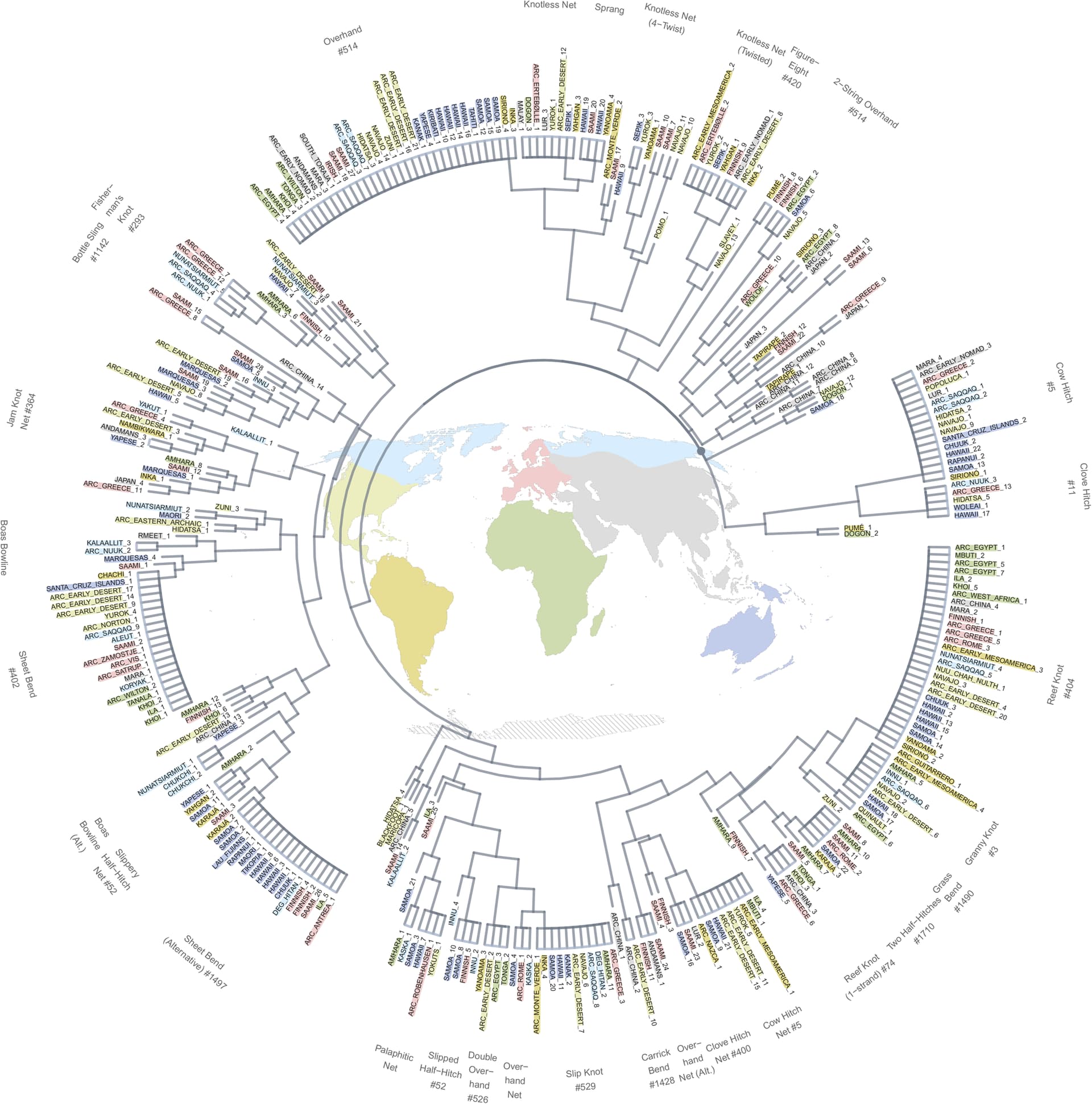
An important cross-cultural analysis of knots. 338 distinct knots across 86 cultures, including a phenogram based on a Gaussian algorithm to code a knot by its starting position and enumerating all crossings, both over- and underpasses. R scripts are used.
Overall, “The most commonly recurring knots across cultures are the sheet bend (clusters #402 and #1497; documented in 29 cultures), overhand knot (#514; 24 cultures), reef knot (#75 and #74; 23 cultures) and cow hitch (clusters #5; 20 cultures).
And…”However, there are several knots that have a more unexpected ubiquity that cannot be explained by their simplicity. Notably, the sheet bend knot (ABoK #402 and #1497) is more complex than the reef knot—it has one more crossing and is asymmetrical (Fig. 1D–E), yet it is the most commonly recurring knot in our dataset.”
And, “Yet it is also worth noting how some knots common in contemporary use are missing from the dataset. For example, even though the bowline knot is today considered one of the most useful knots (it forms a secure loop that does not slip under load, yet is easy to untie), and despite its topological similarity to the sheet bend, our dataset includes no bowline knots (other than its Arctic ‘Boas bowline’ variant, and some other knots with bowline-like features, such as SAAMI_21 and ARC_EASTERN_ARCHAIC_1).”
2 Likes
Continuing on, that study could link up with this book by Dean Falk. She points out that all great apes (Gorillas, Orangutans, Bonobos, Chimpanzees) build (=weave) sleeping nests every single night! Some contained overhand knots, tho observations are sparse. She goes on to argue that, therefore, the earliest hominins sprang from a nest-building ancestor, and the shift to bipedalism freed up the hands to do something else, for example making “slings” to carry infants–which is known to be a human universal. Slings all contain knots, and slings are just portable nests. Nests are also “tools",” and thus nest/slings may be much more ancient (by 3 million years) than stone tools, which are commonly regarded as the first evidence of tools use by hominins. Picking up and putting down infants, in turn, might have lead to the evolution of “motherese,” which is the babbling proto-language that adults use to communicate with infants, and is also a human universal. Motherese, in turn, may have promoted the evolution of true language, the human universal par excellence.
How’s that for the importance of knots?
Just a footnote to the first post about the paper by Kaaronen & Al. Here’s a tabulation of “Knot_names” by Culture from their dataset. To me the most startling Knot Name is “NA,” by which they mean they found 111 knots that are distinct but, I think, have no name in English or any other language, and are not in ABOK (145 total are not in ABOK, but 34 have names in English).
Are these new knots?
| Count of ABOK | ||
|---|---|---|
| Knot_name1 | ABOK | Total |
| 2-string overhand | #514 | 3 |
| Boas bowline | NA | 4 |
| Boas bowline (alt.) | NA | 1 |
| Bottle sling | #1142 | 2 |
| Carrick bend | #1428 | 2 |
| Clove hitch | #11 | 4 |
| Clove hitch net | #400 | 3 |
| Cow hitch | #5 | 16 |
| Cow hitch net | #5 | 9 |
| Double overhand | #526 | 4 |
| Figure-eight | #420 | 4 |
| Fisherman’s knot | #293 | 5 |
| Granny knot | #3 | 8 |
| Grass bend | #1490 | 2 |
| Jam knot net | #364 | 2 |
| Knotless net | NA | 8 |
| Knotless net (4-twist) | NA | 2 |
| Knotless net (twisted) | NA | 5 |
| NA | NA | 111 |
| Overhand | #514 | 32 |
| Overhand net | NA | 3 |
| Overhand net (alt.) | NA | 3 |
| Palaphitic net | NA | 4 |
| Reef knot | #404 | 29 |
| Reef knot (1-strand) | #74 | 4 |
| Sheet bend | #402 | 21 |
| Slip knot | #529 | 11 |
| Slipped half-hitch | #52 | 4 |
| Slippery half-hitch net | #52 | 4 |
| Sprang net | NA | 4 |
| Two half-hitches | #1710 | 5 |
| #52 | 1 | |
| Sheet bend (alt.) | #1497 | 18 |
| Grand Total | 338 |
Shallow and silly observation, but the first author on that paper is named “Roope”. 8)
1 Like
it would be very interesting for the Guild to have a look at the NA list and see if we could identify them?
this spectacular radial chart might’ve been the perfect opportunity to cast onto an azimuth projection map …
but yeh, great find and excerpts there : )