I’m not sure, but I think it’s the same difference between the Buntline hitch and the Two Half hitches: Imagine that you cut the loop of the Adjustable Grip hitch, and then you"melt" the leg of the loop adjacent to the standing part to the tail.I think that this is the knot mentioned by knot4u.
You instead have “melted” the other leg of the loop with the standing part of the original Adjustable Grippig,using the leg adjacent to the standing part as the new standing part.(I do not know, maybe the knot that you show still has some interesting features!)(and please excuse me for my bad English and explanation!)
Interesting, that’s a new knot and different than what I meant. With your knot, I anticipate a problem if the bind is really strong. Also, that structure doesn’t provide much leverage to cinch down strongly. However, it may be suitable for lightweight jobs that don’t require a strong cinch. Have you tried it out?
firstly, could someone show what exactly is a glempir knot? i am not familiar. secondly, i find that a constrictor knot often makes a perfectly fine mid air binder, because a constrictor requires two loops to be held close together yet slide opposite directions. the knot will squeeze well and then will hold very well by friction with the surfaces it is touching, and also a constrictor knot when pulled taught enough will provide it’s own simulated surface with the outer strand, assuming that the knot is under constant tension. if not, they it may be very easily reenforced with a half knot, and that holds excelently.
I’ve attached a picture below. The Gleipnir is probably the most over-hyped tensioner on this board. It uses a lot of rope to barely apply any tension, and usually only works in open air. It loses tension or completely falls apart if it is loaded funny or otherwise tampered with.
This version of the Gleipnir is quite useful. I have about 10 bundles of different stuff around my house bound together with a Gleipnir X in 550 paracord, jute twine, or nylon string.
This version below has a bit more cinch. It’s the same concept but with an added nipping turn.
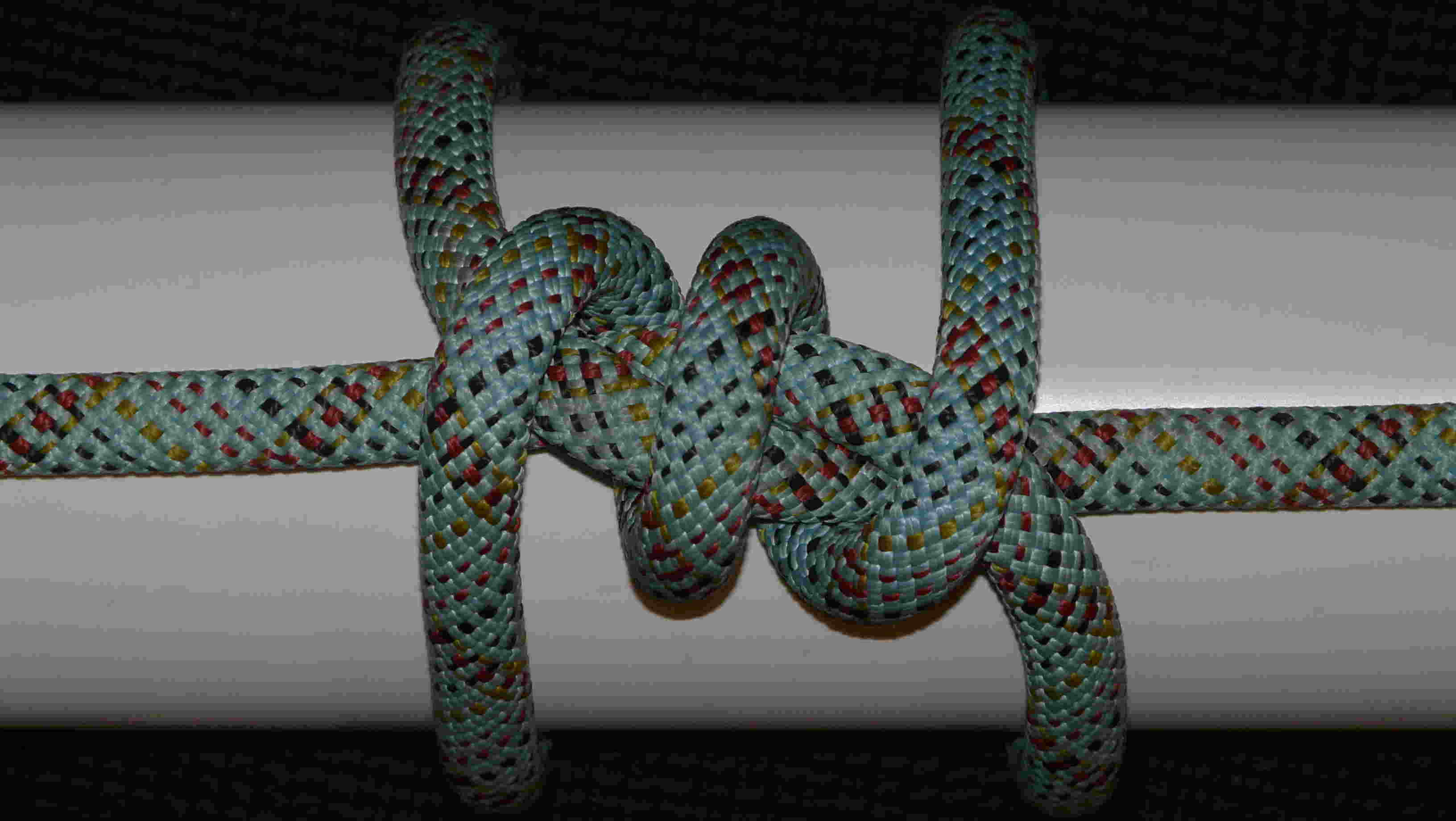
I think that this picture is not as informative as it could be. It does not show very clearly the “twist” of the tails inside the “tube” made by the three nipping loops. For the single as well as the double hitch to work at 100% of their potential, the tails inside the tube should be in an “elbow” configuration (ABoK#35) - i.e., the shape of their paths inside the knot s nub should be that of a double helix. However, a helix has a “helicity”, so there are two possible double helices. The picture at the previous post shows ( not very clearly…) the one, the picture at the present post shows the other.
I tried to describe, verbally, how differently the double version can be tied, but I failed - and the only thing left was to show a picture, of the “other” way the tails can form the “other” double helix. When tied around a pole, the “tube” has a certain inclination to the axis of the pole, so the two ways are different from each other - and I believe this “other” way - the way shown at the attached picture of the present post - leads to tighter knots than the way shown at the picture of the previous post. The way we can see which way is which :), is to watch the ends of the tails : If they pass over the continuations of the tails before they enter the “tube” of the triple nipping loop, it is the one way - if it passes under them, it is the “other” way. If in the one it can be considered that the tails make a clock-wise turn, in the other they make a counter-clockwise turn, and vice versa.
It might be interesting to mention that the double hitch is identical to a triple Strangle hitch, where the middle round turn has not gone around the pole, but it has been left to shrink around the knot itself. (1) I believe that this hitch is probably the most under-estimated tensioner of this board, and one of the best adjustable binders we have. It is superb ( an antonym to “pathetic”). To go beyond this hitch, one would need to use the mechanical advantage offered by some other, more complex hitches - but this is another subject. On the subject of this thread, I wish to say that I believe it remains open : there might well be other binders that would be equally good, and even better, than the ones we know.
OK .. he he .. I just got it all wrong! Apart from that"manipulating"the Buntline in both of these ways i described are obtained,however,two identical Two Half hitches,I would have appropriately to wait the answer by you,that you are the original poster,instead I was to answer to Urfin,also misinterpreting your meaning about the Adjustable Grip Reversed.Please excuse me for this!
My impression is that as an experimenter of practical knots in the field, I’m worth a thousandth of what you’re worth;what I did was to roll up together a pair of thick winter socks in order to obtain a cylinder about 10 cm in diameter, and then I tried the two hitches around it using a 2.5 mm polyester rope:about the Adjustable Grip reversed I personally noticed some little similarity in behavior with what I had tried to describe here:
The difference is that it seems to me that the AGR actually performs much better his job with respect to binding and gripping,compared to what I proposed there,and also has a good zip tie behavior.
About the other reversal of the standard Adjustable Grip(what I thought was the one which you meant) I liked it because it seems to me that it remains very stable when working, and also has the feature that the binding loop widens by pulling on the tail after the work(if this has not been too heavy,I think!);seemed to me also that holds very well,but I do not have many means nor experience to thoroughly test these aspects.
Eventually,If by this mistake at the end came out a knot which could be of some little interest,okay then,so be it!
After further testing, I’m giving both the Constrictor and the Strangle thumbs down as mid-air binders. They don’t skew the standing end as it passes through the loops. The skewing is critical for a mid-air binder. Simply squeezing the standing end is not enough. Consider the Gleipnir for example. The standing end(s) naturally stay dressed in a skewed manner when you’re all done tightening. The same is true for other knots I mentioned in the original post. The skewed portion adds friction and thereby keeps the knot more secure.
Perhaps adding a Half Hitch helps as you said, but then we’re making the knot two complex for what it’s worth. I’d rather go with one of the other knots at that point.
I’ve played a bit with the Adjustable Grip Reversed a bit and I’m rapidly becoming a fan! The knot seems to simply do just what I need of it: slide or hold just when I want. I’ve also checked out Luca’s variation. I’m trying these knots in several small sizes of kernmantle (6mm down to 2mm accessory cord). Just to make sure we are talking about the same knots and I’m not confusing them, I’m attaching the photos:
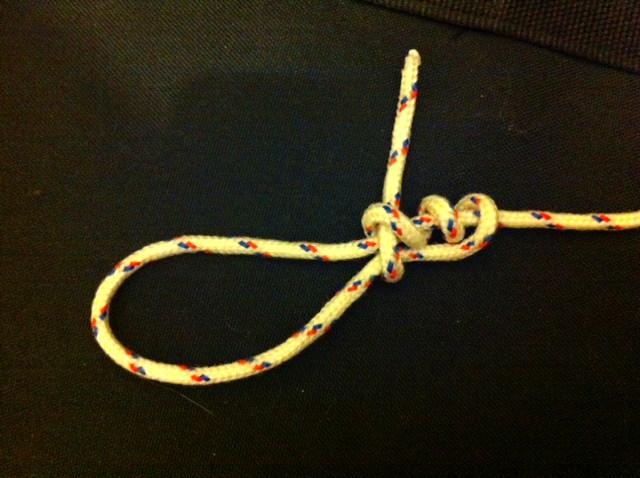
Adjustable Grip original
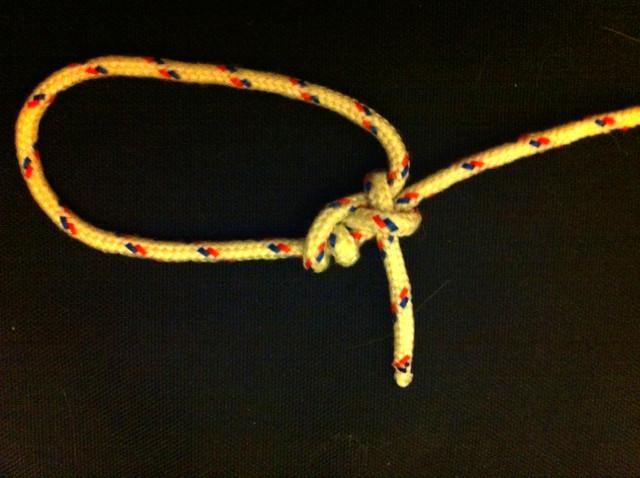
Adjustable Grip Reversed
Adjustable Grip - Luca’s Variation
It seems that variation (3) when used as a binder holds less strongly than reversal (2) (AGR). It seems not to like the almost-180-degree angle. Then I tried to apply knot4u’s reversal (as in (2)) to Luca’s variation (3) with the result of
4. Adjustable Grip - Luca’s Variation Reversed
This one seems to function better as a binder, probably closer to (2)'s strength. On the other hand (3) performs better when used with an acute angle between the loop’s legs, more like the original Adjustable loop
this is another adjustable grip knot i find useful. it’s very similar to a taught line, but the end is make like a consrictor knot instead of a another half hitch
I understand one s enthusiasm with a knot mechanism : a constant source of joy for the knot-tyer. However, I have to add that there hundreds of similar knot mechanisms, able to “slide or hold just when we want “. The possible " Adjustable Grip” hitches are perhaps the most numerous set of knots, and, of course, we know and use just a few only of them. One can say : I have found one knot that “simply does what I need of it” , end of the story. Most knot users do exactly this. Or, he can ask himself : " Is there any other knot that can do even more, much better ?” If he falls into that trap, he becomes a knot tyer… and me, personally, does not know if there is any way to free himself from this, ever.
There are many “occupational knots” used by specialists that are meant to function as adjustable hitches : by climbers and arthroscopic surgeons, for example… Knots that are used as one link of bends, or as hitches, can also be used as adjustable grip hitches, if they grip the straight tensioned line hard enough - I guess that many fishing knots can be transformed and used in a similar manner. It would be nice if there was a systematic presentation of all those knots, but I am afraid that the present knot tying community has not reached the critical mass needed to be able to do what has to be done.
Great knotty work, and very beautiful photos!Thanks.
The knots that you to show also to me seem those that have been discussed.
Handling with these 4 versions of the knot, when I decided to simplify the knot to the maximum (thus avoiding adding any additional wraps that usually are added to increase the grip), I realized that fundamentally the Adjustable Grip is a hitch, around the SPart of which,is provided a Groundline hitch:
If you note, with regard to 1(the original AG)and 2(AGR (orRAG)),the groundline hitch around the SPart is loaded on the contrary from the leg of the loop adjacent to it, with respect to the knot linked by me above;while, with regard to 3 (“Luca’s Variation”? .. oh .. oh .. thanks!But maybe it’s more appropriate"misunderstanding variation",and for 4"Urfin Reversed misunderstanding variation"!)and 4,the Groundline is loaded in the same way of the standard Groundline by the leg of the loop.
Now, if 1 and 2 are normally used respectively: 1,for a normal loading around a pole thin enough to make sure that the two legs of the loop remain almost parallel (loading the “inverted” Groundline lenghtwise respect to the SPart to which it is wrapped);and 2,for the mid air loading around an object much larger than the diameter of the rope,so that the two legs of loops diverge with a very wide angle(loading the inverted Groundline perpendicular to the SPart),and if 1 and 2 are better than 3 and (perhaps!) 4, for these two different tasks, and I think so, if only because they are considered as knots recognized and experienced,then I wonder (a little off topic (and of course I’m not asking only to you,Urfin))if the reversed Groundline hitch is actually a hitch better[in perpendicular and lenghtwise(both lenghtwise directions?)loading] than the standard Groundline.
EDIT:Although, on second thought, maybe it’s a silly question, because the task of a “pure” Groundline Hitch is different from the task that has a Groundline hitch(reversed or not) applied to Spart of an Adjustable Grip hitch.
X1
You’re right that was not informative. I had in mind (and neglected to describe) the following behaviour: when the object is not very large and you tight the reversed AG loosely so that the legs of the loop form an acute angle, it’s possible to simple pull on the standing end and the loop tightens like a noose (depending on the material it might need a little help moving the knot). When it tightens and gets close to the bound object it switches to the standard friction hitch mode of operation. This feature seamed to me very convenient and together with the ease of tying (much faster than Blake for me) made me enthusiastic about it.
Luca
I’ve only used the Groundline hitch (and its beefed up version, I think it’s called Ossel knot) to hitch to a thicker line:
This maybe has to do with my silly question which I wrote above,I think;the knot used around the standing part of the hitches we’ve talked about, in their shape is,however,like a Groundline hitch(if you reduce it"to the bone"), in any case I thank you, because I did not know the variation you speak: is this?
 :), is to watch the ends of the tails : If they pass