I define a mid-air binder as a binder that does not require the knot to touch the object. They’re useful knots to know! I recall being embarrassed once when I tried to tie Reef in mid-air. At the time, I thought the Reef could handle all my binding needs. I was wrong! As another example, a Constrictor hitch is not a mid-air binder because it needs to touch the object in order for the knot to hold.
Here are my favorite mid-air binders:
Adjustable Grip Reversed
Blake Reversed
Gleipnir, and variations thereof
Pole, the one with two nipping turns
Tautline
Two Half Hitches
For most of these, I slip the working end. I most often use Two Half Hitches Slipped. I know: It’s boring and simple. However, it is quick and works well enough for most applications. I sometimes add a Half Hitch lock at the standing end for more security.
It’s important to note these knots are ring loaded if they’re tied in a binder. That’s one thing that makes them binders, rather than hitches.
I understand that there are two situations where we may need such a knot :
A1. A mid/air binder, where we have access to both ends of our rope. When we want to bind tightly a bunch of objects, but the point where we tie the knot is not in touch with the surface of any of them, so we want our knot to remain tied and tensioned, suspended in mid air.
And/or :
A2. An binder + hitch application, where we have access to one only end of our rope. When we want to bind and pull a bunch of objects, but anticipate that we will may need to remove some of them at some time later, without untying the knot. ( or that some of them will slip off by themselves ! :)). However, we want our knot to hold even after this, to remain tied even if not tensioned as a binder, but as a hitch, suspended in mid air, or as fixed end-of-line loop, that will sometimes be more or less ( :)) “ring loaded”.
Binding tightly tubes together, when we plan to be able to move them and remove some of them without untying the knot and tying / tensioning it again, is the first thing that comes to my mind, where we have a situation 2. And if the tubes are only a few, we still have a situation 1, even if we do not remove some of them - because we can not probably be sure that a knot tied on the hard surface of one tube will remain at this point later on.
We may have enough room o move our hand(s) around the point we want to / can tie our knot - or we may not. So, the possible situations are doubled ( B1 and B2). If we do have enough room, any end-of-line bend that can be tightly tied at the first place, can possibly serve as a mid-air binder B1, and many of them also as mid-air binders + hitches B2 - because pulling them by a tail will not untie the knot. If we do not have enough room, and we are forced to tie the knot in mid-air and tighten it only afterwards, we have to :
tie a noose around the object(s), tighten it and then secure it somehow.
tie a loop on the one end, and then pass the other end through it, pull it and tighten the knot, and then secure it, as in the previous case.
Tie an adjustable binder like one of the many we have been talking about the other day, and then tighten the knot by pulling the end(s) parallel to the surface of the object(s), and then secure it/them.
4…
The problem is very interesting, I believe. I do not have much experience in this kind of situations, and I can not tell right now what is the best knot of the many one can think of.
The only thing we can not do, is to achieve this purpose by tying two half hitches ( you will need four…) - unless you mean tying the Sheet bend, the Whatknot, or any of the four double harness bends we might consider to be interwoven half hitches. Can one manage to tie any those knots tightly enough, so they can serve as mid-air binders ?
I tie mid air binders ALL the time when tying down my ladders on my truck. I not only tie them down at the ladder rack point, which is obviously two points per ladder, but I’ll put a packer’s knot in the middle of the stack too. I’d rather use the Gleipnir but it just takes up so darn much more material to tie properly.
Here lately, I’ve been tying down my ladders using all packers knots. Tying the figure eight around the standing part and then hauling down tight with a half hitch lock. I’ve been doing this even on the racks themselves…I was using a truckers hitch for the part that sits atop the ladder rack but the packer’s knot is easier to tie and I don’t have to climb a ladder.
The Gleipnir’s a thing of simplicity and beauty IMO but Jeez, it takes up a lot of rope to actually utilize it. I’ve been toying around with it on books and such and it will destroy a hardback book if you’re not careful. The packer’s knot gets no where near the tension of the Gleipnir. The license plate on my old fishing boat is tied down with a Gleipnir and then a square knot for good measure. I had to be careful when tying it around the plate, I could’ve easily forced enough tension to bend the crap out of the plate. It’s tied around box tubing too…constrictors and such weren’t going to work in this case…a packer’s not would’ve though.
With boot laces or 550 paracord, I can tie a mid-air binder just fine by using Two Half Hitches (slipped for untying convenience). The main limitation is my strength. For me, it works better than the Packer Knot.
Of course, an improvement on Two Half Hitches is a Tautline, which is basically Two Half Hitches with an added Turn in there. When the Tautline is used as a mid-air binder (a.o.t. hitch), it’s being ring loaded, which involves different forces than the hitch form.
When you say using two half hitches, I assume you’re basically tying a packer’s knot? The only difference being you’re not using the fig 8 but just a half hitch and then you’re taking the SE and locking it with a HH?? Is this correct?
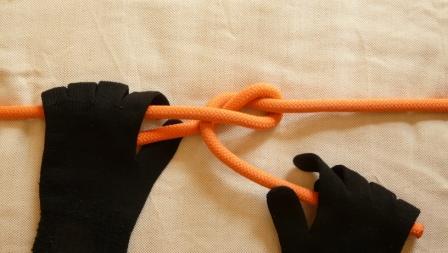
That pic looks like a hitch, but you get the idea. Just imagine the green object as being huge. Below is the slipped version. After cinching down, the knot may be made more secure by applying a Packer Knot ending (not shown in pic).
The size of the oblect can not make a hitch to look like -or turned into - something else…This hitch will be safe as a binder only if the standing end is and remains loaded. If it is not, we should use 4 half hitches…or find something more clever.
I believe the knot in your pic is overly complicated and inconvenient if the knot happens to be pressed against the object. Instead, obtain final security by applying an ending like in the Packer Knot. In other words, after cinching down, use the standing end to tie a Half Hitch around the (slipped) working end. This ending will hold secure and won’t jam. Further, you don’t need access to the tip of the standing end. To untie, simply undue the Half Hitch at the standing end, and then pull out the slipped working end.
I have used the Gleipnir many times now - especially as a throw away knot around rubbish secured with a half hitch either side and as a binder to keep the lid on my lunch box because the catch slips (in the latter case I use cheap garden string which generates high friction and cut it off!).
However I had a try with a tautline as it uses less cordage (and it can be loosened to add more to a bundle. Has a better grip than the packer’s knot which I only occasionally used when it would be cut off rather than undone. Now I’ll use whichever seems best at the time (large bundles, the tautline but my lunch box can stay with string-and-Gleipnir simply because I like it).
Evidently…I said it is NOT clever, so you can imagine what do I think it is…
However, it is the simplest secure arrangement using (non-interlocking) half-hitches, and half hitches only. The knot in your picture, with two half hitches, is not secure.
The most simple secure arrangement of two interlocking half hitches I was able to figure out, is shown in the attached pictures. The second (at the right) half hitch can be tied in any of the two orientations (A or B).( I do not know if it has an(other) name, or if it can be considered as a variation of another knot.)
Hi Xarax, I’ll have to try out your knot! However, before this gets out of hand, understand we are fundamentally talking about different concepts.
The Two Half Hitches I’m describing is like a replacement for the Figure 8 in a Packer Knot. I showed the pics as an unfinished knot for simplification. The knot holds the tension before you take a breath and then finish it. As I explained above, once you’re done cinching down, you can add a Half Hitch ending like in the Packer Knot. This ending is totally secure, and the knot cannot be made loose by pulling on the loop portion of knot. Also, you don’t need access to the tip of the standing end. As long as you have access to the tip of the working end, you can just as easily tie this knot in a rope that is one million feet long.
For non-critical applications, you don’t need to apply the Packer Knot ending, and the Two Half Hitches will hold well enough. I do this when the knot needs to hold for a short while and when someone else may need to untie the knot. Last weekend, I used Two Half Hitches (Slipped) to keep closed an overfilled ice cooler. (My bootlace was too short for a Gleipnir.) The cooler was tossed around in the back of my car, but the knot held secure until my 9-year-old niece (who knows nothing about knots) was able to untie the knot by firmly pulling the slip, just as I planned.
That makes sense, (now ! ) However, if you want to secure this knot by half hitches, you will probably need two more - and not only one, as you say -, so the complete knot would be the same as the 4 hitches knot we condemned as overly complicated and not-so-clever.
So, you are trying solutions for the “loop” part of the situations described at Reply#1.
You tie two half hitches to make the "neck" of a noose, and then you secure the tail of this noose by one, or two ( as I think you should...) half hitches.
My solution shown in Reply#9 , for the same part, ( left, in my picture ) involves something that could be considered as one half hitch, or as the one link of a Sheet bend . Because of the tight way the two parts are interlinked, to complete this knot we could possibly use only one half hitch ( that can be tie in the one (a) or the other (B) orientation).
Try the knot, and tell me if it is secure enough as it is, or if the second (right, in my picture) part , should better need two half hitches, to be absolutely secure.
( I do not have much experience in using “sliped” endings, but I agree that they are useful means to prevent jamming.)
If you’re using climbing rope or whatever that is you’re using, I can see why you think more Half Hitches are necessary. However, when I use bootlaces or 550 paracord, one Half Hitch lock is sufficient (just like in the ending of the Packer Knot). Actually, the Half Hitch lock is usually overkill for non-critical applications where I’m using boot laces or 550 paracord.
I believe this is a very good point made by knot4u, not only in binders, but all working knots. For most applications, it’s more useful to be able to tie (and untie) something quickly than secure, which explains the popularity of knots such as bowline, sheet bend, reef knot and clove hitch.
I would use the buntline hitch instead of three-four half hitches (suggested by xarax) to add more security and tension, but there’s probably a greater risk for the buntline to jam.
For a flying binder where the object isn’t too small and tension is important, I would choose the versatackle.
“Two Half Hitches will never slip.”
I believe that we use two half hitches most of the times, probably because we need them more than the knots themselves. I mean, our eyes are so accustomed to the image of it, our hands are so accustomed to the gesture of tyimg them, that our brains have no choice but follow, whether it is really needed by the particular material or not…
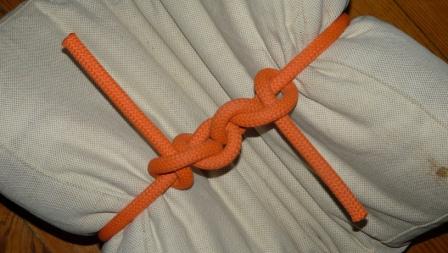
The mid-air binder shown in Reply#9 (1) and at the attached pictures, can also be described as a " Blackwall-hitch-tied-through-an-overhand-knot " ( and not through a hook, as the ABoK#1875 ). Ashley mentions that the Blackwall hitch " is never quite safe unless the rope is large enough to fill the mouth of the hook ". With an overhand knot, it is the “mouth” that shrinks :), so the rope can not but fill it, however large or small it might be.
During the set-up and dress phase, make sure you keep the (left link) tail adjacent and parallel to its standing end ( as shown in the first picture of Reply#9).
If necessary, secure the binder further by one half hitch at the left link, or one half hitch at each link.
I just fiddled this in 2mm? PP kernmantle, which nicely holds
a 25# weight; and in 1/4" PP 3-strand rope, which holds but
which I can’t further hoist/tension a 37# weight (one end of
the structure is girth-hitched to 'biner clipping weight, the
other runs around a 'biner at the top; I’m hauling downwards
trying to increase tension, but in vain). YMMV.
I think that we are talking about two quite different types of knots here ( but I am not sure I can explain what I mean…). At the end of the tightening phase, we can have one, more or less compact, knot nub, i.e. a proper bend - OR we can have two knots nubs, at some distance the one from the other, connected by their tails, that form a compound knot ( the tail of the one knot penetrating the nub of the other knot ), i.e. a proper binder. Some of the knots described at this thread belong to the first type ( for example, the knot described at Replies #9 and #15 ) and some to the second ( the Gleipnir and Gleipnir- like binders, the Trucker and Versatackle (single and double) binders, and the knots described at 1, 2 and 3 ). In both cases, at the end of the tightening phase, the two standing ends of the two links are brought close the one to the other by the pulling of the one or both tails. However,
1 : in the first case, the end result is one fixed knot, and the standing ends can not be brought closer any more, at this or at some other time later.
2 : in the second case, the tails can be pulled more, and the standing ends can be brought closer, even after the two tails are locked by the two knot nubs. In fact, in the second case the end result is a two-nub compound knot.
A Buntline (ABOK #1711) is difficult to jam as a mid-air binder. I have a strong feeling we’re not having a meeting of the minds. Pics may be necessary.
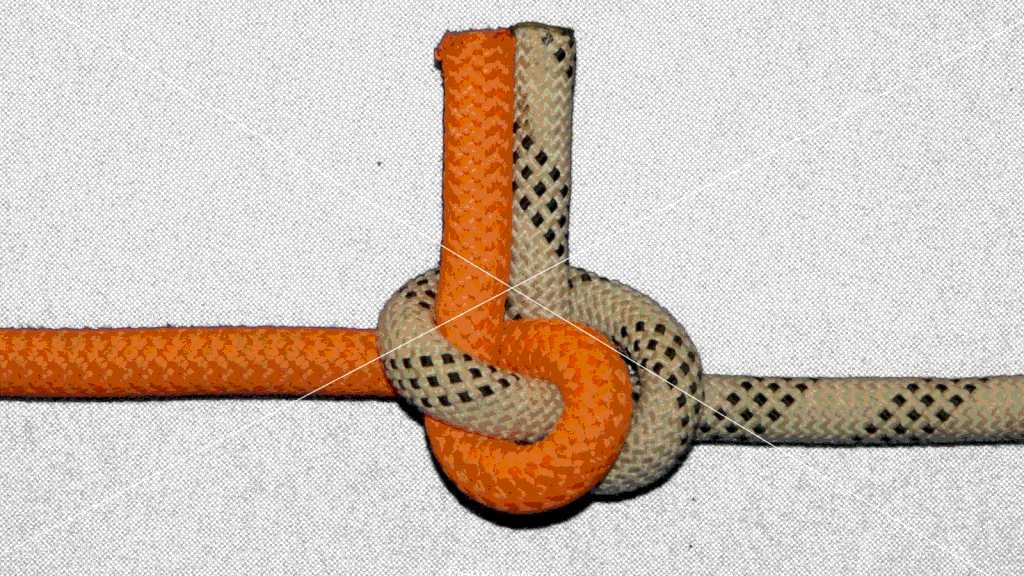
Hi, I’ve tried googling the “Adjustable Grip Reversed” knot, but this seems to be the only place it’s mentioned. Since you mention it first, it must be interesting. I’ve tried guessing in what sense it is “reversed” and this is what I came up with. Is this what you’ve meant?
 ( you will need four…) - unless you mean tying the Sheet bend, the Whatknot, or any of the four double harness bends we might consider to be interwoven half hitches. Can one manage to tie any those knots tightly enough, so they can serve as mid-air binders ?