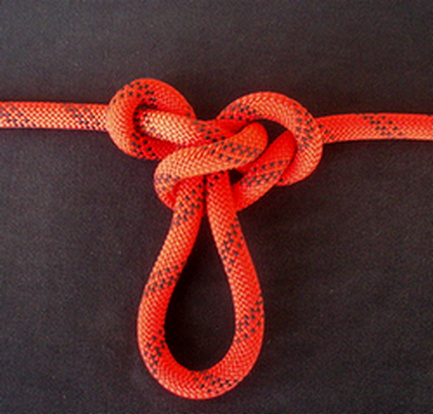
Mid-line TIB Tryout

@tsik_lestat

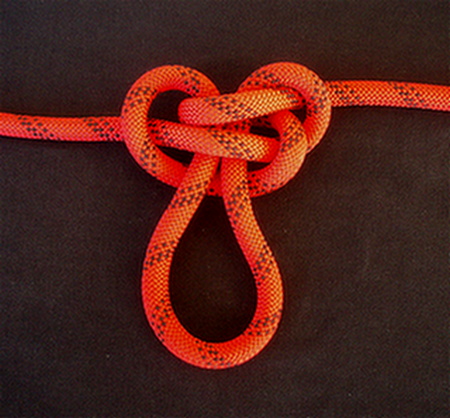
Your recent middle of the line offer gives me some ideas about a jamming resistant TIB loop.
I don?t know if this form has been yet represented.
The eye part of the loop presented here being protected somehow by the last collar “seems” jam resistant to a better degree. The crunching action of the nub is lessened by the accumulation of rope diameter.
Does it make sense?
What do you think?

jr.

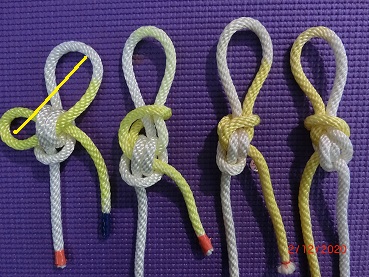
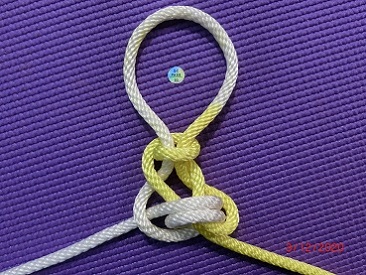
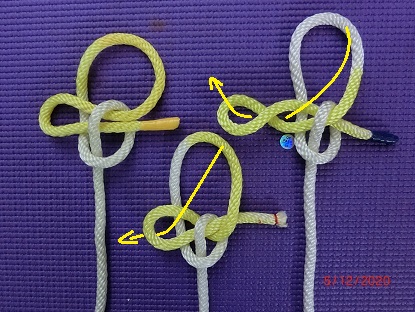
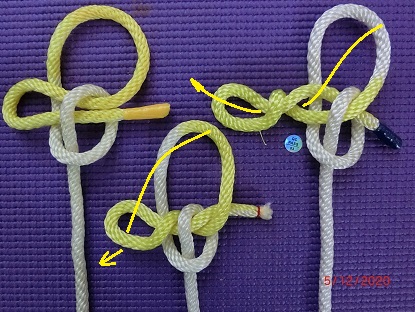
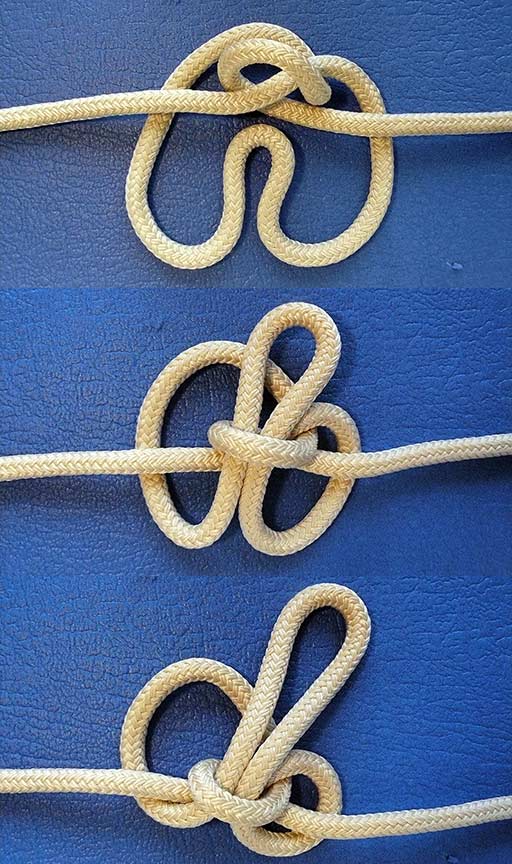
images- Loose form
Side A
Side B


Side-A.jpg

I think it’s good, although the dressing states you show, may appear rather complicated at first glance to a random reader.

However, if one delves it more deeply and caresses the nub a bit, he will realise that the idea behind this knot, is neat and simple.

By flipping the collar that encircles both eye legs and getting the end of the line profile, i see it corresponds to a type of girth hitched based TIB bowline, while the proposed inline knot structure, constitutes its midline version of this very bowline. Dare i say, that the combination of two non jamming components, like a girth hitch and a crossing knot, synthesized to form your structure, is very good tactics.

This generalised methodology of feeding a loop with certain or no chirality and its continuation bight (eye), through simple basic knot structures ( girth hitch, pretzel, crossing knot e.t.c), may be regarded as a TIB eyeknot generator production.

I recall that knotsaver had developed such a method for end termination eyeknots, which could be applied for every TIB eyeknot construction.

Based on that, we can generate myriads of TIB knots, and given that we can’t test them all, it might be hard to separate the good as they come.

Thanks for breeding new ideas.

Yes, I have to admit that this form requires a lot of attention to decipher. But it is possible since you did it without any harm :wink:

It has some pros and cons and I was batting for non-jamming effect.
I must confess that I did this loop right from the start as a TIB exercise, I never thought to consider the end of the line profile as you did.
This proves that you are a more thorough knotter than me. :slight_smile:

Often I use this method of feeding a loop through part of a nub I am fiddling with just in case that there is some hidden treasure hiding ahead.

I too find the approach of describing a knot by dissecting it in smaller components very practical ; as you write, “through simple basic knot structures”
And this approach could be extended to teaching knots to children, give them a kind of “abecedaire”.

Thanks for your review, you are always a pleasure to read you.
jr.

I was thinking about your subtle method that generates TIB loops and it occured to me to replace your initial girth hitch, with a fairly simpler basic structure, a crossing knot, and then proceed with the bight /bight feeding.

The resulting knot, being a product of our interaction rather than a straightforward approach, appears to be the inline version of a bowline i had tied, therefore i redirect you to the original source if you care to revisit.

Link : https://igkt.net/sm/index.php?topic=6841.msg45516#msg45516

        enhaut, tsik_lestat ,
                                Excellence work ! I thinks we got it this time.
                                Loop 001 can transform to improve version of Farmer' loop,
                                I will make a video for it.
                                Crossing knot +Figure 8 knot loop may work too, will look into it.
                                Have some test on the first 4 loops, are doing well with soft rope.
                                 tsik_lestat you knot look great, don't have time for quick test today.
                                will check it tomorrow.
                                Here is the link of some my previous work.
                                 https://igkt.net/sm/index.php?topic=5383.105  
                                  謝謝 alanleeknots.
             More knot

Enhaut s loop.JPG

      Hi All,
              Busy day yesterday, good night sleep and got some of the information digest.
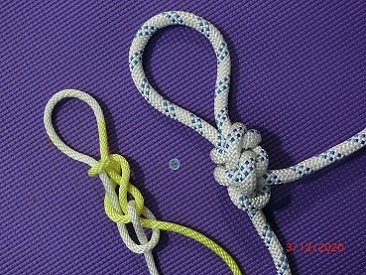
              Two photos here, can solve some minus issue when loading on the yellow standing 
               part alone.   We are getting close.  謝謝 alanleeknots.

005.JPG

006.JPG

@alanleeknots
Hello, I am glad that you joined this topic with your offers.
I have tied the first 4 mid-loop and I am really enjoying your nib component approach. Still working on 5 and 6.
The presentation is superb, I can now tie my own loop with more efficiency. :slight_smile:
For now I am waiting for the results of your stress tests.
Thanks for sharing.
jr.

@enhaut,
I will do more test for your knot, While you are waiting, give you a little project,
just pull the top collar’ down you will find some knot, see if it good for anything.
謝謝 alanleeknot


Crossing knots Project.JPG

       Hi All,  
                Is a huge project, need some help here, I believe we have some good knots here.
                We can do the same thing to Negative nipping loop, with anticlockwise rotation.
                Hope you are on the same page with me.  謝謝 alanleeknots.
                                                          More knots.

P  Clockwise 12 hrs.JPG

P  Clockwise 18 hrs.JPG

                              @ tsik_lestat,  
                                                  Congratulation !!! Beautiful !!!  awesome !!!  I got you knots fixed, all good now. may good for jam proof.
                                                    I have few to share with hope you like it .    謝謝 alanleeknots
                                                      https://www.youtube.com/watch?v=Ws1WDnvOHVg
                                                       https://www.youtube.com/watch?v=W1uderDI1sA
                                                        https://www.youtube.com/watch?v=7DA6-BwvXAE&t=52s
                Hi All,  
                        Ring Hitch Mid-Line loop can be tie using the same method I tie for tsik_lestat Mid-Line.  
                         It look nice too.

Hello Alan, i apologise for my late response, i’ve been busy.

I wish i had four hands available for tying, in order to to keep up with your offerings, being impressed of your never fading source of creativity! That’s quite enough knotting work to process, but i am not complaining.

If i had to name a knotter who might exhaust/cover the tibness in crossing knots concept, that person would be undoubtedly you.

Back in OP, I am kind of stuck on the crossing knot project, at reply#8, as they look rather simpler, exploring also " the “what if” contingencies, but that does not mean that i do not appreciate the rest of the stuff, i am really trying to catch up! I believe you have stricken gold treasure here! Is the second at reply#8, the span loop?

Have we got any stress test for any of these? It’s good to have a clue about their response!

Thanks a lot for your videos, (for giving a go to my inline proposition), and for all this great stuff, and of course Enhaut for launching such a fully intriguing dynamic topic!

Keep on processing…

Gentlemen, you might want to have a look and re-examine the inline variants, of your prototype, end of line, bowline structures.

Some quick observations by me…

  1. Conceptually simple, nub structures, with one of their links having the simplest form (the nipping loop).

  2. Nice opposite geometry SP orientation, a legitimate factor for inline depictions.

  3. Fairly good eye loading profiles, with an unblocking collar component (the one that encircles both eye legs).

  4. Very good SPart to SPart, loading profile, especially to Alan’s knot, while Enhaut’s knot appears to lag behind in that sector, but it functions properly when eye loaded. The myrtle turn, which captures the nipping loop’s crossing point, does make a difference afterall.

  5. I’m not sure how the more compex link, (myrtle, wheel turn), affects the overall jamming immunity, and i’m interested in finding out!

6)The eye legs are in a side by side geometry, going along with the more compact 1051 style, but they could be crossed to coordinate with your original versions.

In search of TIB tying methods… :slight_smile:

Happy new year to all!!


Hello tsik_lestat and alanleeknots
Thanks for your interesting review;
" I’m not sure how the more complex link (myrtle, wheel turn), affects the overall jamming immunity, and i’m interested in finding out!"
Testers out there please give us a hand!
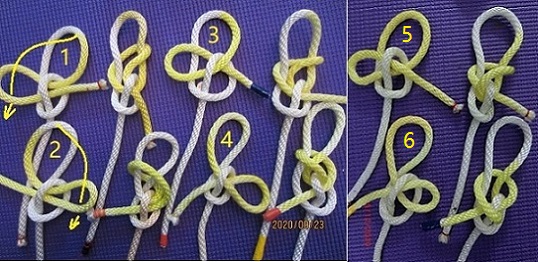
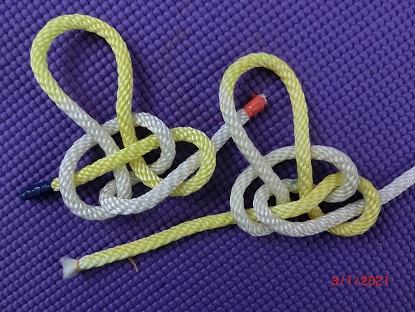
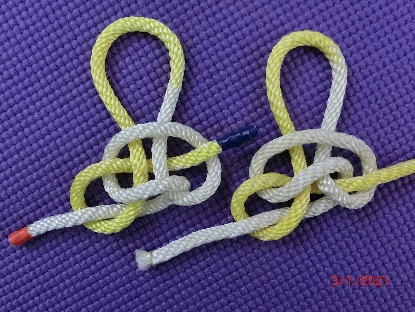
I tried a reversed sequence to see how Alan Lee would perhaps tie his knot with his twist method.
The result is below, hope I did not make any bloopers.
and;
Happy new year!

Images
S?quence 1-2-3
S?quence 4-5-6
Alan Lee’s inline bowline-web


S?quence-4-5-6-web.jpg

Hello enhaut and tsik_lestat, Here is the video, hope you like it. https://www.youtube.com/watch?v=Hf2iFit3iVI&t=93s
tsik is you knot don’t give away. 謝謝 alanleeknots.


Enhaut & tsik_lestat s knot. 1.JPG

Enhaut & tsik_lestat s knot.-2.JPG

@ Alanleeknots,
Of course I like it !
I would not write a dissertation on the merit of one versus the other but the slight difference is intriguing in terms of jamming threshold. We need testing over and over.
Thanks Mr. Lee

Enhaut, after seeing your marvelous tying step illustration, i realised that it was exactly how i had tied in the bight, when i reverse-engineered the structure in the first place.

Of course, Alan Lee’s double twist method is awesome too, plus it resembles somehow, with one of the butterfly tying methods.

Rearranging the eye legs (to follow 1051 style), and presenting a slightly different loading profile of your knots, does not make me an inventor, more like a user of your innovative ideas.

The inline profiles, appear to be quite compact in this form, however, the end termination profiles, technically, have been banished from the bowline zone, by pushing the third rope diameter out of the nipping loop.

Nonetheless, i see that there is plenty of versatility, as one may develop, several end of line configurations, (including the Eskimos), by using the complex link, as an SP, or a WE, or even an eye leg continuation component, depending on the application. That’s what i like about TIB knots :).

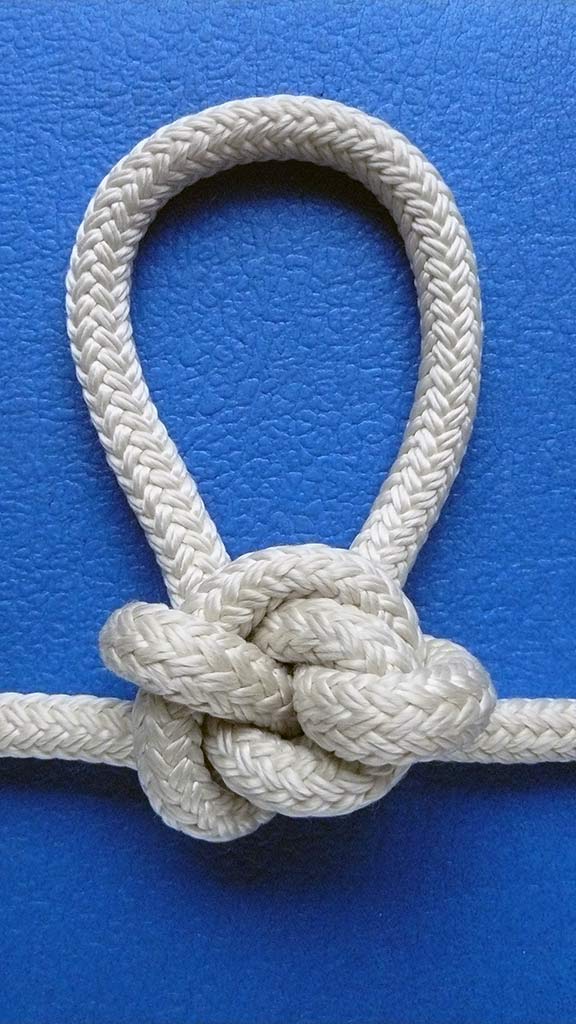
Now, let’s try a different technique, by implementing the rule " first collar then turn", the exact opposite of the previous approach, which was " first myrtle turn then collar", in order to keep the (end of line) knots, in the bowline zone.

Pretty stable resulting knot, with no overhands and two lines of defence against slippage as previously, but that doesn’t ensure jamming immunity right up to its MBS yield point.

@tsik_lestat
In the spirit of knowledge advancement that I see you are working for indeed you are more than welcome to rearrange the knots, I present on this forum.
There is no occurrence when your thoughtful fiddling gave way to lesser results.
It is an honour really when you take the time to adjust one of my offerings.
In fact, I don?t have to give permission to anyone, it is just natural to thriving for the best output possible.
Imagine Ashley’s ghost haunting our dreams because we took liberties with his #1010.
Now I have to study your last post.

jr.

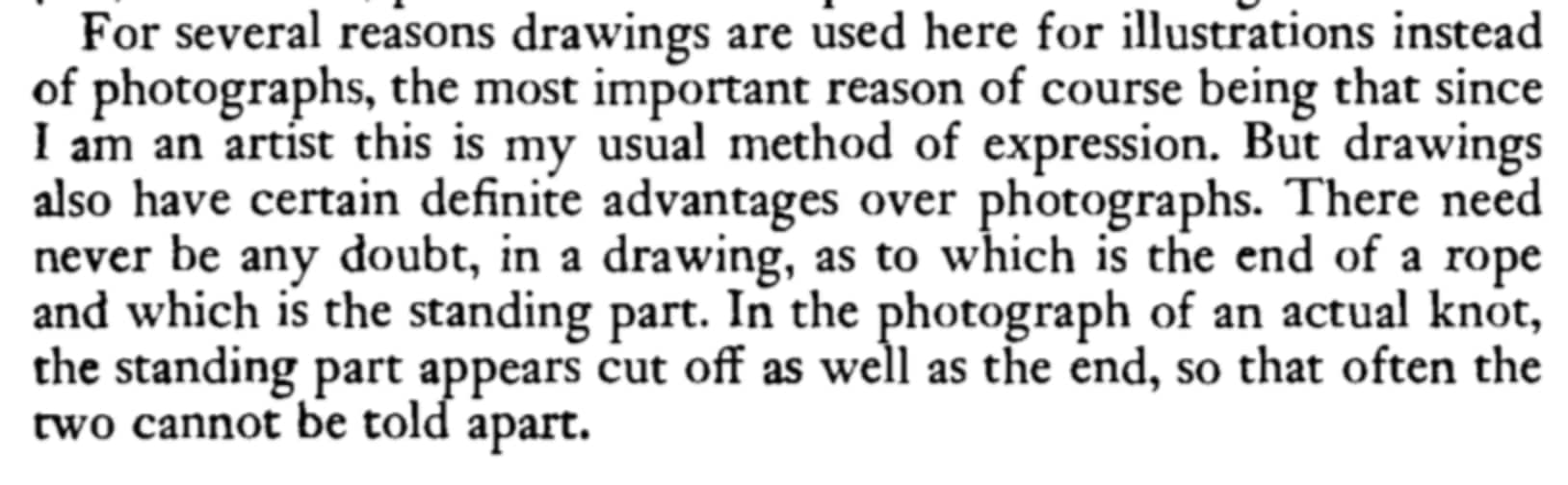
Image = caption from Ashley’s Book who explains that he had to choose between photos or drawings.


choice-web.jpg