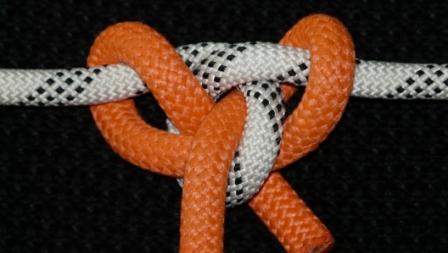
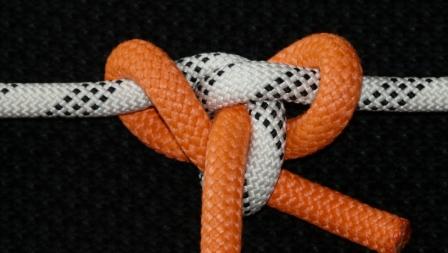
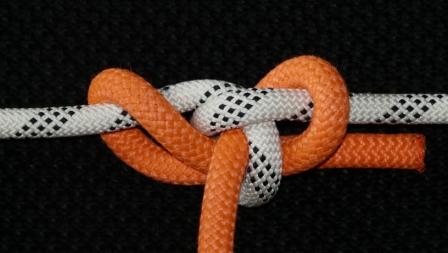
There are six classes of two-line bends: in the case when we have to join two lines, and only the one end of only the one line is accessible, we need a “mid-span” or “mid-line” bend. (The bend should be able to withstand a pull coming out of any end(s) and any direction(s).) A very simple midline bend I can think of is the “midline bowline”, shown in the pictures below (in three variations). Of the many alternatives one can think of, which are the most practical ?
…although the Midspan Sheet Bend can also be made with a minor variation that fits your scenario, such that the U shape is the rope without end-access. This could be modified to a Double Sheet Bend form easily.
Thank you roo,
I dont believe that some friction hitch around a straight rope line, any friction hitch, can serve as a reliable bend…(with the possible exception of the ww hitches). We have to anchor our knot to some curved section of the mainline, be it a loop or else, to achieve a sure footing ( take advantage of the vastly greater friction forces along curved segments ).
The midspan sheet bend is a fine bend. In fact, I do not know any other simple bend that can do its job. However, it addresses the problem/case where we do not have any accessible rope end - so it is probably not the optimum solution for a “midline bend” in the sense described in this thread. Also, even in the modification you propose, it remains a sheet bend, which is not a very secure type of bend for slippery ropes, I believe.
The Sailor’s Hitch, when tensioned by the standing part and free end, will often cause the passive rope to contort such that it is no longer straight, depending on size ratios.
If you are looking for a high-security joint in slippery lines, I’d suggest tying a Butterfly Loop first, and then attaching to that loop with a high-security structure, such as the Zeppelin Loop. A Gnat Hitch could also be used.
Also, since every loop is, at its core, a three-way connection, you can look for some loop knots that can take ring-loading, and can be tied per your scenario. A Water Bowline form works.
That all knots that are worth to be known, are already known.
That you know all known knots.
That only the known knots, or the knots that you know, that are peer-reviewed and field-tested, are the only knots that can possibly embrace simplicity and reliability.
I know many knots that you do not, and vice versa. And I believe that there are still some knots waiting to be discovered, just under our noses - as was the Gleipnir, for example. The “new knots” I know are not peer-reviewed and field-tested, possibly just because most people believe that all that could be known, is already known…and not because they are complex and unreliable !
Leaving this issue aside, I think that the “midline bowline” bend, i.e. the knot nub of a simple “mirror bowline”, is a knot simple enough, but not tested in this form. I do not know if it is reliable if any end(s) is/are pulled from any direction(s), as required. The Zeppelin loop tied onto a bight formed by a Butterfly loop, is a reliable solution, of course, but too “complex” and not so clever and economical in material use, as it could be, I think. ( I put the word “complex” between quotation marks, because the simple arrangement, the one after the other, of two simple knots, do not make a complex knot…) I feel that, in this solution, much of the rope material used is redundant, and could be eliminated.
Yes, but, even if the knot can withstand ring loading, the eye leg of the bight tends to deform the knot s nub if pulled from some opposite direction(s), and it should not be able to do this. I am not sure if this happens with the “mirror bowline” base, or the Water bowline base ( the later being more complex than the former…) So, solutions for end of line loops may not work very well, and solutions that are considered complex and unpractical for end of line loops, might well be acceptable solutions for midspan / midline bends.
I think that this is not too much of a concern for the Water bowline....It works well with ropes of great differences in diameter, isnt it that so ?
The same old argument… I believe that the tools make the applications possible, ( and the instruments/experiments make the theories falsifiable ), and not the opposite !
When you tie a rope with a bend in the middle of a line, you might not know, in advance, if you are going to pull this rope from a right angle or lengthwise. Even if you knew the precise future direction of the pull, you would prefer a bend that is reliable even if the rope you have tied is pulled from any direction, wouldnt you ?
Consider the object on ABoK page 213. Would you be able to predict, in advance, how it will move if the conditions will change ?
Not arguing, I’m genuinely interested in an application where any and/or all ends of a bend are pulled. It might be best not to think about solving this problem by thinking about variations of traditional bends.
If all ends need to be pulled and if I have access to only one end of one rope, I’d might go with interlocking Butterfly loops. I could pull all ends, and the ropes could be completely different. That’s a boring answer, but it should be a good answer to this general question.
If you have a specific application, then we can critique solutions here. Otherwise, the general solutions rule.
In the “midline bowline”, any, or even all, of the ends, except the second collar s tail, can be loaded at once.
The snoods are attached on the longline by means of such midspan / midline knots. However, many of those knots can be tied only with/on very slippery fishing lines, and most of them are similar to many-coil friction hitches. With ropes, the fishing knots I am aware of are not effective, or are too complex and bulky.
I believe that there would be many more cases where such a bend would be needed, rather than a midspan sheet bend, for example, where neither of the four ends is accessible.
The interlocking butterfly loops seems an interesting solution, indeed. Still more complex than the “midline bowline”, :). but tedted and reliable.
Here’s a fairly simple midline bend not based on the bowline/sheetbend. A bit jammy, but definitely simple and has a nice perpendicular lead. The free end of the pendant line can be loaded as well. And as roo notes above, a three leg knot like this can make a reasonable loop knot.
Many variations are possible here, including a constrictor instead of a clove hitch. I didn’t identify anything simpler and less bulky than a clove hitch though. I experimented going either right or left first after the first pass through the loop, but wasn’t able to discern much difference, at least when using a clove hitch.
If there’s concern the hitch is going to slide on the main rope, one can beef it up like this. In this case the first turn of the pendant line should go around the folded portion of the main line.
I’m not aware of ABOK numbers, at least for xarax’s knot in the OP or mine. Given the vagaries of the ABOK index and how spread-out everything is, it’s difficult (at least for me) to claim with 100% certainty something is not in ABOK. As some wise men once said, it would “be rash to claim they have never been used before.”
It’s also important to note that the pendant line in these knots is preventing the main line from straightening. Thus if there is a significant difference in strength of the lines, the pendant may fail within the knot even if no load is placed on it. This is likely a strength/predictability advantage of roo’s suggestion of using a butterfly loop and attaching to that in one of many ways.
The term “simplicity” can be viewed two ways here: there’s the simplicity of the knotted structure itself, and there’s the simplicity of understanding the likely behavior of the overall system. By using well-understood components one can gain some confidence in how the overall structure will perform.
Nice knot, dfred, very nice indeed, the first one you have presented. It IS based on the bowline, :), although in an indirect way, but that is not the issue here. It would be great if you test it and compare it with the “midline bowline”.
Thanks very much. I was pleased when I came across it. Given how little there is to it I’d be very surprised if it’s not already known. Seems useful perhaps for the edge of a net-like structure. The simpler first form seems to be sufficient for just about all the rope I’ve tried it on, so long as it is drawn-up snug before loading.
As far as the bowline/sheetbend relation… If one withdraws the final tuck of the simple form, it is really one of the so-called “single” carrick bends (e.g. #1445). I can’t find a B/SB structure in there. The flow of the line through the loop is always in the same direction, opposite to what one would expect in a B/SB structure. To use the famous bunny analogy: in the knot I pictured the bunny is coming out of the hole, going around something and coming out of the hole again, rather than going back into the hole at any point…
You can " beef up" the hitch in many more interesting ways, as you have noticed, so it will not run the danger of sliding on the main line.
Those turn(s) around the main line, can they be considered as collar-like structures, or not ? If not, I have to agree that there is no bowline structure in there, because I believe that the essential elements of the bowlines are the nipping loop AND the collar.
Interlocking Clove Hitches…if the bend doesn’t have to be untied
I’m talking about interlocking the double loop of each Clove Hitch through each other, nothing fancy.
Features:
-Need access to only one end
-Can be pulled in any direction with any combination of end(s)
-Secure even even while capsized, as long as it’s somewhat tight
-Doesn’t seem to have a natural dressing
-Jams (or seems like it will anyway)
-Has worked with some amount of difference in rope
-May work with any amount of difference in rope
This makes no sense, for the 1st-shown & symmetric knot : there is no
distinction between “tails”, as such.
Please describe an application that involves pulling any and/or all ends, in any direction.
The OP’s knot was presented in the 1928 Alpine Journal by Wright & Magowan
as a middleman’s tie-in knot --possible loading of the attachment against
either or both of the tied-to line’s ends. Another multi-loading application
is netting (which tends to add some constraints), and the common
net-knot has a sheet-bend/… form.
The snoods are attached on the longline by means of such midspan / midline knots. However, many of those knots can be tied only with/on very slippery fishing lines, and most of them are similar to many-coil friction hitches. With ropes, the fishing knots I am aware of are not effective, or are too complex and bulky.
Lobster-pot snoods are tied on with any of a clove, ground-line, ossel
hitch (and variations), with the tail tucked through the lay of the
ground-line once or more times. These knots are pulled up through
the pot-hauler’s V-grooved wheel compressing the knots. (See the
photos in “Knots in the Wild”.)
 I believe that the tools make the applications possible, ( and the instruments/experiments make the theories falsifiable ), and not the opposite !


