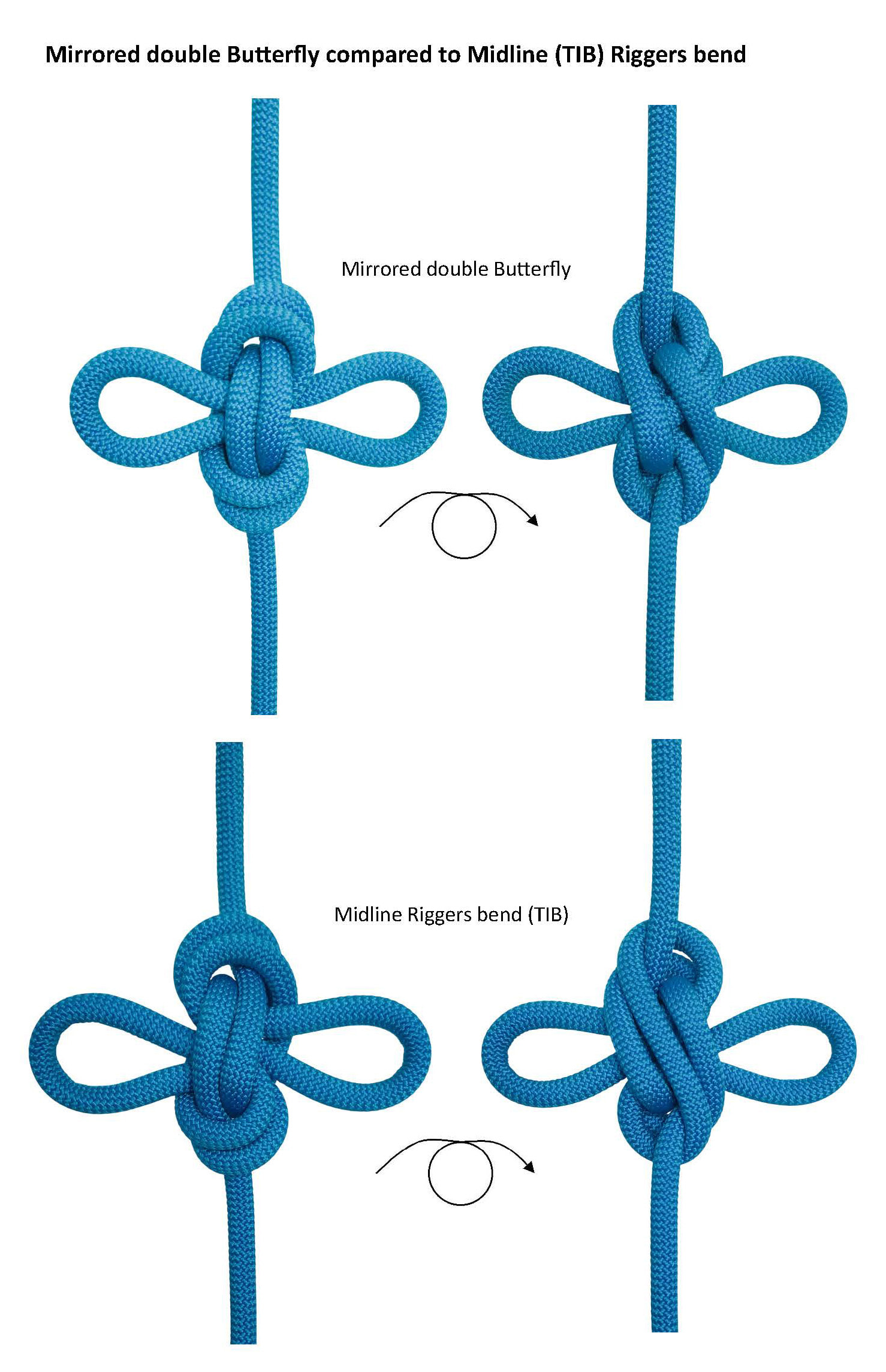
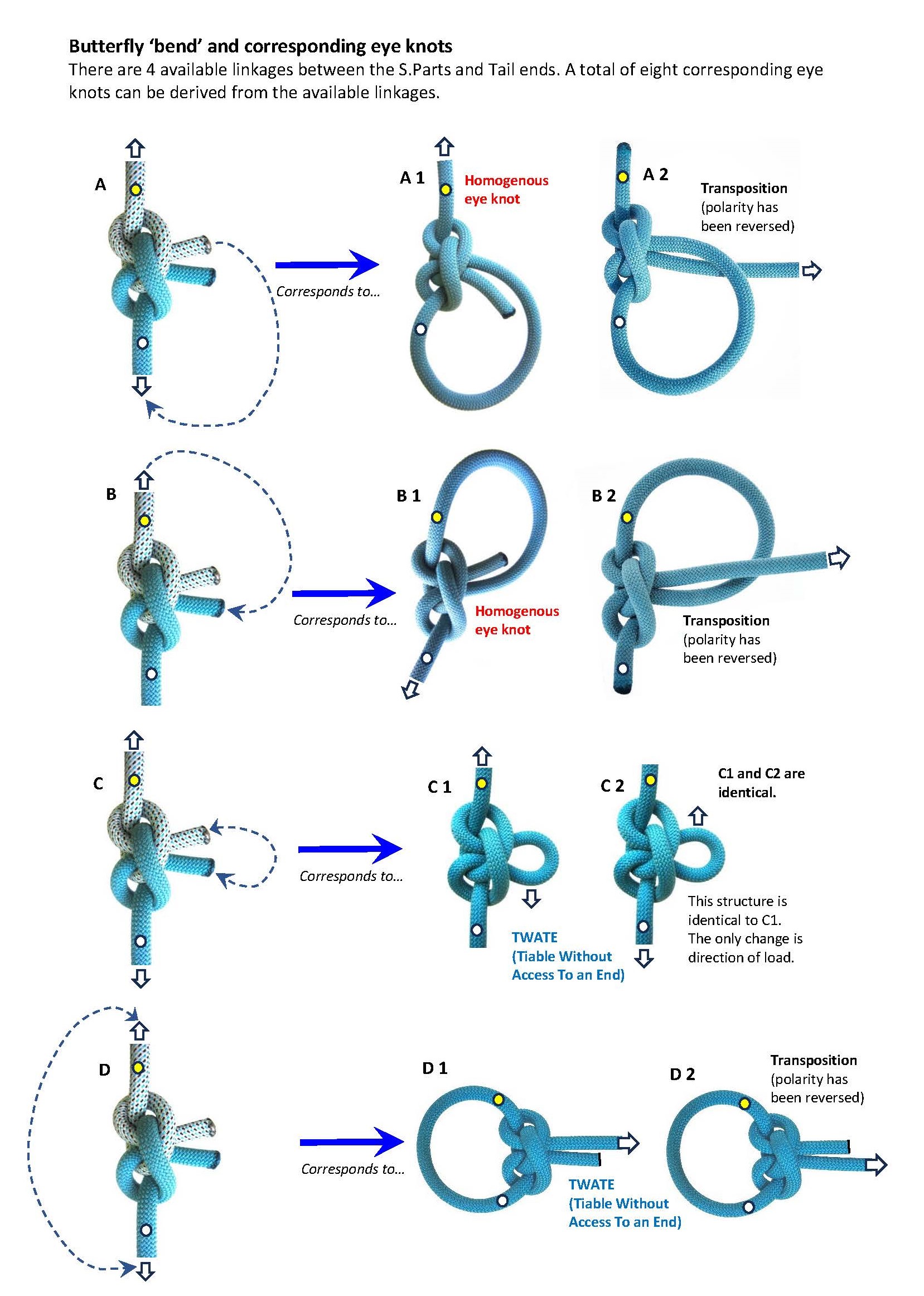
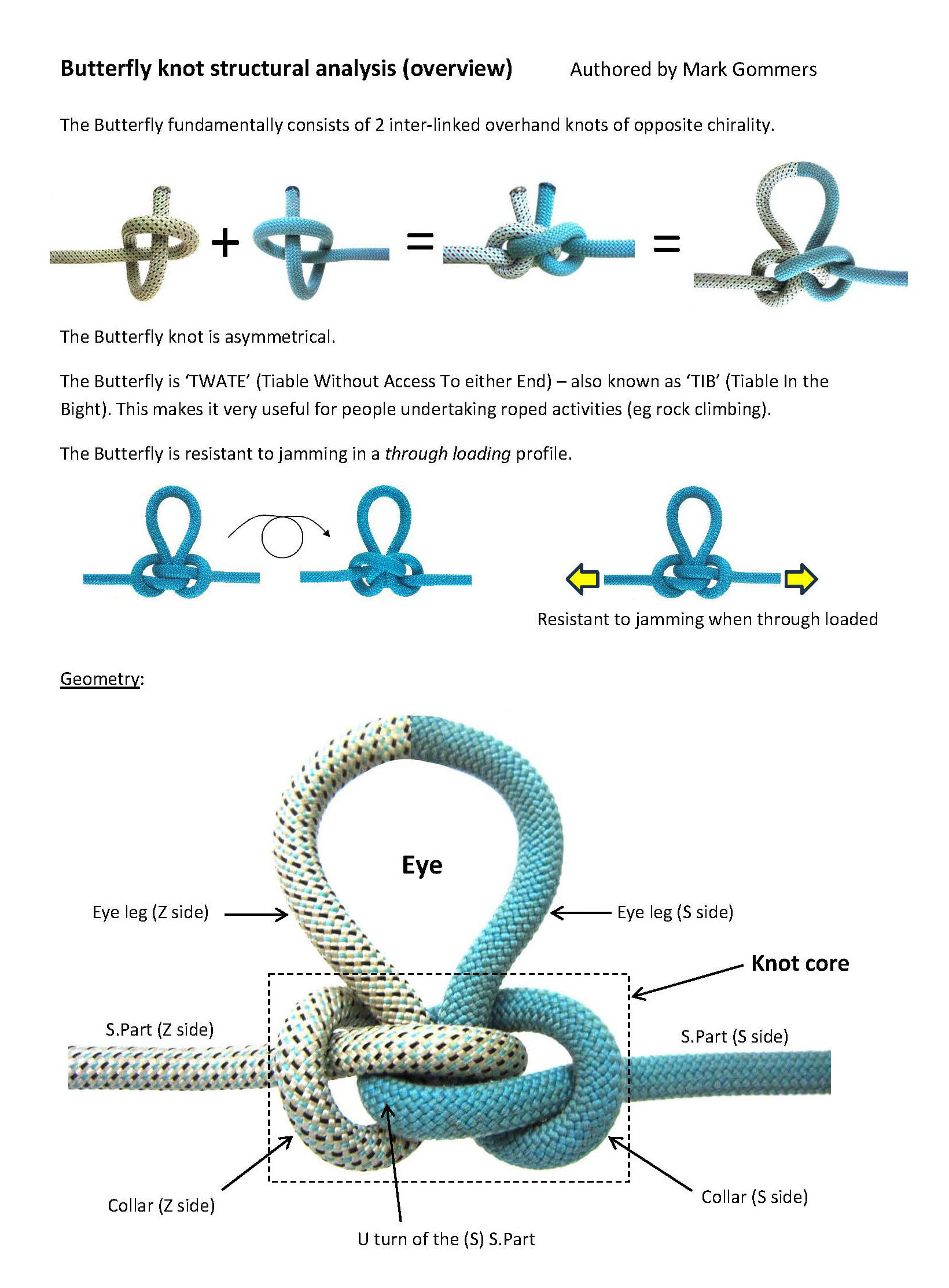
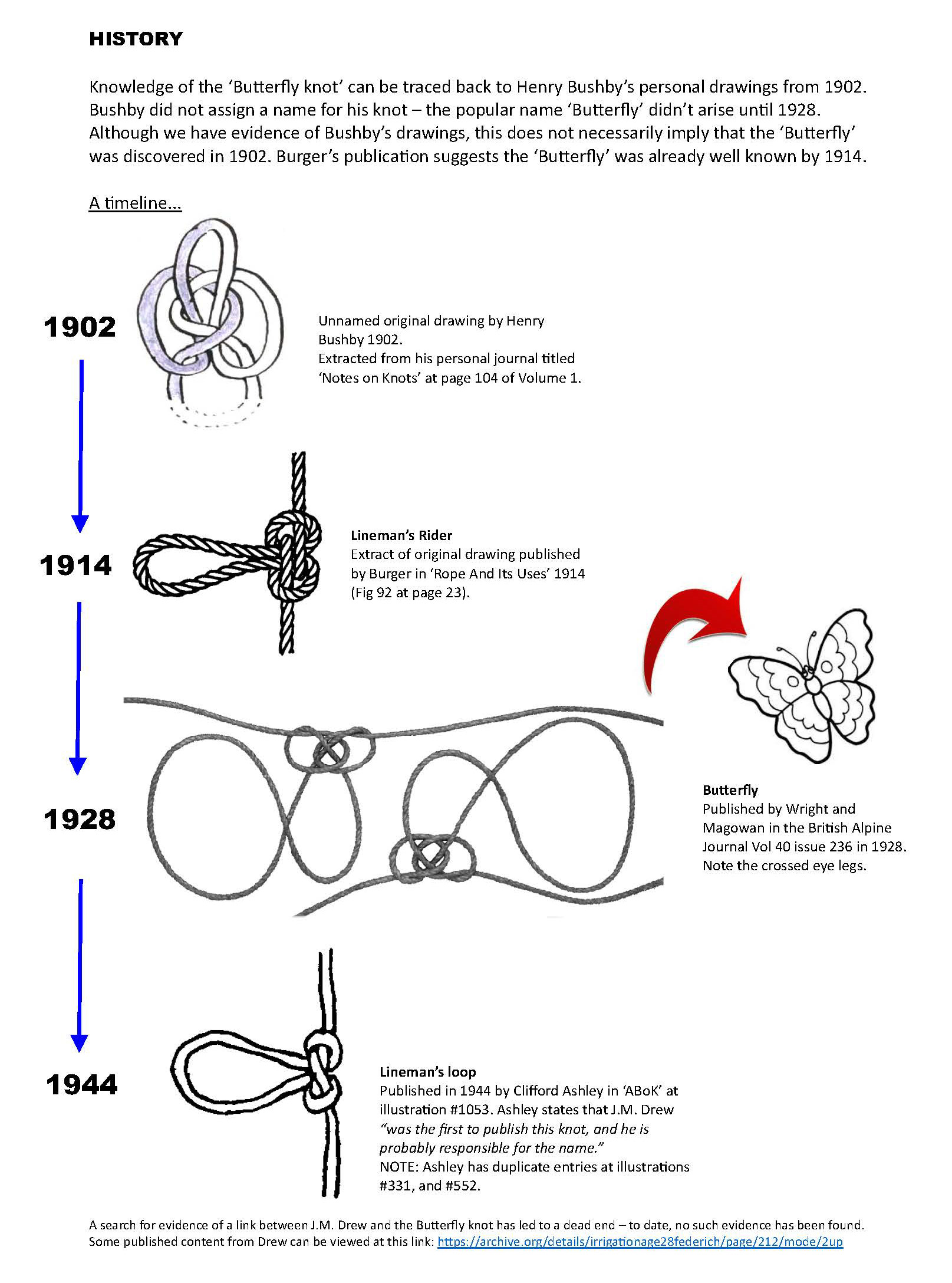
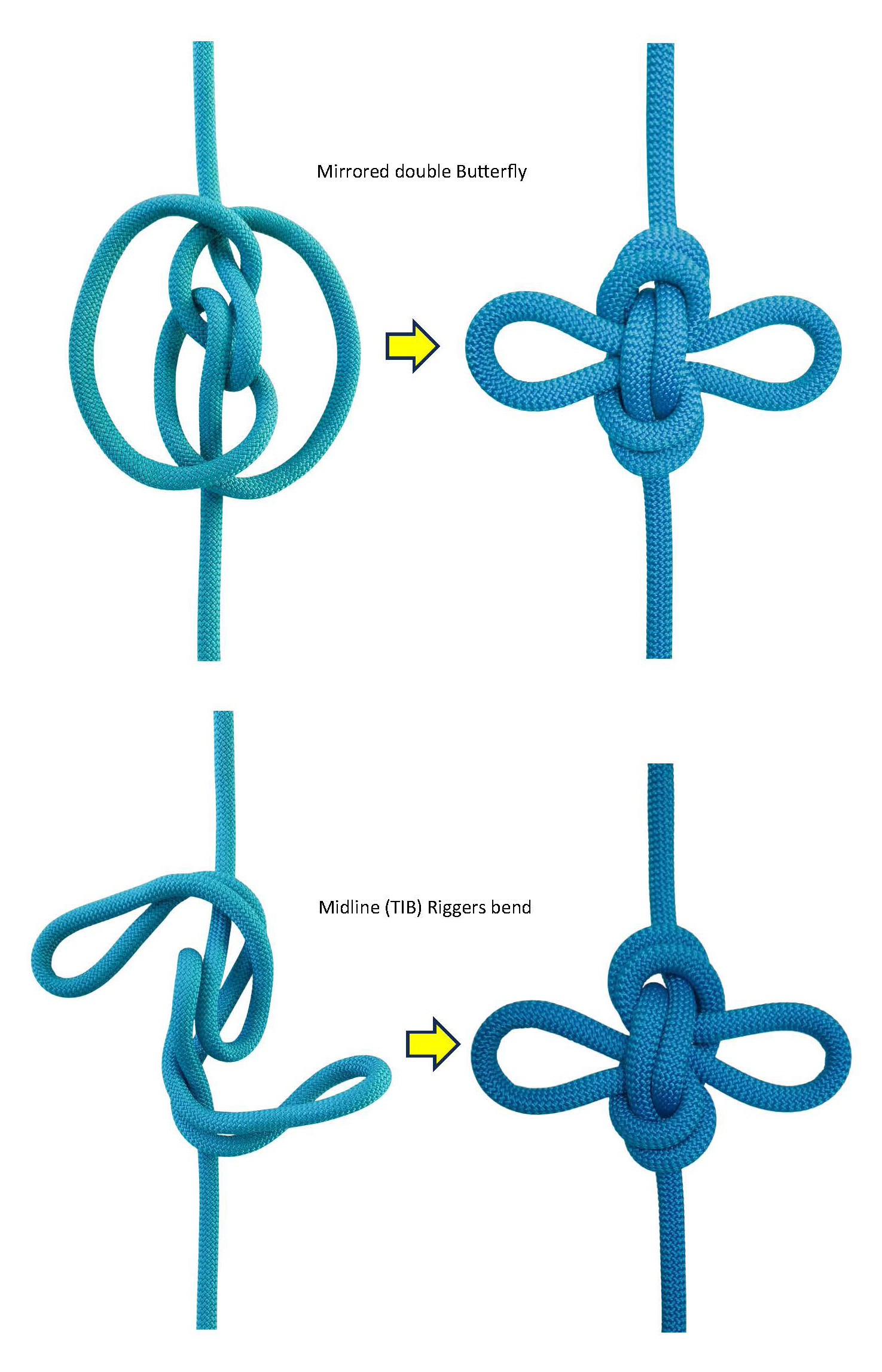
I noted the similar appearance of a mirrored double Butterfly compared to a midline (TIB) Riggers bend.
Refer to image below…
I find these structures interesting - and challenging to tie.
It compels one to think about the definition of a Butterfly - what are the geometric features that make a particular knot a ‘Butterfly’.
Note 1: Some content creators refer to a mirrored double Butterfly as a “counter-directional double alpine Butterfly”.
Note 2: With regard to the use of the word ‘bend’ - in this case it is a likeness to a ‘bend’, not a real ‘bend’ (a pseudo bend).
There is also a midline (TIB) Zeppelin bend (another pseudo bend) - which had been presented some time ago by myself.
Use case: The ‘Mirrored double Butterfly’ has application in high lines used in vertical rescues. In a through-loading profile, it is resistant to jamming. Eye loading would have to be heavy to trigger any potential jamming.
4 Likes
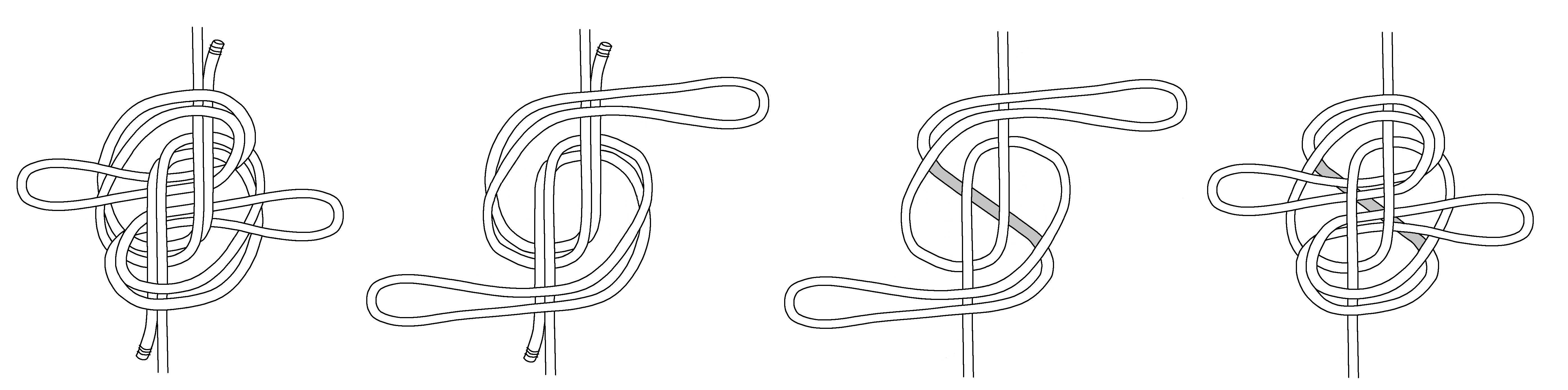
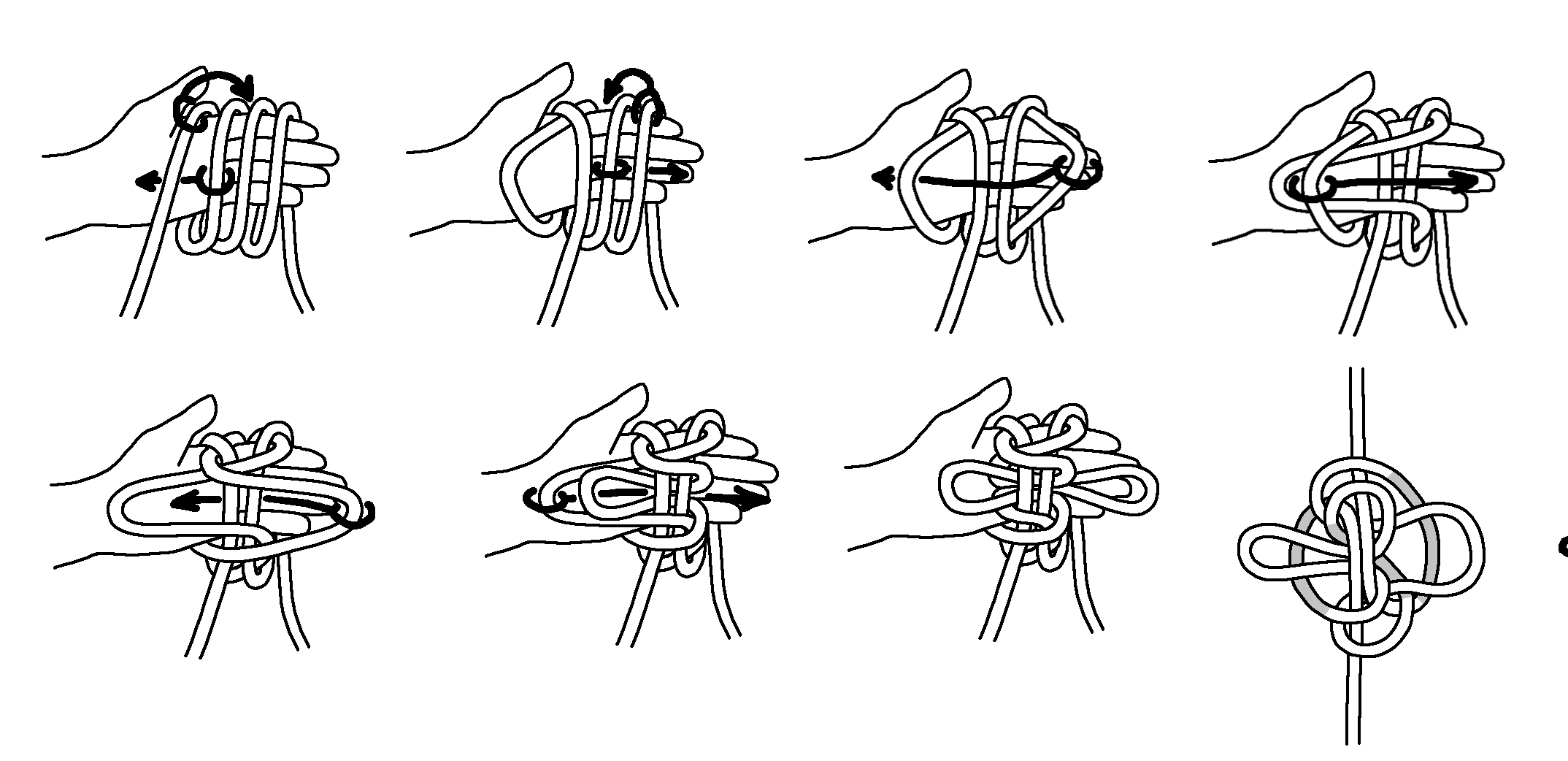
I agree that these are hard to tie. It seems like it is easier to start with a Rigger’s Bend tied with two bights. Then I untie it a bit and locate where the two ends are connected in the pseudo bend (shaded region).
I think that I have the mirror image of your Midline (TIB) Pseudo Rigger’s Bend which gives mirrored loops.
When tightened, this looks like the Mirrored Double Butterfly originally proposed by Oleg Volsky (which he called a Counter Directional Double Alpine Butterfly Knot). But if both are loose, they seem less similar.
front_________________________back
Dennis, working from your third image in the top row,
one can make the nice “twin-eye” midline knots akin
to #1408 or #1452. (And probably some other things
which I’m not bringing to mind --but how many knots
does one need?!).
The hoped-for plus of these is increased strength
(or decreased rope-wear’n’tear) from the S.Parts
crunching so many diameters,
and non-jamming --as the loaded eye that
would’ve tightened its unloaded collar a lot
cannot do so, as the twin collar takes the load
and has its own collar pulled open/wide.
The part in the center which you’ve nicely grey’d
divides the central space where the two 2-B-eyes
get tucked in half, one per eye. I think that there
come some dressing options.
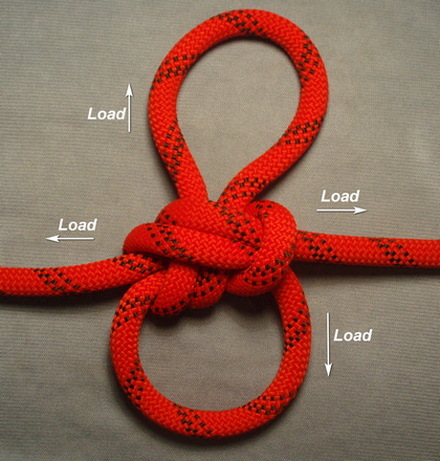
Incidentally, in the Butterfly knot Mark shows completed,
large, with parts labelled, ,if one pulls the eye down & out
–momentarily-- and gives the >>white<< nipping loop
a half-twist pushing the S.Part back away from view
and THEN tuck up the eye,
it’ll be a Fig.8 on the left side (w/pushed white rope)
joined to the left’s OH, and now with the eye-leg
twisting of the S.Parts going the same direction
–and thus more surely nipping. Let’s see the
How Not To … guys see if this variation slips!
–dl*
====*
Dan,
If you want to get mirrored double loops with a pseudo bend, you need to start with a bend where the two ends come out on opposite sides. Your #1408 and #1452 come out on the same side. In addition to the Zeppelin Bend and the Rigger’s Bend which Mark has mentioned, I find in Ashley’s Chapter 18 that #1420, 1421, 1453, and 1474 seem to have free ends which come out on opposite sides. Maybe nothing practical will come out of this, but this is the thread for “explorations.” Still, it is fun to consider these as pseudo bends.
#1420 and 1474 have some promise as they are relatively simple. I had trouble even tightening #1453 as it is given in a symmetrical form, so doubling it is some fashion seems problematic. While Ashley’s diagram implies that #1421 has ends coming out in opposite sides, when you tighten it (especially when you tie it with two bights), the ends tend to move to the back of his diagram and come out close together rather than mirrored.
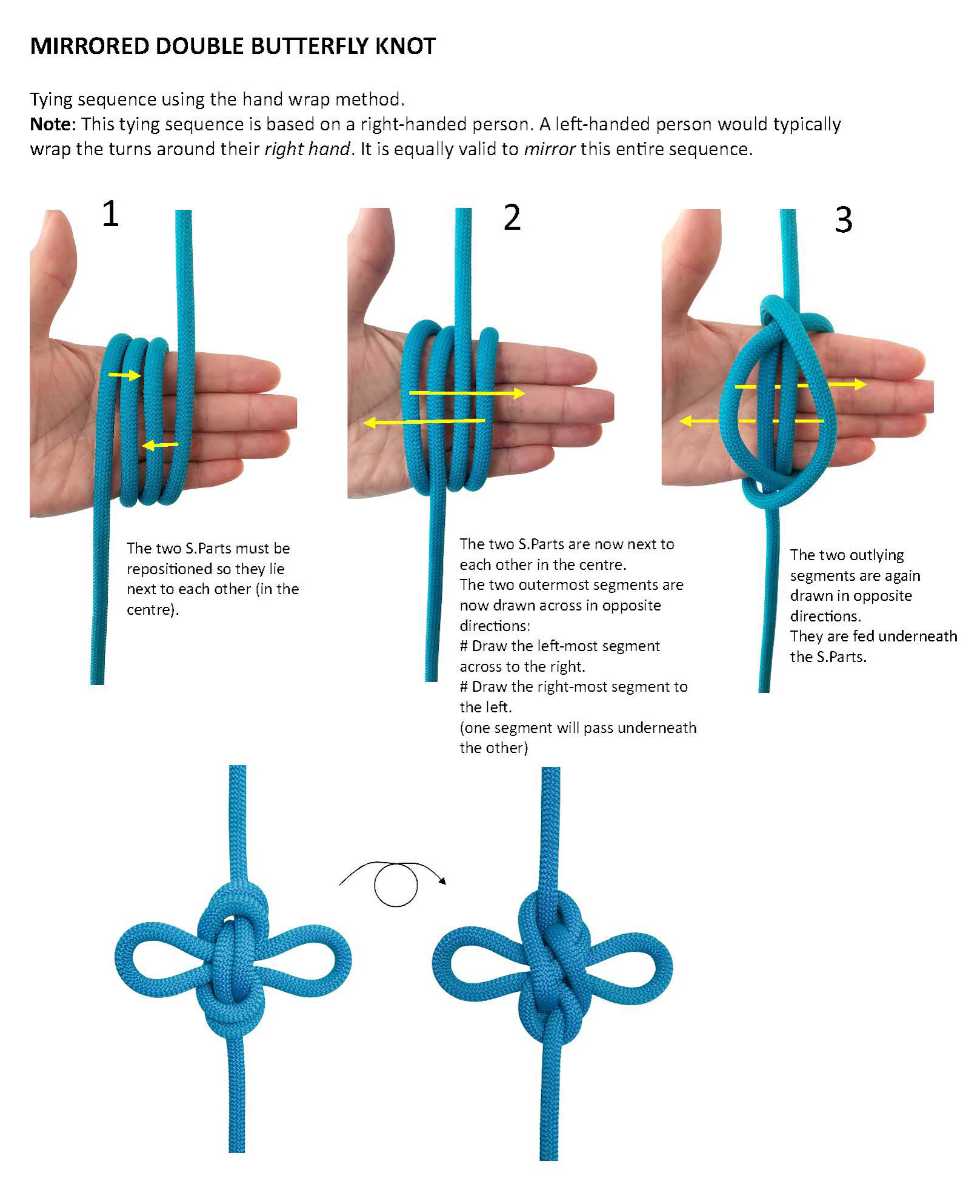
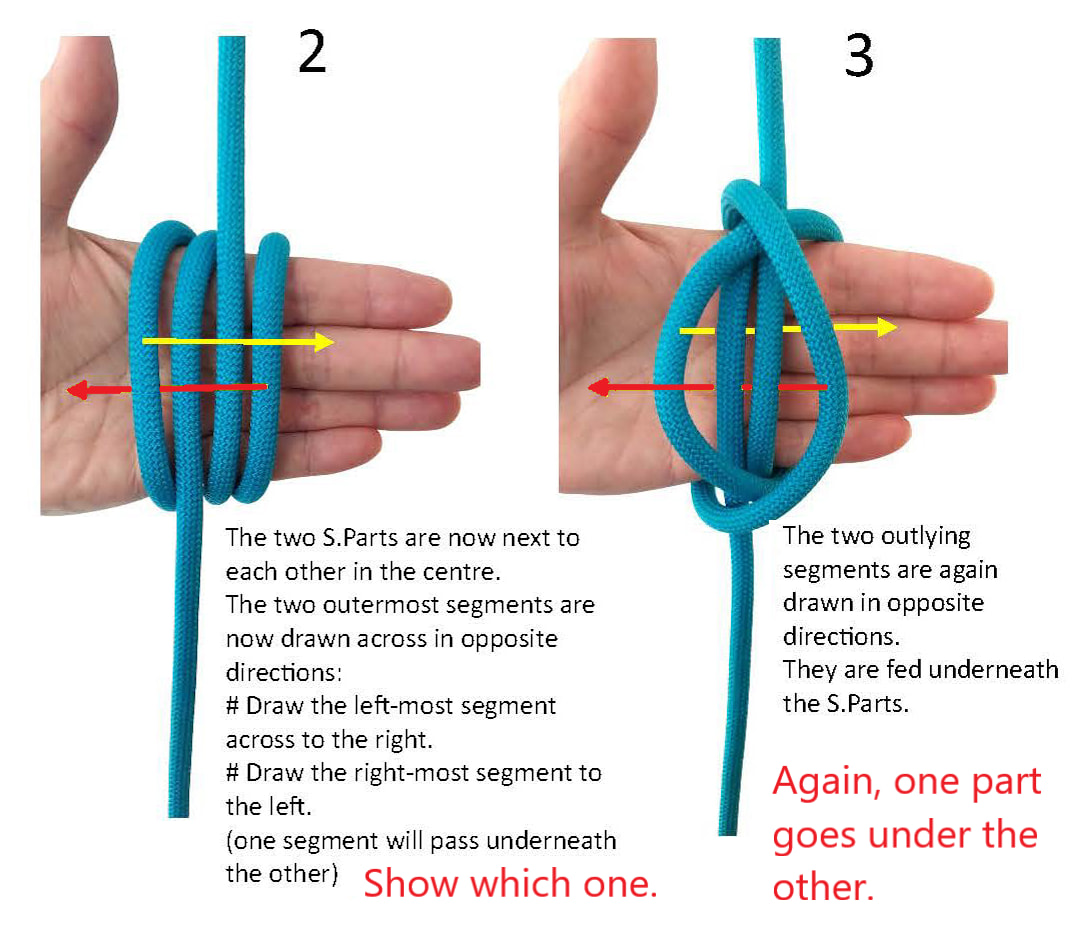
Back to the Mirrored Double Butterfly that began this discussion, it is tied by Oleg Volsky in his YouTube video in a hand wrap method. It is a combination of two hand wrap methods for tying a single Butterfly, one pulling the loop out near your thumb and another pulling the loop out near your fingers. He does both at the same time. Many others use a twist and fold down method for tying a single Butterfly. I have tried without success to figure out some generalization of the twist and fold down (or fold up) method to get the Mirrored Double Butterfly. Maybe someone else has had more success
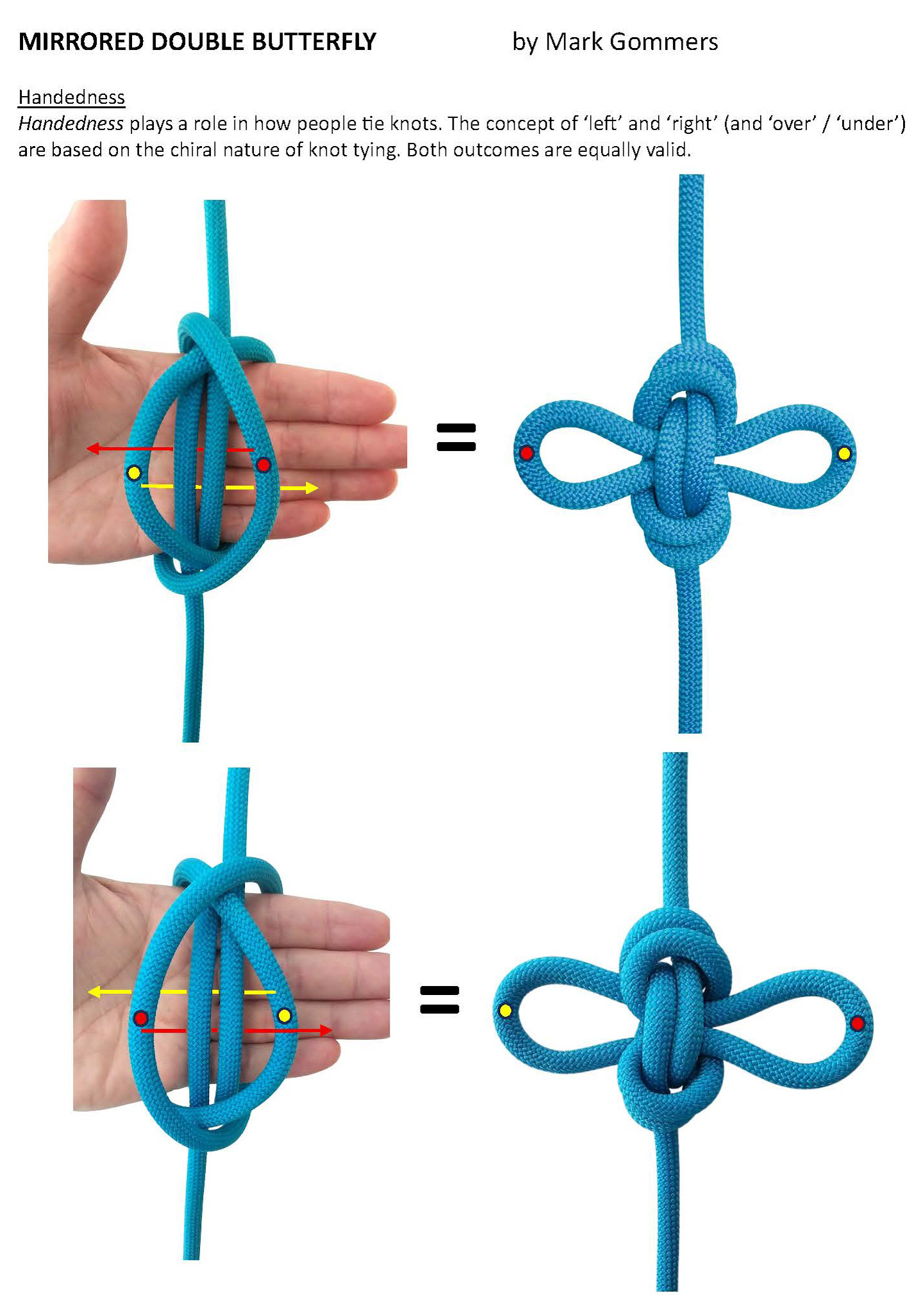
I’ve added an image showing one tying procedure using the hand wrap method. Note that this image sequence assumes a right-handed person. It is equally valid to mirror the entire sequence.
Informative:
The hand wrap method provides a 3D reference frame for the knot tyer. A human hand provides an underlying solid foundation from which the knot structure can be built and then manipulated. It allows the knot tyer to more easily visualise the various stages of the tying process.
All knot tyers have a strong tendency toward a particular ‘handedness’. Knots are complex 3D structures with very specific geometries. In the hand wrap method, one hand serves as a foundation from which to build the structure. Procedural memory is developed by following a sequence and recognising patterns.
A search on the internet for the ‘Butterfly knot’ (aka ‘Alpine’ Butterfly) reveals a myriad of tying methods. This is down to how individuals develop their own procedural memory - every person solves problems in different ways. A knot tyer will develop a strong preference for a particular tying method - because it suits their ‘handedness’ and is optimal within their procedural memory reference frame.
Mark,
It is a little hard to understand all of the steps in your diagrams. Here are some suggestions.
Actually, when Volsky ties the knot in the video, in Step 2, he draws the right-most segment over to the left first and puts it under the other one.
It is a little easier if the steps are all shown separately.
In my last diagram, the parts of the knot behind your hand are shaded grey to help to understand.
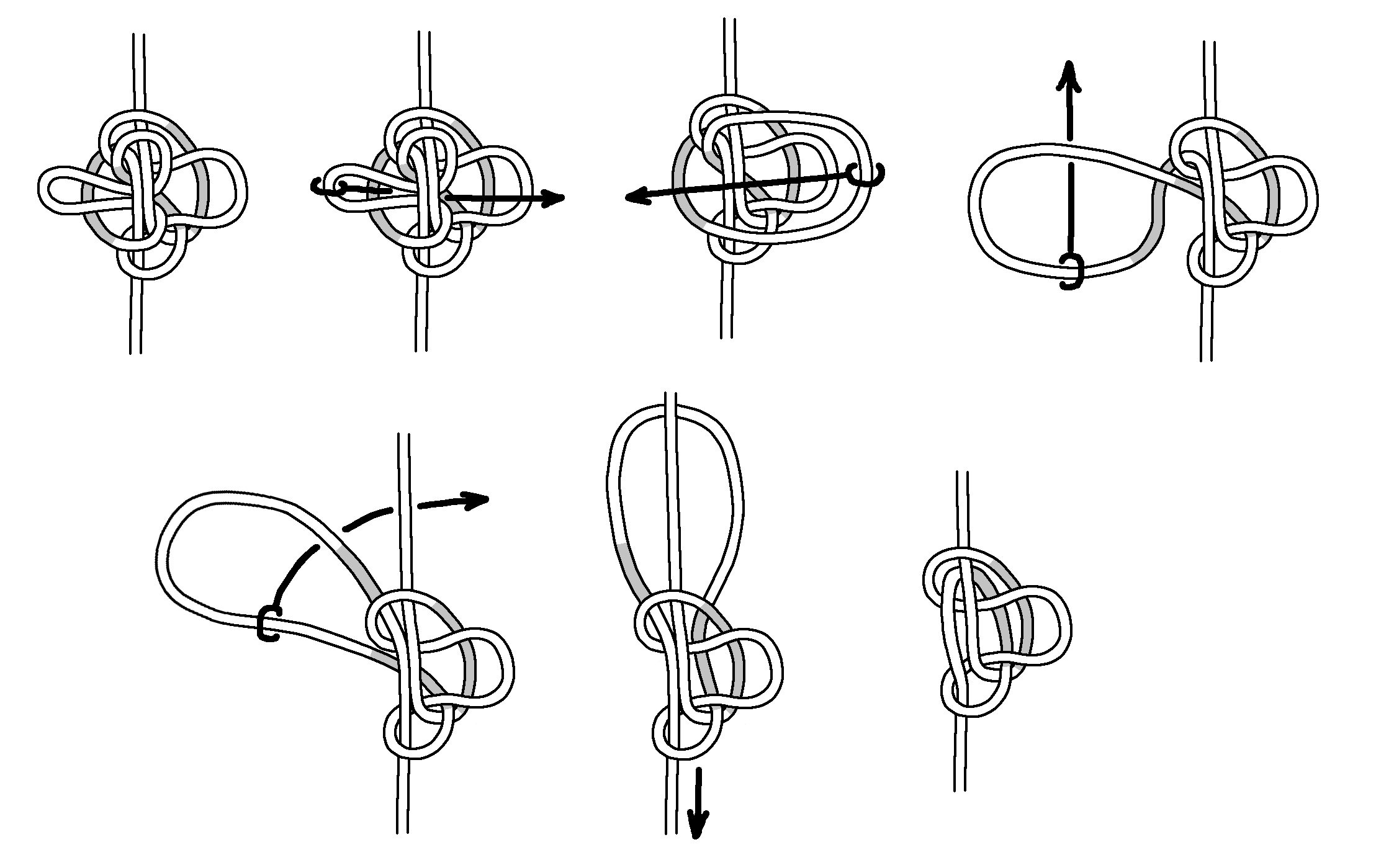
It is possible to partially untie a Mirrored Double Butterfly to turn it into a single. In the diagram below, the “inner wrapped” loop is on the left and it is the one we untie.
These steps are reversable, so this gives a method for turning a single Butterfly into a Mirrored Double. Since a single is possible via a twist and fold method, I guess that this gives a complicated way to do the whole thing via twists and folds (but it would need to be laid out on a table).
It is interesting that if you untie the “outer wrapped” loop on the left, what you get is a single RT Butterfly.
1 Like
If you want to get mirrored double loops
But I don’t want “mirror’d” eyes; I’ve not seen a good
use for them suggested.
(-;
But I don’t want “mirror’d” eyes; I’ve not seen a good
use for them suggested.
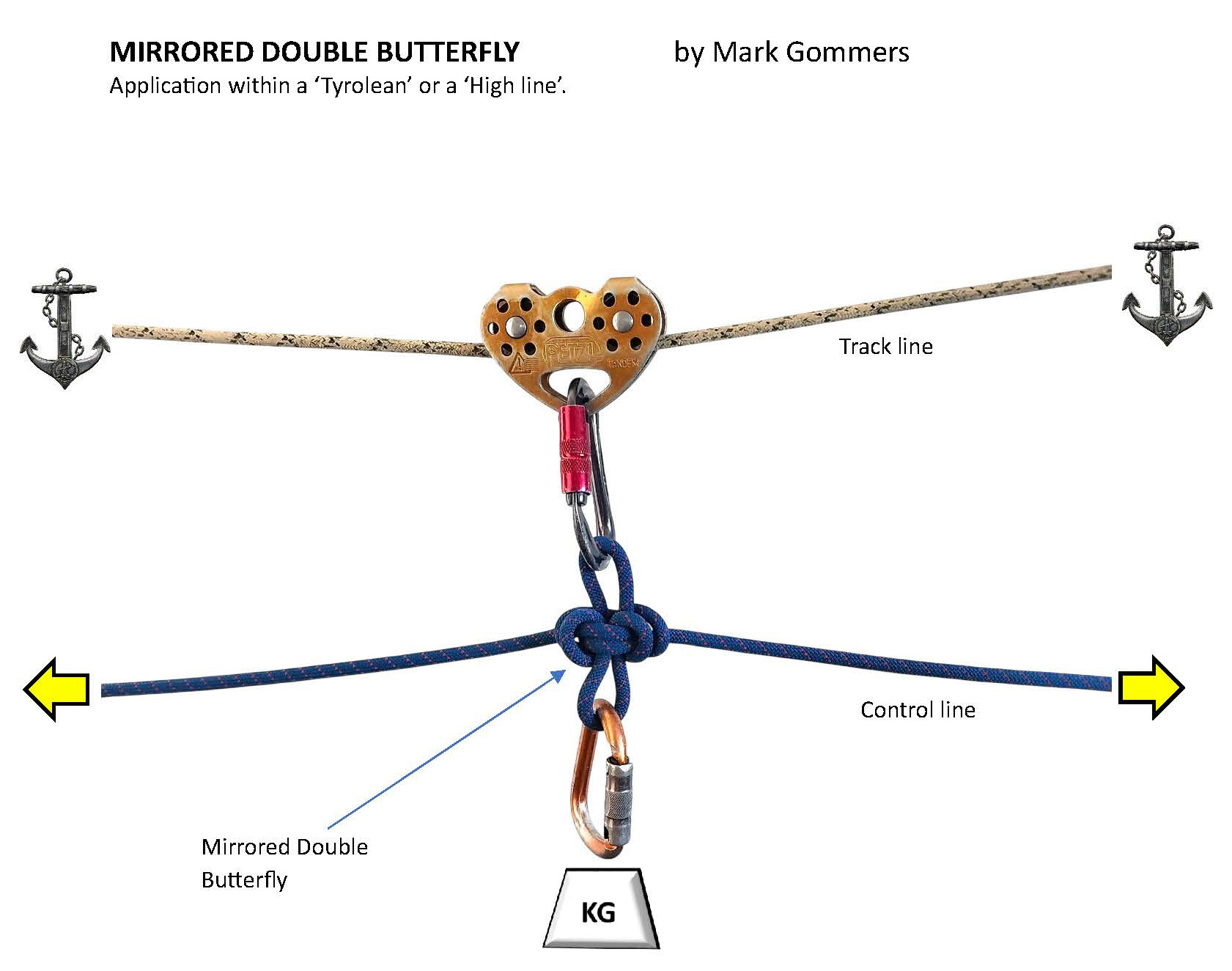
A good use case for the Mirrored Double Butterfly is within ‘high lines’ (vertical rescue). Specifically - as a ‘control line’ (to enable mobility along the ‘track lines’.
Link: Rope Rescue Highline Systems and Rigging Techniques | Rigging Lab Academy
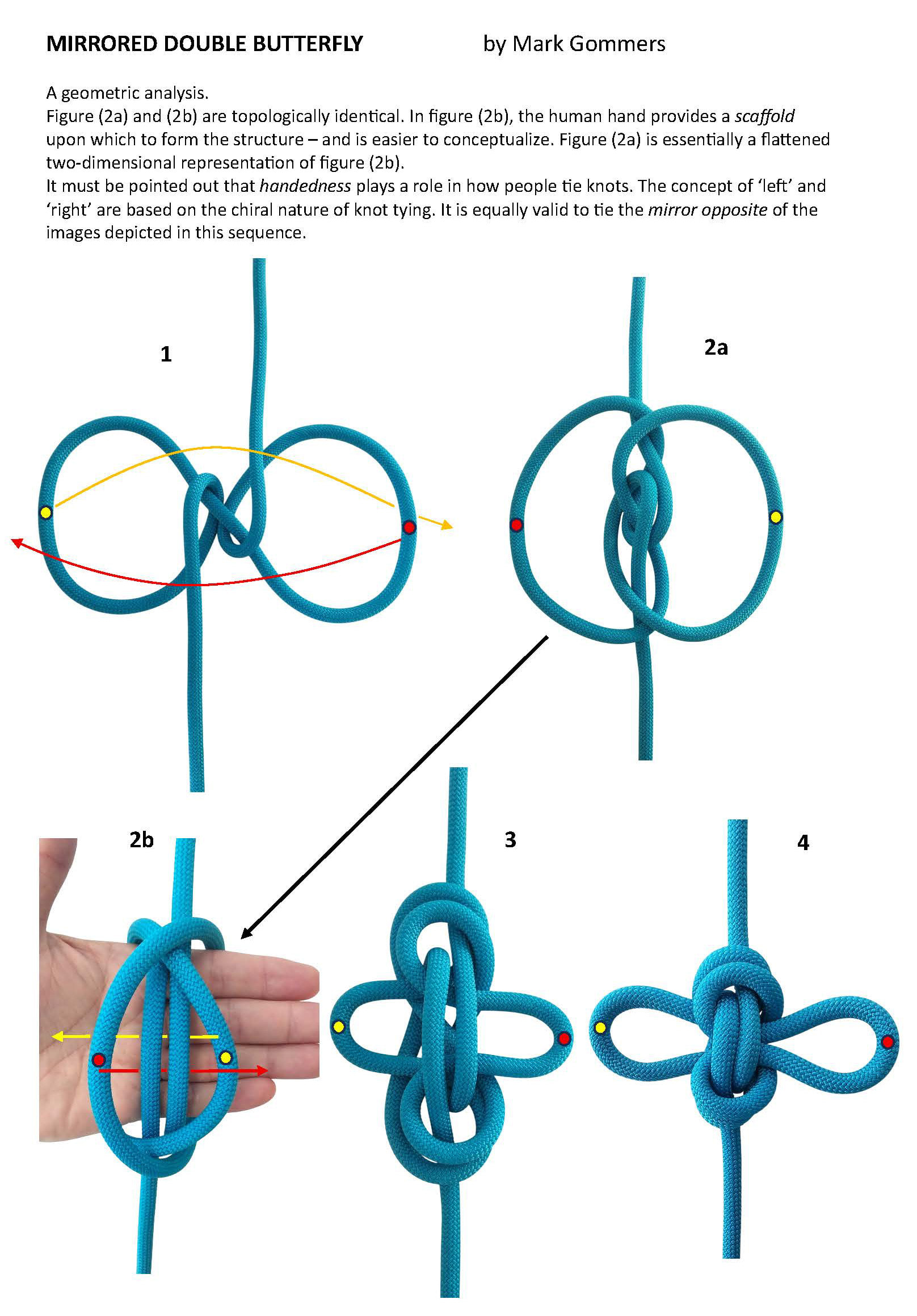
A further analysis of the ‘Mirrored Double Butterfly’ knot in this post.
I’ve attached 2 images showing the chiral nature of knot tying. The ‘handedness’ of a person determines the bias or preference for how the knot is tied.
Most people will find it ‘easier’ to use the ‘hand wrap’ method. The reason for this is that the human hand provides a scaffold framework from which the knot structure can be formed. The same concept applies to the regular #1053 Butterfly - where a multitude of tying methods have been evolved - the majority of which are based around using a human hand as a scaffold framework. Most content creators of the Butterfly knot make the claim that their particular method is ‘better’ or ‘easier’.
I’ve never seen any content creator depict the chiral and geometric nature of the Mirrored Double Butterfly (or any ‘Butterfly’) in the way that I have done. Existing online videos just show some sequence without any supporting explanation.
All of this type of content will appear in my up coming technical paper on the ‘Butterfly’. It will be the definitive paper on the Butterfly - with high quality images and detailed analysis of a number of variant structures.
1 Like
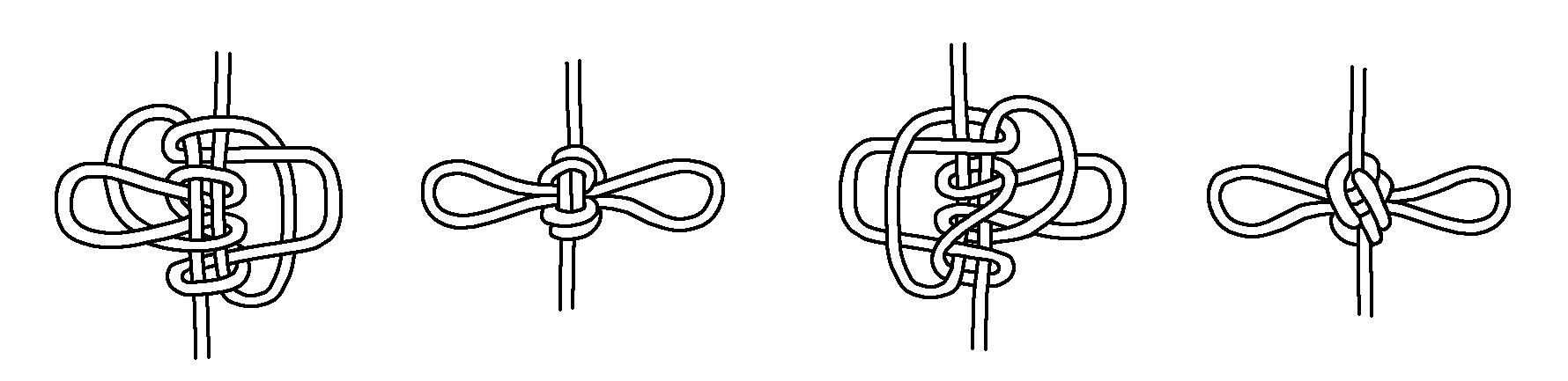
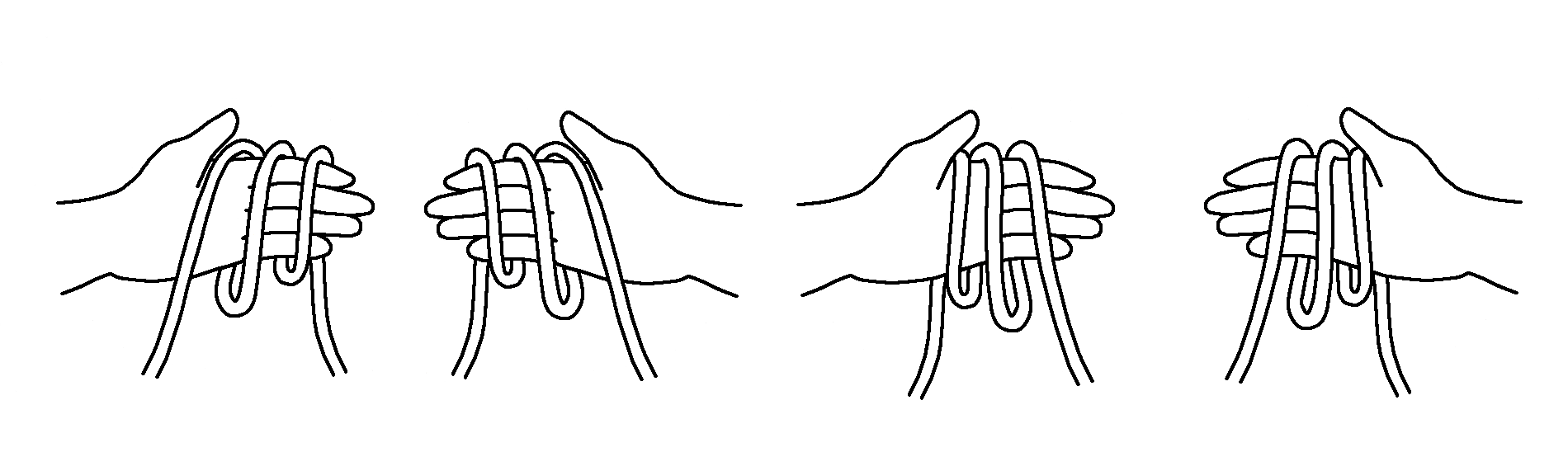
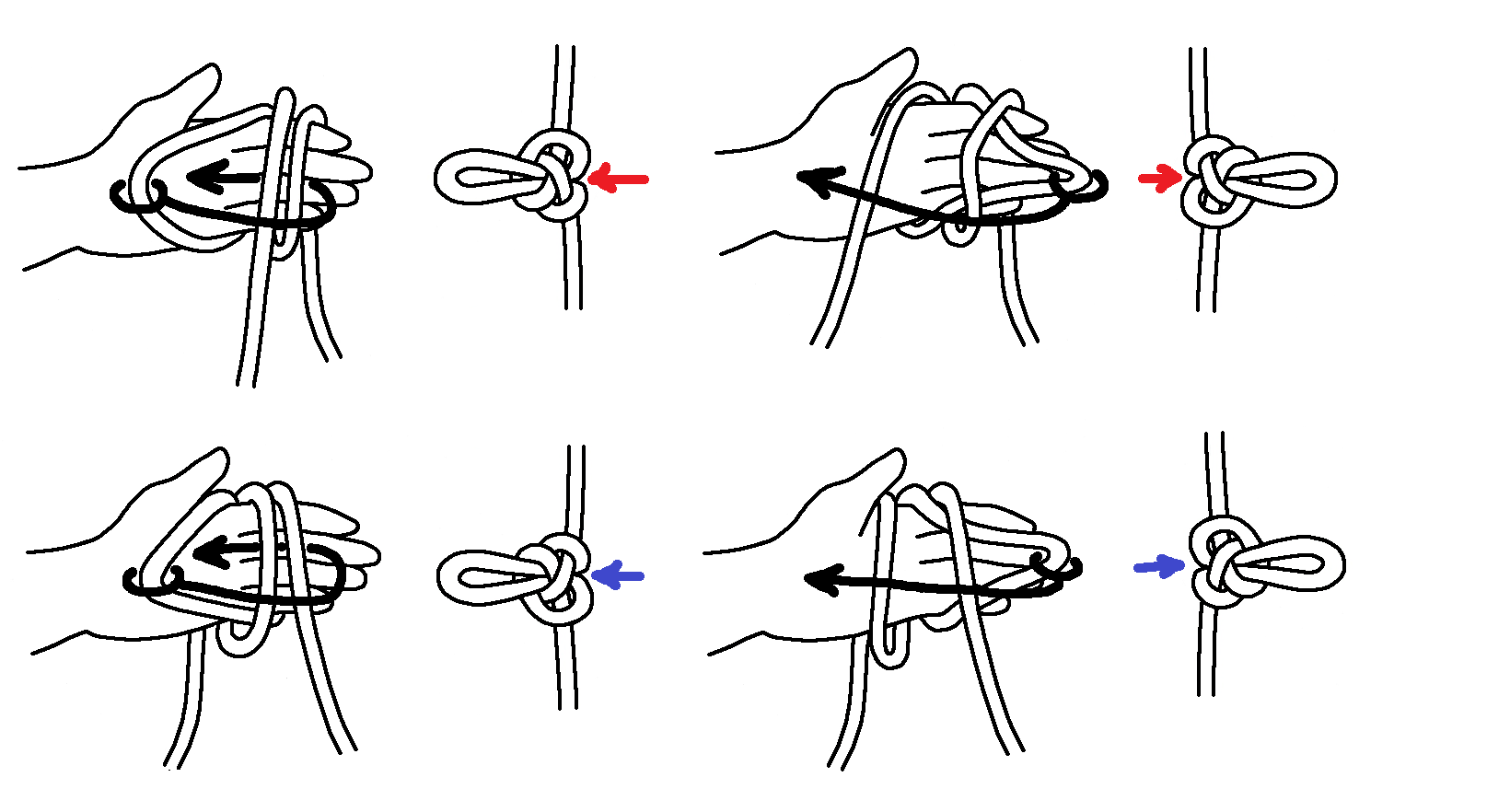
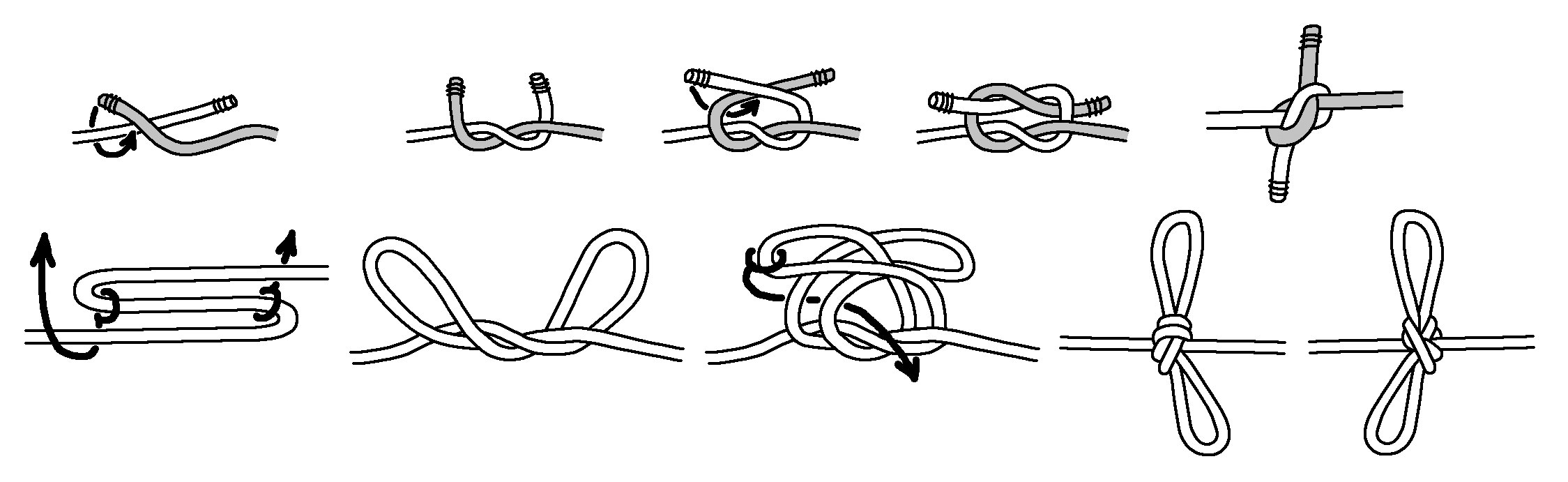
The direction which you wrap around your hand also matters. Most right-handed people wrap as in the first diagram below, wrapping around their left hand so they can do most of the movements with their right hand. A left-handed person would tend use the second diagram, wrapping in the mirror image and getting a mirror image Butterfly Knot. But a right-handed person can also tie the mirror image Butterfly Knot by merely wrapping around their hand in the opposite direction, as in diagram three. Similarly, a left-handed person can tie an original orientation Butterfly by starting as in the fourth diagram.
Whether you pull the chord out near your thumb to start or pull the chord out near your fingers will not change the orientation of the crossing pattern. It just changes the direction of the loop (i.e. it switched the two standing parts). To get a mirror image Butterfly Knot, you need to change the direction of the wrapping.
In doing some browsing … I came across some splayed-eye
knots # 2928..35 --maybe not up to snuff for some things,
or … ?
Thanks for the point to the Control Line;
but I’m yet in the dark how a splayed-eye knot
would be used there (where they have separate
ropes with F8s & friction-hitched sling on either
side of the main, load-bearing pulley.
–dl*
====*
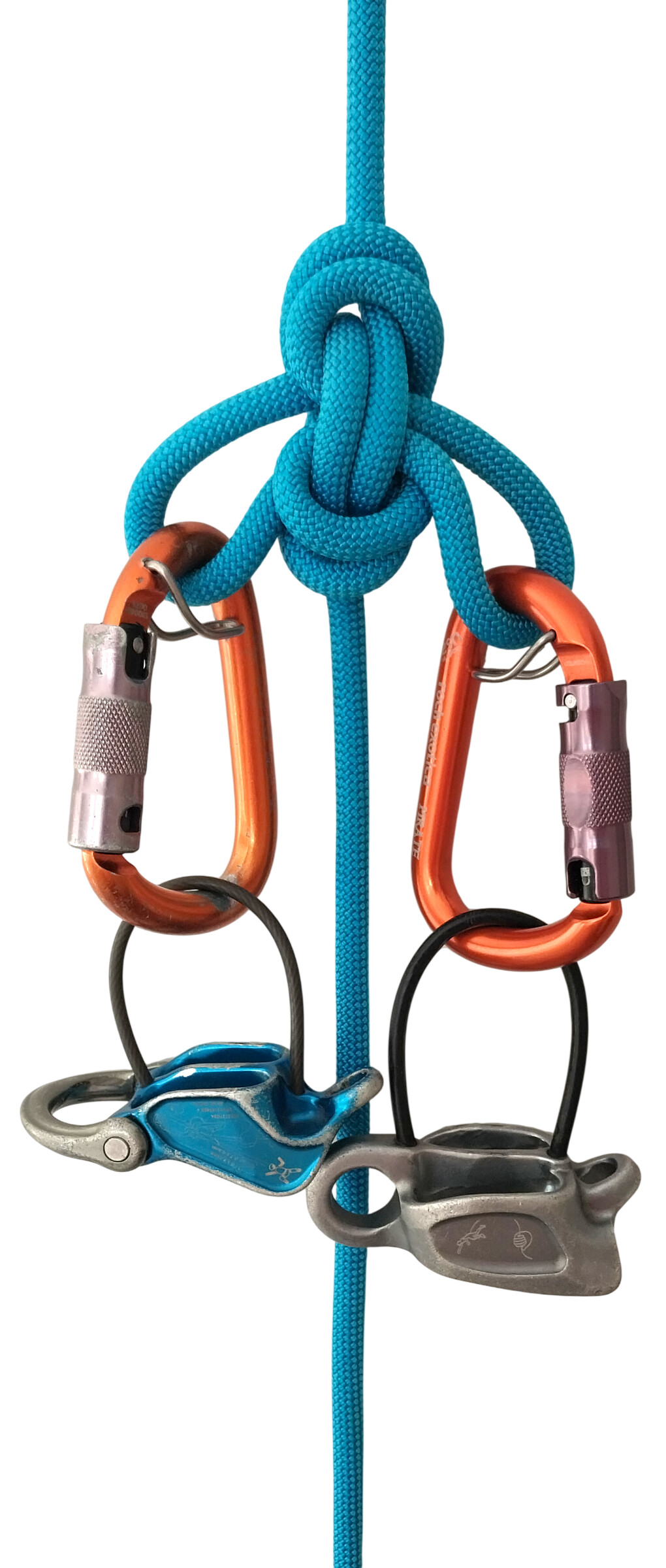
See below for an image of how a Mirrored Double Butterfly could be used within a ‘Tyrolean’ or a ‘High line’. The image is very basic - not intended as a definitive instructional text - just showing the general concept.
I personally have used it to haul heavy backpacks across a canyon (and people too) - on a temporary ‘Tyrolean traverse’.
Wiki link: Tyrolean traverse - Wikipedia
Another use case: Setting up and operating 2 belay devices from a singular fixed rope.
2 Likes
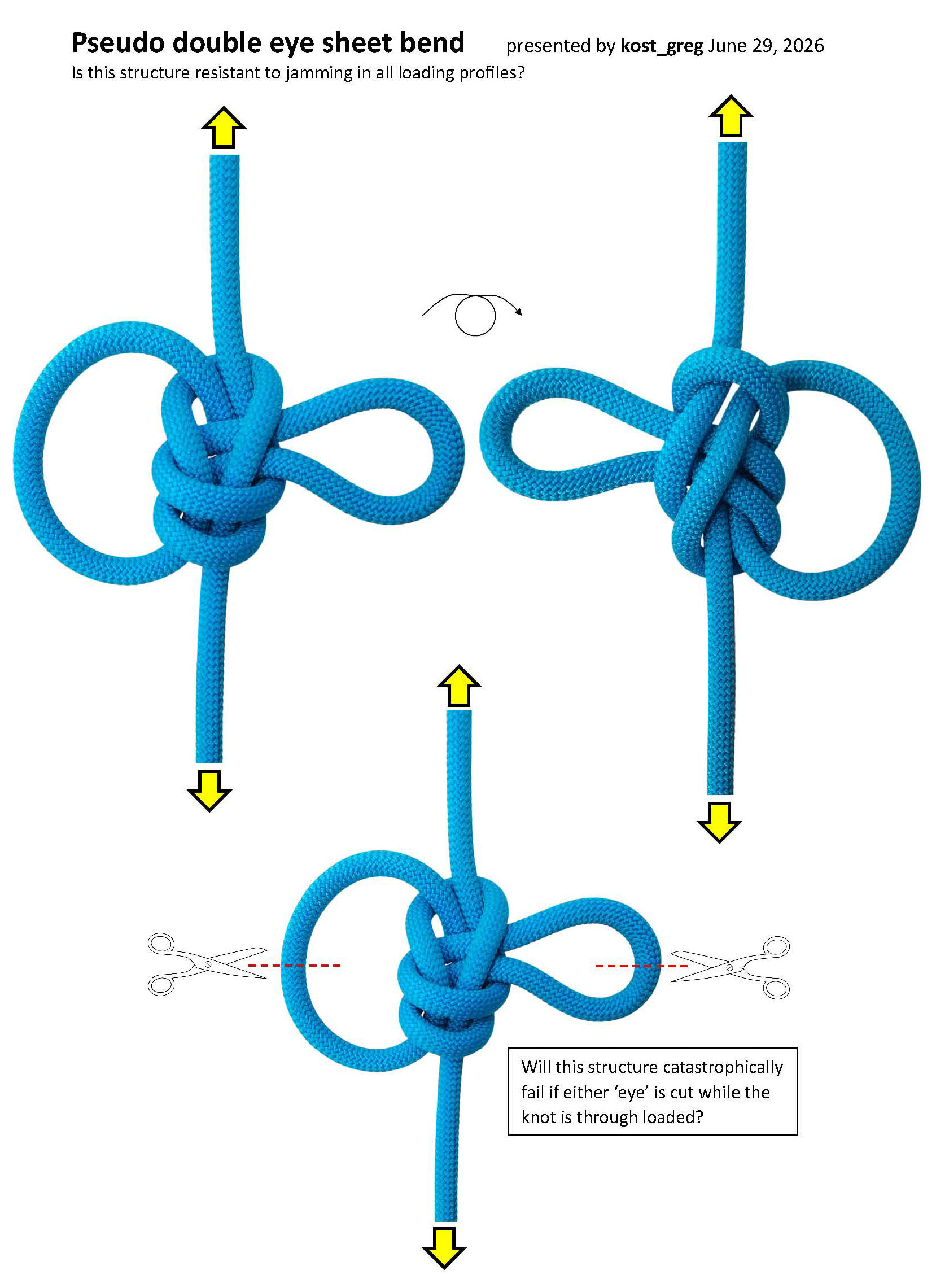
Based on your extensive experience in this particular field of life critical applications, what are your thoughts about the profile below, which also places two counter directional eyes, with a super easy TIB tying method.
Could it comply with all the safety requirements mandated by these specific applications?
I apologise for thread drifting, but i deemed it appropriate to restore this double eyeknot, the moment i saw the above applications.
1 Like
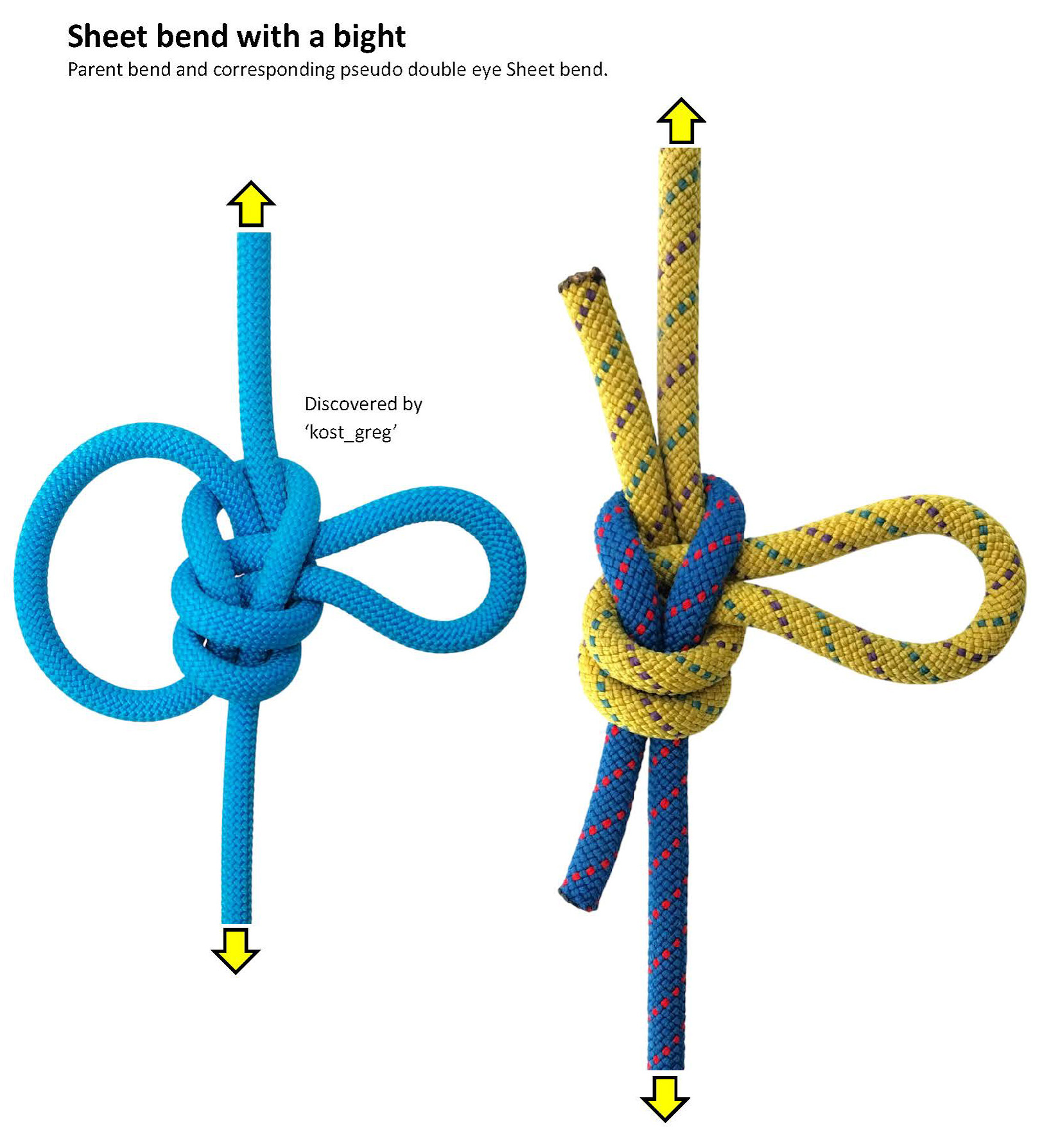
Following up on the pseudo Zeppelin and pseudo Rigger’s bends, here is another pseudo bend that gives mirrored double loops. Since it is based upon the Granny Knot which is not that strong, it might not be appropriate for life-critical applications. It gives a smaller knot for less critical applications.
See ABoK#1146 for a pseudo Square Knot that begins in a similar fashion.
Very nice kost_greg. Wow!
You seem to be making remarkable discoveries in the world of knotting.
Impressive - because its ‘TWATE’, and it might be useful as either a ‘bend’ OR as a means of isolating a damaged section of rope (and thus where a knot bypass must be performed).
I can see that your double eye knot is based on a (pseudo) Sheet bend - and yes, once you understand that, the ‘TWATE’ / ‘TIB’ tying method is simple enough.
Its through loadable - and you get 2 ‘eyes’ - so it also eye loadable.
In terms of using the ‘eyes’ as attachment points, its very secure and stable. Not sure if its resistant to jamming (or if there is some load threshold beyond which jamming occurs?). Alan Lee should load the ‘eyes’ and see if he can trigger jamming?
What gave you the creative idea for this pseudo double eye sheet bend?
1 Like
What gave you the creative idea for this
What gave me the idea for a similar structure
is thinking of the situation where a dock line
with say a 2.5’ spliced eye is wanted to tie
around a bound-together set of pilings
–or merely a single pile but one that doesn’t
allow casting the eye over-&-around it.
So, bring the eye’d line around the object,
and form a U-fold in the S.Part to use qua single
part and tie a Sheet Bend to the spliced eye.
(Rather than using the spliced eye end to tie
a Bwl into the S.part.)
There are some few dressings of this,
and the main concern is slippage under load,
as the twin parts have one loaded but one
unloaded strand, with the latter giving some
protection-from-nip to the other.
(Making this “Sheet Bend” w/U-fold could also
make a variation, S.Part X-ing over itself and
THEN tucking back for the lock --Karash Bwl-like.)
IIRC, the less slipping version had the S.Part
making the “eye-side”/exterior turn; K_G’s
R-side S.Part as shown makes the interior/S.Part-side
turn.
very nice, kost_greg, wow!
Indeed, a clever structure!
And one that might seek some redress for
slippage also by figuring out which loadings
should get the “left-handed (Tail-Outside)”
orientation vs. Tail-Inside.
(And then one can go look for similar sorts
of adaptations of well-known things using
this tie-back-into-self idea!)
(-;
Thank you agent_smith, i was trying to find an inline formation of the anti_bwl on a bight, so this is the result of that process.
Of course, i can understand the relation with the sheet bend, which perfectly justifies the use of a name such as “pseudo double eye sheet bend”.
I believe it constitutes a good option, for applications requiring counter -directional eyes in the middle of the line.
1 Like