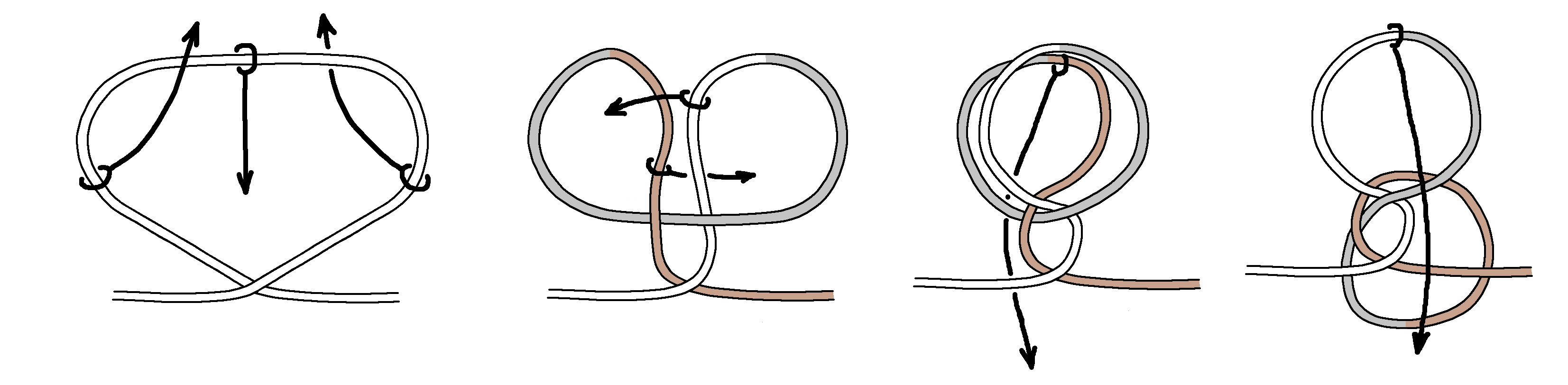
Here is a twist-and-fold method for tying the Mirrored Double Butterfly. First, we rearrange it a bit to get the form we will strive for. It comes off your hand in the hand-tying method as in the first diagram. Then we turn it over and move the loops up. We have not done any untying here, but we have only rearranged the knot as we will get it later.
There are four different twist-and-fold methods for tying a Butterfly. You can twist in either direction and for each you can either fold down in front or you can fold down in back. You see all of these variations. Here for two mirrored loops, we need to fold down in front and in back at the same time.
To begin, we twist once. Then we twist the two loops separately as above and overlap them. One will be folded down in back and one will be folded down in front.
You have the same choices for which loop goes inside the other as in the hand-tying method. Here we pull the back loop inside the front one as we pull it forward to be inserted in the opening. Then the remaining front loop goes back and fits in the same opening under the other one. Finally, we tighten.
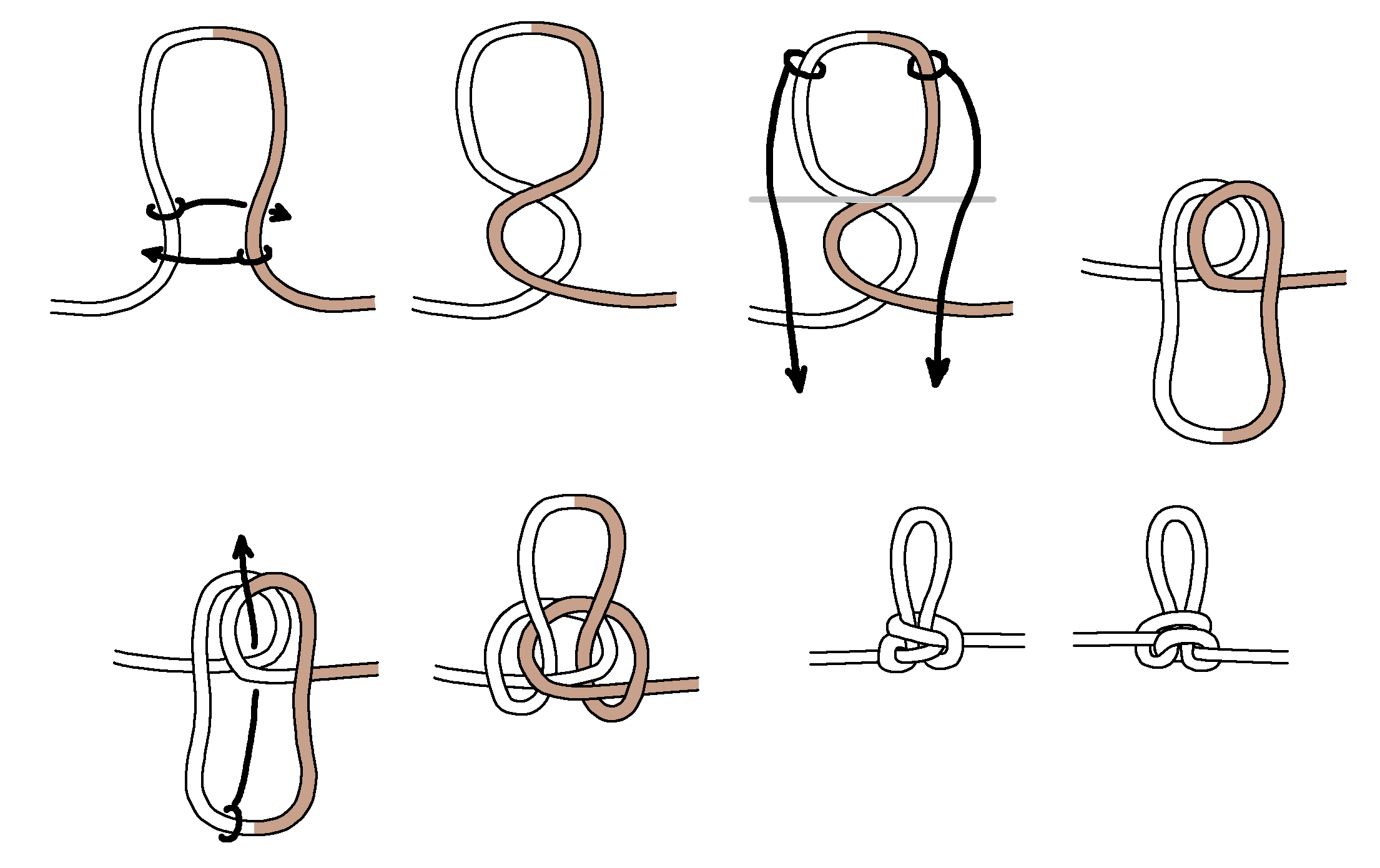
This allows me to go on to also find a mirrored double for a Twin Half Hitches Eye Knot. Here is one way to tie a Twin Half Hitches Eye Knot.
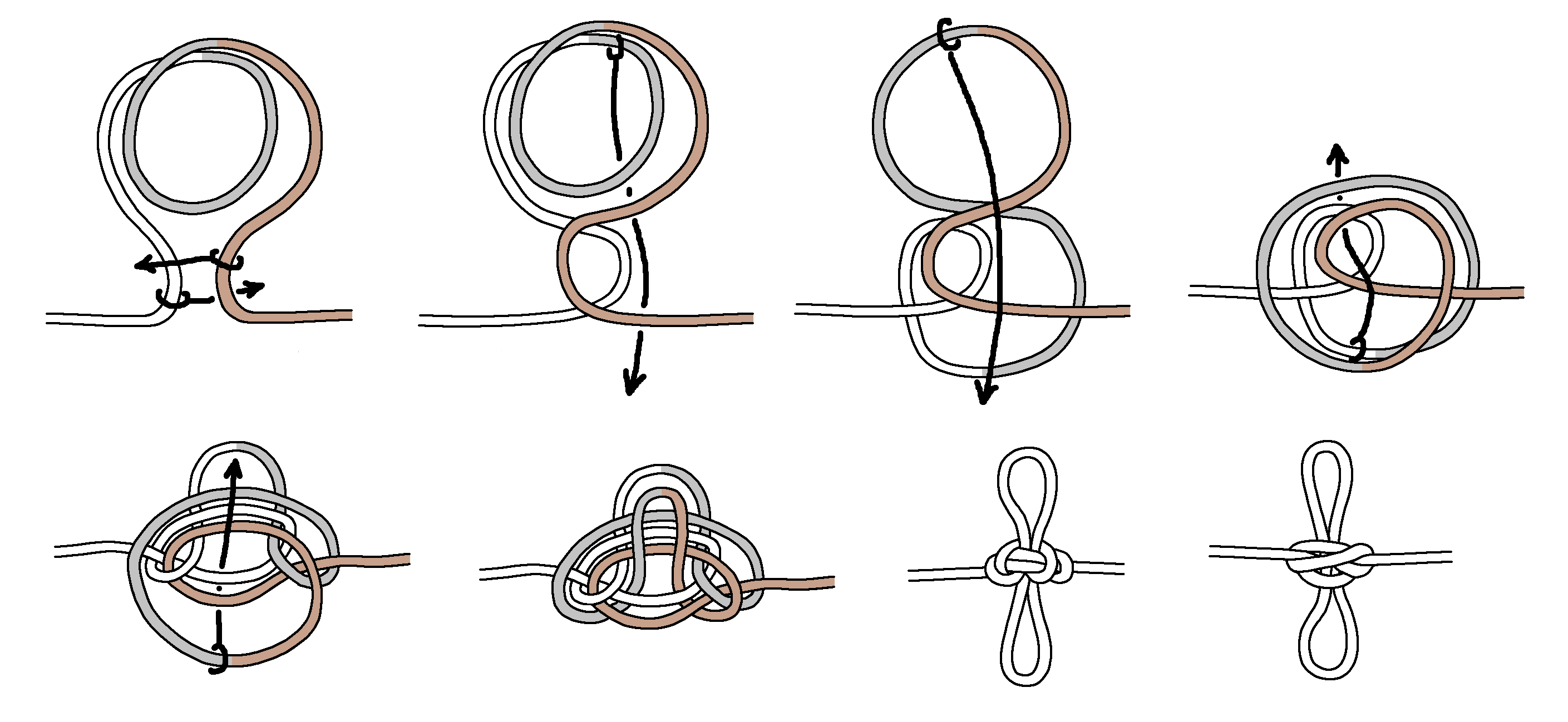
This knot appears in Bushby’s Volume 1, part 2 just two pages before what we now call a Butterfly appeared. This Twin Half Hitches Eye Knot also appears in the Wright-Magowan article right before the Butterfly (where they called the first a “Half-Hitch Noose” and the second a “Butterfly Noose”, although they admitted that the term “noose” was inappropriate in their following article). This Twin Half Hitches Eye Knot is very close to a Butterfly, and it is often mistakenly given instead of the correct Butterfly. Here is a fold down method for tying a Twin Half Hitches Mirrored Double Eye Knot.
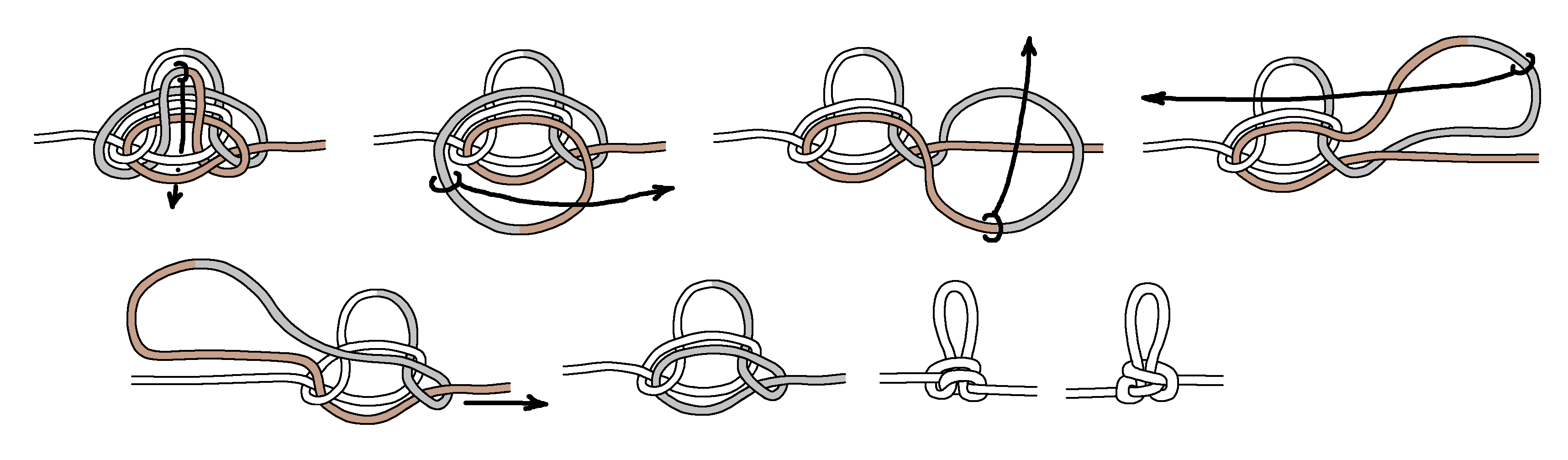
Here we partially untie this Twin Half Hitches Mirrored Double to get the single version.
Since the above steps are reversable, this would be a way to convert a single Twin Half Hitches Eye Knot into a mirrored double loop version.
2 Likes
You've done some nice work here 'Dennis_Pence'.
The so-called 'Half hitch Noose' (per original Wright and Magowan 1928 paper) is less than optimal when through-loaded. In contrast, the 'Butterfly' is optimal in a through-loading profile. The 'Butterfly' is now widely employed in life critical roping systems by rope access technicians, vertical rescue teams, climbers, canyoners, etc. This is because it is secure and stable in through-loading and eye loading profiles (in multiple directions).
With the more complex variant Butterfly knot structures, you'll find that people (in general) have a strong preference to use their hand as a scaffold framework around which to form the knot.
The tying methods you depict will likely remain in the realm of knotting enthusiasts. That's not in any way to diminish or discredit your work! The diagrams and concepts you depict are very good and quite an achievement - thank you! Us 'knotting enthusiasts' like to understand knots including how they work and their underlying structure (we like to look under the bonnet). Most people who drive cars don't care or aren't motivated to understand how an engine and drive train works. They generally dislike looking 'under-the-bonnet' - and leave that part to professional mechanics. Same goes with PC computers - most people don't care about motherboards, hard disk drives, memory sticks, fans, etc. They just want to hit the power button and turn it on...
Although in the context of this IGKT website - the majority of contributors are devoted knotting enthusiasts - and are motivated to look under the bonnet (hood). Our audience is knotting enthusiasts.
I'm exploring some of these concepts in my soon to be published paper on the 'Butterfly' knot.
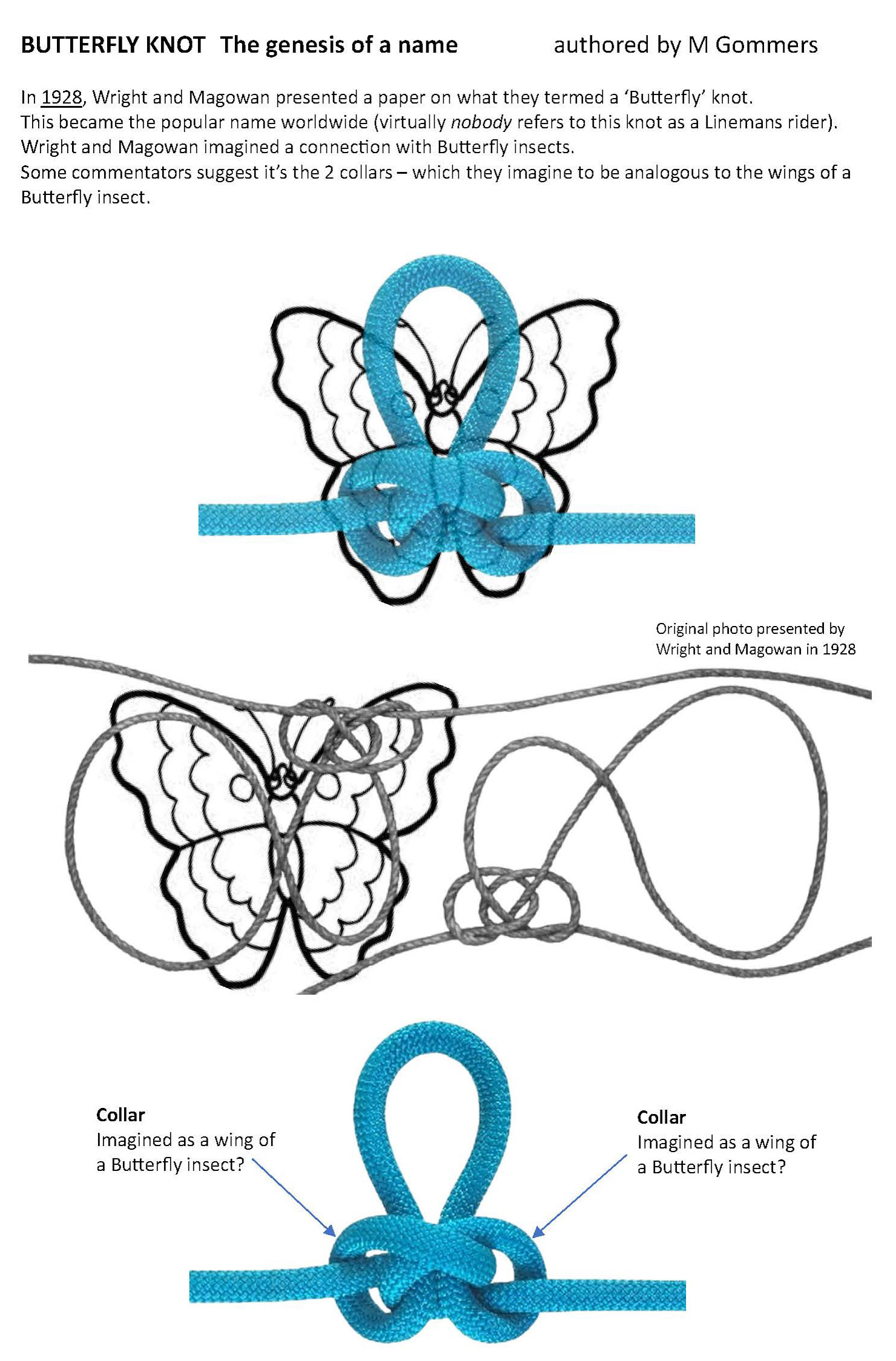
By the way 'Dennis' - I'd be keen to get your opinion on the genesis of the name 'Butterfly'. That is, why did Wright and Magowan imagine an association with the Butterfly insect? Please refer to attached image and comment if you feel like it...
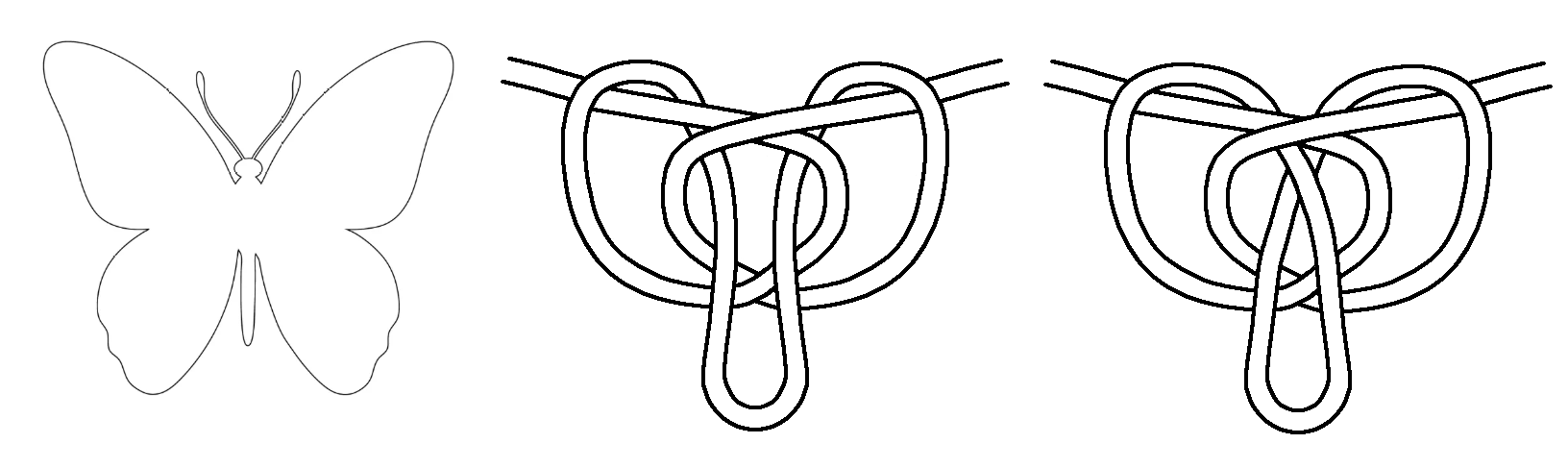
The key phrase in the Wright-Magowan first paper (p. 128) is when they describe how to open the knot. “Open by drawing the wings of the butterfly apart, or pulling the noose back through the knot.” What is clear is that the collars of the knot represent the wings of the butterfly. It is not clear what the eye part of the knot represents. It could be the head of the butterfly as you have it (and they usually put the eye part up). It could also represent the tail of the butterfly.
I almost forgot to include the twisted eye part that they insisted upon.
What I had intended was to specifically ask why they chose the name 'Butterfly' - given there are many creatures that have 2 wings.
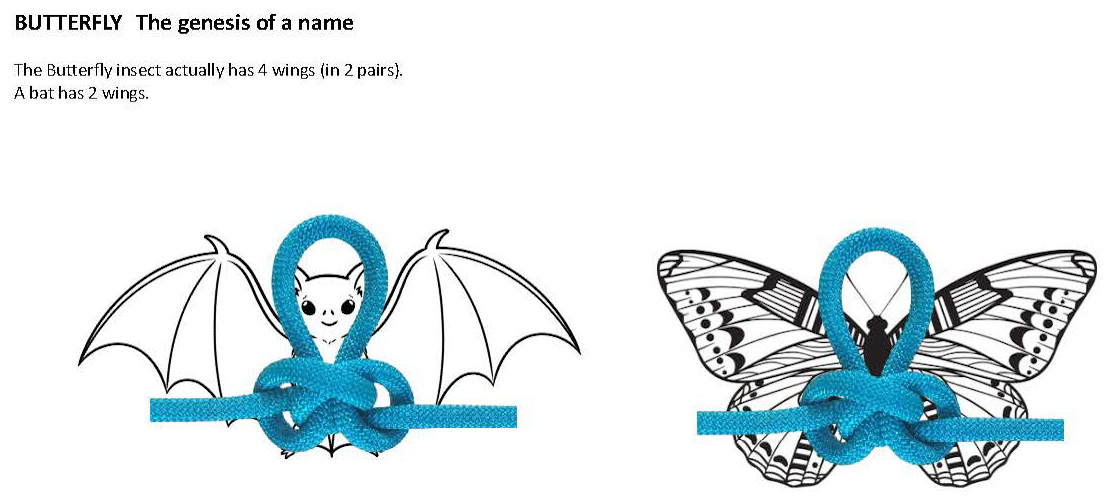
The Butterfly insect in fact has 4 wings (arranged in 2 pairs). In contrast, a bat has 2 wings. Birds have 2 wings and tail feathers.
The crossing of the eye legs is rarely shown by content creators apart from Wright and Magowan. These days, the crossed eye legs are typically a consequence of the induced twists in the rope during a particular tying method.
I imagine that Wright and Magowan fancied a resemblance to Butterflies - despite the anatomical differences.
Butterflies are a less scary/threatening animal than most people find bats. 
1 Like
I am not sure that the name comes from the exact shape of butterfly wings, but rather from how they open up. I think that WM thought of the tight knot as a butterfly with closed wings upright. When the wings open up, they go out and down. The “wings” of a Butterfly Knot are usually moved out and down in a similar fashion. The wings of a bat or most other flying animals do not move in this fashion.
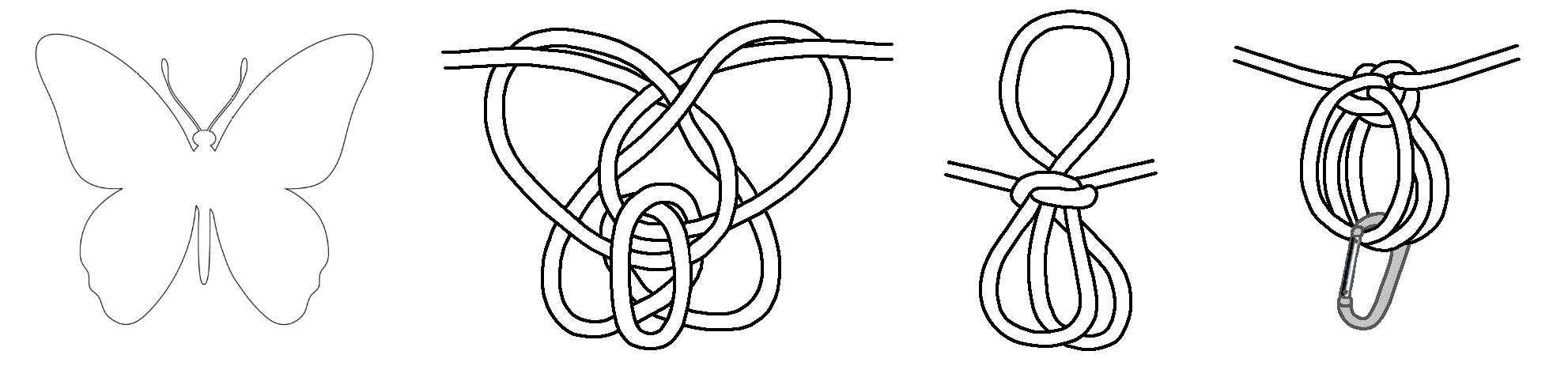
Rereading the Wright-Magowan papers, it caused me to notice what they call a Triple Butterfly (figure XVI.). You can reshape this Triple Butterfly to get a shape more like the shape of Butterfly wings. But I also noticed that when it is tightened, the third loop comes out in the counter direction. This is not a good replacement for the Mirrored Double Butterfly for most of the applications intended because the loops transfer too easily through the knot. The application for the Triple Butterfly that they indicate has all three of the loops going in the same direction (around your waist).