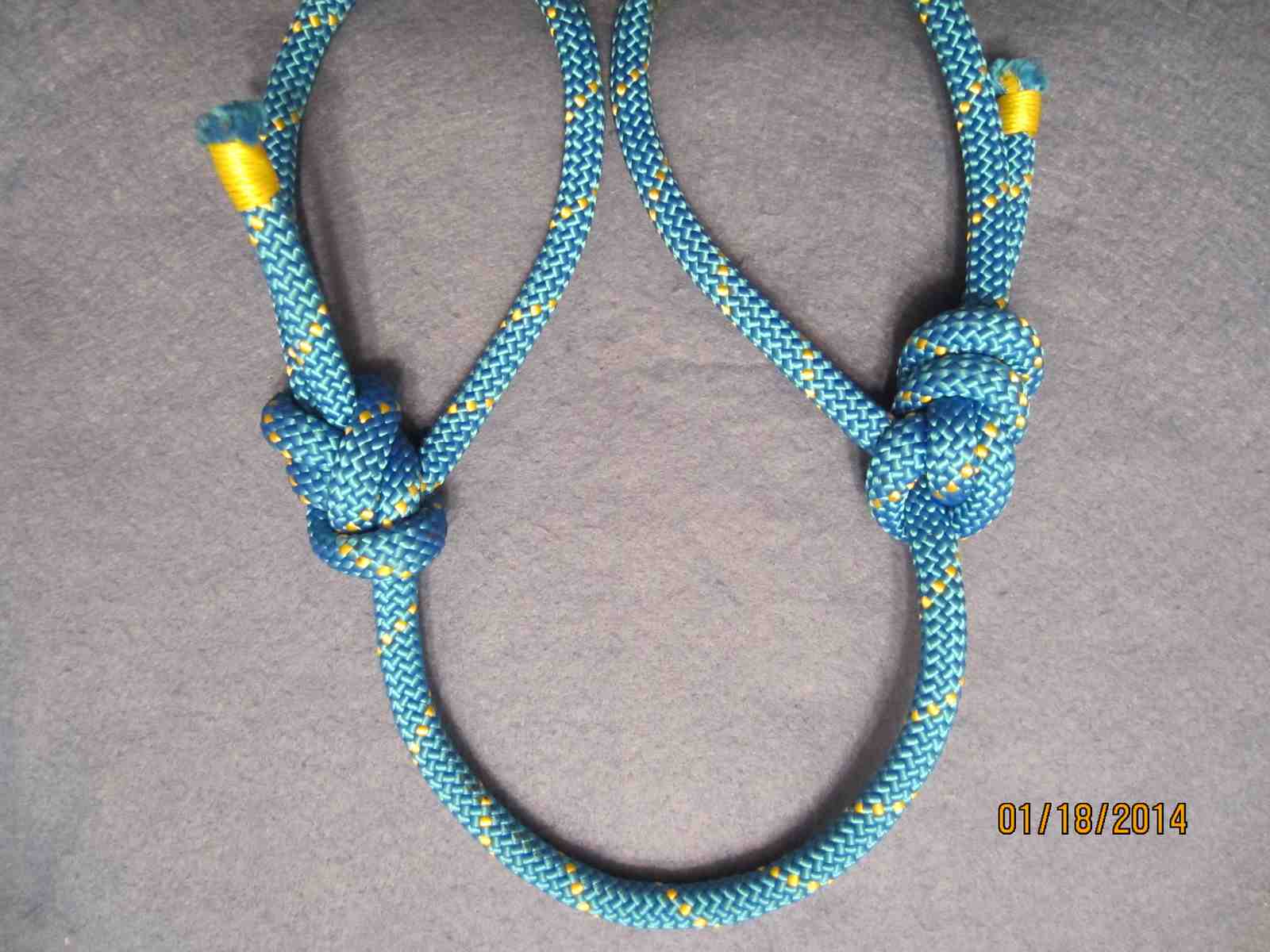
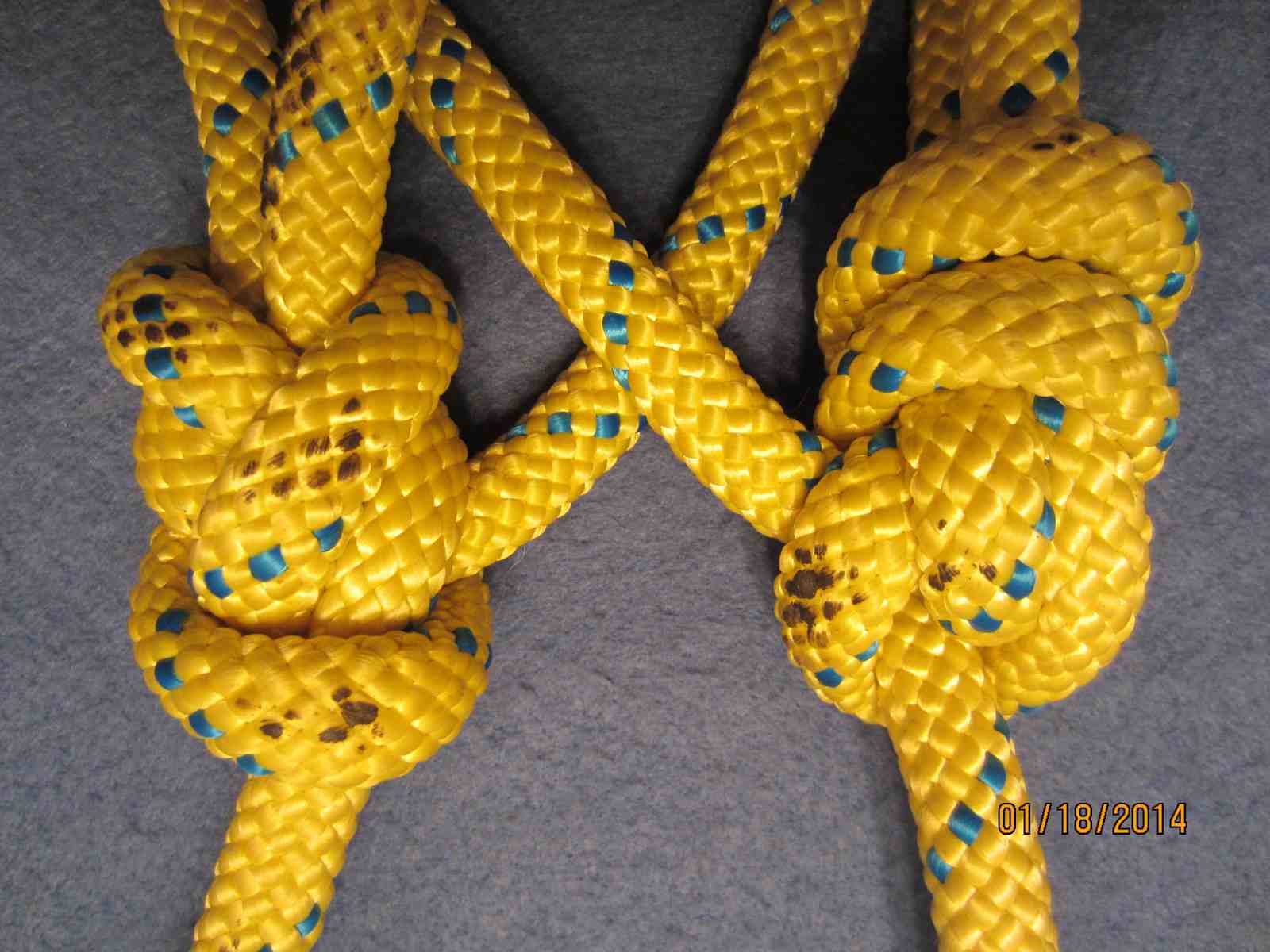
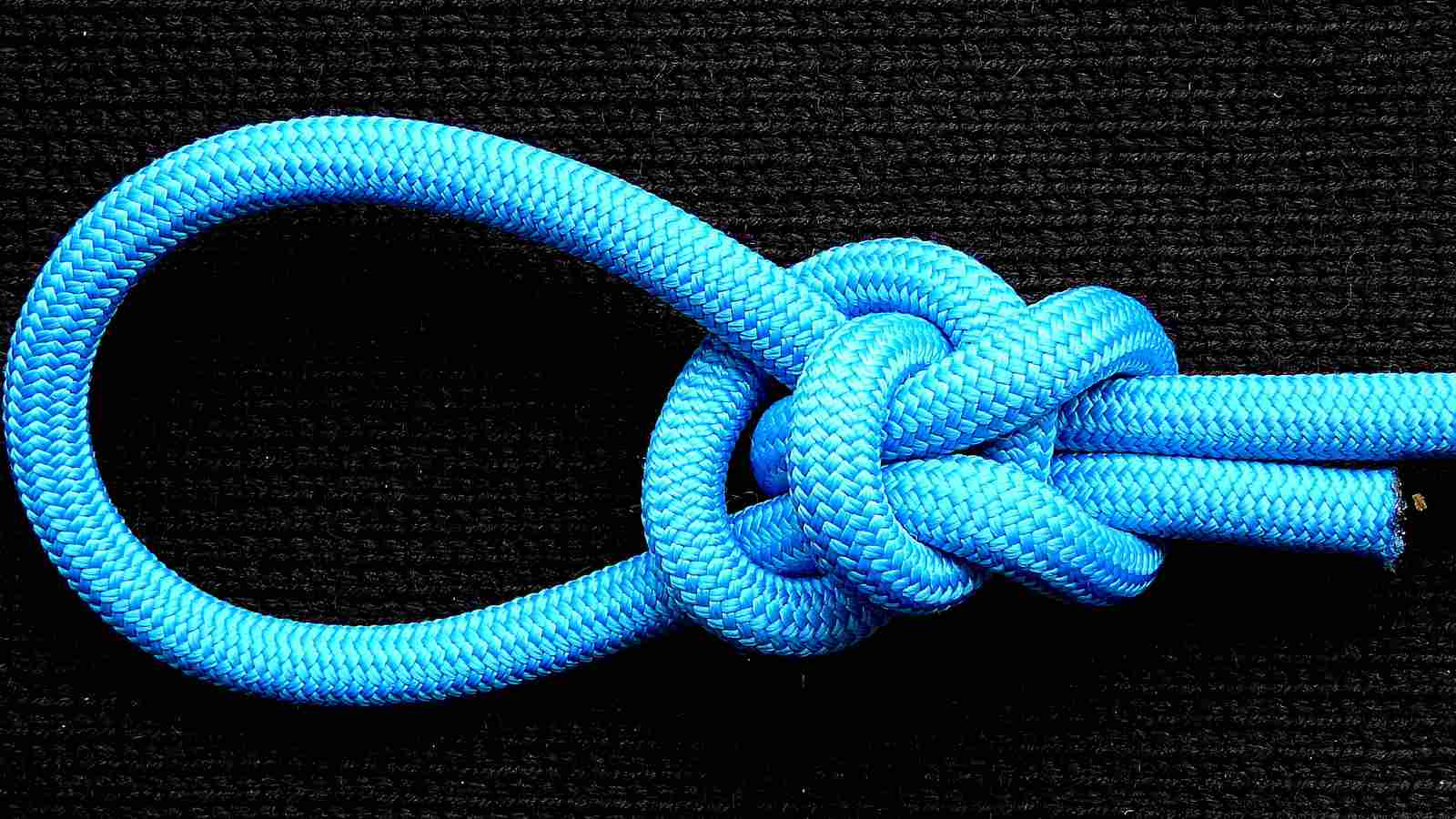
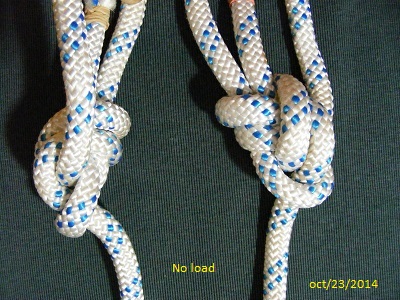
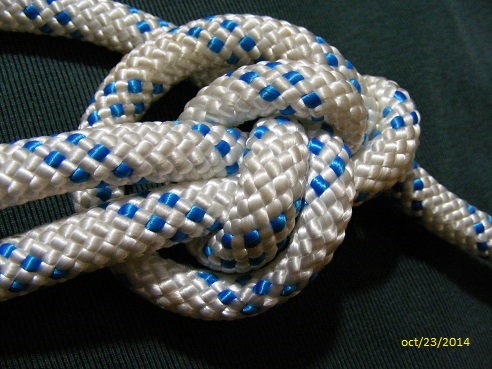
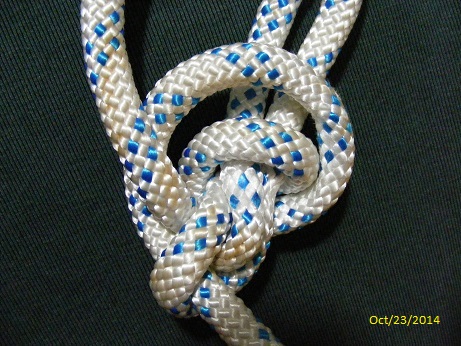
Monsoon Bowline vs WaterBowline w/Yosemite tuck

The Monsoon Bowline is very interesting as an improvement to the Water
Bowline and this is the 1st I have heard of it. Since I had sort of picked the Water Bowline because of super ease an quickness of tying along with improved security I had already figured on improving it with the Yosemite tuck primarily for the reason that it would also lead to allowing my proclivity for getting rid of loose tails by tying as many half hitches as possible onto the main stressed rope part. ( sometimes this can be a dozen or more half hitches)
I see the Monsoon Bowline as very slightly different than the Yosemite
tuck action since it is accomplished by by sticking the rope end between the two small loops. As to my desire to add lots of half hitches, the stub end coming out between the two loops makes that a bit more inconvenient
than when the tuck end comes out parallel with the main rope as in the
Yosemite tuck action.

I have discovered with the Yosemite tuck while making the water bowline,
I can also tighten ( “dress” is the word I think ) the whole knot pretty easily
before I give a final pull on the yosemite tuck end.

Does anyone think that the yosemite tuck location in any way causes an inferior knot to the Monsoon knot with the between the loops tuck location ?

FYI, my way of tying the Water Bowline is far easier than any of the
animation sequences that I have seen.

Try to imagine this procedure…
Take the end of the rope in your right hand and hold it near your right
pants pocket. Take your left hand and hold your arm straight out and
grab hold of the rope about two or three feet out. Then take your
right hand and throw two quick counter clockwise loops in the
loose rope. Now thread the end of the rope through and from the bottom
of those two loops to begin the knot. That is a lot easier, quicker and
more simple than the animation sequences I have seen.

As I realize there are many dozens of bowlines, I have read that the
water bowline is better than all the old classic bowlines and for my
purpose of needing to find and settle on a single knot to learn to
ad to my inventory of known knots it seems like I picked what was
widely acknowledged to be the best and even improved it a bit
more with either the monsoon or yosemite treatment.

My total inventory of knots will grow to four now.
For the last 60 years I have succeeded with only three formal knots,
those being my shoe lace knot, overhand and the half hitch in camping,
boating, construction and logging environments.

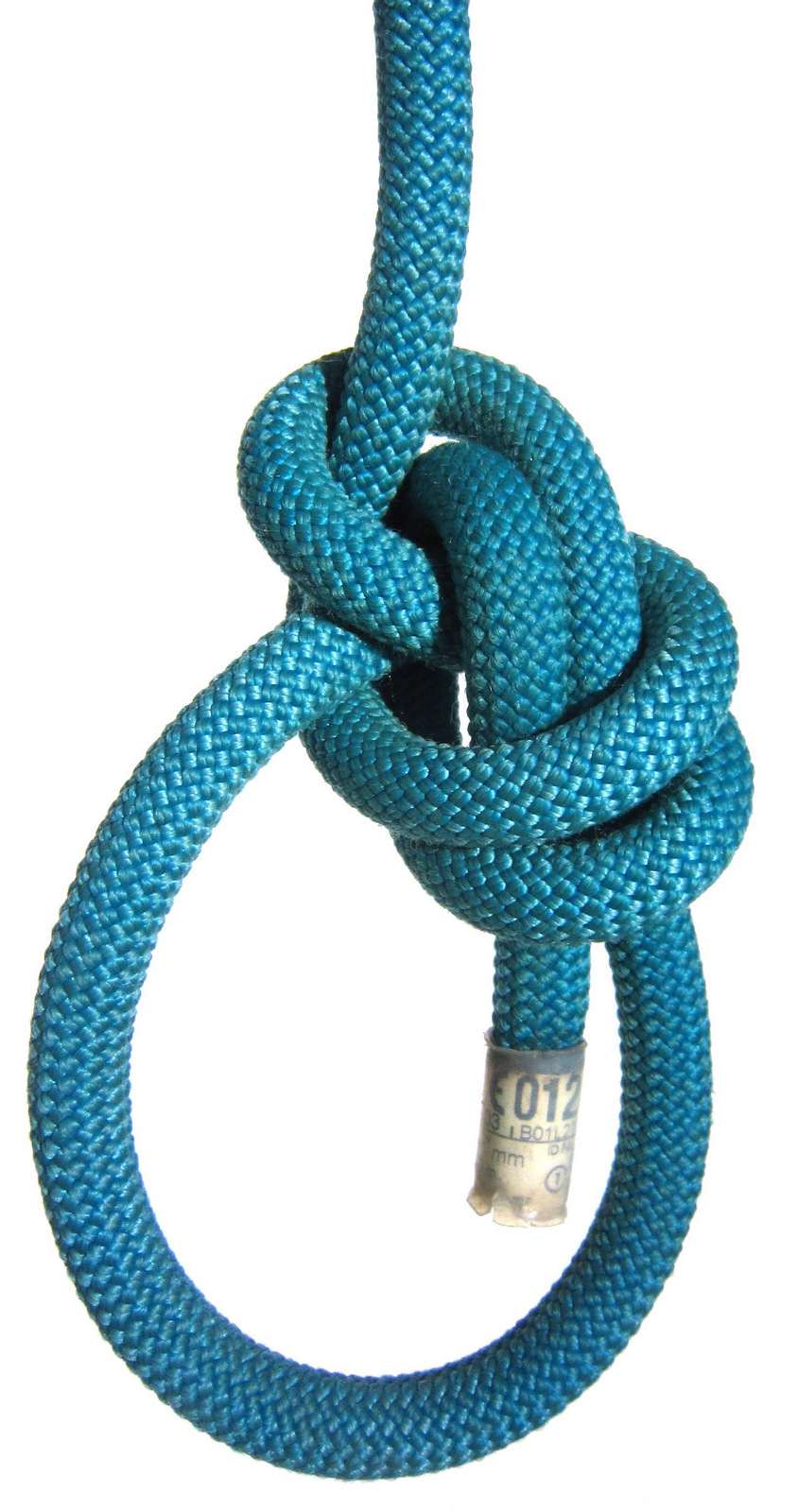
Yes. In security tests, the yosemite tuck shakes out so easily it’s almost pointless.

The ‘Yosemite Bowline’ has its issues, as do all knots.

I would agree that the Yosemite Bowline is not secure in stiffer ropes (also refer to ‘Youngs modulus’: High modulus = low elasticity).

Also, the Yosemite bowline can easily be miss-tied - morphing into a dangerous form (in terms of human life support ropes - eg climbing ropes). This happens when the tail is yanked/drawn up before properly setting the nipping turn.

When the stakes are high (as in mountaineering - no pun intended), most climbers would finish the Yosemite bowline with a strangled double overhand knot (a form of ‘insurance’).

Mark

to : Agent Smith and Roo

Just to be clear, I was talking about a Yosemite tucked “Water” Bowline
and not the regular Yosemite Bowline so I think some of the security
question would be removed … PLUS with the parallel to the main line exit, a strangle overhead knot could be easily added and for foolish extra security ( and housekeeping) I always tie a bunch of half hitches before I get to the overhead strangle to use up the extra dangling rope so it wont be flapping
all around. No way in the universe that my knots are ever coming untied.

Indeed before I found out about sophisticated knots, all I used were
half hitches and overhead strangle type knots.

Further regarding the Monsoon Bowline, the final tuck exit location
seems to me would be more likely to spread the two loops of the
water bowline kinda undressing the knot a little bit which makes me uncomfortable

I believe that a Lie s locked bowline will be 100%secure finish of the Yosemite bowline - and one of the most beautiful knots I have ever met !
The two “dis-advantages” are :

  1. It is not a TIB loop. It would be great if a secure bowline, which is already a PET loop, can also be a TIB loop, too. Versatility = Practicality. Other advantages of a TIB loop are nicely described by a newbie in (1) ! :slight_smile: :slight_smile:

  2. It involves the tying of an overhand knot on the Tail End. For really heavy loading and really easy untying afterwards, I would nt advice the use of an overhand knot ( or, for that matter, of a fig.8 knot ) anywhere in the knot, neither on the Standing End, of course ( where it is loaded on its two ends by 100% and 50% of the force ), nor on the Tail End ( where it is loaded by only 50% and 0%, at most ).
    Having said that, I have also to say that you have to remember that, in KnotLand, " there are no paths. Paths are made by walking ". Also, if you wish to learn from somebody, learn from the masters, not from “wise” traveling salesmen who want only to “sell” their own site, by artificially increasing the number of clicks on them and the amount of money ( $ ) they make from advertising…
    We are lucky to have, in this Forum, a real master of secure bowlines, who has tied more new such knots than everybody else, ever ! Visit his many posts, and tie his many bowlines which he shows there, with clear pictures. Alan Lee has tested his locked bowline, and he had reported his findings. So, the second “dis-advantage” , in this particular case, can well be unjustified . I do not test knots, simply because I can not ! :slight_smile: However, I do not “sell” knots either…
    The attached pictures were offered by Alan Lee, and by the most detailed and useful presentation of secure bowlines we have, the “Analysis of Bowlines”, Read it !

  3. http://igkt.net/sm/index.php?topic=5046.msg33279#msg33279


Lee s-lock_Back.jpg

heavy loaded Lee s locked bowline 1.JPG

heavy loaded Lee s locked bowline 2 (detail).JPG

Alan Lee is no doubt a knot genius but his message is on such a higher level
that effectively is spoken in a foreign language that I cannot follow
and thusly have to shun his ideas because they fail the first and primary
requirement of mine that everything must be simple to understand
and remember. I have fallen in love with the Water Bowline because
it is said to be better than the regular bowline and double bowline
and because I have found the ability to throw two counter clockwise
loops in making it to be as easy as putting food in my mouth with a spoon.

So now I believe with “simple” ( meaning doable with low ability and IQ and
poor memory ) techniques I can perhaps improve on it a bit by tucking the end either in the monsoon fashion or the Yosemite fashion. I prefer the
yosemite tuck position because it allows me to more easily tie half hitches
to use of the extra tail length … and I fear the monsoon tuck location
a bit because I think a wagging around tail would tend to undress
the two loops in the water bowline a bit.

Referring again to Alan Lees bowline analysis, those knots must be great
in performance but how much can they help if you cannot figure out how
to tie them ? Of all the characteristics of rope knots… those being
easy to learn remember, easy to tie, strong, will not come untied, easy to untie, economy of rope used, quantity of effort/speed in tying, esthetic attractiveness of the knot… The two things I can totally sacrifice are
economy of rope and quantity of effort/speed. I dont mind taking a few
extra minutes or using extra rope as tradeoffs to achieve my goal
of creating a useful rope structure mechanism using knots.

The “Analysis of Bowlines” is written by Mark Gommers ( a fine, clear, easy to read and understand text and beautiful pictures, which are improving each year, with the new versions ).
http://www.paci.com.au/downloads_public/knots/Bowlines_Analysis.pdf

I had suggested tying Lee s bowlines, because they are very good PET loops 99% of the time ! - and because this is the best way to learn how to tie many different kinds of secure bowlines.
In particular, his beautiful Lee s locked bowline, is just a retucked Yosemite bowline - if you had ever tied the later, you would nt find any difficulty in tying the former ! :slight_smile:
I believe you claim that a mid line = TIB bowline which can be loaded both ways would be preferable than a not-TIB one ( provided they both are equally good knots, of course, in every other respect ). So. perhaps you should tie and try the TIB bowlines based on the Girth hitch or the Clove hitch nipping structures, and compare them to the other ones you see in various commercial sites…
http://igkt.net/sm/index.php?topic=4695.msg31708#msg31708
http://igkt.net/sm/index.php?topic=4695.msg32103#msg32103


Clove TIB bowline (1).JPG

Xarax- thank you for the terrific information and photos.
The Lee S bowline looks like it could be easily tieable and if
it is effective and unties easy it could be the “ONE” I marry.

Small Clarification please. Xarax just to be absolutely clear,
your Lie-s knot is actually the Lee-s locked bowline. Right ?

When you say it is “100%secure finish of the Yosemite bowline”
I take that to mean it is so much better that people will forget
about the Yosemite bowline as opposed
to any kind of knot “finish” technique. Right ? ( bear with me,
I just wanted to make sure the word finish did not have a technical significance.

When you talk about the disadvantages of “It” It seems like
you are talking about the Lee S locked bowline but from the
photos of the Lee S locked knots, I dont really see the overhead
knots you describe. But if there is an overhead knot
that exists as part of the Lee S bowline, would that reduce the
untie-ability of this the Lee S Locked Bowline ? Your statements
sounded something like a “beware” or “warning” etc.
I cannot consider this knot if it could ever possibly be hard
to untie.

It doesn’t. Please tie it and set it in the type of rope you’re using and shake it as much as you wish. I’m guessing you’ll have a very, very tired arm before it comes undone.

Lee s locked bowline is Lee s locked bowline ! I had no involvement in its development whatsoever. Alan Lie has tied dozens of bowlines I had never even dreamed of ! :slight_smile:

Noope ! :slight_smile: People are much more unpredictable than knots … :slight_smile: They will do whatever they will do, probably obeying tradition or fashion. They will not think before they act, and they will not learn all the possible or the available secure bowlines before they decide. Even mediocre, or even stupid knots can work, because friction is so kind with us.
Lie s locked bowline does not suffer from the problem of the simple/un-tucked Yosemite finish Mark Gommers described. Personally I am not a fan of the Yosemite finish ( there are so many, and better, as I believe, ways to secure further the Tail End of the bowline, many of which generate TIB loops ), but this Lee s magic touch transformed the frog into a beautiful princess.
If you wish to learn more about the Yosemite bowline, ask Gommers, Lehman or Lee.

Have a more careful look at its tying diagram. IFF, I repeat, IFF it will reduce its untiability, it will be only after heavy loading. However, as far as it concerns me, I am not able to test knots as systematically as I would had wished ( simply because I was not born to be an experimentalist - this ability requires some special talents I lack :slight_smile: ), so I had not tested it by myself. Lee himself has not found any such effect. If you buy a cheap hydraulic jack, you will be able to rest it by yourself, and report your findings here.
What I can say, is that this finish improves the Yosemite bowline regarding the problem described by Mark Gommers, and certainly does not makes it less secure or less strong ! Since the Yosemite bowline has been used by climbers ( meaning, climbers have trusted their lives on it ), I conclude that Lee s locked bowline, which is a re-tucked version of Yosemite bowline, is a 100% secure knot. Moreover, what I can also say is that it is a beautiful knot : the flow of lines in his nub is a piece of pure KnotGod s art !
There are other ways to finish = lock a bowline, many of which ate described in :
http://igkt.net/sm/index.php?topic=19.0
http://igkt.net/sm/index.php?topic=19.msg20538#msg20538
http://igkt.net/sm/index.php?topic=19.msg20616#msg20616
http://igkt.net/sm/index.php?topic=19.msg27508#msg27508
In particular, the Scott s TIB bowline presented there by SS369 is a very easily tied, very secure bowline, with a wide, round nipping loop, which is also TIB ! As Luca has shown, it exists in a left- and in a right-handed form :
http://igkt.net/sm/index.php?topic=4517.msg29939#msg29939
http://igkt.net/sm/index.php?topic=4517.msg30269#msg30269

I believe you should also become accustomed to ( = tie a number of times, at least 12 ) the simple, conceptually, and easily tied as TIB [i]Girth hitch[/i] and [i]Clove hitch[/i] based TIB bowlines I had referred to. They have all the advantages of a double-collar Water bowline, plus the versatility of being TIB.

Y R U “Lie”-ing to us about Lee? :o

–this was the question! ::slight_smile:

;D

Hi Xarax,
Since there is question and doubt about Lee s locked bowline whether it will jam under heavy load ?
I have the facility, might at well get it test.

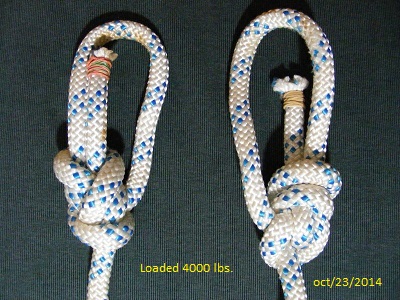
     First test, as I did normally dressed as tight as I can and then my foot step on one side and pull it hard 
     by hand on the other side ,and then dress it up little more tighter then I load it with slow pull to 4000 lbs and slowly release it. 
     I found very easy to untie. 

    Second test I dress it as above, and make little change on the final step, I push the collar down little bite and pull tight on 
    the eye leg of the tail side. this way it can pick up little more slack on the overhand knot. then I test it and  increase the load 
    to 4500 lbs, after slow release the load, I find very easy to untie. 
    This over hand knot don't seem like it going to jam. because there is the nipping loop in between the over hand knot, 
    once you release the nipping loop, you can see the picture below, the over hand knot is loose. 
    even with this way I dress it in the last step, it not picking much slack.
 
    謝謝  alan lee

First test.JPG

DSCF0035.JPG

Hi All, More pictures here


DSCF00363.JPG

DSCF00365.JPG

It is not only that there are segments of the “nipping structure” ( the part before the eye ) woven within / in between segments of the “collar structure” ( the part after the eye ), it is the particular way they do this. I have tried other configurations, with overhand knots tied on the returning eye leg, before the Tail End, and there the overhand knots remained either too loose ( so they were not participating in the function of the knot as much as they should, they were almost redundant ), or they were difficult to untie ! Bottom line, to me, when, after the eye, you tie an overhand knot ( or, for that matter, any self-locking “closed” knot, as the fig.8, for instance ), it seems that you should also be lucky to achieve an easy to untie loop ! :slight_smile:
To establish that the Lee s locked bowline is easy to untie even under heavy loading, you have to test it systematically - meaning test as many samples, as many loading patterns, and as many different climbing/rescue ropes as you can. This is the only way one can analyse the statistics of the experiments, and get reliable results, because the conditions of a few, only, trials can not be controlled 100%. Materials are strange things, even in two nearby segments of the same rope one can find differences, due to local impurities, differences in the weaving of the individual threads, etc.
How easily a knot can be untied, is a matter of SECURITY in many climbing/rescue situations, where there may be an urgent need to release the loop, without cutting it. So, climbers and rescue workers should be absolutely sure their knot will serve this purpose if and when it will be needed. As they are often people who rely mostly on past experience, to make up their mind and replace the retraced fig.8 or fig.9 knot, they will have to be persuaded by “hard” data they would not be able to question, even if they wish - and those hard data can only be provided by big numbers of tests ! :slight_smile:
As mentioned in the " analysis of Bowlines", Mark Gommers " has trialed this bowline on a challenge ropes course activity. The knot retained its dressing and was easy to untie after full day use with approximately 60 participants (the rope was EN1891 low stretch - not stiff, good hand)." . Therefore, I already knew what your trials will show, but I had to express even my most miniscule and remote doubts, just to be 100% on the safe side ! :slight_smile:
The expression “retained its dressing” is very important in the case of Yosemite bowlines, which may suffer from a unfavourable dislocation of their segments inside the knot s nub. For me, it is even more important because, as your pictures show beyond any doubt, the knot retains its beautiful, streamlined compact form, which makes it so well-balanced, able to distribute the tensile forces evenly, throughout the knot s nub, and be easily inspected at any time.