It occurred to me that the eyes of trucker’s hitch
sheave-knots might take a beating when the line
is hauled through them, and maybe a double-eye
would ameliorate the damage!? (Maybe it would
increase the loss of force to friction, argh!) So,
I fiddled around to produce some multi-eye TIB
knots. Presented along with these is one single
bowline in the bight, which also serve in this
capacity.
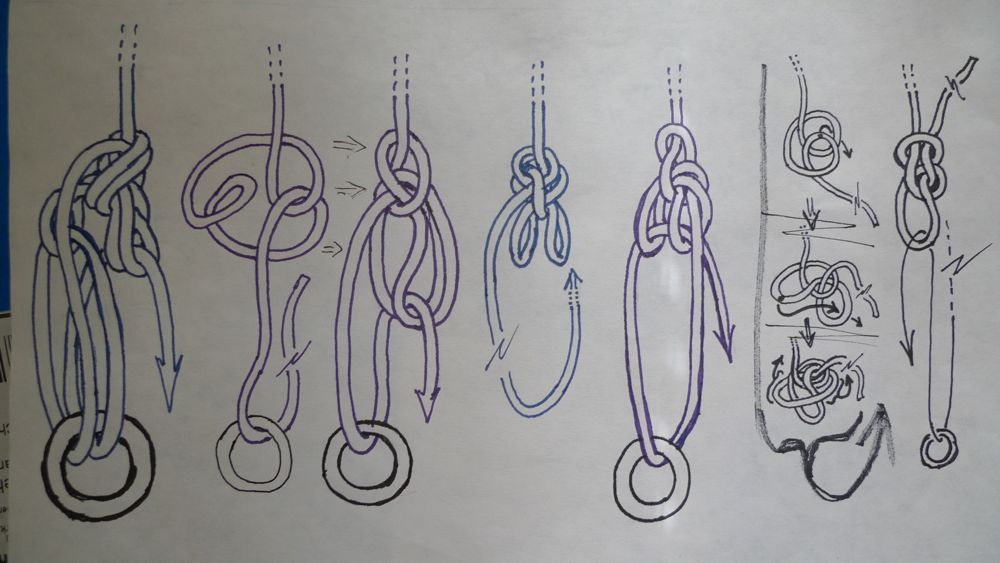
Thanks for the rare drawings, I’ve considered this problem. That’s one approach if you’re hell bent on using one rope.
When I am really concerned about wear, I tie a small sling onto the loop using an extra piece of rope. The sling operates as a sheave. The main rope undergoes essentially no wear at the loop.
Did you find greater/lesser frictional resistance
when hauling through a double eye?
(Note that the rightmost structure --that i bowline
on a bight[/i] is a single-eyed knot; it’s there just to present it as
a possibility for a trucker’s hitch.)
When I am really concerned about wear, I [u][b]tie a small sling[/b] onto the loop using an extra piece of rope[/u]. The sling operates as a sheave. The main rope undergoes essentially no wear at the loop.
!!  --an interesting idea!
[ Current 1st Prize of the Year, Knotting Novelty ]
(Maybe some kind of “Green” award for giving purpose
to small bits of cordage, too.)
But there’s no need, then, for the in-rope eye knot:
it can be --so simply-- a girth/clove hitch on the sling, with
the sling simply overhand stoppered/joined (it could
probably be UNjoined, adequately nipped by the main
rope; but a stopper-knot-loaded joint would help put
the gripping hitch in good orientation).
And it’s a nice way to put to (ab)use an otherwise
useless end of rope (which might be thicker than the
tying-down main rope, better built for the abrasion
and giving better rounding flow to the hauled end).
Tying off with an overhand (would be the notorious
“EDK”/offset water knot but it’s differently
loaded --qua stopper knot– here) and leaving those
tails a little long, to be altered occasionally so as to
keep changing the sheave point of wear, gives good
life to the small bits.
One could imagine a regular user of such things having
a set of the small bits so-knotted and grouped on the truck,
ready to be employed as needed. (The clove h. might be
better for retaining the slings in-line between uses;
the girth/cow h. looks better for ease of untying.)
An even better solution is to use a metal sheave, ring, thimble, or something similar.
Better for gaining mechanical advantage; but worse
for holding that gain when tying off. In many cases,
I suspect that one gets adequate hauling force by the
disposition of the structure --well, of its canonical form
of pulling downwards (over a lorry’s load)–, where body
weight enables “Paul Bunyan” loading and so overcomes
frictive resistance; and, then, the friction helps to make
tying off that tight line easier.
Thanks,
–dl*
In my brief experimentation, I have not found much reduction in wear by using a double rope. After all, the best possible improvement is half the wear on each loop, and that’s if the two loops are precisely even to balance the force. If not balanced, this method is even less effective, and the split of the friction is maybe 60/40 or 70/30. You get the idea.
You answered an unasked question : I asked about any
apparent/felt ease or possibly greater resistance, given
the 2nd eye.
As for wear, I should expect it would be reduced by
more than 50%, though the balancing will be more
difficult to achieve than one might think. (I’ve not
played with this.)
And, as for wear … , I recall one rockclimber doing
a sort of test if abrasion by rigging a sort of “StairMaster”
with a short rope with eyes on each end (to step in)
running through a sling of 1" (?) tubular tape : the
tape won (but paid a price) !! --i.e., the moving
rope though taking wear over a span unlike the
tape nevertheless wore through first (some old 11mm
climbing rope).
–dl*
Pics and a new thread…
I, too, like the idea of the separate piece. The original idea of the trucker’s hitch [I thought] was to release the loop easily, which can certainly be done using a separate loop, such as a Prusik (sp?) loop in ribbon.
SR