Naming ropeParts as components in a working support structure/architecture

per KC:

i will start separate thread and call it Mechanical Advantage systems.
Good decision!

Although all of this is way off topic - I’m responding to you in good faith (best if you start a new topic thread and title it “Mechanical Advantage Systems”).

Mechanical advantage systems (ie M.A.) don’t have much relevance to knots.
I had previously pointed out that within the working parts of a M.A. system , there are no knots.

Furthermore:
M.A. systems employ pulleys and sheaves - the sheaves freely rotate.
… the are no pulleys and/or freely spinning sheaves within a knot

Force is transmitted uniformly within an ‘ideal’ M.A. system
… force is not transmitted uniformly within a knot

I’ll assume that you are aware of and understand the rigging and arrangement of rope and ‘pulley’ within a “3:1 assisted hoist” (a belay person uses it to assist a climber over a difficult section of a climbing route). The climber grasps a rope segment and pulls down…thereby ‘assisting’ in the haulage - ie, provides a ‘boost’ by injecting additional force into the M.A. system.
Regardless of the fact that the climber injects additional force into the system - it remains a 3:1 M.A. system.
I refer to it as a ‘boosted’ 3:1 M.A. system.
I’ve attached 2 images of M.A. systems.
Both yield 3:1 M.A. (one is ‘boosted’ by the climber grasping and pulling down to inject force - but the velocity ratio remains the same).
The velocity ratio in both systems is the same (3:1).

I would comment that mechanical Advantage systems may not be relevant to many IGKT members.
However, a ‘truckers hitch’ might be of interest…
Link: https://www.animatedknots.com/truckers-hitch-knot
Or this link:
https://www.101knots.com/truckers-hitch.html

And a ‘Poldo’ tackle may also be more relevant to the IGKT readers:
Link: https://igkt.net/sm/index.php?topic=5377.0

See also this interesting link: http://itrsonline.org/wordpress/wp-content/uploads/2016/11/Evans.Truebe_A-comparison-of-the-Truckers-Hitch-Voodoo-and-Poldo_Paper.pdf

To me a pulley arc is just a lower friction arc.
Trucker’s and Poldo are 2 of the examples that lead me to see knots as machines
.
There is no such thing as friction free pulley.

what little friction there is , does compound thru the arcs cos + sine by degrees to decrease output from potential.
the linear parts of the pulley systems only add friction per side forces(sine only) of rubbing while on the linear path
the linear frictions compound by distance not degree
i’m sorry i really don’t believe that there are separate rules for the same forces in the same materials
just same rules at different friction values etc.
with the differences we can define further thru each other
.
When i say velocity, i mean speed
The powers of the pulley systems can be increased from their usual nominal given potentials by working other input point with added force
even if that force is the reflected equal and opposite effort of the other input
instead of that promised equal and opposite showing outside the system]
i have found to fold it back into for a single recurse of force
i have measured this many times
in the end it is just collecting all terms and asserting bodyweight + effort + equal and opposite of effort against target at given inputs with none of those forces showing outside the system.
.
The power increase from effort (setting bodyweight input aside) is always 2xNormal - 2 in a compression jig as shown
So a 3/1 can give 4x effort - frictions (+ 3x bodyweight)
a 5/1 8x etc.
You get the 2x expected from using the 2 hands but then
You lose 2xEffort as the top pulley in compression jig does take forces from the ‘left’ hand on that last turn.
.
This is just kinda Conservation of Forces as it is so pervasive even races around this counterintuitive turn
.
i offer this as lit my way in times of doubt; wondering why the compression jig was inset, not serially added to end and much playing and testing lead me to these things.
From “The Marlinspike Sailor” by Hervey Garret Smith:1956
http://www.mytreelessons.com/Marlinspike_%20Sailor_Rig.htm
(won’t embed)
.
i believe this was my drawing used by Brion Toss for 2 months of a monthly puzzle he used to run to similar counterintuitive principles:

http://www.mytreelessons.com/photogallery/mayhem%20what%20is%20loading.jpg

(may have to open in new tab depending on browser settings)
(from during my msPaint period !)

Hello KC,
And thank you for your nice work.

I am replying in good faith - and would like to point out some issues with your posts…

In the context of this forum (the IGKT) and the fact that fundamentally, this forum is dedicated to knots and knotting concepts - mechanical advantage (M.A.) systems is an entirely different subject area.
I am trying to think where the topic of M.A. systems would best fit within this forum?
Maybe under “Chit Chat”?

Just some quick replies:

Trucker's and Poldo are 2 of the examples that lead me to see knots as machines
Yes - the truckers and poldo would be a better fit for this forum - particularly the 'truckers hitch' since it is a [u]composite structure[/u] that consists of hitches (and is designed to be non jamming).

I reaffirm to you that an arrangement of pulleys and rope to create a M.A. system does not in fact contain knots - obviously knots within the system would cause fouling and jamming (a knot wont run through a pulley - it will jam/foul).

i'm sorry i really don't believe that there are separate rules for the same forces in the same materials
I am unclear why you think you need to apologise? I'm confused...
what little friction there is , does compound thru the arcs [b]cos [/b]+ [b]sine[/b]
I note that you often refer to trigonometric functions in your explanations of [i]hitches[/i]. I am unclear what your reference frame is when you do this? Is there an 'up' or 'down' or 'left/right'? How do you assign a [i]cosine [/i]or [i]sine [/i]to a segment of rope? There are many twists and turns within a knot or a hitch or a bend. In assigning a trigonometric function, what universal rules exist for such an assignment? And further, if a segment of rope within a knot core is assigned a trigonometric function, how does that explain conservation of energy within the knot structure? We know that energy enters a knots via the '[i][b]SPart[/b][/i]' (eg in the case of an eye knot). By the time that energy has reaches the tail, it is greatly diminished - to the extent that it is effectively [i]zero [/i]at the [i][b]tail end[/b][/i]. We know that the core of a knot undergoes [i]compression [/i]in response to load and there are localised stress concentrations all of which give rise to heat build up. Failure likely propagates from one of more of these localised stress concentrations (in my view).

I honestly think that you should invest in a high quality thermal imaging camera (eg Flir):
https://www.flir.com.au/browse/industrial/handheld-thermal-cameras/
There would be much to glean from such observations of a knot as it undergoes core compression.
You would be able to see in real time what is actually going on within a knot.

And each knot will have different characteristics under load conditions - eg some jam while others remain 100% jam resistant.
Localised stress concentrations are more pronounced in some knots…

Maybe you could try to invent a more efficient ‘truckers hitch’?
Or try to gain more M.A. yield/power from an alternative composite arrangement?
That would be a challenge for you! (without the use of manufactured pulleys).

To me, i have learned much of capstans/bollards and pulleys that have carried into knot internal secrets and then back to the mechanical devices and back to knots in cyclic growth. The att_frict paper is a very shining example; i always thought so, especially after years of reading it, and then finally really ‘got it’. They all are studies from different angles of the same tensioned rope arcs. The linears in knotting are just connectors to arc, input and termination. Linears controlling frictions are by sine only, and compound by distance. Arcs use all of tensions, the cosine and the sine for controlling frictions and compound by degrees. Then the arcs also have the compound point of pressure onto, not around host. BUT only if from linear force input, that then maintains the focused directional axis thru the system but not if diffused directional radial force of round binding against expansion that has no focused direction, therefore no compounding point w/o other strand. For all tensions equal not degrading to Nipping point. i could not have found these things in knotting without these other supporting views, so offer them all as the more complete tangible fabric to grab, instead of collection of individual points.
.
Knots are machines to me, just in stop/locked position. Poldo and Truckers can take from static to dynamic machine leveraged control, but then lock as static machine again. The linear focused force thru a SPart is diffused to greater area that is more controllable in arcs. Trading in leverages focused force to diffused, as also avails to more frictions in an arc to leverage control with the system. If use lever as a machine to lift dynamically /motion, and then hold the position, it is as knot in a static position, but still a machine taking a linear gravity force and diffusing out to wider arc to control easier with final nip of effort to control remaining force as a ballast against chaining backwards thru the system against load.
.
Stone doesn’t take tension well, but that is what they wanted to make bridges out of to last longest. Had to find the arc(h) in architecture to do that. Arc(h) in architecture to me means not to try to support with Zer0 cosine of cross axis. Necessity being such a mother produced the stone arch allowed to use the borne forces pretty much all in compression that stone can take very well. Rope tension on arc is reverse, all tension used to target as can’t use compression for support. Same science. Bollard/capstan and pulley are same arc science in knots, just showing different faceted aspects of the same jewel. Thus can get a view here and there in one and trace in another. But also, can ‘parity check’ in same way. If think have principle in one, must persist fairly in rest that apply : capstan,bollard, pulley, knot. If can’t cross-verify forwards and backwards against own self and between these members then not seeing correctly. Things i present have run and persisted thru all these gauntlets back and forth over the decades of study. 2 spread pulleys in system only use 180 arc of each given pulley at any time, just as a host mount for knot does, only closer together at higher friction and at end of travel. other wise the same as you take out the straight linear connecting parts.
.
COSINE !
To me cosine is the focused linear support against load, both directions on that loaded axis of Equal & Opposite pair of load vs. support.

sine is anything not on that simple, single dimension. On tv you don’t stand in front or behind a rocket launcher. That is the loaded axis of target force direction and it’s E&O as a loaded axis. Guns and ropes can have recoil on that E&O axis etc. Sine is anything not on that single dimension axis, more compound/complex.
.
Cosine as a number x 100 gives the efficiency of the support column as a percentage form.
if supporting column of rope against imposed load is purely aligned cosine= 1.00, 100% efficient
500# tension will hold 500# load, cuz 500/1=500, 100% efficient use of borne tensions
if however line deformed or angled to 30 degrees cosine .866 is 86.6% efficient
577.35# tension needed to hold against 500# 500/.866 for 86.6% efficiency
577.35 tension x 86.6% efficiency = 500#
577.35 tension x 50% (sine of 30 = .5) gives 288.68 side force also carried
77.35 more on support axis needed as also handle 288.68 across
to carry same 500# that with pure inline support column at most efficiency only was same 500# and only 1 force axis
our friend rope only works in tension
helpful here as any side force expressed will try to groom system more inline proper.
whereas a rigid support may use compression
and compression side force pushes the Equal & Opposite more out of line towards less efficiency
they are running towards each other and have no place else to go!
.
Cosine is not a set direction nor axis, it is the benchmark axis to me. Many books show it as horizontal which very much confused my self study of vertical/gravity fed usage of climbing, rigging and felling. Cosine of support is how efficiently the support aligns to the load. So can benchmark force or support and measure to the other. Many times in talking to school trained folk on cosine, they could only see cosine as horizontal then calc from there and may times struggling to do in the vertical force context. My imagery now is much more fluid than that.
.
i follow the force into the dormant (rope)structure of responding force against the imposed loading.
The linear line of force imposed is my benchmark cosine axis and direction.
Anything to sides, the other 2 dimensions are sine.
Mnemonic of cosine is to my cos(cause), and Sine the distraction sin from, to the sides
to control the load takes the cosine, the sine is just born as extra costly baggage not to target against the porting device.
Less cosine efficiency needs more tension to give same support sum to ballast against same load.

.
So the cosine in Hitches as terminations and Bends as couplings type node deformities in an otherwise straight rope run is that line itself. The SPart is the input to the controlling arcs. It ends in my model where the Primary Arc begins as 180 around host or 90 around other rope part as a Half Hitch pre-fix does in Kellig. The input endpoint of this arc must point in direction of force feeding it.
.
The controlling frictions degrade the tension as you say in a LINEAR decreasing fashion of it running out of gas to the final Nip(s). Noting, in Binding is radial force induced, thus no conversion loss, and not degrading tensions to the final Nip(s).
The radial is diffused evenly around w/o direction in Binding, the focused linear induced maintains the directional axis (horiz or vert) until 90 conversion to cross axis or force termination in Hitch or Bend usage, even of the same knot, just by the type and direction of force imposed.
.
Knots can express compression on a host to use, but only tensioned parts of rope give force internally except for firmer frictions. Cannot give lift, pull etc. If on smaller arc get compression on the interior side as tension pulling on outside, there must be a section between this sliding gradient that is neither stretched nor compressed as rope area segregates to these 3 zones. Only the tension zone is carrying load pull, that is now leveraged to that smaller section, of greater tension to compensate.
.
To me, a pulley system tries to maintain conservation of energy towards end output, while a bollard trades it away for friction before, but in total both conserve the same amount, just that bollards are mostly in friction/heat in a physical to heat force exchange.
.
Trucker’s Hitch efficiency loss is from rope on rope and other hosts. It will always have 3 legs of pull for standard POTENTIALS of:

3x as a compression jig or 2x as a lift if input is downwards where can use body weight/up to as input
unless grab and pull up on something to essentially make self heavier
can reverse trucker hitch vertically, to picking up 3x, or compressing 2x
this way can use strength, like more powerful leg force as input, but more fatiguing than hanging/sitting or rope as input
‘My’ method is for the 2nd pull inside the Truckers Hitch as also hang on it
this takes us from 2xEffort on one end and 3xEffort on the other
to 4xEffort on both, then if can hang on end as input add 3xBodyweight to upper and 2xBodyweight to lower as additives
if cannot hang on end as input, hang on the interior input to then give 2x upper and 1x lower bodyweight additives to the 4xEffort.
In normal operation, the Truckers could choose between leg or gravity input. In this modified version, it can use both and to higher multiplier for the effort.
The 3xEffort potential of the Truckers is converted to (3x2)-2 for 4xEffort as a potential for both ends
5xEffort potential of a 5xcompress is converted to (5x2)-2 for 8xEffort as a potential for both ends
plus bodyweight affects for each.
i would say this conservation of forces, to include those assumed to be outside of the system now folded in
is in itself a more efficient Trucker’s!
ALSO, with the dual input system of effort and weight, can hold tension in Truckers with effort part and impact with bodyweight thru system(or reverse that strategy) to tweak linearly before leveraging/swig across as potential input.
get as tight a lever as possible linearly first, to make less rubbery a lever as come across rope.
So, even tho i can’t offer an improvement to this ‘sledgehammer’ of force; please let me offer to use both hands in it’s style of application for the more you seek.
.
i totally agree on imaging camera but not in budget, and have not seen all could with what have already yet also; but see more than i did before journey started for sure.
.
Thank you for your fine works and also questions here too!

KC,

With regard to compression, I believe agent-smith was referring to the force that an outer wrapping of the knot exerts on an inner wrapping normal (perpendicular) to their contact surface and the axis of the outer wrapping. This is the force which is responsible for the frictional force which keeps the knot from slipping.

This is different than the forces, tension/zero axis/compression, seen in the bending of solid objects like a beam. This bending produce forces within the object which are parallel to the direction of the axis. In what I believe is common experience with multi-strand ropes, the strands of the rope will move and the circular cross-section of the rope will distort and flatten to more of an oval in an attempt to try to distribute the load.

Thanx, was looking at it from more of a too tight bight view.
.
i think of this other as a contact deformity.
i picture rope, even if not moving being pulled clockwise by load
as essentially host is cranking counter clockwise.
Rope between these 2 nonMotions of directional force

breaking rope to sections still
outer ‘race’ pulls clockwise hardest
inner ‘race’ pulls counter hardest
horizontal line markers across ropeParts that hang off host
go diagonal to ‘forward slash’ Z chirality(there i said it) on host
where head of forward slash leans further forward than foot
as head pulls clockwise and foot counters
find all of rope pulling clockwise except dragging foot being pulled back
.
i think we see this thin layer of wrong direction also smooshed/compressed as a mating surface sleeve on contact
seems this mating surface war must deform rope even minutely from pristine linear form
even on a soft arc that gives plenty of support to rope.
Even in flat webbing that presents about nil dimension to be leveraged against it self
that we see in round rope as it raises up high on the host’s arc, farthest part leveraged distance thru rope away from host
This is an assumed fault to me will have on all hosts
then tight bight to compound fault by disallowing even more rope fibers to support that are present on pure inline linear
i think this can happen on internal layers too, especially when core is present and load bearing, not just stuffing the sausage to keep round
.
Round very important concept
all cross axises from linear run are equal
webbing has flat axis of minimal dimension lays on curve nicely, to make Half Hitch arc
but then scrunches to massively deform for lock of Half Hitch as major cross axis of width deforms
Minimal cross axis offers no real dimension to leverage on axis of deformity to arc
but offers massive leveraged deforming cross axis across it’s width to ‘weaken’ it’s support to less efficient
So round rope more predictable and usable powerband of facing various deformities
but think webbing still gets some ‘contact’ deformity
Round host important too, for the rope arc can use all of tension for support (and friction control)
like stone bridge arc uses arc for all compression for load bearing
just rope is in tension, bridge compression
failing earliest in tension >>just makes stone better barometer to how arc(h) works and how well !
.
i hope my model of Zepplines, Hunters and B’Fly jamms suffices as
overly focused , dualled high load force matching as 2 massive bulls in the ring neither willing to give up ground, and no side releif
needs some kind of forgiveness, open side, misalignment etc. to not be too perfect, to not hold too well in such compressed quarters view

Here is my view of the disallowing of some rope fibers for various reasons in arcs and knots:

https://upload.wikimedia.org/wikipedia/commons/c/cb/Types-of-rope-arcs-that-take-some-fibers-from-tension-service-leveraging-same-load-to-fewer-fibers-of-now-greater-tension_resize1000px.png

Reduction of the amount of rope fiber ‘soldiers’ to do same work of supporting against same work load,
Leverages more work to each soldier, in some varying ways.
.
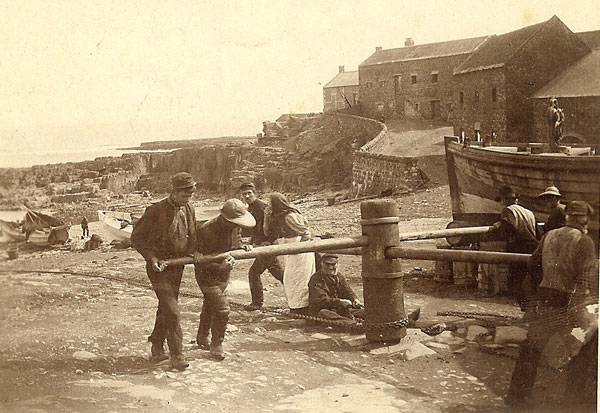
i really like this web page, the century old pics i guess are legally for taking(?) but there is more than one to a single theme from this small port community, and they don’t meet very often to answer my email..
.
The very first capstan pic especially to me shows important knotting concepts and positions:

could be rope pulling boat in with capstan, but is chain >>both part of flexibles class that is only rigid under load inline in tension direction
has linear SPart feeding into controlling arcs
linears only serve as extensions between input, output and controlling arcs
tailing ballast >>tailer man keeps system tight by taut ballast position
(other capstans shown terminate on capstan w/o tailer, can’t be ‘endless’ and as turns stack they ‘gearing’ changes for less leverage)
.
Knots as other rope mechanics work majorly thru controlling arcs as this capstan.
and need final seize or ballast to keep rest of system in working mode/tight.
.
Knots are part of rope mechanics, and are ruled by controlling arcs.
Frictions is a most important part of rope mechanics of arcs
Frictions adjust the amount of compounding force at arc apex to host
as also control the amount of compound reduction of tension thru rope
Controlling both compounded increase against host and compound reduction of tensions >>BOTH!
Just as a pulley models what would happen in a knot arc if turned the volume knob for friction all the way down
Capstans/Bollards show opposite view of turning the friction volume knob all the way up inside of a knot!
The ability of these views expands things to be as other sciences where can vary single factor to monitor outcome.
simple rope tools of history are not separate puzzles, but rather separate pieces of same puzzle
to disallow them from view cripples comprehension with blinders to total effects and testing premises too
to be able to view them in their singled state out of know would be paramount in any other science
And so w/o pulley/bollard only delivers incomplete picture with only pieces of puzzle allowed.
.
Guess should mention no problem using my drawing as done by agent_smith.

In bigger, over ruling sea of rope mechanics, think that are all arc controlled;
Knot Internals most controlling forces are also by arcs on small ‘knot’ island inside ruling sea of rope mechanics.

but are not as intense as arc effects in force thru controlling arcs from linear force
capstans(metered pull)/bollards(metered relief) of tensions
(that are dependent on reductions to a ballasting tailer to maintain tension thru system)
and their reciprocal/antagonistic/other contrary side of arc forces revealed : pulleys (directional compounding)
These tools (capstan and pulley) do benchmark endpoints of reciprocal effects in arcs, encompassing knot arc usage
so that knot usage inherits hybrid mix of both reciprocal effects to varying degrees in all arcs
as how they handle compound force increase AGAINST host as also compound force reduction AROUND host
and examples of what happens if turn the ‘volume knob’ on frictions higher or lower than even can in knots
per ‘setting’ of volume frictions ‘knob’, to favor one over the other (capstan reduction vs. pulley compounding balance in arcs)
Capstan: study of force reduction effects in arcs AROUND host (Capstan, Bollard etc. of excessive turns frictions)
Pulley : study of force compound effects in arcs AGAINST host (reduced frictions end of arc force range)
amount of frictions volume determines how much of each effect revealed in each arc
as reciprocals of each other>>greater friction gives more capstan reduction dropping pulley compounding utility etc. in arc(s)
while reciprocally with less friction, less capstan effect >>lends to more compounding pulley effect revealed/expressed.
Round Binding is not EXTERNAL FOCUSED DIRECTION LINEAR input force to controlling arcs as in Bends and Hitches
for even if same knot used now to Round Bind >>INTERNAL DIFFUSED NO-DIRECTION RADIAL input already inside controlling arcs
All controlling arc tensions same until nip, no friction reduction thru so no capstan effect
nor any compounding effects against host like pulley from no focused directional linear/even radial ‘glow’ of force all points equal until nip

https://upload.wikimedia.org/wikipedia/commons/b/bd/Arcs-in-knots-are-mix-of-capstan-and-pulley-arc-effects-as-reciprocals-per-frictions.png

.
Must have ending ballast of some sort after force reduction(s) of controlling arcs from load input/imposed onto passive(but responding) rope.

Just as dynamically have with tailer on capstan metered tensioning line or bollard metered tension relief tailer position
only to a static /non moving knot (mostly), ruled by same arcs(thus ruled by degrees not distance) in same rope under same tension
Without ending ballast formed somewhere, rope would not load tension, as like electric circuit w/loose ground.
Even between position of arc input, rather than either end:
constant spinning/electric etc. capstan needs load pull and tailer/ ballast to load tensions to really do anything
2 points in opposite direction thru rope(load vs. ballast) forces back and forth buffered/leveraged between by frictions.
controlling arc(s); as most potent frictional reducers using cosine and sine, compounding by degrees
vs linears using only sine for controlling frictions and compounding by distance
(cosine is used against load, straight hang = full cosine, no sine = no frictions etc.)

Ancient Greeks took this from cooking, that from merchandising, another from builders, still more from accountants etc.

and said this is all 1 topic called math as combined all individual understandings to 1 larger shared
then defined so much more from those views cross verifying and expanding each other into this more over-ruling, more tangible fabric of math
Math is the language of understanding and accounting for the differences in things
thus knowing more of 1 thing by comparing to another benchmark etc.
well enough to be able to explain and even predict outcomes.
.
If we extend physically against space or against physical force it is the same math of physical displacements for either
one can be understood, viewed, cross verified etc. by the other
Because these ‘simple’ maths are so pervasive thru all that they are consistent even in light, electric, sound, water etc. waveforms!
.
Working/load bearing ropes including knots as they displace against a load imposed are subject to these same things as all else. Kinda abstraction layer of control to whole stack.
Sine and Cosine as their most minimal , consistent representation/expression as in all else:

https://upload.wikimedia.org/wikipedia/commons/6/66/Sine-cosine-pivotal-cornerstones-of-physical-displacment-of-force-or-space-understandings.png

.
As much of this is geometry affected, if not out rightly based.

https://upload.wikimedia.org/wikipedia/commons/8/81/Force-dimensions-1of4-unique-dimension-of-load-pull-as-best-cosine-axis-vs-all-cross-axises-of-full-sine-instead.png

These things apply to lines of force in rigid support objects, that are always rigid at room temp

or even in the special flexible class supports (like rope) that are only rigid/forge rigid under load
but only along length and in the tension direction along that length as only axis and direction can get rigid against load

https://upload.wikimedia.org/wikipedia/commons/e/e6/Force-dimensions-2of4-same-dimension-support-as-load-is-column-of-full-cosine-opposite-extreme-sis-any-90-degree-angle-from-as-full-sine-most-wrenching-not-support-column.png

They showed us 3 dimensions of space or loading, and to control against a linear dimension of loading

need at least some dimension to opposite direction
or the load will be outside the column of support of the device (on cross axises)

https://upload.wikimedia.org/wikipedia/commons/9/9e/Force-dimensions-3of4-any-loaded-axis-needs-responding-control-against-with-at-least-some-dimension-against-loaded-axis.png

Thus, this is why i think we see at least 3 arcs in lengthwise loading in ABoK

The multi dimensional load (per rope support given) needs a multi-dimensional support system
to even properly get up to bat.
Looking at arcs as the ruling controllers of rope mechanics that knots are a part of
the greatest force is the directional compounding pulley force in the center of each arc
from these greatest forces against host (not around) , connecting the compounding center points
only gives true multi-dimensional support at 3 arcs

https://upload.wikimedia.org/wikipedia/commons/5/5a/Force-dimensions-4of4-multi-dimensional-load-needs-multi-dimesnion-support-from-rope-etc.png

Even Killik has a 90 in and 90 out angles of Half Hitch to arc in final Timber

while also going around host at Half Hitch
the Half Hitch 90in90out itself gives some more inline linear architecture against lengthwise pull, as reducing forces and forming 2nd grab on load

The first image naming Uncrossed Turns >> Turn, Round, Round Turn(RT), Dbl.Round,Dbl.RT, Triple Round, Coil(link)

i offer Round for 360, so that add 180 Turn = 540 Round Turn
what i call out as Round, Dbl.Round, Triple Round are just place holders as less usable forms in working knots anyway.
.
Odd number of 180arcs usually seen of Turn(1), RT(3), Dbl.RT(5), Coil(7).
A single Turn of 1x180 arc in professional use to me is more of a purposeful pass of force, but then upgrade to 3x180 arcs RT get compounding capstan effect and expands to a 2D support framework geometry of ‘footing’ if relevant amount of force left at that point. More arcs expand on RT to give more frictions and extend to greater 2D support framework possible. Crossings on or off host pit the ropeParts accentuate the force reductions per their radial position from the input force directional axis (vertical, horizontal etc.)
.
The most effective points to place the 3 arcs is logically at most loaded point of just after most rawly loaded Standing Part (SPart)as Turns on host, frictions accentuated by Crossing/‘frapping’ turn on host OR around the SPart itself (as off host crossing)w/o significant previous force reduction on host.
.

https://upload.wikimedia.org/wikipedia/commons/d/db/Basic-knots-3arcs--working-class-knots-1of2-arcs-on-host.png

.

https://upload.wikimedia.org/wikipedia/commons/4/41/Basic-knots-3arcs--working-class-knots-2of2-arcs-on-standing-part.png

.
So micro components for linear loads still persist as degrees deflections of 0(linear), 90(convert to cross-axis) and 180 (convert to opposite direction on same axis).
While more modular component assemblies show as Turn, RT, Crossed Turn, Backhand Turn. Final Nip forces, as other rope crossings, are dependent on radial position from the linear force input thru SPart.
.
The 180 arcs rule and control the linear force fed knots, linears in knots are just connectors to inputs, outputs and arcs.
.
Just as an explosion in a container whether is barrel or manifold, is a 3 dimensional radial unfocused explosion force of all axises, then folded to focus and concentrate all that explosion to 1 axis, with 1 side of relief on that axis to provide direction of now concentrated,focused linear force; a linear fed knot does opposite. Linear force imposed by the SPart as input feed, disperses the focused directional force to radial to control. The co$t of conversion from focused linear input to dispersed radial controlling is friction which degrades both the persisting tension and directionality components parted out from the raw linear input.

Concentrating and diluting/dispersing force to 1D focal:

https://upload.wikimedia.org/wikipedia/commons/3/3f/Virtue-of-commanding-change-to-from-concentrated-1D-force.png

.
i picture Bends and Hitches as linear fed force to controlling arcs checked by ballast, such as this function:

Capstan Cranking w/Tailer man
.
Note how to suddenly load tailer man would want to be preset, braced, cheating pull some, to get jump on /against load rather than that load have same advantage over him. Similarly i seek to brace, pre-cheat advantage to the ballast side first in knots, then groom out in dressing

https://upload.wikimedia.org/wikipedia/commons/f/f8/Grooming-and-dressing-knots-to-cleaner-structural-form.png

cosine vs. sine: setting cosine as a benchmark initially in scenario, not outside scenario.
ALL Physical Displacements Against physical space and/or physical force;
can be pivotally expressed every time as cosine of directness;
or it’s non of sine(indirectness, not in same simple , single dimension of cosine benchmark) ; to cover all aspects of connected scenario.
Cosine/Sine are keys to the kingdom, of decoding what is going on in scenario.
.
Classically schooled to statically set cosine to horizontal as benchmark to any scenario framed, but any single dimensional length aspect can be used, so i use a linear force or support against that force for fewer calcs of comparisons. By dynamically setting cosine to scenario; then even cosine so Native to scenario it is one of the comparative elements. Such as using this linear force line as the cosine benchmark, anything not in that single unique dimension flows into the sine of the connected reference. Only the cosine is focused and direct as sine runs out diluting in all directions.

https://upload.wikimedia.org/wikipedia/commons/8/8e/Rock-dropped-into-water-is-linear-cosine-force-line-to-the-radial-sine-of-water-rings-echoing-outward.jpg

It is this sine of segmented dilution that we use in ropes as controls across rope for the forces running thru rope length to Load.
For rope mechanics are simply no different; same completely ruling maths Ancients witnessed forward to us as even commanding the stars who’s revolution took 1yr increment cycle on their clock of 12mos in 4x90 degree quarterly seasons, as a microscopic view of the workings(at least certainly for 800bc) of what they they were dealing with.
.
Rope elements work generally in 2 different ways, powered by 2 different aspects of the imposed/input force.
The force down the length or the rope around the host bears the loading at the end of the rope as cosine in this model.
While the forces across the rope length control the load with frictions, nips and in opposing multiples grips.
This gives the major direct force down the length of the line to holding the load/cosine of rope length

while the lesser, deflected force of sine is used for the controlling frictions, nips and grips(if opposing multiples).
EXCEPT: at points of change/conversion; then in addition to lesser sine, we then have the major cosine force along with sine controlling the load. This can be on a corner between linear faces or much larger point/range of change thru a 180arc in radial face host. The host lends the structural form of the rope, but if radial host can still have some linear parts. Where the rope shows 180 arc structure, it opens the door to those specifically uniquely powerful arc(h) maths.
.
As in all structures, the 180 arc is a king in that it can use both the cosine and sine to same target, not to the usual, lesser separate utilities!
In this model, cosine exhausts out of existence to Equal & Opposite, while sine dilutes out of existence.

Slice by Slice;
as i drive car immediate pure inline, flat forward direction is my cosine of 1 dimensional focus(no side nothing);
i can feel the sine/numbers of a curve or hill that is off the MINIMAL distance/base/nominal (for work) pure flat linear UNIQUE 1 dimensional path.
If know the associated numbers, can feel the numbers to ‘see’ even more sense to them more innately i think.
See this in everyday things becomes so common is not exercise, easier to see in work things.
.
Clock Allegory, have shown, is my always handy ‘decoder ring’ of angles and associated cos/sin/tan that tell story eye to simple to see.
Surprise sideward force on small curve, is the amazing, maximum sine changes in that end of the powerband just off pure alignment/straight that eye only sees thru decoding chart.
While same soft angles of deflection not giving much softer RR track crossing (until greater angle to be effective at dropping cosine faster) is how conversely the cosine barely moves at same range as sine so intense, as are antagonistic reciprocals, that eye doesn’t catch.
.
For 6degrees deflection from pure inline (1 minute on clock) returns 10% side force on the turn a surprising amplitude of force that is immediate so carries impact wallop too,
but going across speed bump or RR tracks, same 6 degrees only reduces the confrontation to the RR tracks 1% as drop in cosine/unnoticeable.
This makes the counter-intuitives seem even farther away, like as inconsistent; until can decode and sort to proper piles.
Increase angle hit tracks to 30degrees deflection, drops cosine by 14% as also giving longer speed reduction time to compound in on reduction multipliers chain, were can appreciate some of the effort, less confronting, more along tracks direction.
(i do prefer aiming at angle, but actual crossing wheels square with car frame).
.
On non radial rope elements; can model force path(as all above) slice as cosine down center of rope of simplest needed (anti)Load force, reducing influences as sine across that cosine as benchmark line in scenario.
Radial elements more to overall scenario force path model i think(than segmented as above) for benchmark cosine, from the input Load direction(until over-ruled to new cosine reference from there from shear across cross axis).
Showing dynamically setting benchmark line of cosine to the scenario, rather than statically a preset frame guide of cosine, that set scenario inside of to weigh and measure scenario as classically taught i guess.
For cosine/sine are just graduated rulers with associated values; that like a measuring tape can take and walk around problem points if want more so to me.
Each way of use, just measuring the same facets/relationships from a different benchmark; sometimes to show different insights , or same insights better at that ‘angle’ of view. So each paradigm very illustrative, but not exhaustive model alone to me.
Model: “Wages of Sin(e)” as a side tax shearing across your work as Samson to pillar:

https://upload.wikimedia.org/wikipedia/commons/1/1f/Sine-friction-across-rope-length-gives-nominal-friction-control-against-host-until-compounded-in-arc-or-corner-direction-conversion-8bit.png

In ropes lessor sine across causing seating to host is automatic, implicit in the Load x Angle as Load cause/cos, sine is incurred as host interrupts that direct flow.
Radial host interrupt/redirect of cosine flow to Load, is most organic/gradual/Natural interruption.

That Linear face host can’t offer, for can only give harsher impact of change/interruption.
Seating to host gives utilities of : potential frictions, nips and grips controlling the Load held by cosine thru core of rope(slice by slice model).
Co$t of Conversion at change of direction is when the greater cosine(to lessor sine)joins in as a controller of the Load.
on a Linear faced host this would be at a spot on a corner
but on a rope arc, especially 180, the conversion co$t is over a more usable RANGE not a point of the deformity causing conversion/direction change.,
therefore also the returns traded(for co$ts) of controls from seating to host(friction, nip, grip potentials).
arc also increases the sine value and uses both cosine and sine together for control
where previously only used sine at a lessor value, to power controls over Load (thru seating to host )of :friction, nip and even grip in self opposing multiples
in 180 arc from Linear source/initial input force type, find seating to host as most compound for strongest compound controls of compound friction and compound nip possible w/some nominal, sine(that is increased in arc) powered only grip potentials.
compound grip achieved as go again to opposing multiples; this time of 180’s for 1D grip w/2opposing 180s potential and if more 180s 2D framework of grip potential.
.
Another place can feel the sin(e) shearing across efforts is vertical Prusiking or camming etc. leg compression lifts.
Benchmark cosine as inline target, aligned to gravity line, every single drop of your center of gravity not inline with cosine is less efficiency;
AND carrying force of sine thru bod as a device too, to a new and crossing direction.
If input pull tension from cam handle overhead, sine more cradles and grooms you to more efficient inline as tension pulls to centerline.
But if input is from more powerful leg, the sine is fought more from pushing you more out of line to less efficient as part of the work.
for compression pushes E&Os apart more
The more you give in to that side/sine push across to more deflection from centerline
the more effort it cost$, in 2 different ways, each to a different direction(cos and sin across) as it tries to beat you in the open weather.
The harder you piston hit with leg(s)upward; the more upward return and also this crosswise, trying to break you as a force vessel (d)effect in return also in this dbl.edged sword.
The thinness of own powerband at that point/range between twilight of can and can’t;
is to the good side; the most sensitive to change range; so yielding most body sense.
Sometimes put self(or scenario) to point between can and cant /almost upside down of what can do; to sift by this measure purposefully in many things, for the magnified/more sensitive view.
Other times, only way to find there is a line, or where it drops off like a cliff, is to step over it/or close to feign to.
.
Driving, rope, water hose etc. can be shown as slices of focused direction as core linear of focus; directly to cause/cos(minimal path) and the co$t of sin(e) shearing across; to contain all connected parts.
Different insights to each can be found from another, if know what parts of the separate knowledge banks link as one.
Including feeling with body the forces in driving, for a more body sense/knowing, gut level familiarity once experience realized and sorted to correct piles.
.

Hello ‘KC’,
I note that you have posted almost identical information over at the ‘treebuzz’ forum.

I’m going to give you some feedback - and its all done in good faith - which means you should not feel harmed or insulted in any way!

In the first instance, your writing style is very difficult to follow.
This is not an insult - its simply that your sentence structure tends to be incoherent and hard to follow - and I speak and read English as a first language (and I struggle reading your narrative).

I know that you are very passionate and want to share your passion - and that’s a very noble cause :slight_smile:
I am sure that readers are trying to decipher your narrative, to try to gain insight into your concepts.

Here’s an example of awkward sentence structure:

Clock Allegory, have shown, is my always handy 'decoder ring' of angles and associated cos/sin/tan that tell story eye to simple to see.
For the average layperson, I think this may be hard to follow.

and this:

Sometimes put self(or scenario) to point between can and cant /almost upside down of what can do; to sift by this measure purposefully in many things, for the magnified/more sensitive view.

With regard to your use of trigonometric functions:

I note that you often try to use trig functions to describe forces.
I personally disagree with this approach - as it assigns a different meaning to trig functions and what they’re used for.

A force has both a magnitude and a direction - which makes it a ‘vector’ quantity (as opposed to a ‘scalar’).
Sine, cosine, tan, etc.. are functions which relate to right angle triangles and angles (they are not ‘forces’ per se).
Trig functions are derived from the ‘unit circle’.
The SI unit of force is the Newton (N) - it is not ‘sine’ or ‘cosine’.
For example, the tension force in a rope is measured in Newtons - not in ‘Sines’ or ‘Cosines’.
And pressure is measured in Pascals.

Furthermore, the core of a knot is 3 dimensional (not 2D / planar) - and so spherical trigonometry would also apply.
In a spherical triangle, the angles don’t add up to 180 degrees!
However, I do accept that on a small/local scale, plane trig functions can be used to determine vector quantities and angles (where locally, a spherical triangle is very close to 180 degrees).

What needs to be understood is that force is at its maximum when entering the core of a knot (via the ‘SPart’) but eventually reaches zero at the tail end.
The reduction in force from initial entry into the core to eventual zero at the tail end is not linear.
I think that in most cases, the force reduces exponentially.

However, whatever names other than rose to a rose; Direction vs. Drag, Cause vs Co$t
what i think have decoded from these views i try to offer; simply 2 separate reciprocal force parts of the whole sum force, as foretold millenniums ago, that sit at 90degrees offset to each other…
No matter how i chase it; i come back to there as the math continues to back it up;
in Linear as well as Radial examples; in all things that rope is just simply a part of that parent set.

And, am most powerful and clear when start analysis from there that always end up at; after i begin to catch on..
.
1 force is focused against the Load, with primary workforce as feeds AROUND host as Load CONNECTION in rope.
The other a deflected byproduct incurred , peak expression calculated at any offset 90 from primary workforce, here seating INTO host w/secondary, deflected force, that gives CONTROL of the Load, everything else is just basic CONNECTION to Load(thru force AROUND not INTO host). Can also name these direction and drag/exploited here as CONTROL. But still part of the focused and deflected/dispersed contexts foretold.
.
Thus, the primary invoked forces mostly race by next to host/NOT seating into, as Load CONNECTION, at little/nominal or no taxation against tensions, or to be too inefficient for many uses.
Until, deformity of either:
‘brashly’ immediate, unNatural, forced hard, corner (mating between linear faces) vs.
gentler span/less immediate, more ‘organic’ , Natural , softly/ deftly changing, less disruptive 180 arc as Nature teaches in Her own usages.
These deformities then employ the primary Load CONNECTION force, as also now adds to controls by seating into host, only at prescribed points. But get this compounding effect as a conversion loss, that linear doesn’t have (much) any; until deformation.
These are inefficiencies might cry over in other things of life, but here capitalize on friction inefficiency as control of Load, the other controls of nips and grips powered by same byproduct side force also to complete tool package.
Because 180 segments have this most powerful use of deformation over such a span, we have this compounding effect of ALL rope tensions , not just the lesser deflected part of force, used for frictions etc. This is why capstan theory shows compounding frictions BY DEGREE, as using ALL TENSIONS.
vs. standard Linear friction that is still in 2 force parts direction/drag etc. model, of only using PART of the total forces found for drag and part for direction/cause, so compound by DISTANCE, not degree.
births 2 models of usages then.
.
The 3 ropePart elements expressed as all arcs : 0(non-arc/Linear), 90 and 180; each are different direction and axis definitions.
0degree arc/Linear endpoints pull in OPPOSING directions along same DIRECTIONAL axis, only in pure Linear axis in straight line/most efficient version
90degree arc endpoints pull on cross-axises and so perpendicular directions as well.
180degree arc VERY uniquely has both endpoints pulling in SAME direction around host and even a greater 3rd force reference at the apex INTO host
so that the
.
This is simply the direction of focused travel and the side drag at 90degrees as in may things, like pushing a cement block across flat surface as shown 2x in Dr. Attaway paper, then in expanding ways as walks us thru to radial theory.
the other seating controls of nip and grip follow the same pattern of usually nominal, but in arc nip can be compounded but only have nominal grip(from only deflected, secondary force seating to host) across arc, until an opposing 180arc. For that is only time can get COMPOUND grip; that contains the primary Load force with an opposer of same on opposite side.
(on linear faced host 4x4 etc., see these effects ‘momentarily’ in corners).
The paper shows to count arcs to calc frictions in 180 increments /radian Pi’s in capstan theory just the same, as rest of frictions are more nominal/if any.
.
Half Hitch gets skull warning in ABoK, but same form with Round Turn instead of simple/single Turn is shown as ‘Anchor’ dependable icon. RT + HH much more secure than HH, as RT reduces propensity for Bitter End(BE) to pull out.
We see this RT preceding in Anchor Hitch too, only the BE is now nipped by the HH’s 90 degree Nip arc converted to MUCH more powerful 180 arc nip. To now trap the lesser propensity to pull out after RT BE; with MUCH more nip, by changing 90arc element to 180arc element. This might be the greater change alone in the security, and the reduced tension/propensity for BE to pull out; just a pre-fixxing frosting on already sweet cake!

Thru all this digging, re-assembling one of largest focuses is how rope/knots should be taught to scouts etc.
Reverse engineering from target back, more assures aligned to target when working forward type strategies.
So, at that level none of this math…
.
BUT, should start off; so if go the distance, aligns to the math, real view, so consistently, rather than scattered from the start then changing view.
Thus i think should focus on SPart as just input handle, arcs as leveraged controllers, final nip as tailer man after capstan.

show how boy could hold man pull if turns on tree in between
show how braced boy, rope tight can take a shock pull from man MUCH better than 2 boys not set, rope slack (dressing lesson).
No math, no waves, but consistent to.
.
We treat rope many times as a complication of same rules use for many other rigid things (if even get that far).
i think because idea support must be rigid against Load is hard to grasp when holding flexible rope in hands that can be rigid against Load is more something might say(if get that far) than understand.
.
Rope is just a construction material; with self linking part functions, that can be formed at room temp unloaded, then forged rigid just enough to stand against Load instantly on loading.
It is only rigid against Load on inline axis and then only in tension direction on that axis, very 1D
instead of looking at this as more complicated, it can be seen as less so actually, as is more minimal
so can L-earn many lessons of world workings in simple rope, then expand to more rigid examples later of more complications of direction and dimensions.
.
Simply best if all lessons are contiguous, aligned to each other in architecture of simple fact.
An intro to how ‘man’ COMMANDS force extensions of will outside of self, thru simplest tools;
that give pivotal lessons that DON’T change , to throw out to kidz, see what sticks to whom etc. as possible evolves to better math, engineering, working FEEL as goes on from these ‘exposures’ to these things that trace our evolution of thought etc.
Carrying with them unspoken lessons thru the ages, not found on the pages!
.
Truly one of the best focuses of al this.

Following the forces, in simplest scenarios; of 1 active/imposing/‘bully’ onto other wise peaceful/calm/passive, but responding (rope) support ‘village’ of operations:
The raw input, imposed force, is therefore the greatest force w/o other active/only responding elements.
The whole ‘village’ are subject to input’s domain of reigning force then, until it is exhausted at extremes and/or nipped from traveling/flowing forward.
.
On round host with linear input i look at the focused, linear input as the benchmark cosine of alignment, all day everyday; that defines the rest of the domain or reign, until hits 90degree switch to cross axis, new reign of new domain.
For a child, squarely aligned for maximum, anything less is less; is good enough.

and is directly to the truth, even if grow to see it as cosine etc. or not, is contiguous to target, just depends on were you stop with it in growth.
in scouting, outside of raw skills, this raw ‘exposure’ to the raw works to COMMAND, can lead to math, engineering, geometry, rescue, seamanship etc. or not, each to their own liking of taste received. And lessons consistent as does grow with these things, w/o waste, fully confident in steps taken, so more confident in where they consistently lead from seeds placed.
.
In workplace ability to see any linear initiating force as cosine, and responding rest all in relation from that benchmark inside it’s domain of broadcast/reign is very dynamic decoding on the spot, w/o lab drafting board, calculator etc. for me. Where to stand and not, greatest forces, what to expect where etc.

https://upload.wikimedia.org/wikipedia/commons/5/50/Kids-coin-slam-force-wave-transference-1of3.png

Shows penny hits of aligned and lesser deflected, dropping to Zer0 at 90 degrees force deflections; as a minimal, very true, functional utility; but also very expandable as already in line with those truths would travel to.
Also can key in at young age in bare bones simple example, trying to visualize unseen force thru the transfer.
.
Very minimally for points to watch:
Key forces in forming round rope on round host: square alignment(many life lessons just hear) and friction
rope elements/parts:
arcs of power (half circle/180arc) primarily;
can also extend to arc of change (quarter circle/90arc);
other nonArc/0arc are simply connectors until crossing can add more utility friction/nip.
.
Rope simply auto connects these simple working elements in groups,
like each element had magnets that could easily connect separate utility functions in chain.
Working Rope is a chain, of non generic force utility parts, that is formable material at room temp, if unloaded.
Working Rope is a glimpse/intro into several aspects of mechanix.
Working Rope only works inline to it’s long axis length, and then only in the tension direction on that axis

if temporarily set aside what think know about simple mechanix
rope can be seen as a starter simplification of 1 direction on 1 axis
and then more commoner rigid supports as a complication adding 2 cross axises and more direction variety as well.
.
Rope Work is special because gives an immediate, formable support structure at room temp, that hardens just enough when loaded to be rigid enough against Load to give support.
We can see it still as this flexible device, but the held static Load’s perspective is that rope is as like forged iron jailer that is captive of!

So many things want to move forward with, trying to set in order to show etc.
and these things are the basis of.

May i please say that instantly seeing cosine line in work can be life saving as well as focus for efficiency etc.
Am all self taught vs formal, but again and again, inescapably what i see AND feel:
Work Achieved= Displacement Gained x Effort Input x Cosine (as efficiency of effort to target application)
Work Needed = Work Needed - friction drag inefficiency
If all other parts in scenario are passive/but responding and introduce a single linear force to rope etc.

That force will be the reigning domain of full efficiency that can set cosine benchmark to until Zer0 force
or Zer0 resistance of cross axis 90 degrees to main axis of active force, now changed axis (round rope on round host)
In very generic, simpler flat terms:

https://upload.wikimedia.org/wikipedia/commons/5/53/Plotting-cosine-benchmark-per-single-active-linear-force-focus-in-event.png

For cosine as target flow of the Linear input force, that defines the rawest force in the scenario.
.

Am not sure if by core mean knot or rope internals please.
But, i think in working with the cosine/sine from aspect of 2, into 3 dimensions, that the rope needs rigidity and perhaps even a linear part that round rope on round host don’t present?
Basically i see, just as ABoK presents, rope right angle pulls as a knot basic, then may also have a lengthwise pull.
But i believe these work in 2D, and also in drawing can show axis thru host minimal axis and long axis on page

but for a 3rd Dimension would have to draw out towards the reader.
i just don’t think the rope that only works on long linear axis and then only in the tension direction, can quite extrude 3D from such a fluid substance with just 2part cosine/sine then?
.

This can see way to most, but still think that the linear essence of an input linear force type is key;
as is different thru the same rope part members if input radial force of binding against swell even with SAME lacing, not untied, just force input altered to same framework. Specifically speaking of using family of Constrictor/Bag/Ground Line force patterns change if used as a termination/Hitch utility of Linear input vs. use for Round Binding against swell as a Radial input force as the ONLY scenario change.

Hello KC,

You appear to be directing questions to me?

I admit to having significant difficulty trying to understand your narrative - and English is my first language (ie, I am a native English speaker - Australian).

I will repeat what I had already pointed out several posts ago…

I disagree with your use of trigonometric functions to describe knot geometry and response to load.
Trig functions are not forces.
In a 2D planar coordinate space, trig functions relate to the ‘unit circle’ with x and y axis coordinates.
Planar triangles add up to 180 degrees.
Spherical triangles do not add up to 180 degrees!

A knot is a 3D object - not a 2D planar object.
If you really wanted to try to determine vector quantities in a 3D knot - you would have to use spherical trigonometry. However, on a small local scale, a planar triangle will be ‘close enough’ to the real larger 3D environment.

You appear to make many posts in this forum and other forums where you assign trig functions to 3D knots.
Again, you would need to provide a coordinate reference frame - showing the x/y/z axis. Without a reference frame with a defined coordinate system, your trig functions are arbitrary and make no sense.

You have also referred to a paper authored by Stephen Attaway (‘mechanics of rope friction in rope rescue’ ?) - and it seems that this is the source/inspiration for your use of trig functions?
Attaway was using trig functions to determine the contact angle (in radians) of rope against a metal surface (eg a belay device) - and this relates to the ‘capstan equation’. He wasn’t specifically examining a knot.

In other words, Attaway wasn’t specifically stating that certain parts of a knot are ‘sine’ or ‘cosine’. He never did this because to do so would be arbitrary.

In my personal view, I think you should invest in a thermal imaging camera (eg a FLIR camera)
Link: https://www.flir.com.au/browse/professional-tools/thermography-cameras/
Apply load to a knot and observe its thermal response as load increases.
You will be able to pinpoint localised stress concentrations which causes heat buildup.
A significant proportion of tension force in a knot is converted to heat (energy is transferred/transformed as heat).
We always see evidence of melting when synthetic ropes are loaded to MBS yield point.

EDIT NOTE:
Tried to find youtube videos of thermal imaging of knot tests…no luck at this stage.
I think Richard Delaney had produced some videos using a thermal imaging camera?

Here is a link to one of Mr. Delaney?s FLIR tests.
[url][https://www.youtube.com/watch?v=P5qDr3qYZ9o/url]

SS