just tied a THK 23x5, around my finger. not that hard 
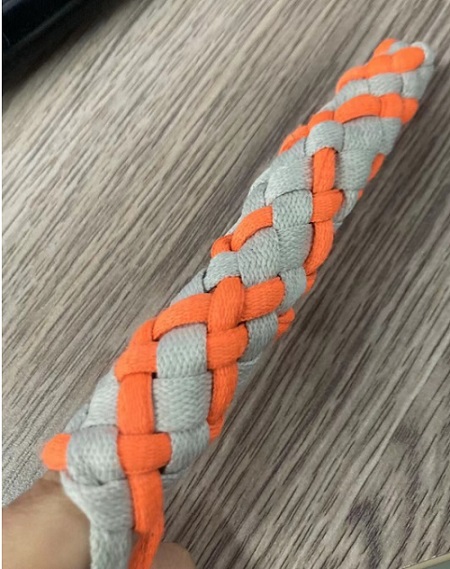
just tied a THK 23x5, around my finger. not that hard
Hi Ruby,
I am not sure why you want to call your 9/14 enlargement ‘linear’.
Is it because the regular knot tree positions those knots on a line governed by your two linear equations?
What do you make of a 13/21, 21/34, or 34/55 then?
(or 21/13, 34/21, or 55/34 in the wide analog due to the symmetry of the regular knot tree)
In that type of knot the fundamental enlargements alternate.
The braiding process is messing up the perceived ‘linearity’.
I have the impression braiders have only found some simple relations.
Schaake & Turner provide all relations, including a way to find the paths in their tree.
Pity that so few braiders seem to understand this matter, it seems to me.
Hi Ruby,
There is one other thing that came to mind about your ‘linear’ equation.
The set of equations does not really represent a ‘linear’ relationship, but something that is ‘intermittent’ at best.
You must have noticed that to retain the U1O1 coding you must skip one node in the regular knot tree.
That is the reason Ashley’s Book of Knots speaks of 4 methods for the square THK’s.
Schaake and Turner have devoted a pamphlet to some of the effects that patterns have on string runs and vice versa.
hi,
you are right, that something is messing up.
9/14, ( and 13/20, 17/26 …) is linear enlargement of 5/8,
but obviously 5/8 is not linear enlargement of any THK.
my point is that, for a speific THK, like 5/8 , or any THK you already knows how to tie it,
you can apply a linear enlargement to it.
and it is clear and easy as an instruction.
Schaake’s theory is not that easy to follow.
though it actually can guide me to reach any THK.
and
I think this linear enlargement is part of Schaake’s theory. they do not conflict.
a tiny small part of it.
by walking at that so called RKT tree,
or actually a Stern-Brocot Tree,
at any THK you have infinite ways to enlarge it to any THK belongs to current branch,
by changing direction randomly left and right.
and among all these ways, the simplest ways are the 2 linear enlargements:
RightSplit and LeftSplit, like from (3,2) to (5,4), or from (3,2) to (7,4),
by not changing direction, and walk only left 2 steps, or only right 2 steps.
so, I am not going to say that I can tie a 13/21, or 21/34 , with a linear enlargement method,
but,
if I can already tie a specified THK, say 13/21, 21/34, or any p/b THK,
or if somebody else just give to me a finished THK like 13/21, 21/34, or any p/b THK,
then, without knowing how he tied it beforewards,
I can apply a linear enlargement method to it, and build a series of enlarged THK.
(also infinite, actually the same size of all THKs , mathematically)
Hi Ruby,
Viewing cylindrical regular grids as numbers (p/b), you can indeed speak of the Stern-Brocot Tree.
The two fundamental enlargements provide you with binary options to branch one way or the other.
The ‘linear enlargements’ you speak of are forced to emerge when you oblige yourself to follow the U1O1 pattern.
If you ignore any pattern and just consider the bare-bone string-run skeleton, you will notice that the sequences I mentioned above will alternate between the fundamental enlargement methods.
Indeed, I think you got it.
If you want to find the paths in the regular knot tree you need to play around with Euclid’s algorithm.
That will tell you which turn to take while making the grid.
Your mind will have to figure out a way to keep track of which pattern you are aiming at.
well, I think the set of equations can represent any linear relationship.
look at the relation of RKT tree and a Stern-Brocot Tree,
I see that:
a THK represent any co-prime pair of number,
a THK represent any rational number
a THK represent any fractional number
according to the Bezou s lemma
for any co-prime number pair, you can write a Diophantine equation to get any number.
so the size of equations is the same of the size of all THKs.
or the size of all integer numbers,
or the size of all rational numbers
for any THK p/b, you can write a Diophantine equation like mp - nb = 1, or mp - nb = 2,
and this is the linear equation of a linear enlargement.
yes Euclid algorithm is easy. just grade school algorithm for finding gcd.
and later I saw Schaake gave detailed method to get every OUOU or O2U2… steps for any THK.
not that hard, but thanks to here : http://freakinsweetapps.com/knots/knotgrid/advanced.html
so we do not need to calculate it any more
so theoretically this help you to make any THK, with the help of a woggle , and many pins
if you want a method to tie pratically sized THK by hand, then it is another story.
to make a THK , to braid a THK, is much different with to tie a THK.
no need to tie any THK,
since the number is same with all natual number, why bother tie any of them?
we need to find some speial method to tie some special THK,
which is very easy to tie, without the help of any woggle or pins
find some squar one, p=b±1 or p=b±2,
or some long one, p / b > 2
or some wide one, b / p > 2
then it is almost enough.
no need to count parts or bights, just run your rope with your finger,
and build a pratically sized THK by hand easily.
Using computers in braiding is like using chatGPT to get a question answered.
If your knot is too big, your machine will suffocate when it runs out of time and space.
If the answer to your question is not (pre-)programmed somehow, your machine will provide you with suboptimal information.
I think you may want to read up on Bezout’s Lemma with respect to the uniqueness of its coefficients.
The path in the regular knot tree is quite unique and this reflects in the Diophantine Equation you will be needing in order to produce your desired pattern.
maybe people now cannot live without computer? or can not live without a smart phone?
THK[13/8]? = first THK[3,2] and then double it, and then apply a LeftSplit
THK[21/13]? = first THK[5,3] and then double it, and then apply a RightSplit.
THK[34/21]? = first THK[8,5] and then double it, and then apply a LeftSplit
THK[55/34]? = first THK[13,8] and then double it, and then apply a RightSplit
using Euclid algorithm I can see that it is always 1111111111…
so the direction is always changing, left right left right…
like the famous Fibonacci sequence equation F[n]=F[n-1]+F[n-2]
there is an equation for golden ratio THK:
TF[n]=TF[n-3] + double + split
Hi Ruby,
One final reflection on your equations.
You probably know there are many other ways to generate sequences of regular knots with, for example, a U1O1 pattern.
Ever heard about the Masurel Method? Its two starts produce all p/b = 4/b THK.
I found it in KM51, pp67-69, December 1995.
Indeed, and that is the first part that messes up the linear equations.
If you insist on retaining your U1O1 pattern, you can lay and split tracks, and your Fibonacci Equation will hold.
For other patterns, the story may well be different.
hi, just checked this article,
yes, this is the easiest linear enlargement
apply LeftSplit or RightSplit of any 2-parts THK to get any 4-parts THK,
left for 4n-1 , right for 4n+1
begin with simple THK as 2-parts or 1-bight, we can get quite a lot THK by only apply LeftSplit or RightSplit linear enlargement.
linear enlargement is especially useful for small THK.
for 55 THKs below 10, only 3 can not be made like this: 75 85 97, and their mirror.
Hi Ruby,
The point is that Masurel’s Method leads to 4/b that have no direct connections in the regular knot tree via Schaake and Turner’s fundamental enlargement methods.
The Masurel Method has two starts, and indeed yields two ‘linear’ sequences:
Where n indicates the number of tucks in the initial Multiple Overhand Knot.
In the regular knot tree, however, you cannot get from for example 4/9 to 4/17, short of untying.
Here are the paths:
It is an interesting exercise to find the location of these 4/b grid diagrams in the regular knot tree.
And subsequently the p/4 grid diagrams.
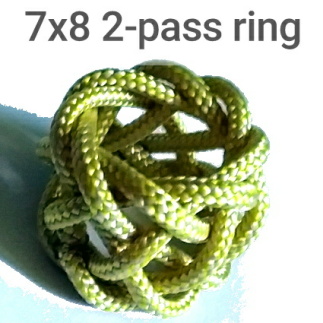
i found my 5x8, except it’s a 7x8 2-pass …!
(in case anyone wanted to see how it looks)