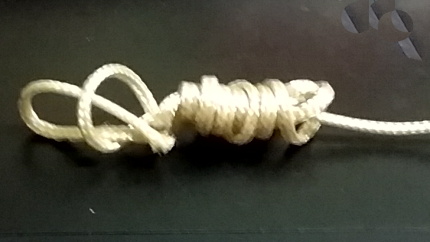
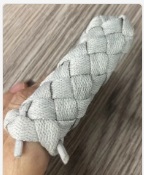
new method for Turk's Head Knot

hi, do you have an easy method to tie THK like 7Leads x 9Bights or 9B x 7L ?

I mean, tie them easily like basic 3 Leads x 2 Bights, around your fingers,
without any grid or pin or mandrel tool.

such as:
5L x 7B
7L x 5B

5L x 8B
8L x 5B

7L x 9B
9L x 7B

7L x 12B
12L x 7B

etc.

I’d like to share my method,
would you share your method?

first, let’s check it in bible ABoK:

5L x 7B #1349 #1355
7L x 5B #1359

5L x 8B #1351
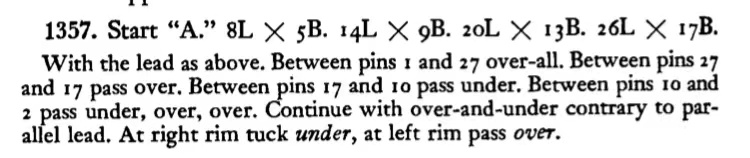
8L x 5B #1357

7L x 9B #1353
9L x 7B ?

7L x 12B ?
12L x 7B ?

so, Ashley did mentioned some of this series.

but I find those braiding method hard to follow, especially if doing without pin tool.

next, check in the famous book, Introduction to Turks-head Knots, by Tomhall.

5L x 7B ?
7L x 5B on page 35

5L x 8B on page 52
8L x 5B on page 37

7L x 9B ?
9L x 7B ?

7L x 12B ?
12L x 7B ?

so Tomhall mentioned some, but he didn’t too much of this series. and the method is still braiding, though much easier to follow than Ashley’s.

on Page 35, Tomhall mentioned 7L x 5B as knots with remainder 2. I think this is a very good method to categories Turk’s Head Knot.

I didn’t get any other new book,
so, about 30 years passed after Tomhall’s book, what is the new method to tie this series of THK?

check by google, I find thai

Loren Damewood at year 2000 has these tutorials:

https://www.golden-knots.com/tie7x9.html

https://www.golden-knots.com/tie7x12.html

though there’re mainly pictures, but I think that’s it, easy method to tie them in hand. and with colorful leads, really easy to follow.?

he didn’t talk about how to expand this pattern.

search in this IGKT forum,

I find that 4 years ago clsn said that:
https://forum.igkt.net//index.php?topic=6115.msg41317

I have tricks for tying all Lx(mL +- 2) THKs
.

and he said he’d write a book to share his trick.

I wonder whether he has his book published now? any links?

and, some old magazine Knotting Matters is digitally available here

I see that there’s plenty of THK related articles.

but most of them seems to rely on grid or mandrel

ok, with modern cheat help of the grid maker
http://freakinsweetapps.com/knots/knotgrid/advanced.html

you can make any THK

for example for 9L x 7B you got these:
Strand 1
From A1 . . . . . . . . to B5
From B5 . . . . . . O . to A3
From A3 . . . . . . O . to B7
From B7 . . . . O . O . to A5
From A5 . . . . O . O . to B2
From B2 . . O . O . O . to A7
From A7 . . O . O . O . to B4
From B4 O . O . O . O U to A2
From A2 O . O . O . O U to B6
From B6 O . O . O U O U to A4
From A4 O . O . O U O U to B1
From B1 O . O U O U O U to A6
From A6 O . O U O U O U to B3
From B3 O U O U O U O U to A1

look at this instruction, those regular changing Over and Under, you know for sure that there’s some easy method to tie it.

once you make it by following instruction, and untie it, you’ll find that method is pretty obvious. just too easy.?

from the catalog 202212 KM Index 1-157CB.xlsx I see that Manny Sardina has an article of A clear exposition of a method of enlarging Turks Heads Enlargements
at KM153.

I do not know how to get the content of this article.

I think maybe he has showed this method already?

Those are the easy knots, Ruby. What about 9/14 or 5/23?

Ruby, I ask about 9/14, because mythical chatGPT was not very informative.

[i]A Turk’s Head Knot of 9 parts and 14 bights can be made by following these steps:

[ol]- [i]Start by making a loop with the working end of the rope, leaving a tail of about 12 inches.

  • [i]Hold the loop in your left hand, and the standing end of the rope in your right hand.

  • [i]Take the standing end of the rope and make a clockwise turn around the loop, bringing it back to the starting position.

  • [i]Make a second clockwise turn around the loop, passing over the first turn.

  • [i]Make a third clockwise turn around the loop, passing over the second turn.

  • [i]Continue making clockwise turns around the loop, working your way toward the standing end of the rope.

  • [i]Make 14 turns in total, always passing over the previous turn.

  • [i]Once you’ve made 14 turns, take the standing end of the rope and pass it through the center of the loop.

  • [i]Pull the standing end tight, and adjust the knot as needed to create a tight and symmetrical Turk’s Head Knot.

  • [i]Finally, take the tail of the rope and tuck it under the last bight of the knot, using a marlinspike or fid to help tuck it in securely.[/ol]

Congratulations, you have now made a Turk’s Head Knot of 9 parts and 14 bights!

well, what’s the matter with that ?

:blush:


23gp9-14.jpg

i’ve got nothin’! i need a pin board,

so 7x4 is as far as i’ve got tying in hand,
(in 2-pass if i consult my notes)

glad you mentioned golden raito,
i have tied 5x8 somewhere,
cant find pic,
and - i needed pin board to do so -
but proportionate and appealing

ChatGPT creativity extending the field of knotting:)

hi, Jan van Leiden, nice to meet you.

ChatGPT is really great. it learns things very fast.

maybe next day it can tell you clearly how to make it,
after someone give him huge amounts of book about Turks Head Knot.

I usually tie THK below 10, largest is 9x8.

but, among other knots exceed 10, 9x14 is a trivial easy one.

I can tell how to tie it in one sentence:

first tie a THK 5x8, and then do a Left Split. done.

of course you already know how to tie all THKs below 10.

FYI:
for every THK, you can apply a Left Split, or Right Split.

for example,
apply a Right Split to 3x2, you get 5x4,
apply a Left Split to 3x2, you get 7x4.
I think everyone knows this?

and 5/23? currently not any experience of a THK exceed 20.
maybe I’ll find some long rope to have a try.

usually THK with 3parts or 5parts is very easy, only need long rope.
I like golden ratio THK, not too long, not too wide, and not too square.
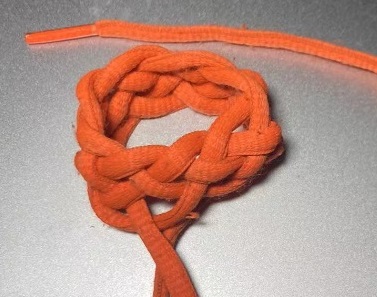
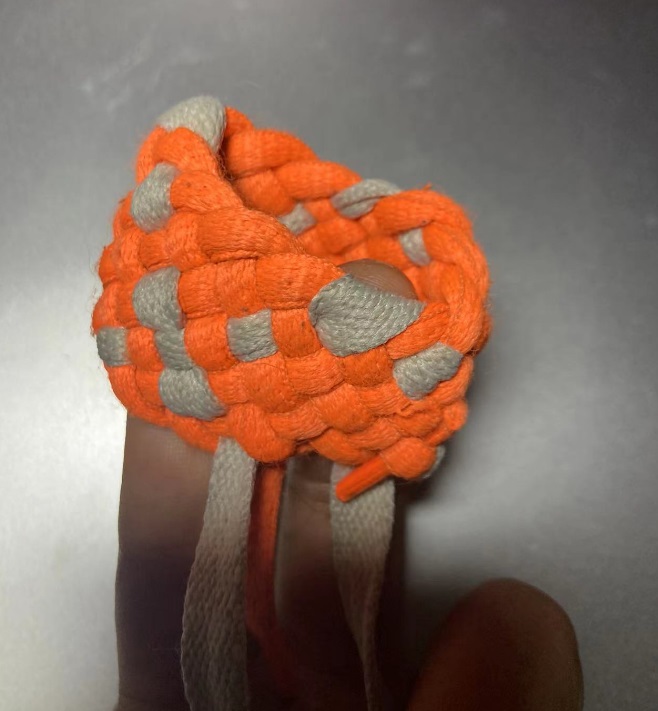
THK5x8.jpg

THK9x14.jpg

hi, alana

golden ratio THK is for knot with near by number of Fibonacci sequence:
1、1、2、3、5、8、13、21。。。
F(0)=1,F(1)=1, F(n)=F(n - 1)+F(n - 2)

such as : 3x2, 5x3, 8x5, 13x8, 21x13…

all pretty easy to tie, with similay method.

for 5x8, you can tie it around fingers without any pin board, in one minute

Hi Ruby, nice meeting you too. You seem very interested in THK. Me too.

I have been reading some of the Schaake & Turner and Tom Hall books you mentioned elsewhere. You are right that for cylindrical regular grid diagrams, the greatest common divisor of their dimensions in parts and bights will determine whether they will have one single component. I think that has been known for a long time. You also write about the Fibonacci sequences above. Schaake & Turner show how these sequences turn up when enlarging regular grid diagrams. They coin the term Regular Knot Tree for these things.

The pattern on these regular grid diagrams is a different story. Most people make an O1U1 pattern, but there are many others. I like the U2O2 best. It gives a nice and stable texture.

I do not like ChatGPT, it produces a lot of rubbish when you ask it about knots - as I did above. I am not sure whether it can learn anything at all, but if it makes people happy to run after this new hype, be my guest.

Schaake’s theory is almost 30 years ago, but seems not many people know it. what a pity.

I recently tied may THKs in hand, using 1 meter shoe lace, and find something interested. but after some search I find Schaake has sovlved this long before, just that not many people talking about it. maybe because it is too easy? or too hard?

some more about THK 9x14:

5x8 to 9x14, 4 parts and 6 bights added,
and split again?
9x14 to 13x20, another 4 parts and 6 bights added,
next? 17x26

it’s easy to find the math equation:

p= 5 + 4n
b= 8 + 6n
n= 0,1,2,3…

and obviously this is the Parametric Equation of a Line.

so point (5,8) , (9,14), (13,20)… etc all lie in a straight line

so this method is a linear enlargement of a THK.

and note that:

4x8 - 6x5 = 2
4x14 - 6x9 = 2
4x20 - 6x13 = 2

this is always true for a right split.

and what did Ashley say about 9x14?

well, at AboK #1357 Ashley mentioned about from 8x5 to 14x9 to 20x13.

and one interesting thing about THK is the mirror effect.

e.g.
if you apply a RIGHT split to 3x2 and get 5x4
then, the mirror,
you apply a LEFT split to 2x3 and get 4x5
notice that right change to left, part change to bight. bights change to part

so according to Ashley AboK #1357, from 8x5 to 14x9, and I can infer that 9x14 is from 5x8


after I find the fact of the mirror effect, that is to say,
the method to to tie a PxB thk is the mirror to tie a BxP thk,
then I often only tie a THK with parts bigger than bights. so usually 8x5 or 9x7, not 5x8 or 7x9.

usually I find it’s more comfortable to tie THK with more parts(lead) than bights.


AboK #1357.jpg

and speaking of a 5x23 THK,
what I’d like to try is a 23x5 THK.

the difference of Parts and Bights is too big,
so the first step is to reduce it somehow,

subtract bights each time,

23x5 → 18x5 → 13x5 → 8x5

23x5 ==> (8+5*3) x 5

so the method to tie a 23x5 THK is similar to tie a 8x5 THK,
and is the mirror of 5x8.

so if you can tie a 5x8, then 23x5 is almost the same step.
and 5x23 is the mirror of 23x5.

anyway I just tried to tie a 13x5 THK around my finger.
first a 3x1 and double it and do a right split.

maybe I need a more long rope and a more long finger to tie a 23x5 THK.
first tie a 5x1 and double it and do a right split to 23x5


THK 13x5.jpg