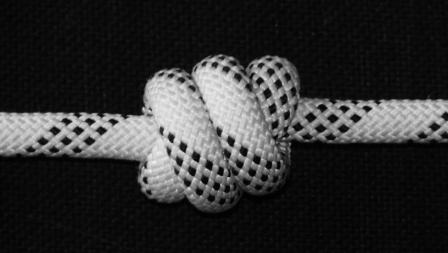
I was playing around the other day and believe that I may have come up with a new stopper knot. It is a large stopper knot that is easy to tie and untie, but it will not slip. I would like to have it reviewed to see if it is in fact a new knot or if it already exists. I have sketches and pictures of the knot but can not get them small enough to post here. I would like to have this knot reviewed, so could someone please tell me how to get the pictures on to the forum. Thanks in advance for your help.
Bryn
Hello Bryn and welcome to the forum.
I’d love to see and read what you’ve conjured up.
Please think about how to describe this in words and also if you could use any number of image editing software(s), shrink the pictures to 100kb/s and post them right here in this thread.
If you still have challenges and would like to, you could email the pictures to me (email address in my profile) and I will reduce them and add them here.
SS
Try this…
http://tinypic.com/
Also, just about any pic viewing software allows you to reduce the size.
Bryn took me up on my offer of help, so here is a drawing of his stopper knot.
If needed I have some pictures in the tying series as well, but the drawing does it nicely.
SS
What a delight.
Derek
Bryn approached me about a knew stopper knot and I suggested he place details on the forum, which I’m glad he did as I’ve not seen this configuration before.
Barry
If you take away the extra coils, this looks to be the Oysterman’s Knot or the Ashley Stopper Knot.
When seriously strained, the core mechanism of the knot pulls through the coils and becomes difficult to untie.
Hello Roo.
I am unsure as to what you were quoting me as saying?
As for hard to untie, well that could be just fine and dandy for a permanent stopper.
Drawing down into the bulk will be quite a task if we are talking about using rope as the medium and not string.
If you were to take away a number of parts of this knot and add a couple of parts you could see a couple of knots that belong to the fishing knot genre.
Would make a nice heaving line knot as well Bryn. Thank you for bringing it!
I didn’t find it in a cursory browse through ABOK.
SS
(Not sure why SS469 was quoted --just a fer-sure this reference?)
As for its likeness to Ashley’s Stopper, there is the general structure
of a noose-hitch clamping its own tail --and that works for any
number of noose-hitches to become stopper knots, pretty well.
By this time of forum discussion we should not be making assertions
about the knot but, if we’ve actually done some testing, about
some particularly knotted material! And I see some at my feet
where the thought of the tail being pulled through is hard to raise
–some theoretical possibility but not one likely in practice, IMO.
I’ve fiddled it in a couple 5/8" laid ropes (a firm, stiff, soft-laid
CoEx PP/PE one, and a soft-laid (and darn shedding of fibre bits)
manila one, and a small single-braided (nylon?) cord). In setting
the knot, the S.Part-end loop is first tightened, and the coils can
then be drawn tight with the tail, before tightening the tail-end
loop upon it --so there should be no room to pull the tail through
these tightened coils. But that is a risk of poorly set such knots,
and the Ashley’s stopper in particular (esp. as that knot is
so poorly presented with regard to tying).
The knot is bulky, but I don’t find the consumption of material
to be all so beneficial, to be so well disposed. It’s halfway or
further to being a decent heaving-line knot! The double-nipping
(or -noosing) construct is fun idea to explore further, for those
keen to fiddle.
Thanks,
–dl*
Not nitpicking Dan, but it is an easy nickname to copy. >“(Not sure why SS469 was quoted --just a fer-sure this reference?)”
Is there something Freudian about this?
SS369
When watering down the knot presented in this thread (skip the step 2 coils), I get the Oysterman’s/Ashley stopper exactly, even down to the same handedness. Perhaps your method of beefing up an Oysterman’s Knot up is different.
Don’t look at the steps, look at the end product.
Since step 4 is redundant, and step 2 is where the extra coils are added, I’d ask you to execute steps 1, 3, and 5, and compare it to an Oysterman’s.
Hold both by the free end of the rope, and look for the bowlinesque structure.
I’ve repeated the steps a number of times. You can arrive at the same knot by apparently different avenues.
Tell me, do you at least see the bowlinesque structure in either the Oysterman’s or the watered down version of the knot presented in this thread (which I contend are the same)?
The upper lobe of the starting figure 8 structure is twisted 180 degrees in such a way that the carrying around of the working end around, under, behind and over after being put through down through the upper side of the lower lobe after step 1 instead of after adding more turns at step 2 is topologically the same as untwisting that upper lobe and brining the working end around as in the Ashley stopper and putting up through the bottom of the untwisted upper lobe.
If I omit step 2 and proceed with the rest, but do some careful twisting of the final assembly after step 6 while tightening without changing the topology, I get the Ashley stopper.
I thought for efficiency’s sake (and just the graphic appeal of it all!)
I’d jump further into the stimulating discussion of Roo4Uknot.
Roo seems to be listening or not pretty well,
but his vision is 20/20 here,
and Mr. 100% might care to stop hitting the keyboard
long enough to double-check (or more) what he’s saying,
given that it has been challenged.
Which I did, and cannot thus “verify what [Knot4U] is saying”
(which at first I thought I was going to do!),
because it’s false --Roo is correct.
The deceptive part is the wiggle made in Step 1’s laying out
the bight : with the tail brought through the loop to make an
overhand (absent those wraps), one only superficially has a
different-than-Ashley’s-stopper, and the tail doesn’t need to
“come in from the other side” because in reality this overhand
should rotate to the other side itself, and that makes the actual
passage of the tail as shown complete the . . . Ashley’s . . stopper !
QED

For a stopper that has not to be bulky, I think that the primordial triple overhand knot is a satisfactory, neat solution. Much easier to dress than the stopper shown in this thread. And I do not find it very difficult to untie, because stopper knots can not, and need not, be tightened very hard.
This is a strange and false assertion : stoppers obviously can be
tightened very hard (in setting or in use), and some might need
to be so. Ashley’s stopper, e.g., runs the risk of deformation
–the sort of pull-through Roo pointed to-- if the overhand knot
isn’t set tight before finishing the knot so to tighten its constriction
of the S.Part and thereby start its fight to brook no room for pulling
through (but seldom is this step recommended in published presentations
of the knot!).
OTOH, there might indeed be no need in some application for such
tightening, nor a risk of it in use --different strokes for differeint folks.
Ashley’s stopper got published in one case in reverse, and so is
a compressed bowline --(!) accidental invention–; it works rather
well, for staying tied, though might become less easy to untie.
. . . p o s s i b i l i t i e s . . .

Among commercial-fishing knotting of stoppers for floats,
one can find just repeated overhands in various orientations,
which seem to do the job asked of them. I’ll wander over to my
“Knots in the Wild” thread and add a set of these to gander.
voici, quote of msg.#143:
http://igkt.net/sm/index.php?topic=1017.143
–dl*
I have been reading all the feedback on my knot and have found it enlightening and confusing at the same time. I have enjoyed the back and forth that it has created amongst some people. I have to be honest that I don’t see how it can be called an Ashley stopper. It is nothing like an Ashley stopper. Maybe if you omit steps along the way and rework it you can come up with an Ashley stopper, but I do feel I need to say this. If you omit steps of the knot I created and rework it then it is not my knot but something else. There are many knots that you can do this to but they are still their own knots just the same.
When I stumbled upon this knot the first thing that came to my mind was that is was a bulkier stopper than anything I had seen previously. Being that I am involved in Scouting the first thing that came to mind, for me, was that this could be a handy knot for tarps. My first thought was that if you used this knot on a tarp with grommet holes it might create less stress on the grommet because it is larger and would spread out the load more evenly on the grommet (I plan on testing this theory during the course of the year during campouts). I am hoping that will help the tarp not to tear at the grommet, because they have a nasty habit of doing that no matter how you tie them off.
If you have a tarp that doesn’t have grommets holes this knot is large enough, if you use 3/8" rope or larger, to be tucked under the tarp in the corner. You can then bring the rope over top of the tarp and form a clove hitch around the base of the knot and draw it tight around it to create a tying off point for the tarp. It is a method we use in Scouts to tie of a tarp without grommets, but a stone was used in place of the knot.
I do appreciate all the help and feedback that I have received to date and hope that you can look at the knot as it stands. My question would be this. Did this knot exist before? If not, does there seem to be a practicle use for the knot?
Thanks again.
Bryn
The Ashley stopper comment is just an astute observation
regarding the structure. And it does point to your question about
this knot offering something that that one doesn’t, for the bulk
got by your extra wraps is measured pretty much only in the
depth/length of the knot but not in the width of the
stopper face --which is the important dimension for impeding
penetration through an opening, except perhaps by some
deformation of this face.
Have you tried the Ashley stopper and found it inadequate
for your cordage and tarp grommets?
Note that one can tie a double Ashley stopper by simply
doubling the material at the appropriate point (to avoid
doubling at the standing part, so to keep the stopper
face clean). This make a fine wide stopper.
... this could be a handy knot for tarps. My first thought was that if you used this knot on a tarp with grommet holes it might create less stress on the grommet because it is larger and would spread out the load more evenly on the grommet (I plan on testing this theory during the course of the year during campouts). I am hoping that will help the tarp not to tear at the grommet, because they have a nasty habit of doing that no matter how you tie them off.
Yes, I know what you mean --grommets are often not very strongly
attached to the material. But I think that using a stopper knot could
aggravate that weakness : with the biased loading of the grommet,
it will be tilted, and this I think will concentrate loading and lead
to quicker failure (though perhaps pulling material at an angle to
the grommet is a tad stronger than pulling straight away from it?).
One could tie a clove hitch around behind the grommet and
then run the hitch’s tail through the grommet and pull the grommet
point of the tarp back over the hitch with a stopper to hold it.
If you have a tarp that doesn't have grommets holes this knot is large enough, if you use 3/8" rope or larger, to be tucked under the tarp in the corner. You can then bring the rope over top of the tarp and form a clove hitch around the base of the knot and draw it tight around it to create a tying off point for the tarp. It is a method we use in Scouts to tie of a tarp without grommets, but a stone was used in place of the knot.
! Clever idea, here, yes. --“soft stones” one might call it.